Jusuf Blegur, Zuvyati Aryan Tlonaen and Ade Evriansyah Lubis
2026 VOL. 13, No. 3
Abstract: This study investigated the correlation between students’ digital competence (DC) and autonomous learning (AL) within an online instructional environment. A quantitative correlational design was used, with a sample comprised of 195 students selected through simple random sampling. The research instruments comprised the Students’ Digital Competence Scale (28 items) and the Autonomous Learning Scale (12 items), both of which were linguistically adapted. Data analysis was conducted non-parametrically using the Mann-Whitney U test and Spearman’s rank correlation. The results of the Mann-Whitney test revealed that, although the DC profile was homogeneous across semesters, there were significant differences in the independence of learning indicator/dimension (U = 3984.500; p = 0.049) between second- and sixth-semester students. Furthermore, the Spearman test indicated a positive, significant, and moderate correlation (ρ = 0.612; p < 0.001). Specifically, the evaluation indicator/dimension in DC demonstrated the strongest association with independence in learning (ρ = 0.582; p < 0.001), thereby confirming that evaluative capacity serves as a key catalyst for autonomous learning, rather than merely technical skills. Nevertheless, despite the limitations associated with a cross-sectional design and self-reported data, this study concludes that DC functions as a strategic enabler of AL. Consequently, the implications of this research underscore the need to reorient educational policy to integrate critical digital literacy into the curriculum and to strengthen lecturers’ roles as facilitators of metacognition to foster a proactive and sustainable culture of independent learning in the era of digital transformation.
Keywords: autonomous learning, digital competence, independent learning, students
The pedagogical transformation in the digital era has disrupted the higher education paradigm, shifting the locus of knowledge production from conventional classrooms to complex online ecosystems. For instance, Virtual Reality Learning Environments (VRLEs) have emerged as potential spaces for enhancing autonomous learning through immersive, flexible learning experiences (Fernández-Arias et al., 2026). This phenomenon positions autonomous learning (AL) not merely as an option but as a fundamental prerequisite (Saad et al., 2025). However, emerging research problems indicate a disconnect between the availability of technological infrastructure and students’ internal capacities. The primary challenge in the effectiveness of online learning lies not only in technical aspects but also in students’ deficits in integrating cognitive, metacognitive, affective, and social dimensions simultaneously (Mares-Ruiz et al., 2023; Monazam-Tabrizi et al., 2026; Wael et al., 2023). This internal unpreparedness suggests that students’ autonomous learning remains superficial and requires systematic reinforcement through relevant supporting variables.
In response to this urgency, the present study positions digital competence (DC) as the independent variable and autonomous learning as the dependent variable. Digital competence is interpreted broadly, extending beyond technical skills (hard skills) to encompass data literacy, cyber collaboration, and digital security oriented toward problem-solving (Zhang et al., 2026; Zhao et al., 2021). Meanwhile, AL is defined as a psychometric construct encompassing strategic initiative, self-directed goal setting, and critical reflection on learning outcomes (Chong & Reinders, 2025; Hepsi & Priyadharsini, 2025; Macaskill & Taylor, 2010). This theoretical framework assumes that mastery of digital tools functions as a primary catalyst enabling students to take full control of their cognitive processes. Therefore, examining the relationship between DC and AL is essential for mapping the determinants of educational success in online learning environments that demand a high degree of learner autonomy. This critical analysis is expected to address a gap in the literature regarding how digital literacy transforms into a modality of intellectual autonomy.
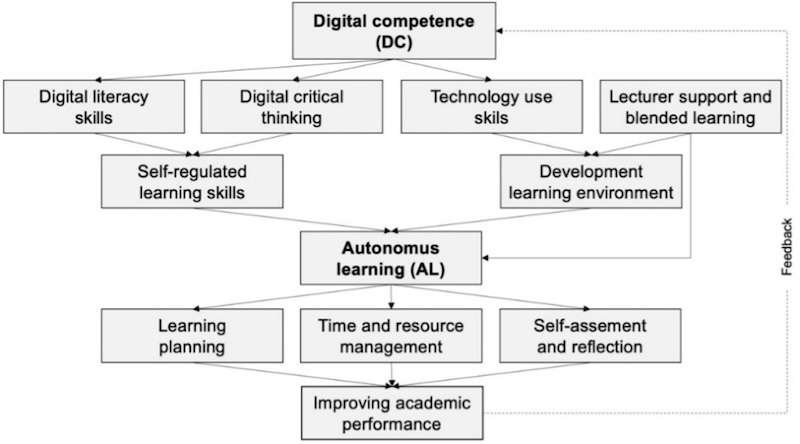
The conceptual framework of this study integrates constructivist theory and self-directed learning (SDL) as its epistemological foundation to explain learning dynamics in the digital era (see Figure 1). From this perspective, learning is understood as an active process of knowledge construction, in which students proactively direct their cognitive development through digital interaction, information exploration, and experiential learning processes (Charokar & Dulloo, 2022; Garrison, 1997; Saad et al., 2025). Autonomous learning is positioned as the main outcome influenced by multidimensional digital competencies, including digital literacy, critical thinking skills in evaluating digital information, as well as technological skills for communication, collaboration, and problem-solving (de Vries et al., 2025; Ma & Ismail, 2025; Spante et al., 2018; Vuorikari et al., 2026; Zhao et al., 2021). These competencies contribute to self-regulated learning, which encompasses planning, resource management, and self-reflection and evaluation.
In addition to these internal factors, external influences such as lecturer support and the implementation of blended learning also play a significant role in shaping a more adaptive learning environment that fosters autonomous learning (Ma et al., 2026; Maulana et al., 2016; Wang & Zhang, 2022). The interaction between internal factors (e.g., digital literacy and self-regulation) and external factors (e.g., lecturer support and learning environment design) ultimately determines the effectiveness of autonomous learning.
From a theoretical standpoint, students with high digital efficacy tend to be more capable of accessing, evaluating, and synthesising information from various digital sources, thereby enhancing their flexibility in adapting to diverse learning models (Vishnu et al., 2022). However, this framework also acknowledges that the functionality of digital competence is not monolithic but rather emerges from complex interactions with intrinsic motivation and the design of the academic ecosystem (Al-Khasawneh et al., 2024). Therefore, the relationship between digital competence and autonomous learning should be understood as an interactive and contextual process rather than a simple causal relationship.
The literature presents an ambivalent perspective regarding the effectiveness of technology in education. On the one hand, the use of e-learning has been shown to enhance students’ flexibility and discursive engagement (Rasjid et al., 2023). On the other hand, although the current generation of students is often characterised as being composed of digital natives with adequate technological literacy (Bahrani, 2023), empirical evidence indicates a substantial gap between technical proficiency and pedagogical independence. The finding by Mirmoadi and Satwika (2022) of a low correlation (9.9%) between digital literacy and AL represents a notable anomaly. This is further reinforced by other studies reporting that technology use is often superficial and not accompanied by metacognitive practices such as systematic planning, self-monitoring, and reflective evaluation of information and data on digital platforms (Anthonysamy, 2021; Yot-Domínguez & Marcelo, 2017).
In response to this inconsistency, this study reconstructs digital competence as a multidimensional construct. Rather than merely measuring the frequency of device use, it explores how technology is leveraged to support reflective cognitive processes. Addressing the urgency highlighted by Wiwin et al. (2022) and Mares-Ruiz et al. (2023), this study seeks to fill a gap in the literature through an in-depth analysis of the substantive relationship between digital modalities and learning autonomy. Through this approach, the study aims to resolve inconsistencies in previous findings and to provide a more comprehensive understanding of the determinants of self-directed learning effectiveness in a competitive digital environment.
From a theoretical perspective, this study is expected to enrich the educational psychology literature by positioning digital competence as a crucial determinant of cognitive resilience and student learning autonomy. Through this examination, the research not only maps students’ digital competence profiles but also establishes the extent to which technological skills can be transformed into reflective learning modalities. From a practical perspective, the findings of this study are expected to serve as a foundation for higher education institutions in Indonesia, particularly in the field of sports science, in formulating pedagogical strategies that are adaptive, innovative, and aligned with the demands of 21st-century global competencies.
Based on these gaps, this study aimed to:
Based on the conceptual framework and literature review outlined above, the research hypotheses were formulated as follows:
H1: There are no significant differences in several aspects of students’ digital competence based on semester level.
H2: There are significant differences in several aspects of students’ autonomous learning based on semester level, particularly in the indicator of learning independence.
H3: There is a positive and significant relationship between digital competence and students’ autonomous learning within the context of online learning.
These hypotheses are grounded in the assumption that adequate digital competence enables students to more effectively manage, direct, and reflect on their learning processes independently.
This study adopted a quantitative correlational design to investigate the degree of association and the significance of relationships between variables within the target population (Fraenkel et al., 2011). This approach was selected to examine the extent to which digital competence, positioned as the independent variable (X), demonstrated a functional relationship with autonomous learning capacity as the dependent variable (Y).
This study involved a representative sample of 195 students drawn through simple random sampling from a population of 1,539 students in the Physical Education, Health, and Recreation (PEHR) Study Programme, Faculty of Teacher Training and Education, Universitas Kristen Artha Wacana, Kupang, East Nusa Tenggara, Indonesia. The demographic profile of respondents indicated an average age of 20.8 years, with a gender composition comprised of 168 males (86.2%) and 27 females (13.8%).
Participants were classified based on academic progression to examine the dynamics of competence across levels. The second-semester group consisted of 93 students (47.7%), representing the initial phase of academic adaptation. In contrast, the sixth-semester group consisted of 102 students (52.3%), representing the advanced phase with more complex academic exposure.
The selection of PEHR students as research subjects provided a critical dimension to this study. Although the PEHR discipline has traditionally centred on kinetic physical activity, the acceleration of digital transformation has reshaped its learning modalities. Consequently, students are now confronted with dual demands: maintaining physical performance while simultaneously mastering digital tools for navigating learning materials, engaging in online collaboration, and managing platform-based assignments. This situation underscores that digital competence for PEHR students has evolved from a peripheral skill into an essential determinant that integrates practical and cognitive dimensions to achieve holistic learning effectiveness in an era of disruption.
This study was approved by the Research Ethics Committee of Universitas Kristen Artha Wacana (Approval Letter No. 114/LEMLIT/UKAW/P.10/XI.2024, dated November 7, 2024). Written and oral informed consent was voluntarily obtained from all participants. To protect the rights and privacy of participants and expert committee members, all collected information is kept confidential and used solely for research purposes.
Digital competence (DC) was measured using the Students’ Digital Competence Scale (SDiCoS) developed by Tzafilkou et al. (2022). This scale has been validated in previous research, involving 156 undergraduate and postgraduate students, demonstrating acceptable model fit and reliability with NFI = 0.667, Chi-Square = 843.442, construct reliability > 0.80 (0.835-0.898), AVE > 0.50 (0.537-0.677), and discriminant validity = 0.724-0.823. During its development, SdiCoS comprised six main indicators. First, search, find, and access included five items (1-5). Second, develop, apply, and modify consisted of six items (6-11). Third, communicate, collaborate, and share comprised three items (12-14). Fourth, store, manage, and delete included five items (15-19). Fifth, evaluation consisted of six items (20-25). Sixth, protection comprised three items (26-28). Respondents provided their responses using a five-point Likert scale, ranging from strongly disagree to strongly agree.
Autonomous learning (AL) was measured using the Autonomous Learning Scale (ALS) developed by Macaskill and Taylor (2010) which has reported internal consistency reliability (alpha = 0.78). This instrument was previously tested on 386 university students. The 12 ALS items consisted of two indicators, namely independence of learning (loading factor = 0.49-0.79), as many as seven items, namely 1, 6, 7, 8, 10, 11 and 12. Meanwhile, the study habits indicator (loading factor = 0.47-0.86) consisted of five items, namely 2, 3, 4, 5, and 9. Two items (item 2 represents the study habits indicator, item 10 represents the independence of learning indicator) were formulated negatively to prevent respondent response bias. Respondents to the ALS used a five-point Likert scale: 1 = very unlike me, to 5 = very like me.
Both the SDiCoS and ALS instruments were translated into Indonesian using the forward–backward translation method. Furthermore, content validation was conducted through expert judgment by lecturers in educational technology and educational psychology to assess construct appropriateness, language clarity, and cultural relevance. Through this series of methodological procedures, the resulting instruments not only demonstrated technical validity but were also contextually reliable in measuring the targeted psychometric constructs.
The research procedure was implemented systematically through the following chronological stages. First, the initial stage focused on determining a validated measurement instrument to capture the essential dimensions of both variables. The questionnaire was developed in Indonesian to ensure accurate comprehension by respondents and employed a five-point Likert scale to measure the intensity of their responses. Subsequently, the survey was administered online via the Google Forms platform to enhance reach and efficiency, from January 12 to March 7, 2025. This online data collection technique was selected to reflect the digital context relevant to the research focus. Finally, the raw data obtained were tabulated using Microsoft Excel to ensure data integrity. Thereafter, inferential statistical analysis was conducted using SPSS (Version 29), including prerequisite tests and hypothesis testing to validate the substantive correlation between the variables under investigation.
Descriptive statistics were used to summarise the mean and standard deviation of the two research variables (digital competence and autonomous learning). Prior to hypothesis testing, a normality test was conducted using the Kolmogorov-Smirnov test, which indicated that the data were not normally distributed for both digital competence (p < 0.001) and autonomous learning (p < 0.001). Based on these results, non-parametric statistical techniques were employed. Differences between Semester II and Semester VI students were analysed using the Mann-Whitney U test. In addition, the relationship between digital competence and autonomous learning was examined using Spearman’s rank correlation analysis. The strength of the correlation coefficient was interpreted using classification proposed by Schober et al. (2018) and Dancey and Reidy (2020), namely: (1) 0.00-0.10 (negligible), (2) 0.10-0.39 (weak), (3) 0.40-0.69 (moderate), (4) 0.70-0.89 (strong), and (5) 0.90-1.00 (very strong). Finally, the entire data tabulation and analysis process used Microsoft Excel and SPSS (Version 29).
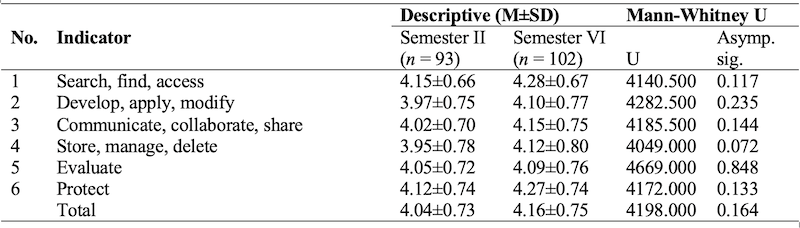
Descriptive analysis confirmed that all dimensions of digital competence (DC) at both academic levels (Semester II and VI) were consolidated in the high category. This phenomenon indicates a relatively established standard of technological independence among students. Specifically, the research findings revealed several critical points. First, the search, find, and access indicator recorded the highest scores in both groups, Semester II (M±SD = 4.15±0.66) and Semester VI (M±SD = 4.28±0.67). It reflects that digital information navigation skills were the competencies most mastered by students.
Second, there was variation in the lowest scores; Semester II students showed limitations in the store, manage, and delete aspect (M±SD = 3.95±0.78), while Semester VI students excelled in the evaluate aspect (M±SD = 4.09±0.76). These findings indicate that although senior students were more technically skilled, their capacity for critical evaluation of information still required strengthening.
Finally, although the cumulative mean for Semester VI (M±SD = 4.16±0.75) numerically exceeded that for Semester II (M±SD = 4.04±0.73), the difference did not reach statistical significance.
A comparative analysis using the Mann-Whitney test further supports this argument regarding homogeneity. The test results for the total digital competence score (U = 4198.000; p = 0.164) and for all individual indicators consistently showed no significant differences. Even the search, find, access indicator (U = 4140.500; p = 0.117), which visually exhibited the largest gap, still failed to reach the threshold of statistical significance (see Table 1).
This finding implies that semester progression does not necessarily correspond linearly with improvements in digital competence. While the study did not directly measure the causes of this pattern, the researchers assumed that uniform external factors—such as daily exposure to technology or the demands of large-scale online learning systems—could have contributed to shaping students’ digital profiles into relatively similar patterns, regardless of the duration of their university studies.
Table 1: Data Digital Competence Description

The descriptive analysis of the autonomous learning variable indicates that students’ autonomy profiles were predominantly within the moderate to high category. Although there was a numerical increase over the study period, the disparity between the two student groups did not demonstrate a substantial difference.
Several critical points emerge from the analysis. First, across both academic levels, the independence of learning indicator consistently ranked highest. Semester VI students demonstrated slightly higher scores (M±SD = 3.89±1.02) compared to Semester II students (M±SD = 3.80±0.99). This finding indicates that the technical ability to learn without direct instruction represented the most developed aspect of autonomous learning. Second, the study habits indicator exhibited relative stability between the senior (M±SD = 3.82±0.92) and junior (M±SD = 3.77±0.91) groups. This phenomenon suggests that students’ study routines and patterns tend to be established early in their academic journey and do not undergo substantial transformation in later semesters. Third, the Mann-Whitney test revealed a notable finding. Although the total AL score did not show a significant difference (U = 4172.500; p = 0.144), the independence of learning dimension was statistically significant (U = 3984.500; p = 0.049) (see Table 2).
Scientifically, these findings provide insight into the impact of semester progression on student learning. While an extended study period appeared to strengthen students’ self-confidence and independence in making learning decisions (independence), it did not substantially alter more fundamental study behaviours (study habits). Although students become more autonomous over time, their approaches to managing academic routines remain relatively homogeneous, possibly influenced by a consistent academic environment throughout their studies.
Table 2: Data Autonomous Learning Description
The results of the Spearman’s Rank correlation analysis confirmed a positive and statistically significant relationship between digital competence and autonomous learning, with a correlation coefficient of 0.612 (p < 0.001) (see Table 3). Based on the criteria of Schober et al. (2018) and Dancey and Reidy (2020), this value indicates a moderate level of relationship (0.40-0.69). This finding empirically demonstrates that strengthening digital literacy contributes proportionally to increasing student learning autonomy.
Table 3: Intercorrelation of Digital Competence with Autonomous Learning
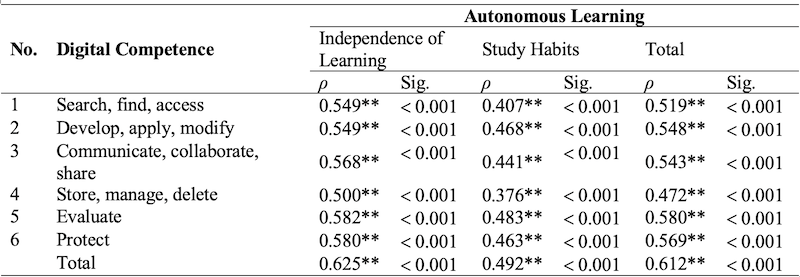
** Correlation is significant at the 0.01 level (2-tailed).
Further exploration through intercorrelation tests between indicators revealed more specific relationship dynamics. First, a correlation was found between the evaluation dimension (DC) and independence of learning (AL), with a value of 0.582 (p < 0.001). It implies that students’ critical ability to evaluate digital content was a key driver for their independent learning initiatives. Second, there was a correlation between the store, manage, delete (DC) and study habits (AL) dimensions, with a value of 0.376 (p < 0.001). While still significant, this low coefficient indicates that the technical data management aspect had a more limited influence on shaping students’ study routines or habits in depth.
Scientifically, this finding confirms that digital competence serves as an intellectual catalyst, facilitating students’ transition to proactive learning. Therefore, to institutionalise a robust culture of autonomous learning, synergy is needed between lecturers, higher education institutions, and policymakers to implement systematic interventions to strengthen digital competence. Improving DC should no longer be viewed as merely technical literacy but, rather, as a pedagogical prerequisite for developing proactive and adaptive learning behaviours in the digital era.
This study identified a moderate positive correlation between students’ digital competence and learning autonomy, with the evaluative dimension emerging as the most significant contributor. These findings confirm that students’ skills in evaluating, filtering, and integrating digital information form a foundational basis for autonomous learning. However, the moderate strength of the correlation indicates that digital competence was not a sole determinant but rather a catalyst that interacts with other factors such as motivation, self-efficacy, and institutional support. In other words, while digital competence enhanced the likelihood of learning autonomy, this correlation did not guarantee that students would automatically achieve optimal self-directed learning.
Although digital transformation provides adequate infrastructure, including immersive environments such as VRLEs, contemporary studies highlight that students frequently encounter internal unpreparedness in managing the learning process autonomously (Fernández-Arias et al., 2026; Mares-Ruiz et al., 2023). This gap creates a dilemma: the mere availability of technology does not necessarily translate into effective learning. Students might have easy access to information sources but without adequate metacognitive skills, critical reflection, and self-regulation (Adhya & Panda, 2026), autonomous learning tends to remain superficial. This suggests that digital competence, while important, constitutes only one component of a more complex ecosystem, in which internal readiness and external support collectively determine the success of autonomous learning.
Recent literature emphasises that digital competence extends beyond technical skills; it is multidimensional, encompassing data literacy, cyber collaboration, digital security, and critical thinking skills for information evaluation (Zhang et al., 2026; Zhao et al., 2021). These findings reinforce earlier research indicating that the evaluative dimension is the most influential factor in promoting autonomous learning. However, as noted by Vishnu et al. (2022) and Al-Khasawneh et al. (2024), the effectiveness of digital competence emerges from its interaction with motivation, attitudes toward technology, and the design of academic ecosystems. Therefore, digital competence should be understood as an interactive and contextual process: students’ technological proficiency must be integrated with internal readiness and environmental support to achieve optimal autonomous learning outcomes.
The findings challenge reductionist perspectives that consider digital competence as the sole determinant of learning autonomy. Theoretically, this study underscores the importance of evaluative and reflective approaches that enable students to manage their learning processes independently (Saad et al., 2025; Zimmerman, 2015). Practically, higher education institutions should develop digital learning programmes that not only teach technical skills but also strengthen evaluative abilities, self-regulation, and resilience to cognitive distractions. By integrating internal and external factors, students can transform from passive information consumers into active learning agents. Consequently, this study asserts that digital competence functions as a key catalyst for autonomous learning, yet its effectiveness depends heavily on students’ internal readiness, multidimensional interactions, and the digital learning context, confirming that success in autonomous learning in the digital era is the result of a complex process rather than mere access to technology.
These findings necessitate a comprehensive reorientation of institutional policies. First, higher education curricula should transform digital competencies from peripheral technical skills into integrated, cross-disciplinary critical literacies, as digital literacy is increasingly understood not merely as operational proficiency but as a multidimensional competence involving critical, ethical, and communicative capacities in digital environments (Ramdana et al., 2026). Second, the role of lecturers should evolve from mere transmitters of knowledge into facilitators of metacognition capable of accelerating students’ independent digital navigation, since metacognitive self-regulation has been shown to strengthen students’ability to transform digital competencies into meaningful academic engagement and autonomous learning (Ko, 2026).
Finally, universities and the government must collaborate synergistically to ensure equitable access to cyber infrastructure (Leong, 2025). Without such equitable access, digital disparities will continue to widen the gap in learning autonomy, thereby hindering academic inclusivity in the era of disruption. Prior studies further emphasise that inadequate technological access and infrastructure remain major barriers to sustainable digital literacy development in higher education, particularly in under-resourced contexts (Nikou & Aavakare, 2021; Ramdana et al., 2026). Therefore, synergy among curricular, pedagogical, and structural dimensions is essential to ensure the sustainability of future education.
This study has several limitations that should be considered when interpreting the results. First, the use of a correlational design limits the study’s ability to establish causal relationships between digital competence (DC) and self-regulated learning (AL), thereby preventing a definitive determination of their direction of influence. Second, the data were primarily self-reported, which may be subject to respondents’ subjective bias, particularly in assessing their own digital competence and level of learning independence. Third, this study did not fully account for other variables that could function as mediators or moderators, such as intrinsic motivation, self-regulation, institutional support, or students’ academic backgrounds. Furthermore, the study’s limited context in online learning restricts the generalisability of its findings to offline or blended learning environments. Therefore, further research is recommended that employs longitudinal or experimental designs and incorporates a broader range of contextual variables.
The methodological limitations of this study’s cross-sectional design limit the ability to observe dynamic fluctuations in learning autonomy. Therefore, future research agendas should adopt a longitudinal approach to chronologically map the evolution of autonomous learning (AL) throughout students’ academic trajectories. Furthermore, the integration of mixed methods is strongly recommended to explore in-depth qualitative dimensions, such as the dynamics of intrinsic motivation and perceived ambivalence toward digital barriers, which were not captured by the quantitative data. In addition, exploring new mediating variables, such as digital well-being and cyber self-efficacy, is essential to enrich the conceptual model of learning autonomy. The inclusion of these variables should provide a more holistic understanding of how mental well-being and self-confidence in digital environments function as anchors of intellectual autonomy. By expanding the scope of variables and enhancing methodological rigour, future research can contribute more robustly to addressing the challenges posed by the accelerating transformation of global education.
Adhya, D.H., & Panda, S. (2026). An integrative systematic review analysis of research on technology-enabled personalized learning and self-regulated learning. Smart Learning Environments, 13(1), 3. https://doi.org/10.1186/s40561-025-00428-8
Al-Khasawneh, F., Huwari, I., Alqaryouti, M., Alruzzi, K., & Rababah, L. (2024). Factors affecting learner autonomy in the context of English language learning. Cakrawala Pendidikan: Jurnal Ilmiah Pendidikan, 43(1), 140-153. https://doi.org/10.21831/cp.v43i1.61587
Anthonysamy, L. (2021). The use of metacognitive strategies for undisrupted online learning: Preparing university students in the age of pandemic. Education and Information Technologies, 26(6), 6881-6899. https://doi.org/10.1007/s10639-021-10518-y
Bahrani, B. (2023). Tracing the trend on digital competence of English teacher; The characteristic and strategic improvement. PEDAGOGIK: Jurnal Pendidikan, 10(1), 73-85. https://doi.org/10.33650/pjp.v10i1.5940
Charokar, K., & Dulloo, P. (2022). Self-directed learning theory to practice: A footstep towards the path of being a life-long learner. Journal of Advances in Medical Education and Professionalism, 10(3), 135-144. https://doi.org/10.30476/jamp.2022.94833.1609
Chong, S.W., & Reinders, H. (2025). Autonomy of English language learners: A scoping review of research and practice. Language Teaching Research, 29(2), 607-632. https://doi.org/10.1177/13621688221075812
Dancey, C., & Reidy, J. (2020). Statistics without maths for psychology (8th ed.). Pearson.
de Vries, D.A., Piotrowski, J.T., & de Vreese, C. (2025). Developing the DigIQ: A measure of digital competence. PLOS One, 20(5), e0322995. https://doi.org/10.1371/journal.pone.0322995
Fernández-Arias, P., del Bosque, A., & Vergara, D. (2026). Virtual reality learning environments: A review of support for autonomous learning development. Multimodal Technologies and Interaction, 10(2), 18. https://doi.org/10.3390/mti10020018
Fraenkel, J.R., Wallen, N.E., & Hyun, H.H. (2011). How to design and evaluate research in education (8th ed.). Mc Graw-Hill.
Garrison, D.R. (1997). Self-directed learning: Toward a comprehensive model. Adult Education Quarterly, 48(1), 18-33. https://doi.org/10.1177/074171369704800103
Hepsi, E.A., & Priyadharsini, P.R.S. (2025). Inculcating learner autonomy (LA) in a technical English course using OASIS3: A 5-stage model. Humanities and Social Sciences Communications, 12(1), 736. https://doi.org/10.1057/s41599-025-04981-y
Ko, H. (2026). Bridging digital learning competence and academic achievement: The roles of informal digital learning and metacognitive self-regulation. Journal of Intelligence, 14(2), 31. https://doi.org/10.3390/jintelligence14020031
Leong, W.Y. (2025). Designing for diversity: Creating inclusive digital learning environments for global classrooms. engineering Proceedings 103(1). https://doi.org/10.3390/engproc2025103017
Ma, H., & Ismail, L. (2025). Bibliometric analysis and systematic review of digital competence in education. Humanities and Social Sciences Communications, 12(1), 185. https://doi.org/10.1057/s41599-025-04401-1
Ma, L., Tian, X., & Miao, J. (2026). The impact of teacher autonomy support on student engagement in higher education: Exploring the mediating roles of student motivational beliefs and self-regulated learning. Thinking Skills and Creativity, 59, 102031. https://doi.org/10.1016/j.tsc.2025.102031
Macaskill, A., & Taylor, E. (2010). The development of a brief measure of learner autonomy in university students. Studies in Higher Education, 35(3), 351-359. https://doi.org/10.1080/03075070903502703
Mares-Ruiz, C.M., Cardoza-Sernaqué, L.S., Jiménez-Jáuregui, Y.J., Belleza-Torrejón, S.E., Salas-Torres, L.M., & Peláez-Valdivieso, J.V. (2023). Autonomous learning in higher education students: A systematic review of the literature on WoS between 2019-2022. International Journal of Membrane Science and Technology, 10(4), 423-433. https://doi.org/10.15379/ijmst.v10i4.2060
Maulana, R., Helms-Lorenz, M., Irnidayanti, Y., & van de Grift, W. (2016). Autonomous motivation in the Indonesian classroom: Relationship with teacher support through the lens of self-determination theory. The Asia-Pacific Education Researcher, 25(3), 441-451. https://doi.org/10.1007/s40299-016-0282-5
Mirmoadi, B.S., & Satwika, Y.W. (2022). Hubungan antara literasi digital dengan self regulated learning pada mahasiswa. JDMP (Jurnal Dinamika Manajemen Pendidikan), 7(1), 8-23. https://doi.org/10.26740/jdmp.v7n1.p8-23
Monazam-Tabrizi, N., Kurt, Y., & il-Kuk Kang, W. (2026). Navigating learning disruptions: The role of digital learning platforms in student motivation, feedback and emotion. Computers & Education, 246, 105534. https://doi.org/10.1016/j.compedu.2025.105534
Nikou, S., & Aavakare, M. (2021). An assessment of the interplay between literacy and digital technology in higher education. Education and Information Technologies, 26(4), 3893-3915. https://doi.org/10.1007/s10639-021-10451-0
Ramdana, A.D., Munir, & Furqon, C. (2026). Advancing digital literacy in higher education through pedagogical innovations and institutional strategies between 2014 and 2025. Discover Education, 5(1), 227. https://doi.org/10.1007/s44217-026-01256-9
Rasjid, A.R., Al Yakin, A., Muthmainnah, M., & Obaid, A.J. (2023). Exploring students’ autonomous learning behaviours toward e-learning to higher education performance. AL-ISHLAH: Jurnal Pendidikan, 15(2), 2551-2561. https://doi.org/10.35445/ALISHLAH.V15I2.1449
Saad, S., Abdullah, A., Sulaiman, S.H., & Zolkifli, A.N.F. (2025). Mapping the intersection of learner autonomy and digital pedagogies in higher education: A bibliometric exploration of emerging themes. International Journal of Research and Innovation in Social Science, 9(3), 7846-7862. https://doi.org/10.47772/IJRISS.2025.903SEDU0588
Schober, P., Boer, C., & Schwarte, L.A. (2018). Correlation coefficients: Appropriate use and interpretation. Anesthesia & Analgesia, 126(5), 1763-1768. https://doi.org/10.1213/ANE.0000000000002864
Spante, M., Hashemi, S.S., Lundin, M., & Algers, A. (2018). Digital competence and digital literacy in higher education research: Systematic review of concept use. Cogent Education, 5(1), 1519143. https://doi.org/10.1080/2331186X.2018.1519143
Tzafilkou, K., Perifanou, M., & Economides, A.A. (2022). Development and validation of students’ digital competence scale (SDiCoS). International Journal of Educational Technology in Higher Education, 19(1), 30. https://doi.org/10.1186/s41239-022-00330-0
Vishnu, S., Raghavan Sathyan, A., Susan Sam, A., Radhakrishnan, A., Olaparambil Ragavan, S., Vattam Kandathil, J., & Funk, C. (2022). Digital competence of higher education learners in the context of COVID-19 triggered online learning. Social Sciences & Humanities Open, 6(1), 100320. https://doi.org/10.1016/j.ssaho.2022.100320
Vuorikari, R., Pokropek, A., & Muñoz, J.C. (2026). Enhancing digital skills assessment: Introducing compact tools for measuring digital competence. Technology, Knowledge and Learning, 31(1), 519-546. https://doi.org/10.1007/s10758-025-09825-x
Wael, A., Akib, M., Hasanudin, H., & Akib, R. (2023). Autonomous learning strategies for academic speaking by English education department students. J-SHMIC: Journal of English for Academic, 10(1), 51–62. https://doi.org/10.25299/JSHMIC.2023.VOL10(1).10269
Wang, X., & Zhang, W. (2022). Improvement of students’ autonomous learning behavior by optimizing foreign language blended learning mode. SAGE Open, 12(1), 10. https://doi.org/10.1177/21582440211071108
Wiwin, D., Utami, U.W., & Taris, T. (2022). Digital media and its implication in promoting students’ autonomous learning. JET (Journal of English Teaching), 8(1), 97-106. https://doi.org/10.33541/jet.v8i1.3284
Yot-Domínguez, C., & Marcelo, C. (2017). University students’ self-regulated learning using digital technologies. International Journal of Educational Technology in Higher Education, 14(1), 38. https://doi.org/10.1186/s41239-017-0076-8
Zhang, L., Yang, C., & Zheng, Y. (2026). Digital competence for sustainable education of pre-service teachers: A systematic literature review (2014-2024). Frontiers in Psychology, 16, 1710983. https://doi.org/10.3389/fpsyg.2025.1710983
Zhao, Y., Pinto Llorente, A.M., & Sánchez Gómez, M.C. (2021). Digital competence in higher education research: A systematic literature review. Computers & Education, 168, 104212. https://doi.org/10.1016/J.COMPEDU.2021.104212
Zimmerman, B.J. (2015). Self-regulated learning: Theories, measures, and outcomes. In International encyclopedia of the social & behavioral sciences (pp. 541-546). Elsevier. https://doi.org/10.1016/B978-0-08-097086-8.26060-1
Author Notes
Jusuf Blegur is a full-time lecturer in the Physical Education, Health, and Recreation Study Program, Faculty of Teacher Training and Education, Universitas Kristen Artha Wacana, Indonesia. His research interests include physical education learning, instructional planning, teaching strategies, learning models, and micro-teaching. Email: jusufblegur@ukaw.ac.id (https://orcid.org/0000-0002-5932-198X)
Zuvyati Aryani Tlonaen is a full-time lecturer in the English Language Education Study Program, Faculty of Teacher Training and Education, Universitas Kristen Artha Wacana, Indonesia. Her research interests focus on Teaching English as a Foreign Language (TEFL). Email: zuvyatitlonaen@ukaw.ac.id (https://orcid.org/0009-0001-8948-9855)
Ade Evriansyah Lubis is a full-time lecturer in the Physical Education, Health, and Recreation Study Program, Faculty of Teacher Training and Education, Universitas Riau, Indonesia. His research interests include sport science, sport education, and physical education. Email: ade.evriansyahlubis@lecturer.unri.ac.id (https://orcid.org/0000-0002-7537-4950)
Cite as: Blegur, J., Tlonaen, Z.A., & Lubis, A.E. (2026). Relationship between digital competence and autonomous learning of university students in an online learning environment. Journal of Learning for Development, 13(3), 404-416.
DOI: https://doi.org/10.56059/a8jfxa10