Rajiv Jhangiani and Oya Pakkal
2026 VOL. 13, No. 4
Abstract: This report describes a cross-provincial initiative to assess capacity for open educational practices (OEP) across public post-secondary institutions in Ontario and British Columbia, Canada. Using the Institutional Self-Assessment Tool (Version 2) 41 post-secondary institutions self-evaluated their capacity across 22 dimensions. Results identified common strengths, including library partnerships and technological infrastructure, as well as persistent challenges related to policy, leadership, incentives, and student partnerships. The project demonstrates how capacity assessment can inform strategic planning and sector-wide investment.
Keywords: open educational practices (OEP), open educational resources (OER), higher education, capacity development
For over a decade, Canada has been a global leader in open educational resources (OER) usage. At a system level, this formally began in British Columbia (BC), where the BC Open Textbook Project was launched in 2012 with a $1 million investment from the provincial government. Fourteen years later, the BC Open Collection hosts over 1,528 open textbooks and materials that have been adopted across 43 institutions by over 1,025 faculty members, saving 354,212 students over $41 million (BCcampus, n.d.). Ontario—the largest province by population in Canada—has also made significant investments in OER development, notably $1 million in June 2017 followed by $35 million from the Ontario Ministry of Colleges and Universities (MCU), as part of the Virtual Learning Strategy. OER use in Ontario is also substantial; 46 institutions collectively report OER adoption by 621 unique educators across the province, impacting a total of 512,010 learners (eCampusOntario, n.d.). This generates significant savings for learners — $47,928,301 and counting to date.
Beyond BC and Ontario, coalitions of post-secondary institutions, educators, librarians, and students have worked to raise awareness, develop supports, and engage in advocacy for OER across Canada, including through regional initiatives such as AtlanticOER and Alberta OER Community of Practice, as well as national organisations such as the Canadian Association of Research Libraries — Association des bibliothèques de recherche du Canada (CARL-ABRC), and the Canadian Alliance of Student Associations — Alliance canadienne des associations étudiantes (CASA-ACAE).
In 2021, OER practitioners and advocates from across the country formed the OER National Strategy — Stratégie nationale en matière de ressources éducatives libres (REL) group, which then developed a National Advocacy Framework for OER in Canada (McNally & Ludbrook, 2023). Specifically, the framework recognises Canada’s “responsibility to uphold the 2012 and 2019 UNESCO commitments to OER by playing an active role in the sustainable global production of freely available educational materials” (pp. 7-8). In doing so, it specifically highlights the importance of promotion, infrastructure development, and capacity-building for quality OER in English and French.
Finally, in 2025, BCcampus, Campus Manitoba, eCampusOntario, and Atlantic OER came together to form the Canadian Coalition for Affordable Learning (CCAL). CCAL aims to leverage interprovincial collaboration to make post-secondary education more accessible and affordable for Canadian students, with one of its focuses being the adoption and promotion of OER.
Complementing these significant provincial investments and grassroots advocacy and organising efforts have been institutional investments in OER grant programmes and dedicated staffing, along with serious efforts to translate institutional strategic priorities that align with OER into supportive policies, procedures, and practices. For example, the faculty collective agreement at Brock University in Ontario stipulates that the development of OER may be used to demonstrate the quality and effectiveness of teaching in an application for tenure or promotion; the intellectual property policy at BC’s Kwantlen Polytechnic University explicitly encourages faculty and staff to create and adapt OER; the University of Alberta utilises course marking to indicate to students which course sections have zero textbook costs (e.g., due to the use of OER); the University of British Columbia formally recognises faculty champions of OER each year through awards presented by both the student association and the Provost; Alberta’s University of Calgary provides an OER workshop series as part of their educational development programme; and the Council of Atlantic Academic Libraries’ AtlanticOER service provides access to an open textbook authoring platform for use by educators in the Atlantic provinces of Newfoundland and Labrador, New Brunswick, Nova Scotia, and Prince Edward Island. All of this work is increasingly undergirded by evidence of OER programme impact, including public data dashboards that track student cost savings that result from OER adoption, and empirical research into the perceptions, efficacy, and impact of open educational practices (OEP), a term that encompasses the creation, use, and reuse of OER as well as the embrace of open pedagogies (Cronin, 2017), at Canadian post-secondary institutions (e.g., Ashman, 2023; Hendricks et al., 2017; Jhangiani et al., 2025a). However, only a single, limited effort has previously been made to formally investigate the capacity of Canadian post-secondary institutions to support OEP (Morgan et al., 2021).
Given the significant provincial and institutional investments in building capacity to support the creation, adaptation, and adoption of OER, a strong need for empirical research has emerged to help ensure that gaps in support are identified and that increasingly limited resources, at both institutional and provincial levels, are channeled into areas where they will yield the greatest collective benefit.
Consequently, between 2024 and 2025, all public post-secondary institutions across the Canadian provinces of Ontario and British Columbia, including colleges, universities, polytechnics, and Indigenous institutes, were invited to participate in a coordinated assessment of the sector’s capacity to support OEP. This research, which was supported by the Social Sciences and Humanities Research Council of Canada and conducted in partnership with the provincially funded bodies eCampusOntario and BCcampus, employed the ISAT2 ( Jhangiani et al., 2024a), an adaptation of an earlier, validated institutional self-assessment tool (Morgan et al., 2021) that draws on quantitative and qualitative data to assess institutional capacity across 22 dimensions organised around the six dimensions of: a) vision and implementation, b) partnerships, c) policies, incentives and professional development, d) institutional supports, e) leadership and advocacy, and f) culture change. These investigations delivered a snapshot of the state of OEP in each province, as well as customised reports that provided each participating institution with a benchmarked scorecard along with tailored actionable guidance to further build their capacity. In total, this research included 21 post-secondary institutions from Ontario and 20 from British Columbia, which represented a 40% and 77% participation rate, respectively.
In both provinces, invitations were directed to institutional leads for open education initiatives (as identified by eCampusOntario or BCcampus, respectively), where applicable, or to Provosts/Vice Presidents Academic. Invitees were able to redirect the survey to another institutional representative if deemed appropriate. Respondents were encouraged to consult relevant institutional colleagues prior to submitting their responses. The use of identical methodology across both jurisdictions allowed findings to be considered across provincial contexts while appreciating differences in the types of institutions and participation rates.
The ISAT2 was administered online and included 28 items, comprising 23 multiple-choice and five open-ended questions. Most dimensions used four- or five-point ordered response scales ranging from absent or limited activity up to institution-wide, ongoing, robust, or sustainable activity. Items with Likert scales were supplemented by open-ended prompts seeking details about institutional practices. The final two ISAT2 questions prompted respondents to reflect on perceived changes in attitudes toward OEP and perceived barriers to change. In the Ontario phase, data collection took place between February and July 2024 whereas, in the British Columbia phase, data collection took place between January and April 2025.
Quantitative responses for each dimension were summarised with descriptive statistics, with each provincial report examining overall distributions and median responses while also comparing patterns by type of institution. Open-ended responses were used to contextualise these scaled responses. These were reviewed independently by two members of the research team to identify recurring themes in reported examples, perceived changes, and barriers, all of which were reported retrospectively.
As the surveys were designed as institutional self-assessments rather than population estimates, the results characterise participating institutions and should not be interpreted as comprehensive estimates of either provincial sector. This consideration is especially important for cross-provincial comparison because the participation rates differed substantially between Ontario (40%) and British Columbia (77%).
This project introduced a structured, evidence-informed approach to understanding and strengthening institutional capacity for OEP through the ISAT2. As a bilingual (English and French), openly licensed, online instrument that is free of cost, the ISAT2 enables post-secondary institutions worldwide to assess their capacity and maturity in supporting OEP, including multidimensional support for OER and open pedagogy, and use those insights to inform evidence-based reflection, planning, and decision-making. The ISAT2 is available at: https://inclusiveeducationlab.com/isat2/
Beyond assessment, the ISAT2 was designed to support action. By combining institutional self-assessment with tailored recommendations from the reports, the approach positions assessment as a mechanism for organisational learning and continuous improvement. Participating institutions may use assessment findings to inform strategic planning, resource allocation, and the development and scaling of supports for open education, while aggregated findings generate evidence to inform broader policy, funding, and capacity-building efforts across the sector. Overall, the tool supports local adaptation while providing a consistent approach to evaluating institutional readiness to support OEP, helping institutions move from isolated initiatives toward more coordinated and sustainable strategies.
Through the participation of 41 public post-secondary institutions across Ontario and British Columbia, the two-phase research project produced province-wide evidence on the capacity of participating institutions to support OEP. The resulting reports, published by eCampusOntario (Jhangiani et al., 2024b) and BCcampus (Jhangiani et al., 2025b), respectively, provide detailed results, including the identification of shared strengths, common challenges, and opportunities for targeted investment at both institutional and provincial levels.
Across both provinces, library partnerships stood out as the strongest dimension for institutional supports. For example, in Ontario, 17 of 21 institutions (81%) reported partnerships with the library to support OEP. Of these, nine institutions reported ongoing and sustainable partnerships that reflect a long-term commitment across partners to support OEP, one reported ongoing partnerships limited to specific areas of the institution (e.g., one or more faculties or departments) or that were limited term, four reported partnerships limited to one-off projects, and three reported limited, incidental, or informal partnerships (e.g., individual relationships). In BC, 18 of 20 institutions (90%) reported partnerships with the library to support OEP. Of these, seven institutions reported ongoing and sustainable partnerships that reflect a long-term commitment across partners to support OEP, six reported ongoing partnerships limited to specific areas of the institution or that were limited term, two reported partnerships limited to one-off projects, and three reported limited, incidental, or informal partnerships.
Looking across all ISAT2 dimensions, participating institutions in Ontario reported moderate institutional support across the majority of the dimensions of internal capacity, with median responses typically at the mid-point of the five-point scale, which indicated supports that were localised to specialised areas of the institution. These self-assessments revealed plenty of room for further investment in funding and other institutional resources to support OEP, the development of external partnerships and professional development opportunities, the use of communication channels, and the evaluation of the impact of OEP initiatives. These modest levels of institutional support reflect the lukewarm embrace of OEP within institutional visions, as well as the moderate levels of institutional awareness of OEP and utilisation of provided resources.
Looking at differences between types of institutions, Ontario’s colleges reported having developed a greater capacity to support OEP than the universities. For example, responding colleges reported greater integration of OEP with institutional visions, greater implementation of their action plans, and more sophisticated partnerships (including with students, the library, centres for teaching and learning, and external bodies). Colleges also reported supporting more professional development, were more likely to have dedicated staff positions to support OEP and/or have an OER publishing programme, have experienced greater uptake of available resources, and have more advocates who are administrators and faculty. Conversely, there were only four dimensions along which responding universities demonstrated greater maturity with OEP supports: institutional policies, open access scholarship, communication channels, and formalised leadership structure.
Across the country in BC, participating post-secondary institutions generally showed greater awareness of OEP as well as formal and institution-wide communications concerning OEP. However, there was only moderate institutional support across the BC sector for professional development and external partnerships related to OEP. Moderate levels of adequacy of resourcing for OEP were also reflected by moderate use of the resources. The absence of a systematic approach to evaluation of the impact of OEP appears to be a missed opportunity, as proper evaluation of OEP initiatives could demonstrate the strong return on investment for institutions found elsewhere (e.g., higher enrolment and retention in courses using OER), thereby making a strong argument for greater resourcing. Dimensions that showed significant room for improvement included student partnerships, policies, incentives, resources/funding, leadership structure, and curriculum integration. As with Ontario, relatively weak levels of institutional support reflect the weak integration of OEP within institutional visions and the implementation of such visions.
Unlike in Ontario, however, BC’s participating universities reported stronger institutional support for OEP than colleges or institutes. Specifically, whereas BC universities showed only slightly greater integration of OEP in the institutional vision in their median responses, they demonstrated a much stronger implementation of that vision. Overall, the dimensions that showed the greatest differences between types of institutions were resources/funding and incentives. In both cases, universities reported supports that were at least two levels above the median levels of support reported by colleges and institutes.
Across both provinces, qualitative responses provided by respondents described what they perceived as evidence of shifts in attitudes toward OEP, including increased faculty engagement in professional development and OER grants, more explicit integration of OEP into institutional strategy, active encouragement from administrators, and growing institutional efforts to integrate OEP into curriculum and programme planning. These responses represent respondents’ retrospective perceptions and examples rather than longitudinal measures of attitude change. Respondents also described barriers to the further embrace of OEP, including inadequate staffing, funding, or expertise, competing institutional priorities, and a lack of time for faculty to devote to developing, adapting, or adopting OER or embracing open pedagogies.
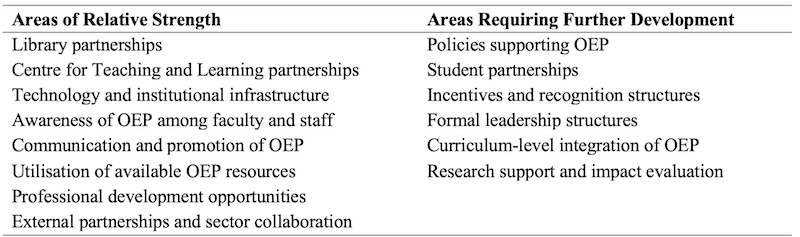
Despite the many differences across institution types and provincial contexts, the two provincial assessments identified several common areas of relative strength. For example, participating institutions across both provinces frequently reported relatively mature partnerships with libraries and centres for teaching and learning, established technological infrastructure to support OEP, and a growing awareness of open education among faculty and staff. The assessments also identified several common opportunities for growth. Across both provinces, capacity was comparatively lower in areas such as policy development, incentives and recognition structures, research support, formal leadership structures, student partnerships, and curriculum-level integration of OEP.
Taken together, the findings show that institutional capacity for OEP can develop unevenly across domains. In both provinces, dimensions associated with infrastructure and established support units, such as libraries and centres for teaching and learning, have tended to demonstrate greater maturity than dimensions requiring institution-wide coordination, including policies, incentives, leadership structures, and curriculum integration. This pattern may indicate that institutions are often able to build localised support mechanisms before embedding open education more fully into their strategy, governance, and reward structures. The findings also highlight the importance of looking beyond OER adoption alone when evaluating institutional progress. While many institutions reported active OER initiatives and growing awareness of open education, capacity assessments revealed that important organisational supports remain underdeveloped. As a result, institutions might face challenges sustaining and scaling OEP without additional investment in leadership, coordination, and strategic planning.
A particularly important outcome of the project was the translation of assessment findings into strategic actions, as participating institutions received benchmarked reports that identified areas of relative strength, highlighted opportunities for growth, and provided tailored recommendations to support future development. At the sector level, the aggregated findings generated evidence that can inform policy development, professional development programming, strategic investments, and collaborative infrastructure efforts undertaken by organisations such as eCampusOntario and BCcampus. In this way, the sectoral application of the ISAT2 offers not only a snapshot of institutional capacity, but also a demonstration of how assessment data can be mobilised to guide decision-making and strengthen open education ecosystems across Canadian post-secondary education.
Table 1 provides a summary of the ISAT2 dimensions on which median responses from participating institutions across both provinces fell at or above the mid-point of the scale (i.e., anything from localised supports to robust institution-wide supports; a relative strength) or below the mid-point of the scale (i.e., absent, incidental, or informal supports; an area requiring further development).
Table 1: Shared Strengths and Challenges in Supporting OEP Across Ontario and British Columbia
Note. Strengths and challenges represent dimensions that emerged consistently across the Ontario and British Columbia sector assessments and are based on aggregate institutional responses across participating institutions.
In addition to providing valuable intelligence and sector-level benchmarks, the provincial self-assessments highlighted opportunities for targeted capacity-building efforts that have already influenced the strategy and approach of eCampusOntario and BCcampus. For example, following the publication of the provincial report, BCcampus developed a specific post-secondary grant opportunity for institutions that aligned with the recommendations of the customised reports delivered to participating institutions. Additional opportunities being considered for sector-level support and coordination include exploring the potential of additional shared services and infrastructure as well as the organisation of professional development opportunities and sharing of leading practices pertaining to domains of institutional capacity identified as most in need of strengthening.
In addition to providing an important benchmark of institutional capacity to support OEP across two Canadian provinces, this project provides a field test of an improved and automated self-assessment tool now available for post-secondary institutions worldwide. This broad application demonstrates the feasibility of using the ISAT2 across diverse public post-secondary institutions; however, the present project should not be interpreted as a formal psychometric validation of the instrument. A primary future direction for the research team is the further refinement and translation into additional languages of the ISAT2 to further enable institutional self-assessment and benchmarking. Participating institutions may choose to engage in repeated assessments using the openly-licensed ISAT2 to evaluate progress, identify emerging needs, and determine whether capacity-building efforts result in meaningful organisational change. Finally, there is also potential for similar assessments to be undertaken by researchers in other provincial, national, or international contexts, creating opportunities for regional benchmarking, knowledge sharing, and a broader understanding of how post-secondary systems support OEP.
As governments, institutions, and sector organisations continue to invest in open education, systematic approaches to assessing institutional capacity will play an increasingly important role in ensuring that these investments translate into sustainable and scalable educational change.
Ashman, M. (2023). Faculty and student perceptions of open pedagogy: A case study from British Columbia, Canada. The Open/Technology in Education, Society, and Scholarship Association (OTESSA) Journal, 3(2), 1–29. https://doi.org/10.18357/otessaj.2023.3.2.40
BCcampus. (n.d.). Open textbook stats. BCcampus OpenEd Resources. https://open.bccampus.ca/advocate-for-open-education/open-textbook-stats/
Cronin, C. (2017). Openness and praxis: Exploring the use of open educational practices in higher education. The International Review of Research in Open and Distributed Learning, 18(5). https://doi.org/10.19173/irrodl.v18i5.3096
eCampusOntario. (n.d.). Impact. Open Library. https://openlibrary.ecampusontario.ca/impact/
Hendricks, C., Reinsberg, S.A., & Rieger, G.W. (2017). The adoption of an open textbook in a large physics course: An analysis of cost, outcomes, use, and perceptions. The International Review of Research in Open and Distributed Learning, 18(4). https://doi.org/10.19173/irrodl.v18i4.3006
Jhangiani, R.S., Pakkal, O., Lachaîne, C., & Luke, R. (2024a). Institutional self-assessment tool, version 2 (ISAT2). eCampusOntario. https://openlibrary.ecampusontario.ca/item-details/#/2ed81854-c5a6-4811-8f8c-8ac4bc71fd2f
Jhangiani, R.S., Pakkal, O., Lachaîne, C., & Luke, R. (2024b). On a path to open: A report on the capacity of Ontario’s post-secondary institutions to support open educational practices. eCampusOntario. https://ecampusontario.ca/wp-content/uploads/2024/11/On-a-Path-to-Open-EN-tagged.pdf
Jhangiani, R., Pakkal, O., & Xia, X. (2025a). The multi-year impact of Canada’s first zero-textbook-cost initiative. Open Praxis, 17(2), 326–348. https://doi.org/10.55982/openpraxis.17.2.832
Jhangiani, R.S., Pakkal, O., Lalonde, C., & Gray, J. (2025b). Leading with openness: A report on the capacity of British Columbia's post-secondary institutions to support open educational practices. BCcampus. https://legacy-files.devbcc.com/wordpress/bccampus.ca/2025/12/BC-OER-Report_v3.pdf
McNally, M., & Ludbrook, A. (2023). A national advocacy framework for open educational resources in Canada. Canadian Association of Research Libraries. https://www.carl-abrc.ca/wp-content/uploads/2023/06/A-National-Advocacy-Framework-for-Open-Educational-Resources-in-Canada.pdf
Morgan, T., Childs, E., Hendricks, C., Harrison, M., DeVries, I., & Jhangiani, R.S. (2021). How are we doing with open educational practice initiatives? Applying an institutional self-assessment tool in five educational institutions. The International Review of Research in Open and Distributed Learning, 22(4), 125–140. https://doi.org/10.19173/irrodl.v22i4.5745
Author Notes
Dr Rajiv Jhangiani is Vice Provost, Teaching and Learning at Brock University, where he is a Full Professor of Educational Studies with a cross-appointment in Psychology, and directs the Inclusive Education Research Lab. His scholarship focuses on open educational practices, student-centred pedagogies, and ethical approaches to educational technology. Formerly an Ambassador for the Global Advocacy of OER with the International Council for Open and Distance Education and a member of the Board of Directors of Open Education Global, he currently serves as Board Chair of the Canadian Digital Learning Research Association. Email: rjhangiani@brocku.ca (https://orcid.org/0000-0002-2357-4782)
Oya Pakkal is a PhD Candidate and Sessional Instructor at Brock University. She has contributed to a growing body of scholarship in open education and educational equity, including research examining student perceptions of social justice framing in course syllabi, the long-term impact of Canada’s first Zero Textbook Cost initiative, and provincial capacity to support open educational practices. She has co-authored provincial reports that have informed conversations about educational access and open education in Canada. Email: ot20jg@brocku.ca (https://orcid.org/0009-0001-0969-055X)
Cite as: Jhangiani, R., & Pakkal, O. (2026). Mapping institutional capacity for open education: Insights from Ontario and British Columbia. Journal of Learning for Development, 13(4), 763-770.
DOI: https://doi.org/10.56059/tqqapk09