Joel Mark Rodriguez, John Jarold Flores and Lourdes Q. Palallos
2026 VOL. 13, No. 3
Abstract: The research investigates how college students use AI literacy skills to make ethical choices, while digital confidence serves as a linking factor, and responsible AI use acts as a regulating element. The researchers collected data from 483 students at a Philippine state university using a quantitative-correlational design with Structural Equation Modeling (SEM) analysis performed through WarpPLS (Version 8.0). The study found that AI literacy directly affects both digital confidence and ethical decision-making processes, while digital confidence serves as a partial mediator between the two variables. The results demonstrate that responsible AI use strengthens the connection between AI literacy and digital confidence, highlighting how ethical technology use affects digital trust. The study shows that AI-enabled learning environments require competence, confidence, and responsibility to work together as essential components for students to make ethical decisions. The results demonstrate that Open and Distance Learning (ODL) providers should establish three core areas, which contain AI literacy, ethical training, and confidence-building methods, to create digital learning systems that enable responsible and efficient technology operation.
Keywords: AI literacy, ethical decision-making, digital confidence, responsible use of AI, 21st-century skills
Artificial intelligence (AI) is quickly transforming higher education in ways that are difficult to summarise, reshaping how students learn, talk, tackle issues, and even prepare for future work. With generative AI technologies becoming more common, the doors of education have opened wider for many learners but, at the same time, fresh ethical dilemmas arise around issues such as academic integrity, privacy, bias, openness, and just how responsibly people use the technology. Because of this, AI literacy is starting to look like a key competency, not only a useful technology, but a tool that stimulates critical thinking, moral awareness, and some responsible participation in digital spaces (Southworth et al., 2023; Walter, 2024). In open and distance learning (ODL), where students now often depend on AI-supported and self-guided environments, building AI literacy has become crucial for encouraging genuine engagement, better and more well-informed decisions, and careful use of newer tools.
At the same time, newer perceptions of 21st-century skills also suggest that learners need more than just technological know-how. They have to strengthen creativity and teamwork, develop digital citizenship, and become adaptable, plus they should learn ethical reasoning for a life in digital societies that keep changing (Thornhill-Miller et al., 2023; Trilling & Fadel, 2009; van Laar et al., 2020). AI literacy can be treated as a multidimensional idea that spans technical ability, digital confidence, and ethical accountability. In other words, when students really understand how AI works, they are expected to feel more confident using digital tools while still making sound ethical judgements when applying AI in school or professional settings.
Recent studies have shown that AI literacy is positively associated with students’ digital competence, self-efficacy, and even academic results (Bećirović et al., 2025; Xiao et al., 2024). Other work has also pointed out that ethical AI education is crucial for cultivating responsible technology use and digital citizenship (Ngo & Hastie, 2025; Usher & Barak, 2024). Still, most of these studies treated AI literacy, digital confidence, responsible AI use, and ethical decision-making as separate issues, rather than as a single connected design or integrated framework. At the same time, although responsible AI use has been considered important for promoting academic integrity, fairness, transparency, and privacy (Golding et al., 2024; Tubella et al., 2024), not much empirical work has explored whether it also acts as a moderating element between AI literacy and digital confidence. This is especially meaningful in ODL settings, where learners depend heavily on self-guided study supported by AI technologies, so they need both technical capability and ethical judgement to handle digital learning responsibly, not just efficiently.
This study aimed to investigate how AI literacy supports digital confidence, responsible use of AI, and ethical decision-making among college students in a Philippine state university. It tried to determine what happened between these elements when students were learning and using AI, especially in everyday academic settings. Specifically, it aimed to:
Contemporary literature increasingly frames AI literacy as part of 21st-century skills, and learners need more than just technical competence; they also need critical thinking, digital citizenship, the kind of adaptability that actually fits messy real-life situations, and ethical responsibility, so they can survive and even thrive in AI-mediated environments (Thornhill-Miller et al., 2023; Trilling & Fadel, 2009; van Laar et al., 2020). More recent work has stretched AI literacy far beyond “knowing AI concepts”, to include how to judge AI-generated outputs, identify algorithmic bias, protect privacy, and use AI in a proper, responsible manner, both in academic and professional tasks (Kong et al., 2022; Stolpe & Hallström, 2024; Walter, 2024; Zhang et al., 2025). The empirical view also seems to point in a consistent direction: AI literacy is related to better digital competence, higher self-efficacy, and improved academic performance (Bećirović et al., 2025; Xiao et al., 2024). Meanwhile, ethics-oriented AI instruction appears to help learners identify and handle ethical dilemmas in a more grounded way (Ngo & Hastie, 2025; Usher & Barak, 2024). Taken together, it seems AI literacy is not only about technical know-how but also about enabling responsible participation in technology-enhanced learning.
Other studies keep returning to the idea that digital confidence and ethical responsibility matter when people use technology. Much research shows that students who feel digitally confident tend to engage more with digital tools, adapt more easily to online learning, and feel more ready to handle ethical issues that show up during technology use (Bancroft et al., 2024; Rosales-Márquez et al., 2025; Zhao et al., 2021). Similarly, ethical decision-making is often linked with structured ethics education, critical reflection, and students’ ability to consider the consequences of technology-related choices (Pai et al., 2021; Parvari et al., 2024). At the same time, responsible AI use has become a core expectation in higher education. Studies stress the value of transparency, academic integrity, fairness, privacy, and also the need to avoid overreliance on AI tools, particularly just for convenience (Cai et al., 2025; Golding et al., 2024; Tubella et al., 2024). So, overall, these studies suggest that technical competence, confidence, and ethical awareness work together as mutually supportive pieces for responsible AI adoption.
A great deal of earlier research treated AI literacy, digital confidence, ethical decision-making, and responsible AI use as separate constructs, or as independent outcomes, and there has been less focus on how they connect inside one shared explanatory model. More specifically, few empirical studies have examined whether digital confidence mediates the link between AI literacy and ethical decision-making, or whether responsible AI use can strengthen the relationship between AI literacy and digital confidence. This is especially relevant in higher education and Open and Distance Learning (ODL) contexts. To help fill this gap, the present study folded these constructs into one single conceptual model. It aims to explain how AI literacy could promote ethical decision-making through digital confidence, while also trying to verify the moderating role of responsible AI use. This integrated approach adds to the expanding literature on AI-enabled learning by delineating what we know about the cognitive, behavioural, and ethical processes that help students engage responsibly with AI in higher education.
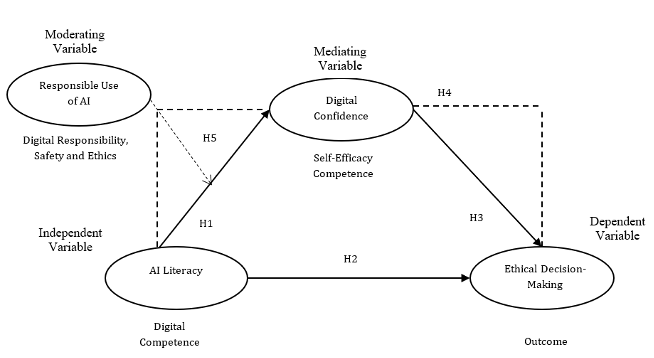
Based on the 21st-century Skills Framework (Trilling & Fadel, 2009) (see Figure 1), plus some newer AI literacy research, this study argues that AI literacy boosts students’ digital confidence and also improves how they make ethical choices. Digital confidence here means learners’ own belief that they can effectively work with digital and AI technologies. It should act like a mediator, so AI literacy leads to stronger digital confidence, and that confidence then helps shape better ethical decision-making. In other words, the technical use leads to responsible behaviour, and is not just stored as theory. Responsible use of AI, which includes ethical awareness, transparency, fairness, privacy, and accountability, is also expected to moderate behaviour. That is, responsible use should make the link between AI literacy and digital confidence stronger because it reinforces how students feel able to apply their technical competence in genuinely responsible ways. Taken together these elements create one integrated conceptual picture about competence, confidence and responsibility, and interact to support ethical decision-making among university students. This happens especially in AI-supported learning environments, where the tools are present and the students have to decide what to do with them.
This study employed a quantitative research design using Structural Equation Modeling (SEM) to examine the relationships among AI literacy, digital confidence, responsible use of AI, and ethical decision-making among college students. SEM was selected because it enables the simultaneous examination of direct, indirect (mediation), and moderating relationships among multiple latent constructs, providing a comprehensive assessment of the proposed conceptual framework. Specifically, digital confidence was examined as a mediating variable, while responsible use of AI was tested as a moderating variable in the relationship between AI literacy and ethical decision-making. This methodological approach is appropriate for testing complex theoretical models and validating the hypothesised relationships among constructs in educational research, particularly in understanding how technical competence, self-efficacy, and ethical responsibility collectively influence students’ ethical decision-making within AI-supported learning environments.
The study was conducted among 483 undergraduate students from a state university in the National Capital Region of the Philippines. Stratified random sampling was utilised to select the respondents in order to ensure proportional representation across the different academic programmes and year levels for a more representative sample. Power analysis was used to determine the sample size, which was sufficient to detect statistically significant relationships among the study variables and to meet requirements for Structural Equation Modeling (SEM), which recommends an adequate sample size for complex mediation and moderation models.
Data was collected through a structured questionnaire that consisted of four constructs: AI literacy, digital confidence, responsible use of AI, and ethical decision-making. The instrument was adapted from previously validated measures reported in the literature and used a five-point Likert scale. To verify the accuracy of the content, the questionnaire was examined by professionals in educational technology, research methodology and artificial intelligence in education. Before the main survey, a pilot test was conducted with 30 students and the reliability and validity of the instrument were satisfactory, with Cronbach’s alpha, Composite Reliability (CR), and Average Variance Extracted (AVE) above the recommended values for internal consistency and convergent validity.
The data was collected by using Google Forms and the respondents could fill out the survey anonymously and voluntarily. All respondents were informed of the study objectives, confidentiality, and their right to withdraw from the study at any time without penalty, and provided informed consent to participate. Ethical approval was obtained from the appropriate university ethics review body prior to data collection. The responses were screened for completeness and accuracy before being analysed with WarpPLS 8.0 to test the measurement and structural models including direct, mediating, and moderating relationships among the study variables using Structural Equation Modeling.
Table 1 shows that the fit indices for the model indicate a good overall fit of the structural model with the data. The Chi-square value (χ² = 945.32, p < .05) was statistically significant, but this was expected with such a large sample size and was therefore not considered a fatal weakness. This gives a Chi-square/df ratio of 2.15 and is well under the upper threshold of ≤ 3.0, indicating a good fit. The RMSEA value of 0.047 is indicative of a close fit to the population model, whereas both GFI (0.92) and TLI (0.95) exceeded the 0.90 benchmark, thus confirming the adequacy of the model. The SRMR value of 0.041 is also below the admissible threshold, clearly exhibiting acceptable residuals with respect to observed and predicted correlations. Such fit indices, together as a whole, point to the conclusion that measurement and structural models met the essential statistical conditions and thus provided strong support for the reliability of proposed relationships of AI Literacy, Digital Confidence, Responsible Use of AI, and Ethical Decision-Making.
Table 1: Model Fit Indices
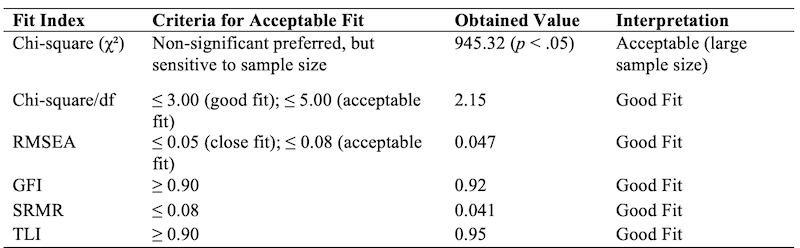
Table 2 shows the constructs reached strong reliability and convergent validity as demonstrated by the CR (Composite Reliability) of the constructs ranging above 0.70 and the AVE (Average Variance Extracted) values being above the 0.50 cutoff. AI Literacy (AVE = 0.721; CR = 0.911), Digital Confidence (AVE = 0.707; CR = 0.905), Responsible Use of AI (AVE = 0.693; CR = 0.897) and Ethical Decision Making (AVE = 0.732; CR = 0.913) all complied with the recommended values for internal consistency. For all four constructs, the item loadings per indicator vary from within: AI Literacy 0.754-0.889, Digital Confidence 0.763-0.874, Responsible Use of AI 0.765-0.881, and Ethical Decision-Making 0.769-0.884—all above the minimum cut-off of 0.70, thereby confirming that each and every respective item was significant for its own construct. The results thus confirm the reliability and validity of measurement, which thus assured an acceptable base for testing the structural relationships hypothesised among AI Literacy, Digital Confidence, Responsible Use of AI, and Ethical Decision Making.
Table 2: Construct Reliability and Validity
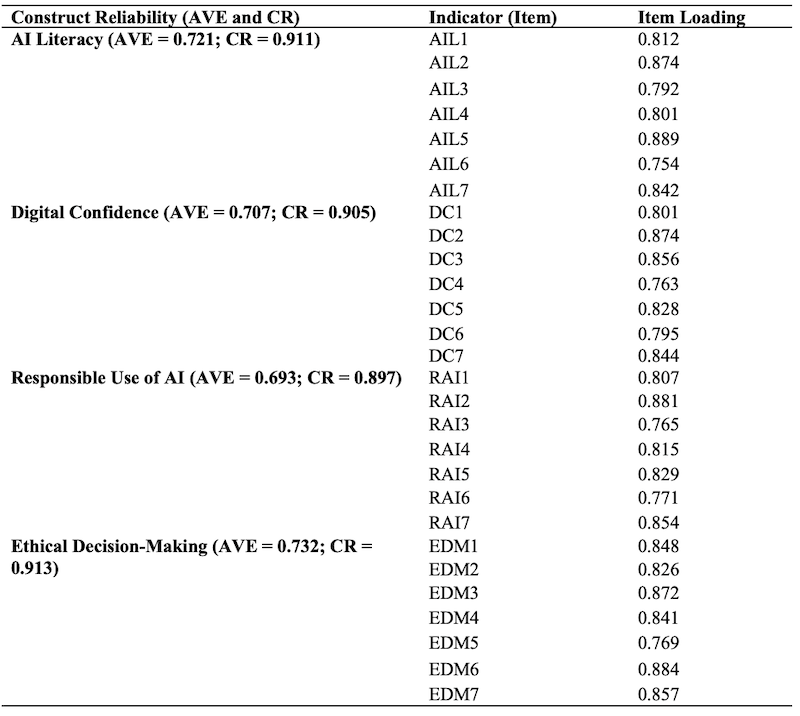
Table 3 displays moderate to high explanatory power and predictive relevance for the endogenous variables. Digital Confidence had an R² value of 0.46, indicating that AI Literacy explained 46% of its variance, while the Q² value of 0.31 indicates moderate predictive relevance. Ethical Decision-Making, on the other hand, had an R² value of 0.58, meaning AI Literacy, Digital Confidence, and Responsible Use of AI jointly explain 58% of its variance, while the Q² value of 0.39 shows strong predictive relevance. This indicates that the proposed model explains a large amount of variance in both constructs, and possesses strong predictive validity, thus validating its power in demonstrating how AI literacy, confidence, and responsible use interact to shape students' ethical decision-making.
Table 3: R2 and Q2 Value

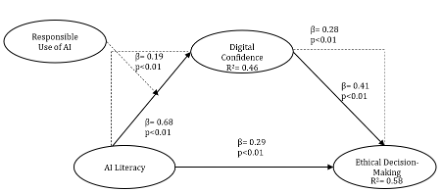
The results in Table 4 show that students with higher AI literacy scores demonstrated improved digital confidence (β = 0.68, p < .001) and ethical decision-making (<β = 0.29, p < .001) because they possess greater AI knowledge. The study found that digital confidence served as a major predictor for ethical decision-making (β = 0.41, p < .001) because self-efficacy directly influenced how people behaved ethically. The mediation analysis shows that digital confidence changes the relationship between AI literacy and ethical decision-making because confidence acts as the primary method which people use to turn their knowledge into ethical behaviour. Responsible use of AI functions as a significant factor, which determines how AI literacy affects digital confidence because ethical awareness creates a stronger connection between literacy skills and confidence levels. The research demonstrates that literacy skills and confidence levels together with responsible behaviour create the essential elements which scientists use to study ethical decision-making in educational environments that utilise AI technology.
Table 4: Hypotheses Testing Result
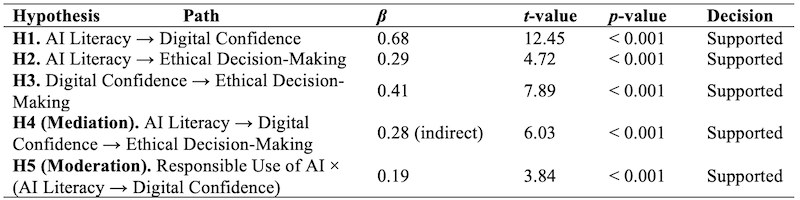
Table 4 illustrates the structural model results for the direct link between AI literacy and digital confidence. It shows that AI literacy had a meaningful positive influence on digital confidence (β = 0.68, t = 12.45, p < .001), so this supports H1. This suggests that students who have stronger AI literacy tend to feel more certain about using AI-enabled and other digital tools for studying as well as academic work. The model also implies that AI literacy accounts for a great deal of the variance in digital confidence (R² = 0.46), which shows why it matters as a predictor for students’ self-efficacy within AI-supported learning contexts.
The results further reveal that AI literacy significantly predicts ethical decision-making (β = 0.29, t = 4.72, p < .001), providing support for H2. This finding suggests that students who have more knowledge and a better grasp of AI are more able to recognise ethical dilemmas and make responsible choices when working with AI technologies. The outcome also shows that AI literacy contributes directly to ethical judgement, rather than just occurring through students’ digital confidence.
Digital confidence was found to have a significant positive effect on ethical decision-making (β = 0.41, t = 7.89, p < .001), so it supports H3. In other words, students who feel more secure when using digital and AI tools tend to show stronger ethical judgement in learning contexts that are mediated by technology. This outcome underlines why self-efficacy matters, because it helps turn technological competence into responsible conduct.
Mediation analysis affirms that digital confidence significantly mediates the link between AI literacy and ethical decision-making (indirect β = 0.28, t = 6.03, p< .001), supporting H4. This result implies that AI literacy helps shape ethical decision-making both directly and indirectly via students’ confidence when using AI technologies. In other words, the mediation effect shows that digital confidence operates as an important psychological pathway through which AI literacy steers ethical behaviour.
The moderation analysis shows that when AI is used responsibly it significantly strengthens the link between AI literacy and digital confidence (β = 0.19, t = 3.84, p < .001), which supports H5 (see Figure 2). In other words, students who show higher levels of responsible AI use tend to show a stronger positive connection between AI literacy and their digital confidence, compared to students with lower responsible AI use. The result points to how crucial ethical awareness is for maximising the gains from AI literacy when developing students’ confidence in AI-supported learning environments.
The present study adds to the growing literature on AI literacy by demonstrating that AI literacy impacts ethical decision making directly and indirectly via digital confidence, and that responsible AI use strengthens the relationship between AI literacy and digital confidence. Previous research has shown that AI literacy improves the learners’ technological competence, self-efficacy, and academic performance (Bećirović et al., 2025; Southworth et al., 2023; Xiao et al., 2024). Others have pointed out the importance of ethical AI education to promote responsible technology use (Ngo & Hastie, 2025; Usher & Barak, 2024). However, these studies mostly examined these constructs in isolation. The present study provides insights into the psychological and ethical mechanisms that explain the relationship between technical competence and responsible behaviour. To this end, AI literacy, digital confidence, responsible AI use, and ethical decision-making were incorporated into one explanatory model. The findings, therefore, add to the 21st-century Skills Framework by demonstrating that digital competence in itself is insufficient, but should be accompanied by confidence and ethical responsibility to equip learners to navigate AI-supported environments. They also contribute to AI literacy by framing AI literacy as a technical and ethical competency, and support digital confidence by showing that confidence is the mechanism by which AI knowledge is translated into ethical decision-making.
The findings offer useful guidance for higher education institutions that want to prepare students for a society influenced by AI. AI literacy should be incorporated across various fields instead of being limited to technology-focused programmes. This approach would allow students to build technical skills along with ethical reasoning. Curriculum design should include hands-on learning activities, real AI applications, case discussions, and reflective exercises that urge students to assess issues like bias, privacy, transparency, fairness, and accountability. Faculty development is also crucial. Educators need ongoing professional learning to effectively incorporate AI into their teaching while demonstrating responsible and ethical AI practices. At the institutional level, universities should create clear AI governance policies that outline acceptable AI use, academic integrity, disclosure of AI-assisted work, and data privacy. These policies should promote responsible innovation while protecting students' critical thinking, creativity, and independent judgment instead of fostering excessive reliance on AI technologies.
The findings are especially significant for Open and Distance Learning (ODL). In this context, learners rely more on AI-supported technology for independent study, online collaboration, and assessment. Students in ODL environments often have more freedom to use AI tools. This makes it necessary for them to build digital confidence and practise responsible AI use to ensure ethical learning. The results indicate that ODL providers should include AI literacy and digital ethics in online courses, virtual orientation programmes, and learner support services. This could help students critically assess AI-generated information and use AI responsibly. AI-assisted assessments should come with clear guidelines from institutions on acceptable AI use, attribution, and academic honesty. This could help keep assessments credible while promoting meaningful learning. Additionally, online learning platforms should offer activities that boost learners' confidence in using AI ethically. This approach should encourage responsible digital citizenship, reduce inappropriate reliance on AI, and support equal participation among remote learners with different levels of tech experience.
This study shows connections among AI literacy, digital confidence, responsible AI use, and ethical decision-making. However, there are still several areas that need more investigation. Long-term studies are suggested to see how these connections change as students gain more experience with AI technologies. Comparative studies across multiple universities, countries, and cultures would improve the generalisability of the results and provide insights into differences in AI use and ethical decision-making. Future research could also explore these relationships in Open Universities, Massive Open Online Courses (MOOCs), and other online learning environments where AI-supported education is growing quickly. Furthermore, expanding the model to include teachers, instructional designers, and educational leaders would give a wider view of how AI literacy and responsible AI use impact teaching, curriculum design, and institutions' readiness for AI-powered education. Future studies might add more factors like trust in AI, digital citizenship, AI anxiety, technological readiness, or learning outcomes to better explain responsible AI use and ethical decision-making in higher education.
Bancroft, R., Challen, R., & Pearce, R. (2024). Searching for a shared understanding of digital confidence in a tertiary context: A scoping review. Journal of Learning Development in Higher Education, 30). https://doi.org/10.47408/jldhe.vi30.1061
Bećirović, S., Polz, E., & Tinkel, I. (2025). Exploring students’ AI literacy and its effects on their AI output quality, self-efficacy, and academic performance. Smart Learning Environments, 12J(29). https://doi.org/10.1186/s40561-025-00384-3
Cai, L., Msafiri, M.M., & Kangwa, D. (2025). Exploring the impact of integrating AI tools in higher education using the Zone of Proximal Development. Education and Information Technologies, 30, 7191-7264. https://doi.org/10.1007/s10639-024-13112-0
Golding, J.M., Lippert, A., Neuschatz, J.S., Salomon, I., & Burke, K. (2024). Generative AI and college students: Use and perceptions. Teaching of Psychology, 52(3), 369-380. https://doi.org/10.1177/00986283241280350
Kong, S., Cheung, W., & Zhang, G. (2022). Evaluating artificial intelligence literacy courses for fostering conceptual learning, literacy and empowerment in university students: Refocusing to conceptual building. Computers in Human Behavior Reports, 7, 100223. https://doi.org/10.1016/j.chbr.2022.100223
Ngo, T.N., & Hastie, D. (2025). Artificial intelligence for academic purposes (AIAP): Integrating AI literacy into an EAP module. English for Specific Purposes, 77, 20-38. https://doi.org/10.1016/j.esp.2024.09.001
Pai, H-C., Hwu, L-J., Lu, Y-C., & Yen, W-J. (2021). Effects of an ethical decision-making reasoning scheme in nursing students: A randomized, open-label, controlled trial. Nurse Education Today, 108, 105189. https://doi.org/10.1016/j.nedt.2021.105189
Parvari, S., Farajidana, H., Mahmoodi, Z., Mohamadi, F., Kabir, K., Boostanchi, M., & Khonsari, N. (2024). Components related to ethical decision making in medical science students: A structural equation model. PLOS ONE, 19(4), e0297494. https://doi.org/10.1371/journal.pone.0297494.
Rosales-Márquez C., Carbonell-García, C.E., Miranda-Vargas, V., Diaz-Zavala, R., & Laura-De La Cruz, K.M. (2025). Self-confidence as a predictor of digital skills: A fundamental pillar for the digitalization of higher education. Frontiers in Education, 9. https://doi.org/10.3389/feduc.2024.1515033
Southworth, J., Migliaccio, K., Glover, Joe, Glover, Ja’Net, Reed, D., McCarty, C., Brendemuhl, J., & Thomas, A. (2023). Developing a model for AI across the curriculum: Transforming the higher education landscape via innovation in AI literacy. Computers and Education: Artificial Intelligence, 4, 100127. https://doi.org/10.1016/j.caeai.2023.100127
Stolpe, K., & Hallström, J. (2024). Artificial intelligence literacy for technology education. Computers and Education Open, 6, 100159. https://doi.org/10.1016/j.caeo.2024.100159
Thornhill-Miller, B., Camarda, A., Mercier, M., Burkhardt, J-M., Morisseau, T., Bourgeois-Bougrine, S., Vinchon, F., El Hayek, S., Augereau-Landais, M., Mourey, F., Feybesse, C., Sundquist, D., & Lubart, T. (2023). Creativity, critical thinking, communication, and collaboration: Assessment, certification, and promotion of 21st century skills for the future of work and education. Journal of Intelligence, 11(3), 54. https://doi.org/10.3390/jintelligence11030054
Trilling, B., & Fadel, C. (2009). 21st century skills: Learning for life in our times. Jossey-Bass. https://www.wiley.com/en-us/21st+Century+Skills%3A+Learning+for+Life+in+Our+Times-p-9780470553916
Tubella, A.A., Mora-Cantallops, M., & Nieves, J.C. (2023). How to teach responsible AI in higher education: Challenges and opportunities. Ethics and Information Technology, 26(3), 1-14. https://doi.org/10.1007/s10676-023-09733-7
Usher, M., & Barak, M. (2024). Unpacking the role of AI ethics online education for science and engineering students. International Journal of STEM Education, 11(35). https://doi.org/10.1186/s40594-024-00493-4
van Laar, E., van Deursen, A.J.A.M., van Dijk, J.A.G.M., & de Haan, J. (2020). Determinants of 21st-century skills and 21st-century digital skills for workers: A systematic literature review. SAGE Open, 10(1). https://doi.org/10.1177/2158244019900176
Walter, Y. (2024). Embracing the future of artificial intelligence in the classroom: The relevance of AI literacy, prompt engineering, and critical thinking in modern education. International Journal of Educational Technology in Higher Education, 21(15). https://doi.org/10.1186/s41239-024-00448-3
Xiao, J., Alibakhshi, G., Zamanpour, A., Zarei, M.A., Sherafat, S., & Behzadpoor, S-F. (2024). How AI literacy affects students’ educational attainment in online learning: Testing a structural equation model in higher education context. The International Review of Research in Open and Distributed Learning, 25(3), 179-198. https://doi.org/10.19173/irrodl.v25i3.7720
Zhang, S., Ganapathy Prasad, P., & Schroeder, N.L. (2025). Learning about AI: A systematic review of reviews on AI literacy. Journal of Educational Computing Research, 63(5), 1292-1322. https://doi.org/10.1177/07356331251342081
Zhao, Y., Sánchez Gómez, M.C., Pinto Llorente, A.M., & Zhao, L. (2021). Digital competence in higher education: students’ perception and personal factors. Sustainability, 13(21), 12184. https://doi.org/10.3390/su132112184
Author Notes
Joel Mark Rodriguez is a seasoned educator and management professional with extensive experience in both corporate and academic sectors. He is also a Licensed Professional Teacher and holds a Master’s of Business Administration and is pursuing a Doctor of Business Administration. Joel is the Chief of the Senator Neptali Gonzales Research Center for Development Studies and a Regular Faculty member at Rizal Technological University’s College of Business, Entrepreneurship, and Accountancy (CBEA), specialising in Human Resource Management. Email: mprodriguez@rtu.edu.ph (https://orcid.org/0009-0009-7195-8164)
John Jarold Flores holds a Master's degree in Business Administration and is currently pursuing a Doctor of Business Management at Pamantasan ng Lungsod ng Marikina. He is a regular faculty member of the Human Resource Management Department, under the College of Business, Entrepreneurship and Accountancy at Rizal Technological University. Email: jjmflores@rtu.edu.ph (https://orcid.org/0009-0004-0456-9293)
Lourdes Q. Palallos is an aspiring operations management professional and a Master’s of Business Administration student with a strong foundation in business operations, logistics, and supply chain management, complemented by hands-on experience in government and higher education institutions. She is committed to continuous learning and operational excellence, leveraging her analytical, organisational, and leadership skills to develop innovative solutions and contribute effectively to organisational success. Email: lourdespalallos.08@gmail.com (https://orcid.org/0009-0008-7870-5891)
Cite as: Rodriguez, J.M., Flores, J.J., & Palallos, L.Q. (2026). AI literacy and ethical decisions: The mediating role of digital confidence and the moderating effect of responsible AI use of college students. Journal of Learning for Development, 13(3), 429-440.
DOI: https://doi.org/10.56059/f9bcax54