Genimon Vadakkemulanjanal Joseph, Anit M. Thomas, Dawn Jose, Athira P and Nidhin Romeo
2026 VOL. 13, No. 3
Abstract: This study examines how AI literacy shapes the teaching efficiency of Higher Education Institution (HEI) teachers in Kerala, India. Responses were obtained from 380 respondents/teachers, collected through voluntary sampling, and analysed using Pearson correlation and mediation analysis. Teaching efficiency was significantly and positively correlated with AI literacy, perceived ease of use (PEOU), perceived usefulness (PU) and trust in AI tools. Demographic variables such as gender, age, qualification and subject specialisation showed no significant influence on the responses. Prior AI training and AI tool exposure significantly improved all measured variables. Mediation analysis confirmed that PEOU, PU, and trust partially mediate the relationship between AI literacy and teaching efficiency. These findings suggest that institutions should develop clear policies on data privacy, ethical AI use and academic integrity.
Keywords: AI literacy, teaching efficiency, PEOU, perceived usefulness, higher education, India
AI tools and chatbots are widely adopted for automating routine and complex tasks. Covid-19 accelerated technology adoption in education, and the post-Covid AI era shows stronger acceptance of digital tools (Bergdahl & Sjöberg, 2025; Putri & Sain, 2025; Velli & Zafiropoulos, 2024). Teachers in India often face challenges in adopting AI because of limited infrastructure, training and institutional support (Joseph & Thomas, 2021; Yao & Wang, 2024).
The integration of Artificial Intelligence (AI) tools in education can significantly transform the teaching and learning environment, especially in Higher Education Institutions (HEIs) (Nazaretsky et al., 2022; Velli & Zafiropoulos, 2024). AI tools promise to enhance teaching efficiency by automating repetitive tasks, enabling personalised learning experiences, and offering insights through data analytics (Yue et al., 2024). However, the adoption and success of AI-powered education technology (AI-EdTech) largely depend on teachers’ attitudes towards AI tools, their own competency and openness to technology systems (Shin et al., 2024; Zhang et al., 2024). The perceived usefulness (PU) and perceived trust in AI tools are concerns for adoption (Pillai et al., 2024; Zhang et al., 2024). Studies indicate that teachers’ technology attitudes are framed by their perceived usefulness and trust in AI tools and AI-based chatbots (Choi et al., 2023; Yue et al., 2024). Teachers’ AI-based technology acceptance is thus crucial in HEIs. Teacher efficiency directly affects equitable access for first-generation and disadvantaged students in India.
The Technology Acceptance Model (TAM) for the AI era better captures the nuances of AI technologies but keeps the central idea of PU and Perceived Ease of Use (PEOU) of AI systems (Baroni et al., 2022; Venkatesh & Davis, 2000). Researchers have extended TAM with additional constructs like user trust in AI, perceived quality of AI output, and collaborative intention with AI applications (Baroni et al., 2022; Choung et al., 2023; Nazaretsky et al., 2021). This modified TAM has been used to assess the acceptance of AI-based applications like intelligent tutoring systems and AI-powered pedagogical tools (Baroni et al., 2022; Kavitha & Joshith, 2024). The study extends the modified TAM by treating AI literacy as the starting point. Teachers’ understanding of AI can shape how useful, easy to use, and trustworthy they find AI tools (Bergdahl & Sjöberg, 2025; Celik et al., 2026; Ng et al., 2021). Trust is particularly important because AI systems often make decisions that users might not fully understand (Baroni et al., 2022; Choung et al., 2023).
This study was framed by the modified TAM to describe teachers’ AI tool integration for teaching-learning purposes. This descriptive study is concerned with the teachers’ perception of the PU and perceived trust in AI tools for their teaching effectiveness with respect to the HEIs. AI tool adoption among teachers directly influences the quality and accessibility of distance education delivery and, thus, this study was framed to provide relevant suggestions to Open and Distance Learning (ODL) providers.
Perceived usefulness (PU) refers to the degree to which teachers believe that AI tools will enhance their teaching effectiveness and efficiency (Gong & Mao, 2026; Yao & Wang, 2024). Teachers in HEIs perceive AI tools as useful for enhancing efficiency, personalising learning, improving student engagement, and enabling data-driven decision support (Gökçearslan et al., 2024; Joseph & Thomas, 2020; Labadze et al., 2023). AI-based LLMs such as ChatGPT and Gemini automate repetitive tasks such as grading, attendance, scheduling and report generation, thus, freeing teachers to focus on curriculum design and student interaction (Gökçearslan et al., 2024; Takona, 2024). Training, peer support and frequent exposure strengthen teachers’ perceived usefulness of AI tools (Bergdahl & Sjöberg, 2025), enabling adaptive and efficient learning (Yuan & Liu, 2025). Teachers who follow constructivist teaching practices are more likely to use AI tools than those who rely on traditional teaching methods (Choi et al., 2023). This shows that teaching culture also influences AI adoption.
PEOU refers to the extent to which one finds technology tools user-friendly and free of complexity (Venkatesh & Davis, 2000). Most AI tools are easy to use, even for beginners, because their interfaces are similar to social media platforms (Baroni et al., 2022). Integration with learning management systems (LMS) and proper training can make them even easier to use (Galán-Rodríguez et al., 2025; Seo et al., 2024). Teachers generally prefer tools that are easy to learn and fit into their existing work (Yuan & Liu, 2025).
Trust is a critical factor influencing the adoption and effective use of AI tools (Choung et al., 2023). Teachers’ trust in AI tools has two aspects: trust in their human-like features and trust in the accuracy of their outputs. Trust in functionality has a stronger influence on teachers’ intention to use AI (Choung et al., 2023; Nazaretsky et al., 2021). The perceived benefits of AI tools and user-friendly interfaces significantly increase teachers’ trust in AI tools (Ayanwale et al., 2024). Cultural values and geographic context can also influence trust in AI (Celik et al., 2026; Choudhury & Shamszare, 2023). Training programmes that explain how AI makes decisions can improve teachers’ trust in and willingness to use AI tools (Wang et al., 2024). Trust in AI-based educational technology is also related to PU and PEOU, supporting the modified TAM framework (Nazaretsky et al., 2021; Wang et al., 2024).
Teaching efficiency refers to a teacher’s ability to deliver high-quality education while optimising time, resources, and effort (Xu et al., 2025). AI tools can improve teaching efficiency by automating grading and reporting, adapting content to learners’ needs, and providing real-time feedback through intelligent tutoring and adaptive learning platforms (Kaur et al., 2024; Xu et al., 2025). AI-based educational technology can also reduce costs and support learning at scale (Damaševičius & Sidekerskienė, 2024; Sipahioglu, 2024). Chai et al. (2021) found that AI literacy and self-efficacy are important factors in improving teaching efficiency, which supports the theoretical basis of this study.
AI literacy is an emerging concept in the technology adoption scenario, and it remains largely unexplored in the field of teacher education (Bergdahl & Sjöberg, 2025; Sperling et al., 2024). AI literacy refers to the ability to comprehend, evaluate, and effectively use AI technologies. It includes understanding the principles behind AI systems, such as their capabilities, decision-making mechanisms, and potential errors (Mills et al., 2024; Ng et al., 2021; Su et al., 2023). AI-literate teachers can make better decisions when selecting and using AI tools (Long & Magerko, 2020). The UNESCO AI competency framework for teachers highlights knowledge, evaluation, collaboration, contextualisation, autonomy, and ethics as key areas of AI literacy (Allen & Kendeou, 2023; Cukurova & Miao, 2024; Ding et al., 2024; Sperling et al., 2024). In countries like India, where classroom sizes are large and resources are stretched, AI literacy among teachers becomes a practical tool for delivering equitable learning at scale.
AI literacy, PEOU, PU and trust were earlier studied separately in relation to AI adoption. However, few studies have examined them together as predictors and mediators of teaching efficiency among HEI teachers in India. Most existing studies focus on Western or East Asian settings (Celik et al., 2026; Zhang et al., 2023). The Indian HEI context remains less explored, especially given its large class sizes, limited resources, and diverse ODL settings. Previous studies have also rarely treated AI literacy as the starting point that influences the downstream TAM constructs. This study addresses this gap by placing AI literacy at the beginning of the model. This gap is particularly important to ODL providers in India, where teachers’ AI skills can directly affect the quality of technology-based learning for distance learners.
This study pursued three research objectives:
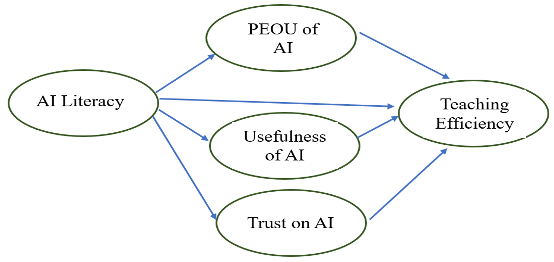
This study used a descriptive quantitative survey design to examine teachers’ perceptions of AI tools and their relationship with teaching efficiency across a large and geographically diverse sample (RO1–RO3). The modified TAM keeps PEOU and PU separate from the original model and adds trust in AI and AI literacy as extensions (Baroni et al., 2022; Choung et al., 2023). AI literacy was included as the independent variable because teachers’ understanding of AI can influence the other TAM constructs (Bergdahl & Sjöberg, 2025; Ng et al., 2021). Figure 1 presents the conceptual framework, with AI literacy as the independent variable, PEOU, PU, and trust as parallel mediators, and teaching efficiency as the dependent variable.
Based on the research model, the following null hypotheses were formulated:
H0-1: There is no significant relation between the AI literacy, PEOU of AI, Perceived Usefulness of AI tools, Perceived Trust in AI tools, and teaching efficiency of the HEI teachers (addresses RO1)
H0-2: There is no significant role for demographic variables on AI literacy, PEOU of AI, Perceived Usefulness of AI tools, Perceived Trust in AI tools, and teaching efficiency of the HEI teachers (addresses RO2).
H0-3: There is no significant mediation in the relation between the AI literacy and teaching efficiency of HEI teachers through PEOU of AI, Perceived Usefulness of AI Tools and Perceived Trust in AI Tools (addresses RO3).
The study focused on full-time teachers in HEIs across the Malabar region of Kerala, India. Teachers were invited through their institutions and 380 completed the survey. The sample included teachers from universities, autonomous and affiliated colleges and ODL institutions across science, arts, engineering, medicine, management, and commerce. Consent was received from the head of each institution and the respondents before collecting the data. The study adhered to all ethical research norms, and confidentiality was maintained in all stages of the research.
The study used a five-point Likert scale (1 = Strongly Disagree to 5 = Strongly Agree) for all items, with subscales measuring AI literacy, PEOU, PU, trust in AI tools, and teaching efficiency. Content validity was established through expert review before piloting. The questionnaire items were tested with a pilot study of 60 respondents/teachers, and modifications were incorporated in the final instrument. All five subscales fell within the accepted reliability range as measured by Cronbach’s alpha: AI literacy (α = .83), PEOU (α = .81), PU (α = .79), Trust (α = .82), and Teaching Efficiency (α = .85).
Data was collected through Google Forms and analysed using SPSS (Version 22). Descriptive statistics were used to check data normality. Pearson correlation was used for RO1 (H0-1). One-way ANOVA was used for RO2 (H0-2) to examine differences across demographic groups. For RO3 (H0-3), PROCESS Macro Model 4 was used to test the mediating roles of PEOU, PU, and trust. The analysis used 5,000 bootstrap samples with 95% bias-corrected confidence intervals.
This study was conducted in accordance with standard ethical guidelines for educational research. Institutional permission was obtained from the heads of the participating HEIs prior to data collection. Informed consent was secured from all respondents. The respondents participated in this study voluntarily and were assured of anonymity and confidentiality. No personal identifying information was recorded or retained. The data collected were coded and secured. Formal review board approval was not sought, as the study involved an anonymous, non-interventional survey of consenting adult professionals and posed no more than minimal risk to the participants.
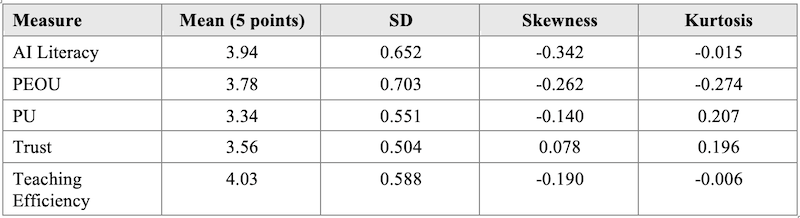
The responses from 380 respondents/teachers were collected, and consisted of 55.5% female respondents; 60.8% aged below 35 years, and 69.3% PG qualified. Their subjects of specialisation were science, arts, engineering, medicine, management, and commerce, with 89.2% of the respondents having undergone AI tool-related training during the academic year, and 79.2% being familiar with AI-powered educational tools or AI-based website services for their work. The tool items fell under the accepted reliability (Cronbach’s alpha). The data were normally distributed, as shown by the descriptive statistics in Table 1.
Table 1: Descriptive Statistics of the Measures
H0-1 was tested using Pearson correlation analysis (Table 2).
Table 2: Pearson Correlation Analysis Between the Measures
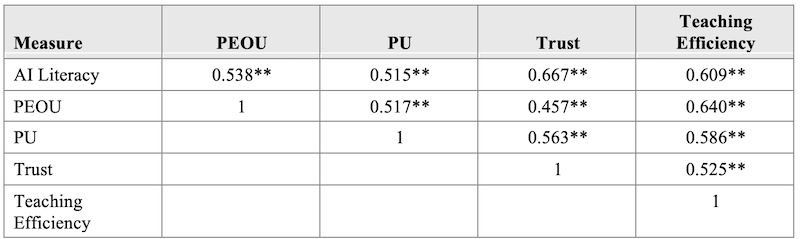
** Pearson Correlation is significant at the 0.01 level (2-tailed).
The Pearson correlation analysis found a statistically significant (p = 0.000) existence among the study variables, and all the correlations were positive in direction. AI literacy showed a strong positive correlation with teaching efficiency (r = 0.609), trust (r = 0.667), PEOU (r = 0.538), and PU (r = 0.515). All inter-variable correlations were positive and moderately strong. Thus, H0-1 is rejected: there is a significant positive relationship between AI literacy, PEOU, PU, trust, and teaching efficiency among HEI teachers.
H0-2 was tested using one-way ANOVA. Gender, age, educational qualification, and subject specialisation showed no significant (p > 0.05) influence on any of the study variables. However, teachers with AI tool exposure and those who had undergone AI tool training significantly differed in their AI literacy, PEOU, PU, trust, and teaching efficiency scores. H0-2 is therefore partially rejected: demographic variables do not matter but AI training and exposure do. This finding is consistent with Bergdahl and Sjöberg (2025) and Celik et al. (2026), who report that structured AI exposure is a stronger predictor of teacher AI attitudes than demographic characteristics.
H0-3 was tested with PROCESS Model 4 (parallel multiple mediation), using 5,000 bootstrap samples and 95% bias-corrected confidence intervals. The overall model predicting teaching efficiency from AI literacy, PEOU, PU, and trust was significant (R = 0.7431, R² = 0.5523, F (4, 375) = 111.63, p = 0.000). The model summary is given in Table 3.
Table 3: Model Summary of the Outcome Variables in the Mediation Analysis
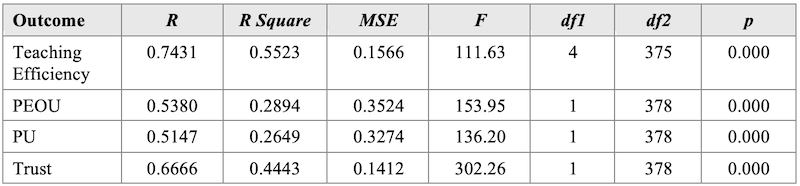
The direct effect of AI literacy on teaching efficiency was significant: b = 0.2342 (SE = 0.0450, t = 5.2057, p = 0.000, 95% CI [0.1458, 0.3227]). The total indirect effect via PEOU, PU, and trust was also significant: b = 0.3157 (Boot SE = 0.0391, 95% CI [0.2383, 0.3926]). Specific indirect effects: via PEOU, b = 0.1084 (Boot SE = 0.0245, 95% CI [0.0631, 0.1574]); via PU, b = 0.0602 (Boot SE = 0.0190, 95% CI [0.0270, 0.1013]); via trust, b = 0.1471 (Boot SE = 0.0270, 95% CI [0.0981, 0.2031]). All bootstrap confidence intervals excluded zero, confirming that PEOU, PU, and trust each individually mediated the AI literacy-teaching efficiency relationship. H0-3 is rejected.
This study examined how AI literacy relates to the teaching efficiency of HEI teachers in Kerala, India, using a modified TAM with PEOU, PU, and trust as mediators. AI literacy, PEOU, PU, and trust in AI tools were all significantly and positively related to teaching efficiency. AI exposure and AI tools training were the only variables that significantly differentiated teachers on all study measures; demographic factors did not. PEOU, PU and trust each partially mediated the relationship between AI literacy and teaching efficiency, with trust carrying the largest share of this indirect effect (b = 0.1471). This is consistent with the broader trust literature in AI-EdTech (Choung et al., 2023; Nazaretsky et al., 2022), which identifies trust as a uniquely important mediator for AI systems, given their opacity and complexity.
The main contribution of this study is that it brings AI literacy, PEOU, PU, and trust together in one empirically tested model to explain teaching efficiency among HEI teachers in India, which had not been done before in this context. This gives institutions concrete evidence that investing in AI literacy training is likely to pay off with better teaching efficiency. And it gives ODL providers a theoretically grounded and empirically supported rationale for making AI literacy a standard component of distance educator preparation. The results are further discussed as follows.
The strong positive correlations among AI literacy, PEOU, PU, trust and teaching efficiency show that these factors were closely related among Indian HEI teachers. This finding supports and extends the modified TAM literature (Baroni et al., 2022; Kavitha & Joshith, 2024) by showing that AI literacy can serve as the starting point for PEOU, PU and trust. Teachers who understand AI are more likely to find it easy to use, useful, and trustworthy. This could also improve their teaching efficiency. This finding is consistent with Ng et al. (2021) and Bergdahl and Sjöberg (2025), who highlight AI literacy as an important basis for effective AI use. AI training and exposure were the only factors that showed significant differences across all study variables. Other demographic factors showed no significant differences. This suggests that AI literacy gaps can be addressed through targeted training rather than being linked to demographic characteristics. This finding is consistent with Celik et al. (2026) and Ding et al. (2024), who found that professional development can improve teachers’ AI literacy and use of AI tools. Teachers also raised concerns about privacy, the ethical use of AI and the need for access to full-version AI tools. This shows that HEIs should provide not only training but also financial support and clear data governance policies.
The study has clear policy implications. HEIs should include structured AI literacy programmes in teacher professional development, as training exposure was more important than demographic factors. Institutions should also develop clear policies on data privacy, ethical AI use and academic integrity. Financial support for full-version AI tools is also required because cost can limit their effective use. Communities of practice can support peer learning and continued AI use beyond initial training (Cukurova & Miao, 2024; Wang et al., 2024). HEIs should also regularly assess the effectiveness of AI tools using feedback from teachers and students.
The findings are particularly relevant to ODL providers. In ODL settings, teachers often teach asynchronously to learners in different locations with limited real-time interaction. This makes AI literacy especially important because AI tools can provide timely feedback and adapt content to learners’ needs (Kassenkhan et al., 2026; Xu et al., 2025). Teachers with higher AI literacy, PEOU and trust in AI outputs are better able to use these tools in asynchronous teaching. This can improve learning quality and accessibility. The study also shows that targeted AI literacy training can improve teaching efficiency. This is important for ODL providers looking for scalable and cost-effective ways to improve teacher readiness. Many teachers in the study also reported using online and distance learning to improve their AI skills. ODL is therefore both a teaching context and a means of professional development. ODL institutions should include AI literacy modules in teacher training and ensure that teachers have equal access to AI tools (Celik et al., 2026; Cukurova & Miao, 2024).
This study has certain limitations that future research should address. The voluntary sample from one region of Kerala may limit generalisability to other Indian states or international contexts. The cross-sectional design precludes causal inference. Future studies should adopt longitudinal designs to examine how AI literacy development over time affects teaching efficiency. Research in other Indian states and in international ODL contexts would strengthen generalisability. Additional variables such as AI self-efficacy (Bergdahl & Sjöberg, 2025), institutional culture and AI tool-specific characteristics (Celik et al., 2026) could extend the model. Comparative studies between face-to-face and ODL teaching staff on AI literacy and efficiency would be particularly valuable.
Acknowledgments: This research was officially supported by research cell (VJCRS) and IQAC of Vimal Jyothi Institute of Management and Research, Chemperi, Kerala. The authors acknowledge the contributions of all the co-authors and there is no conflict of interest. The authors also acknowledge the use of Grammarly for limited language editing purposes in the preparation of this manuscript. All intellectual content, analysis and conclusions are the sole work of the authors.
Allen, L., & Kendeou, P. (2023). ED-AI Lit: An interdisciplinary framework for AI literacy in education. Policy Insights from the Behavioral and Brain Sciences, 11, 3–10. https://doi.org/10.1177/23727322231220339
Ayanwale, M.A., Adelana, O.P., & Odufuwa, T.T. (2024). Exploring STEAM teachers' trust in AI-based educational technologies: A structural equation modelling approach. Discover Education, 3(1), 1–22. https://doi.org/10.1007/s44217-024-00092-z
Baroni, I., Calegari, G., Scandolari, D., & Celino, I. (2022). AI-TAM: A model to investigate user acceptance and collaborative intention in human-in-the-loop AI applications. Human Computation, 9, 1–21. https://doi.org/10.15346/hc.v9i1.134
Bergdahl, N., & Sjöberg, J. (2025). Attitudes, perceptions and AI self-efficacy in K-12 education. Computers and Education: Artificial Intelligence, 8 100358. https://doi.org/10.1016/j.caeai.2024.100358
Celik, I., Muukkonen, H., & Siklander, S. (2026). Teacher–Artificial Intelligence (AI) interaction: The role of trust, subjective norm and innovativeness in teachers’ acceptance of educational chatbots. Policy Futures in Education, 24(1), 164-188. https://doi.org/10.1177/14782103251348551
Chai, C.S., Lin, P.Y., Jong, S.Y., Dai, Y., Chiu, K.F., & Qin, J. (2021). Perceptions of and behavioral intentions towards learning artificial intelligence in primary school students. Educational Technology & Society, 24(3), 89–101. https://www.jstor.org/stable/27032858
Choi, S., Jang, Y., & Kim, H. (2023). Influence of pedagogical beliefs and perceived trust on teachers' acceptance of educational artificial intelligence tools. International Journal of Human–Computer Interaction, 39(4), 910–922. https://doi.org/10.1080/10447318.2022.2049145
Choudhury, A., & Shamszare, H. (2023). Investigating the impact of user trust on the adoption and use of ChatGPT: Survey analysis. Journal of Medical Internet Research, 25, e47184. https://doi.org/10.2196/47184
Choung, H., David, P., & Ross, A. (2023). Trust in AI and its role in the acceptance of AI technologies. International Journal of Human–Computer Interaction, 39(9), 1727–1739. https://doi.org/10.1080/10447318.2022.2050543
Cukurova, M., & Miao, F. (2024). AI competency framework for teachers. UNESCO Publishing. https://doi.org/10.54675/ZJTE2084
Damaševičius, R., & Sidekerskienė, T. (2024). AI as a teacher: A new educational dynamic for modern classrooms for personalized learning support. In Z. Ahmed, A. Hassan, & R. Saeed (Eds.), AI-Enhanced teaching methods (pp. 1-24). IGI Global Scientific Publishing. https://doi.org/10.4018/979-8-3693-2728-9.ch001
Ding, A.C.E., Shi, L., Yang, H., & Choi, I. (2024). Enhancing teacher AI literacy and integration through different types of cases in teacher professional development. Computers and Education Open, 6, 100178. https://doi.org/10.1016/j.caeo.2024.100178
Galán-Rodríguez, N.M., Bobadilla-Pérez, M., & Barros-Grela, E. (2025). Attitudes and perceptions: The role of artificial intelligence in the training of future secondary school foreign language teachers. Texto Livre, 18, e51692. https://doi.org/10.1590/1983-3652.2025.51692
Gökçearslan, S., Tosun, C., & Erdemir, Z.G. (2024). Benefits, challenges, and methods of artificial intelligence (AI) chatbots in education: A systematic literature review. International Journal of Technology in Education, 7(1), 19–39. https://doi.org/10.46328/ijte.600
Gong, X., & Mao, M. (2026). Perceived usefulness, trust, and behavioral intention: A study on college student user adoption behaviors of artificial intelligence generated news based on Technology Acceptance Model. Big Data, 14(1). https://doi.org/10.1177/2167647X261423109
Joseph, G.V., & Thomas, K.A. (2020). Volatility of digital technology enabled learning through social media: educators’ apprehensions. TEST Engineering and Management, 82, 5832-9.
Joseph, G.V., & Thomas, K.A. (2021). Integration of technology initiatives with educational neuroscience and its impact on technology readiness to technology adoption by HSS Teachers, Kerala. In Neuro-systemic applications in learning (pp. 423-444). Cham: Springer International Publishing. https://doi.org/10.1007/978-3-030-72400-9_21
Kassenkhan, A., Serbin, V., Beisembekova, R., Abshukirova, A., & Mendekina, B. (2026). AI-supported gamification in e-learning: A systematic review of adaptive architectures and cognitive outcomes. Information, 17(3), 282. https://doi.org/10.3390/info17030282
Kaur, S., Budhraja, K., Pahuja, A., Nayyar, V., & Saluja, S. (2024). Leveraging artificial intelligence in education: Enhancing learning experience. In Ethical AI and data management strategies in marketing (pp. 125–140). IGI Global. https://doi.org/10.4018/979-8-3693-6660-8.ch010
Kavitha, K., & Joshith, V.P. (2024). Artificial intelligence powered pedagogy: Unveiling higher educators acceptance with extended TAM. Journal of University Teaching and Learning Practice, 22(8). https://doi.org/10.53761/s1pkk784
Labadze, L., Grigolia, M., & Machaidze, L. (2023). Role of AI chatbots in education: Systematic literature review. International Journal of Educational Technology in Higher Education, 20(1), 56. https://doi.org/10.1186/s41239-023-00426-1
Long, D., & Magerko, B. (2020). What is AI literacy? Competencies and design considerations. In Proceedings of the 2020 CHI Conference on Human Factors in Computing Systems (pp. 1–16). https://doi.org/10.1145/3313831.3376727
Mills, K., Ruiz, P., Lee, K., Coenraad, M., Fusco, J., Roschelle, J., & Weisgrau, J. (2024). AI literacy: A framework to understand, evaluate, and use emerging technology. Digital Promise: Accelerating Innovation in Education. https://doi.org/10.51388/20.500.12265/218
Nazaretsky, T., Ariely, M., Cukurova, M., & Alexandron, G. (2022). Teachers’ trust in AI-powered educational technology and a professional development program to improve it. British Journal of Educational Technology, 53, 914–931. https://doi.org/10.1111/bjet.13232
Nazaretsky, T., Cukurova, M., & Alexandron, G. (2021). An instrument for measuring teachers’ trust in AI-based educational technology. In LAK22: 12th International Learning Analytics and Knowledge Conference. https://doi.org/10.1145/3506860.3506866
Ng, D.T.K., Leung, J.K.L., Chu, S.K.W., & Qiao, M.S. (2021). Conceptualizing AI literacy: An exploratory review. Computers and Education: Artificial Intelligence, 2, 100041. https://doi.org/10.1016/j.caeai.2021.100041
Pillai, R., Sivathanu, B., Metri, B., & Kaushik, N. (2024). Students’ adoption of AI-based teacher-bots (T-bots) for learning in higher education. Information Technology & People, 37(1), 328–355. https://doi.org/10.1108/itp-02-2021-0152
Putri, D.F., & Sain, Z.H. (2025). From chalkboards to chatbots: Revolutionizing education with AI-driven learning innovations. Educative: Jurnal Ilmiah Pendidikan, 3(1), 1–10. https://doi.org/10.70437/educative.v3i1.823
Seo, K., Yoo, M., Dodson, S., & Jin, S.H. (2024). Augmented teachers: K-12 teachers’ needs for artificial intelligence's complementary role in personalized learning. Journal of Research on Technology in Education, 1–18. https://doi.org/10.1080/15391523.2024.2330525
Shin, C., Seo, D.G., Jin, S., Lee, S.H., & Park, H.J. (2024). Educational technology in the university: A comprehensive look at the role of a professor and artificial intelligence. IEEE XPlore. https://doi.org/10.1109/access.2024.3447067
Sipahioglu, M. (2024). Empowering teachers with generative AI tools and support. In Transforming education with generative AI: Prompt engineering and synthetic content creation (pp. 214–238). IGI Global. https://doi.org/10.4018/979-8-3693-1351-0.ch011
Sperling, K., Stenberg, C.J., McGrath, C., Åkerfeldt, A., Heintz, F., & Stenliden, L. (2024). In search of artificial intelligence (AI) literacy in teacher education: A scoping review. Computers and Education Open, 6 100169. https://doi.org/10.1016/j.caeo.2024.100169
Su, J., Ng, D.T.K., & Chu, S.K.W. (2023). Artificial intelligence (AI) literacy in early childhood education: The challenges and opportunities. Computers and Education: Artificial Intelligence, 4, 100124. https://doi.org/10.1016/j.caeai.2023.100124
Takona, J. (2024). AI in education: Shaping the future of teaching and learning. International Journal of Current Educational Studies, 3(2), 1–25. https://doi.org/10.46328/ijces.121
Velli, K., & Zafiropoulos, K. (2024). Factors that affect the acceptance of educational AI tools by Greek teachers — A structural equation modelling study. European Journal of Investigation in Health, Psychology and Education, 14, 2560–2579. https://doi.org/10.3390/ejihpe14090169
Venkatesh, V., & Davis, F.D. (2000). A theoretical extension of the technology acceptance model: Four longitudinal field studies. Management Science, 46(2), 186–204. https://doi.org/10.1287/mnsc.46.2.186.11926
Wang, D., Bian, C., & Chen, G. (2024). Using explainable AI to unravel classroom dialogue analysis: Effects of explanations on teachers' trust, technology acceptance and cognitive load. British Journal of Educational Technology, 55(6). https://doi.org/10.1111/bjet.13466
Xu, T., Zhang, Y., Chu, Z., Wang, S., & Wen, Q. (2025, April). AI-driven virtual teacher for enhanced educational efficiency: Leveraging large pretrain models for autonomous error analysis and correction. In Proceedings of the AAAI Conference on Artificial Intelligence, 39(28), 28801-28809). https://doi.org/10.1609/aaai.v39i28.35144
Yao, N., & Wang, Q. (2024). Factors influencing pre-service special education teachers’ intention toward AI in education: Digital literacy, teacher self-efficacy, perceived ease of use, and perceived usefulness. Heliyon, 10(14). https://doi.org/10.1016/j.heliyon.2024.e34894
Yuan, L., & Liu, X. (2025). The effect of artificial intelligence tools on EFL learners’ engagement, enjoyment, and motivation. Computers in Human Behavior, 162, 108474. https://doi.org/10.1016/j.chb.2024.108474
Yue, M., Jong, M.S.Y., & Ng, D.T.K. (2024). Understanding K-12 teachers’ technological pedagogical content knowledge readiness and attitudes toward artificial intelligence education. Education and Information Technologies, 29 1–32. https://doi.org/10.1007/s10639-024-12621-2
Zhang, C., Hu, M., Wu, W., Kamran, F., & Wang, X. (2024). Unpacking perceived risks and AI trust influences pre-service teachers’ AI acceptance: A structural equation modeling-based multi-group analysis. Education and Information Technologies, 30, 1–28. https://doi.org/10.1007/s10639-024-12905-7
Zhang, C., Schießl, J., Plößl, L., Hofmann, F., & Gläser-Zikuda, M. (2023). Acceptance of artificial intelligence among pre-service teachers: A multigroup analysis. International Journal of Educational Technology in Higher Education, 20(1), 49. https://doi.org/10.1186/s41239-023-00420-7
Author Notes
Genimon Vadakkemulanjanal Joseph (Jinuachan) is a professor, academician, researcher and institution builder in Engineering and Management. He began his career at Vimal Jyothi Institution, India in May 2005. His research covers educational technology, AI-supported education and sustainability. He has published many Scopus- and Web of Science-indexed articles and serves as a reviewer for reputed journals. His academic domains include HRM, Financial Derivatives, portfolio management, Insurance and Risk Management, Training and Management. Email: jinuachan@vjim.ac.in (https://orcid.org/0000-0001-6115-1097)
Dawn Jose has a PhD in Management Studies (Marketing) from MG University, India and 17 years experience in university teaching. His research focuses on social media marketing, consumer behaviour, social commerce and emerging technologies. He has published and presented papers at various conferences and currently teaches at Xavier Institute of Management & Entrepreneurship (XIME), Kochi as Senior Assistant Professor. Email: dawnjose@xime.org (https://orcid.org/0009-0006-9934-7160)
Anit M. Thomas is an Assistant Professor in Computer Science and Engineering (ADS) with over 4.5 years of academic experience. She teaches Data Science and Programming Fundamentals and has published research papers in national and international journals, including Scopus-indexed journals. Her interests include technology-enhanced learning, student-centric pedagogy, and AI applications in education. Email: anitthomasm@vjec.ac.in (https://orcid.org/0000-0003-0922-1427)
Athira P is a management faculty member with 14 years of teaching and project-guiding experience. She holds an MBA in Human Resource Management and Marketing Management and is a qualified UGC NET in Human Resources Management. She has published five national and four Scopus-indexed papers. Email: athira@vjim.ac.in (https://orcid.org/0009-0007-5490-8865)
Nidhin Romeo is an experienced educator and academic professional with over nine years of experience in higher education and international academic environments. He has taught business-related subjects, provided career guidance, supported students, and coordinated academic activities. He is currently pursuing Transformation Studies and sustainability at Brandenburg University of Technology, Cottbus, Germany, with interests in teaching, innovation, sustainability, and higher education. Email: romeonid@b-tu.de (https://orcid.org/0009-0005-9199-223X)
Cite as: Joseph, G.V., Jose, D., Thomas, A.M., P, A., & Romeo, N. (2026). AI literacy, technology acceptance, and teaching efficiency among higher education teachers. Journal of Learning for Development, 13(3), 417-428.
DOI: https://doi.org/10.56059/kb9v4b74