Runu Mani Das and J.V. Madhusudan
2026 VOL. 13, No. 4
Abstract: Gamification is widely used to enhance learner engagement and motivation in online and distance learning (ODL) contexts, however, its interaction with reward mechanisms remains underexplored. This study examined the combined role of gamification and rewards as a motivational strategy in higher education ODL contexts using a descriptive survey design with a sample of 239 higher education students. Descriptive and inferential analyses were conducted, including correlation and multiple regression techniques. Pearson correlation analysis indicated that gamification and rewards were both positively correlated with learner engagement (r = .35 and r = .61, respectively; p < .01), and gamification was also moderately correlated with rewards (r = .52, p < .01). Multiple regression analysis revealed that gamification and rewards jointly explained a substantial proportion of the variance in learner engagement (R² = .38, adjusted R² = .37, F (2, 236) = 70.65, p < .001). However, when examined simultaneously, rewards emerged as a significant predictor of engagement (β = .59, p < .001), whereas gamification did not demonstrate a significant independent effect (β = .05, p = .418). These findings suggest that while gamification is associated with engagement, rewards also play a central role in predicting learner engagement within gamified ODL contexts. The proposed integrative perspective offers practical implications for instructional designers and ODL providers seeking to develop sustainable engagement strategies.
Keywords: gamification, reward, learner engagement, self-determination theory, online and distance learning contexts
Learner engagement is considered the key component in online and distance learning (ODL) contexts. However, challenges in maintaining learner engagement still persist, including sustaining engagement, maintaining motivation, ensuring course satisfaction, and preventing feelings of isolation, which continue to be major issues. These challenges are particularly critical in ODL environments, where learners often study independently with limited face-to-face interaction and institutional support. For ODL contexts, sustaining engagement is directly linked to student retention, course completion, and overall learning effectiveness. To sustain learner engagement, researchers have suggested some strategies and frameworks (Hew, 2016; Wang & Baker, 2015; Wüster & Ebner, 2016) which are considered to influence academic success, usefulness, interest, and also foster a motivating learning environment (Subramanian & Budhrani, 2020).
Gamification (Chang & Wei, 2016; Núñez et al., 2014; Wüster & Ebner, 2016) involves incorporating game-design elements into non-game contexts (Deterding et al., 2011) to foster learner engagement and create immersive learning environments (Gee, 2003). These components include challenges, chance, competition, cooperation, and feedback, and rewards represented by elements like points, levels, badges, avatars, and leaderboards. Established on the basis of self-determination theory, gamification promotes active participation (Mishra & Kotecha, 2017), and supports learners’ basic psychological needs (Ryan & Deci, 2000). On the other hand, rewards are known as a specific motivational mechanism that can influence both extrinsic and intrinsic motivation. In psychological research, rewards are understood as incentives such as recognition, positive feedback, praise, or tangible benefits that reinforce learners’ engagement and goal-directed behaviour (Hidi, 2016; Ryan & Deci, 2000). While extrinsic rewards directly stimulate behaviour through external incentives, intrinsic forms of reward emerge when learners experience satisfaction, competence, or enjoyment as a result of engaging in an activity.
Gamification and rewards are often studied separately, with gamification primarily associated with learner engagement and rewards examined mainly from a motivational perspective. This separation limits understanding how these mechanisms function together within ODL contexts. Therefore, this study investigated whether integrating gamified design elements with reward-based strategies, grounded in psychological theory, could enhance learner engagement and support intrinsic motivation. It also examined the relationship between gamification and rewards to better understand how these constructs interact within ODL environments.
Research has consistently shown that gamification enhances learner participation, engagement, and academic performance in ODL through elements such as points, badges, leaderboards, and interactive quizzes (Rutkauskiene et al., 2016; Saleem et al., 2022; Zainuddin et al., 2020). Gamified e-learning environments have also been associated with behavioural engagement and persistence, suggesting that game mechanics encourage sustained participation (Kamunya et al., 2019).
However, evidence indicates that the motivational effects of gamification are more complex than initially assumed. Kyewski and Krämer (2018) found that badges had limited effects on motivation and performance, with intrinsic motivation declining over time regardless of badge condition. Similarly, Mekler et al. (2017) reported that points, levels, and leaderboards increased task performance but not intrinsic motivation or perceived competence, while Chan et al. (2018) showed that leaderboard-based competition could reduce intrinsic motivation when rankings were provided without meaningful feedback. These findings suggest that some gamification elements function primarily as extrinsic incentives rather than promoting intrinsic motivation.
Nevertheless, gamification may improve learning outcomes through alternative motivational mechanisms. García-López et al. (2023) found that a gamified mathematics platform reduced behavioural dissatisfaction and improved academic performance despite no significant increase in intrinsic motivation. Its effectiveness also depends on learner characteristics, motivational profiles, and instructional design (Bovermann & Bastiaens, 2020), particularly when game mechanics are integrated into pedagogically coherent courses with meaningful feedback (Ghai & Tandon, 2022). Overall, gamification consistently enhances participation and performance, whereas its effects on intrinsic motivation remain mixed, highlighting the need to examine complementary mechanisms such as rewards.
Rewards have also been recognised as important motivators that encourage learners’ effort and achievement (Reiss, 2005). Although some studies suggest rewards may undermine intrinsic motivation (Ryan & Deci, 2000), others report the positive effects of rewards (Cameron et al., 2005; Reiss, 2011). Recent evidence indicates that reward effects are complex and context-dependent rather than simply positive or negative (Harackiewicz, 2011). Additionally, rewards and reward expectations can enhance attention, cognitive effort, memory, and performance while increasing learners’ willingness to undertake more challenging tasks and invest greater effort in learning activities (Balconi & Vanutelli, 2018; Clay et al., 2022; Duan et al., 2020; Jurczyk et al., 2019; Schultz, 2006). In online learning, supportive feedback, instructor presence, and peer interaction may also function as rewards that strengthen engagement (Hidi, 2016). These findings suggest that reward effectiveness depends less on the incentives themselves than on their design, timing, and alignment with learners’ effort and achievement.
Previous research has shown that gamification enhances learner engagement, motivation, and academic performance, whereas reward-based approaches have primarily been examined from a motivational psychology perspective. However, their combined influence remains underexplored. This study addresses this gap by integrating gamification and reward mechanisms to examine how design-based and psychological motivational strategies jointly promote sustained learner engagement and persistence in ODL environments.
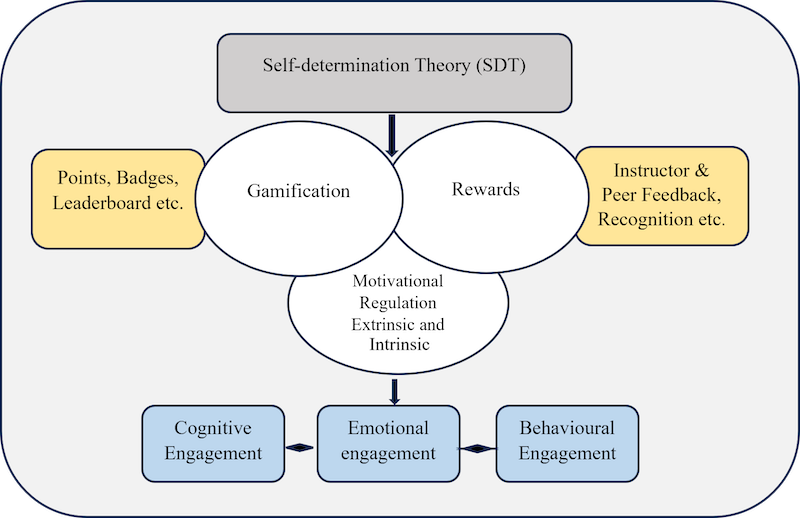
This study is based on the Self-Determination Theory (SDT) (Deci & Ryan, 1985; Ryan & Deci, 2000) which provides the theoretical foundation for this study by explaining how motivational strategies influence learner engagement through the satisfaction of three basic psychological needs: autonomy, competence, and relatedness (Ryan & Deci, 2017; Vansteenkiste et al., 2020) (Figure 1). Within this framework, gamification and rewards are conceptualised as complementary strategies. Gamification encourages participation through design elements such as points, badges, and leaderboards, whereas rewards reinforce competence and achievement when perceived as recognition of mastery rather than external control (Buckley & Doyle, 2016; Ghai & Tandon, 2022; Ryan & Deci, 2020). Accordingly, the proposed framework uses SDT to explain how these strategies jointly promote cognitive, emotional, and behavioural engagement in ODL.
Despite the explanatory potential of SDT, several gaps remain in the literature. First, gamification and rewards have predominantly been examined as independent motivational strategies, with limited attention given to their combined relationship with learner engagement. As a result, the literature provides a fragmented understanding of how these two motivational strategies operate together in ODL environments. Second, existing studies have generally focused on the direct effects of either gamification or rewards on engagement outcomes, with comparatively little evidence regarding whether reward mechanisms strengthen the engagement-enhancing role of gamification. Third, while SDT distinguishes between rewards that support competence and those perceived as controlling (Deci et al., 1999), this distinction has rarely been examined in relation to the integration of gamification and rewards within ODL contexts. Taken together, these gaps suggest that the existing studies lack a clear understanding of how gamification and reward strategies jointly contribute to sustained learner engagement in ODL environments. To address these gaps, this study draws on SDT as a theoretical lens for understanding the motivational processes underlying gamification and rewards, which were examined as complementary motivational strategies, and their relationships with learner engagement were empirically assessed through correlation and multiple regression analysis.
Two research objectives were designed to achieve the targeted goals:
RO1: To examine the relationships among gamification, rewards, and learner engagement in ODL.
RO2: To examine the predictive relationships of gamification and rewards on learner engagement in ODL.
This study employed a descriptive survey design to investigate the relationship among gamification, rewards and learner engagement in ODL contexts.
The study involved higher education students from across India who had undertaken one or more online courses while pursuing their bachelor’s, master’s, or doctoral programmes. Participants were recruited using a non-probability purposive sampling approach through a Google Forms questionnaire distributed via WhatsApp groups. Participants were eligible if they had prior experience with online learning and were actively enrolled in online courses during the study period. The sample comprised 239 students, including bachelor’s (N = 24), master’s (N = 149), and doctoral (N = 66) students. The sample included 93 male and 146 female participants, with most respondents aged 25–34 years (N = 173). Data were collected between December 2023 and January 2024 using a non-probability purposive sampling approach.
Participants reported using various online learning platforms, including SWAYAM (an Indian national platform), Udemy, and other platforms, with SWAYAM being the most frequently reported. These platforms represented participants’ prior online-learning experiences and were used by participants to undertake online courses. Regarding engagement frequency, participants reported engaging monthly, weekly, daily, and rarely, with monthly engagement being the most common.
The study used a structured questionnaire comprised of 42 items measured on a five-point Likert scale (1 = strongly disagree to 5 = strongly agree) across three main variables: student engagement (N = 12 items), gamification (N = 15 items), and rewards (N = 15 items). Gamification comprised five sub-dimensions: perceived enjoyment (N = 3 items), perceived motivation (N = 3 items), perceived feedback (N = 3 items), social interaction (N = 3 items), and perceived relevance (N = 3 items). Rewards comprised five sub-dimensions: perceived encouragement (N = 3 items), perceived recognition (N = 3 items), sense of accomplishment (N = 3 items), feedback as a reward (N = 3 items), and social rewards (N = 3 items). Student engagement comprised three sub-dimensions: behavioural engagement (N = 4 items), emotional engagement (N = 4 items), and cognitive engagement (N = 4 items).
Content Validity
Experts in Educational Technology evaluated each item for its clarity, relevance, and comprehensiveness. For the assessment of content validity, the experts rated each item using a four-point relevance scale (1 = not relevant, 4 = highly relevant). The item-level Content Validity Index (I-CVI) was calculated by dividing the number of experts who rated an item as either 3 or 4 by the total number of experts. Items that demonstrated insufficient expert consensus or raised qualitative concerns were subsequently revised to enhance their content adequacy. The scale-level Content Validity Index (S-CVI/Ave) was computed as the average of the retained item-level validity indices, yielding an S-CVI/Ave of .89, indicating an acceptable level of content validity and relevance.
Reliability Analysis
The reliability of the scale was assessed using Cronbach’s Alpha to evaluate the internal consistency of the measurement tool. The analysis was conducted using IBM SPSS (Version 20). The Cronbach’s Alpha coefficients for the key dimensions were as follows: gamification (0.820), rewards (0.753), student engagement (0.796), and its sub-dimensions, behavioural, emotional, and cognitive engagement, collectively showed an Alpha value of 0.821. All coefficients exceeded the commonly accepted threshold of 0.70, indicating a high level of reliability and internal consistency of the scale used in this study. These results confirm that the measurement scales demonstrate acceptable to good internal consistency, supporting their reliability for further statistical analysis.
Data were obtained through a structured online questionnaire developed and administered using Google Forms. The questionnaire link was distributed through WhatsApp groups to higher education students who met the eligibility criteria. Participants were eligible if they were higher education students with prior experience of online learning and were actively engaged in online courses during the study period. Information about the study’s purpose was provided within the questionnaire before participants proceeded to complete it. The data collection process was carried out over a two-month period, from December 2023 to January 2024.
Data analysis involved descriptive and inferential statistical techniques to address the research objectives. Descriptive statistics, including mean and standard deviation, were computed to summarise the distribution and variability of the study variables. To address RO1, Pearson correlation analysis was conducted to examine the relationships among gamification, rewards, and learner engagement. To address RO2, multiple regression analysis was conducted to examine the predictive contribution of gamification and rewards to learner engagement. The results of these analyses are presented in the ‘Results’ section below (Tables 1–5).
The study followed established ethical standards for educational research. Participants were provided with information about the study’s purpose, anonymity, confidentiality, voluntary participation, and informed consent within the Google Forms questionnaire before responding. Completion and submission of the questionnaire constituted informed consent, and no personally identifiable information was collected.
Descriptive statistics for the study variables are presented in Table 1 to provide an overview of the observed levels and distribution of gamification, rewards, and learner engagement in the sample. The mean score for gamification was 49.87 (SD = 8.36), indicating a relatively high perception of gamified elements. Rewards also showed a high mean score (M = 54.27, SD = 6.87). Engagement levels were moderate to high, with a mean score of 45.90 (SD = 6.53). The minimum and maximum values indicate sufficient variability across all constructs. These descriptive results provide the context for the subsequent correlation and regression analyses addressing RO1 and RO2.
Table 1: Results of Descriptive Statistics

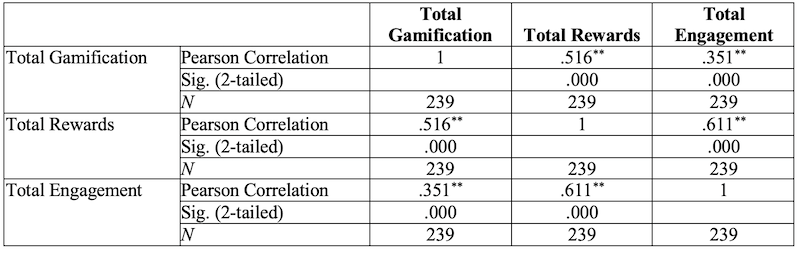
Pearson correlation analysis was conducted to examine the relationships among gamification, rewards, and engagement. As shown in Table 2, gamification was positively and significantly correlated with rewards (r = .52, p < .01) and engagement (r = .35, p < .01). Rewards also demonstrated a strong positive correlation with engagement (r = .61, p < .01). The correlations indicate that higher perceptions of gamification and rewards were associated with higher levels of learner engagement, with rewards showing the stronger association with engagement.
Table 2: Correlation Results of the Study
** Correlation is significant at the 0.01 level (2-tailed).
Multiple regression analysis was conducted to examine the predictive relationships of gamification and rewards with learner engagement. Regression analysis was employed to determine the extent to which gamification and rewards jointly explain variance in engagement and to identify the relative contribution of each predictor while controlling for the other.
As presented in Table 3, the regression model was statistically significant [F (2, 236) = 70.65, p < .001], indicating that the predictors reliably explained variation in engagement. The model yielded an R value of .61, with an R² of .38 and an adjusted R² of .37, suggesting that approximately 37.5% of the variance in total engagement was explained by total gamification and total rewards. The standard error of the estimate was 5.19, indicating an acceptable level of prediction accuracy. These findings indicate that gamification and rewards together explained a substantial proportion of the variation in learner engagement.
Table 3: Regression Model Summary

a. Predictors: (Constant), Total Rewards, Total Gamification
The ANOVA results in Table 4 indicate that the regression model is statistically significant (F = 70.65, p < .001), suggesting that the overall regression model significantly predicted learner engagement.
Table 4: ANOVAa Results for Regression Model

a. Dependent Variable: Total Engagement;
b. Predictors: (Constant), Total Rewards, Total Gamification
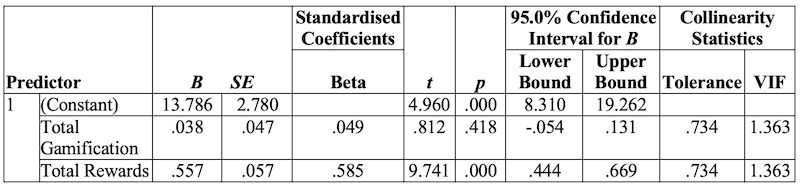
The regression coefficient results presented in Table 5 reveal that total rewards emerged as a significant positive predictor of engagement (B = .56, β = .59, t = 9.74, p < .001). This indicates that higher perceptions of rewards were associated with higher levels of learner engagement. In contrast, total gamification did not significantly predict engagement when controlling for rewards (B = .04, β = .05, t = .81, p = .418), suggesting that gamification elements alone may not independently influence engagement beyond the effect of rewards in MOOC-based and distance learning platforms. Collinearity diagnostics indicated no multicollinearity concerns (tolerance = .73; VIF = 1.36).
Table 5: Regression Coefficients Results for Learner Engagement
The findings of this study indicate that gamification and rewards were both positively associated with learner engagement, with rewards showing a comparatively stronger relationship. The positive association between gamification and engagement is consistent with research showing that game elements can support participation and engagement through badges, leaderboards, challenges, and visible progress (Saleem et al., 2022; Zainuddin et al., 2020). However, evidence indicates that the motivational value of gamification varies according to the design of game elements and the context in which they are experienced (Kiili & Dindar, 2026; Kyewski & Krämer, 2018; Li et al., 2024; Mekler et al., 2017; Sailer et al., 2026). Thus, the present findings should not be interpreted as evidence that gamification is inherently motivational; rather, its association with engagement may depend on how gamified elements are experienced within the learning environment. The stronger rewards-engagement relationship further suggests that integrating rewards with gamification may support sustained learner engagement.
Building on the correlational findings, the regression analysis showed that rewards significantly predicted learner engagement, whereas gamification did not make a significant independent contribution when both predictors were considered simultaneously. The stronger contribution of rewards is consistent with research highlighting their role in supporting learner motivation, effort, and persistence (Balconi & Vanutelli, 2018; Clay et al., 2022; Duan et al., 2020). The findings further suggest that integrating meaningful rewards, including recognition, feedback, accomplishment, and social reinforcement, with gamification may provide a stronger motivational basis for engagement than game mechanics alone. Prior evidence similarly highlights the role of meaningful feedback, autonomy, collaboration, and instructional facilitation in strengthening gamification’s motivational impact (Sappaile et al., 2026).
The findings provide insight into SDT (Deci & Ryan, 1985; Ryan & Deci, 2000) by distinguishing the motivational role of gamification and rewards in learner engagement. The results indicate that reward experiences may play a more salient role than gamification alone. Rather than treating gamification and rewards separately, the findings suggest that they may function as complementary strategies, with gamification providing a structural context for engagement and meaningful reward experiences offering greater motivational relevance. Implications in Relation to Prior Research
The findings support and extend prior research on gamification and rewards in online learning. The limited independent contribution of gamification after accounting for rewards is consistent with evidence that badges, points, and leaderboards can produce limited or inconsistent effects on intrinsic motivation. By demonstrating a stronger independent contribution of rewards than gamification to learner engagement, the study highlights the importance of considering reward experiences alongside game mechanics when explaining engagement.
The findings of this study have significant implications for the integrated use of gamification and rewards in ODL. For instructional design, gamified elements should therefore be linked to meaningful rewards, including recognition, constructive feedback, accomplishment, and opportunities for learner choice, rather than be treated as standalone engagement mechanisms. At the institutional and policy level, ODL quality standards and learning-technology decisions should evaluate not only the availability of gamification features but also how these features are connected to meaningful feedback, recognition, learner choice, and social interaction. Professional development for online educators should similarly address the pedagogical design of reward mechanisms alongside the technical use of gamification.
This study has several limitations. The descriptive survey design may be subject to response bias and limit causal interpretation. The purposive sampling approach may also constrain generalisability across broader educational contexts. Further, the sample comprised only higher education learners, limiting applicability to school-level and other educational settings. Future research may address these limitations by:
In addition, future studies could examine potential mediating and moderating factors, including environmental and institutional conditions, to clarify the mechanisms and contextual influences.
Balconi, M., & Vanutelli, M.E. (2018). Functional EEG connectivity during competition. BMC Neuroscience, 19(1), Article 63. https://doi.org/10.1186/s12868-018-0464-6
Bovermann, K., & Bastiaens, T.J. (2020). Towards a motivational design? Connecting gamification user types and online learning activities. Research and Practice in Technology Enhanced Learning, 15, Article 1. https://doi.org/10.1186/s41039-019-0121-4
Buckley, P., & Doyle, E. (2016). Gamification and student motivation. Interactive Learning Environments, 24(6), 1162–1175. https://doi.org/10.1080/10494820.2014.964263
Cameron, J., Pierce, W.D., Banko, K.M., & Gear, A. (2005). Achievement-based rewards and intrinsic motivation: A test of cognitive mediators. Journal of Educational Psychology, 97(4), 641–655. https://doi.org/10.1037/0022-0663.97.4.641
Chan, E., Nah, F.F-H., Liu, Q., & Lu, Z. (2018). Effect of gamification on intrinsic motivation. In HCI in business, government, and organizations: 5th International Conference, HCIBGO 2018, Las Vegas, NV, USA, July 15–20, 2018, Proceedings (Vol. 10923, pp. 445–454). Springer. https://doi.org/10.1007/978-3-319-91716-0_35
Chang, J-W., & Wei, H-Y. (2016). Exploring engaging gamification mechanics in Massive Online Open Courses. Educational Technology & Society, 19(2), 177–203. https://doi.org/10.2307/jeductechsoci.19.2.177
Clay, G., Mlynski, C., Korb, F.M., Goschke, T., & Job, V. (2022). Rewarding cognitive effort increases the intrinsic value of mental labor. Proceedings of the National Academy of Sciences, 119(5), Article e2111785119. https://doi.org/10.1073/pnas.2111785119
Deci, E.L., Koestner, R., & Ryan, R.M. (1999). A meta-analytic review of experiments examining the effects of extrinsic rewards on intrinsic motivation. Psychological Bulletin, 125(6), 627–668. https://doi.org/10.1037/0033-2909.125.6.627
Deci, E.L., & Ryan, R.M. (1985). Intrinsic motivation and self-determination in human behavior. Springer.
Deterding, S., Dixon, D., Khaled, R., & Nacke, L. (2011). From game design elements to gamefulness: Defining “Gamification.” In Proceedings of the 15th International Academic MindTrek Conference: Envisioning Future Media Environments, 9–15.
Duan, H., Fernández, G., van Dongen, E., & Kohn, N. (2020). The effect of intrinsic and extrinsic motivation on memory formation: Insight from behavioral and imaging study. Brain Structure and Function, 225(5), 1561–1574. https://doi.org/10.1007/s00429-020-02074-x
García-López, I.M., Acosta-Gonzaga, E., & Ruiz-Ledesma, E.F. (2023). Investigating the impact of gamification on student motivation, engagement, and performance. Education Sciences, 13(8), Article 813. https://doi.org/10.3390/educsci13080813
Gee, J.P. (2003). Opportunity to learn: A language-based perspective on assessment. Assessment in Education: Principles, Policy & Practice, 10(1), 27–46. https://doi.org/10.1080/09695940301696
Ghai, A., & Tandon, U. (2022). Integrating gamification and instructional design to enhance usability of online learning. Education and Information Technologies, 28(2), 2187–2206. https://doi.org/10.1007/s10639-022-11202-5
Harackiewicz, J.M. (2011). I can’t explain. In R.M. Arkin (Ed.), Most underappreciated: 50 prominent social psychologists describe their most unloved work (pp. 185–187). Oxford University Press. https://doi.org/10.1093/acprof:osobl/9780199778188.003.0036
Hew, K.F. (2016). Promoting engagement in online courses: What strategies can we learn from three highly rated MOOCs. British Journal of Educational Technology, 47(2), 320–341. https://doi.org/10.1111/bjet.12235
Hidi, S. (2016). Revisiting the role of rewards in motivation and learning: Implications of neuroscientific research. Educational Psychology Review, 28(1), 61–93. https://doi.org/10.1007/s10648-015-9307-5
Jurczyk, V., Fröber, K., & Dreisbach, G. (2019). Increasing reward prospect motivates switching to the more difficult task. Motivation Science, 5(4), 295–313. https://doi.org/10.1037/mot0000119
Kamunya, S., Maina, E., & Oboko, R. (2019). A gamification model for e-learning platforms. Proceedings of the IST-Africa Week Conference (IST-Africa 2019), 1–9. https://ir-library.ku.ac.ke/server/api/core/bitstreams/941da63b-1469-4730-9f97-c376b1fd7800/content
Kiili, K., & Dindar, M. (2026). Advancing gameful learning research: Insights on instructional design, learner engagement, and analytical approaches. Learning and Individual Differences, 129, 102951. https://doi.org/10.1016/j.lindif.2026.102951
Kyewski, E., & Krämer, N.C. (2018). To gamify or not to gamify? An experimental field study of the influence of badges on motivation, activity, and performance in an online learning course. Computers & Education, 118, 25–37. https://doi.org/10.1016/j.compedu.2017.11.006
Li, L., Hew, K.F., & Du, J. (2024). Gamification enhances student intrinsic motivation, perceptions of autonomy and relatedness, but minimal impact on competency: A meta-analysis and systematic review. Educational Technology Research and Development, 72(2), 765–796. https://doi.org/10.1007/s11423-023-10337-7
Mekler, E.D., Brühlmann, F., Tuch, A.N., & Opwis, K. (2017). Towards understanding the effects of individual gamification elements on intrinsic motivation and performance. Computers in Human Behavior, 71, 525–534. https://doi.org/10.1016/j.chb.2015.08.048
Mishra, R., & Kotecha, K. (2017). Students’ engagement through gamification in education: Gamifying formative assessment. Journal of Engineering Education Transformations, 30(Special Issue), 199–204. https://doi.org/10.16920/jeet/2017/v0i0/111751
Núñez, M.M., Gené, O.B., & Blanco, Á.F. (2014). Social community in MOOCs: Practical implications and outcomes. In ACM International Conference Proceeding Series (pp. 147–154). https://doi.org/10.1145/2669711.2669893
Reiss, S. (2005). Extrinsic and intrinsic motivation at 30: Unresolved scientific issues. The Behavior Analyst, 28(1), 1–14. https://eric.ed.gov/?id=EJ752373
Reiss, S. (2011). The 40-year debate on motivation. Psychology Today.
Rutkauskiene, D., Gudoniene, D., Maskeliunas, R., & Blazauskas, T. (2016). The gamification model for e-learning participants engagement. In Smart Innovation, Systems and Technologies (Vol. 59, pp. 291–301). Springer. https://doi.org/10.1007/978-3-319-39690-3_26
Ryan, R.M., & Deci, E.L. (2017). Self-determination theory: Basic psychological needs in motivation, development, and wellness. Guilford Press.
Ryan, R.M., & Deci, E.L. (2000). Intrinsic and extrinsic motivations: Classic definitions and new directions. Contemporary Educational Psychology, 25(1), 54–67. https://doi.org/10.1006/ceps.1999.1020
Ryan, R.M., & Deci, E.L. (2020). Intrinsic and extrinsic motivation from a self-determination theory perspective: Definitions, theory, practices, and future directions. Contemporary Educational Psychology, 61, Article 101860. https://doi.org/10.1016/j.cedpsych.2020.101860
Sailer, M., Ninaus, M., & Greiff, S. (2026). Gamification of learning and instruction – Learning processes and individual differences. Learning and Individual Differences, 130, 102965. https://doi.org/10.1016/j.lindif.2026.102965
Saleem, A.N., Noori, N.M., & Ozdamli, F. (2022). Gamification applications in e-learning: A literature review. Technology, Knowledge and Learning, 27(1), 139–159. https://doi.org/10.1007/s10758-020-09487-x
Sappaile, B.I., Chan, R., & Tan, M. (2026). Gamification and student motivation: Evaluating eLearning engagement from an educational psychology perspective. Journal Neosantara Hybrid Learning, 4(2), 176–193.
Schultz, W. (2006). Behavioral theories and the neurophysiology of reward. Annual Review of Psychology, 57, 87–115. https://doi.org/10.1146/annurev.psych.56.091103.070229
Subramanian, K., & Budhrani, K. (2020). Influence of course design on student engagement and motivation in an online course. In SIGCSE 2020: Proceedings of the 51st ACM Technical Symposium on Computer Science Education (pp. 303–308). https://doi.org/10.1145/3328778.3366828
Vansteenkiste, M., Ryan, R.M., & Soenens, B. (2020). Basic psychological need theory: Advancements, critical themes, and future directions. Motivation and Emotion, 44, 1–31. https://doi.org/10.1007/s11031-019-09818-1
Wang, Y., & Baker, R. (2015). Content or platform: Why do students complete MOOCs? MERLOT Journal of Online Learning and Teaching, 11(1). https://learninganalytics.upenn.edu/ryanbaker/Wang-Merlot-JOLT.pdf
Wüster, M., & Ebner, M. (2016). How to integrate and automatically issue open badges in MOOC platforms. In Proceedings of the European Stakeholder Summit on Experiences and Best Practices in and around MOOCs (EMOOCS 2016) (pp. 279–286).
Zainuddin, Z., Chu, S.K.W., Shujahat, M., & Perera, C.J. (2020). The impact of gamification on learning and instruction: A systematic review of empirical evidence. Educational Research Review, 30, 100326. https://doi.org/10.1016/j.edurev.2020.100326
Author Notes
Runu Mani Das is a PhD research scholar in the Department of Education and Education Technology, School of Social Sciences, University of Hyderabad, India. Her research interests include online learning, the community of inquiry model, augmented reality, mixed reality, bibliometric analysis, and the systematic review method. She has published articles and papers in reputable journals and has presented research at various conferences. Email: 20semd04@uohyd.ac.in (https://orcid.org/0000-0003-0583-7603)
J.V. Madhusudan is a professor in the Department of Education and Education Technology, School of Social Sciences, University of Hyderabad, India. He is an expert in the areas of demography of schooling, educational technology, health education and the sociology of education. He has published several articles and papers in reputable journals and is the member of the 14th Educational Research and Innovations Committee (ERIC) of the National Council of Educational Research and Training (NCERT) to advise on planning, identifying and supporting basic research, as well as research and innovations in the field of school education and teacher education. Email: madhusudanjv@uohyd.ac.in (https://orcid.org/0000-0002-6582-0152)
Cite as: Das, R.M., & Madhusudan, J.V. (2026). Effectiveness of integration of gamification and rewards for learner engagement in online and distance learning contexts. Journal of Learning for Development, 13(4), 593-604.
DOI: https://doi.org/10.56059/dhye8e61