Vasiliki Christoforou
2026 VOL. 13, No. 3
Abstract: This case study examined an educational intervention in a Greek primary school integrating Human Rights Education (HRE) and Sustainable Development Goals (SDGs) via Scratch. Over five sessions, 17 sixth-graders, including students with learning difficulties, collaboratively modified a pre-designed Scratch game to express social justice messages. Guided by research objectives on Computational Thinking (CT), inclusive participation, and critical human rights consciousness, data from participatory observation, digital artefacts, and student reflections were interpreted through qualitative thematic analysis. Grounded in constructionist theory, the project demonstrates how multimodal digital storytelling fosters inclusive participation and critical awareness of global issues. By employing freely available tools, the study highlights pedagogical strategies for equitable citizenship education and offers practical implications for Open and Distance Learning (ODL). Findings reveal that accessible technology empowers young learners — including those with disabilities — as active digital authors, providing a scalable framework for values-based coding in inclusive settings.
Keywords: Sustainable Development Goals, Human Rights Education, Scratch programming, digital storytelling, primary education
In a 21st-century landscape marked by rapid technological change and social tensions, identifying the transversal skills students need for future citizenship is a key challenge for primary education (Silva et al., 2021). Human Rights Education (HRE) and inclusive digital pedagogy share the goal of student empowerment. HRE equips learners with the knowledge and attitudes needed to recognise and respond to injustice while promoting human dignity and equality (UNESCO, 2023). This case study presents a project in a Greek primary school aimed at introducing young learners to core concepts of human rights and the Sustainable Development Goals (SDGs) through discussion, digital creativity, and collaborative problem-solving. By adapting an existing Scratch game, students explored issues of gender equality, quality education, and reduced inequalities — three goals central to UNESCO’s vision of Education for Sustainable Development (ESD) (UNESCO, 2017, 2020). The initiative responds to the urgent call for structural transformations in education by addressing the risks and opportunities posed by emerging technologies while fostering a fundamental shift towards sustainable development (UNESCO, 2020). The project also demonstrates how a classroom teacher without specialist training can integrate global citizenship topics using freely available digital tools (Resnick & the Scratch Team, 2009), an approach relevant to scalable and cost-effective practices in Open and Distance Learning (ODL). Human Rights Education and global citizenship values are encouraged within the Greek curriculum, though practical implementation varies widely. In particular, the integration of HRE through programming remains limited (Struthers, 2017; Tsikalakis et al., 2023).
While computer programming is increasingly introduced in primary curricula to foster Computational Thinking (CT), the specific educational objectives often remain restricted to technical competence rather than broader cognitive domains (Fagerlund et al., 2021). Recent research (2021-2026) highlights that technology-enhanced inclusive education requires more than administrative adjustments; it demands pedagogical approaches that facilitate “critical creation” and meaningful interaction (Navas-Bonilla et al., 2025). However, a significant research gap exists regarding the use of block-based programming as a medium for “praxis” in HRE, as current primary education often leans towards didactic rote learning, failing to empower students as human rights activists (Struthers, 2017). Furthermore, emerging literature identifies a “theoretical fragmentation” in the integration of CT for students with disabilities, noting that interventions often focus on tools rather than how CT itself is conceptualised and adapted to diverse educational needs (Cecchetti & Granone, 2026). Although interactive communication is recognised as central — not merely supportive — to equitable literacy in inclusive settings (Amalia et al., 2025), there is limited empirical evidence on its function within creative digital environments. This case study addresses these gaps by exploring the transformative potential of digital storytelling as a pathway for students to reinterpret global challenges through a disability-sensitive lens (Anrango Yacelga & Sacoto Loor, 2026; Cecchetti & Granone, 2026).
The project draws on constructionist learning theory, which suggests that students learn most effectively when they create meaningful digital artefacts (Butler & Leahy, 2021). By engaging in programming, students develop CT, which involves practices such as abstraction, problem decomposition, and algorithmic reasoning that support complex problem solving (Fagerlund et al., 2021; Levin et al., 2025).
Scratch’s block-based design lowers technical barriers and enables young learners to move from being passive technology users to active digital creators (Montiel & Gomez-Zermeño, 2021; Resnick & the Scratch Team, 2009). This approach aligns with the goals of HRE (Struthers, 2017). By constructing their own digital versions of the SDGs, students use code as a “partner-to-think-with” to reinterpret global challenges through their own cultural and ethical lenses (Levin et al., 2025; Tsikalakis et al., 2023). Furthermore, block-based programming fosters inclusive participation by bridging the “digital divide” for diverse learners, providing multimodal learning pathways and an “emotionally safe” environment where error is viewed as a natural part of the learning process (Amalia et al., 2025; Anagnostopoulou et al., 2021; Anrango Yacelga & Sacoto Loor, 2026). In this context, the teacher acts not merely as an instructor but as an “accessibility mediator,” facilitating participation across cognitive and communicative domains (Cecchetti & Granone, 2026).
This project follows a transformative pedagogy that moves beyond “banking education” by encouraging student agency through the creation of digital artefacts that express perspectives on justice and equality (Struthers, 2017). The case study therefore explored how a classroom-based Scratch project can support the integration of HRE and SDG awareness in an inclusive primary school setting, while offering insights for scalable practices in ODL environments.
To fulfill the requirement for a research-based critical case, the study was guided by the following objectives:
This study adopted a qualitative case study design (Butler & Leahy, 2021) to investigate the integration of HRE and SDGs through creative programming. The methodology followed the paradigm of “systematisation of experiences,” defined as a participatory, critical, and reflective process aimed at reconstructing and re-signifying pedagogical practices (Anrango Yacelga & Sacoto Loor, 2026). Grounded in constructionist learning theory, the research examined how digital artefacts created by students serve as “objects-to-think-with” for exploring complex social justice themes (Butler & Leahy, 2021; Levin et al., 2025). By focusing on “critical creation,” the methodology moved beyond descriptive reporting to a research-based analysis of how students transition from passive technology users to active digital authors of social justice messages (Navas-Bonilla et al., 2025).
The project utilised a purposive sampling method (Asmayawati et al., 2024) to select a representative environment for inclusive digital pedagogy. The intervention was implemented at the 38th Primary School of Larissa, a public urban school in Central Greece. The sample consisted of 17 sixth-grade students (aged 11-12) from diverse socio-economic backgrounds, including three students with diagnosed learning difficulties such as Attention Deficit Hyperactivity Disorder (ADHD) and dyslexia. Consistent with inclusive education principles, learner diversity was viewed as a strength that enriches the learning process through adaptive teaching strategies (Amalia et al., 2025; Cecchetti & Granone, 2026). Limited technological resources (four tablets and an interactive whiteboard) necessitated collaborative group-based work as a fundamental pedagogical condition for the intervention.
To ensure scholarly rigour and interpretative validity, the study employed data triangulation, cross-referencing multiple evidence sources (Amalia et al., 2025; Anrango Yacelga & Sacoto Loor, 2026):
Reliability was strengthened through iterative thematic coding of these materials to ensure consistent interpretation of patterns over time (Fagerlund et al., 2021). Interpretative validity was maintained through “member checks” (Amalia et al., 2025) and by situating findings within established international HRE success factors and Universal Design for Learning (UDL) principles (Navas-Bonilla et al., 2025; UNESCO, 2023).
To ensure analytical transparency, each research objective (RO) was addressed through specific evidence sources and analytical procedures linked to the five-session procedure.
RO1 (Computational Thinking) was investigated primarily through systematic artefact analysis of the Scratch modifications produced in Session 3. Successive versions of the projects were examined using the CEPs framework (Fagerlund et al., 2021) to identify patterns of abstraction, decomposition and algorithmic reasoning.
RO2 (Inclusive participation) was examined through participatory observation conducted across all five sessions, with particular attention to the implementation and effects of interactive communication strategies (visual cues, simplified language and choice-based questioning) on students with special educational needs.
RO3 (Critical human rights consciousness) was evaluated through thematic analysis of the reflective data collected in Sessions 4 and 5 (written rationales, group concept maps and anonymised audio recordings).
Reliability was strengthened through iterative thematic coding of these materials, while interpretative validity was supported by member checks and triangulation across the three data sources (Amalia et al., 2025; Cecchetti & Granone, 2026; Fagerlund et al., 2021; Navas-Bonilla et al., 2025).
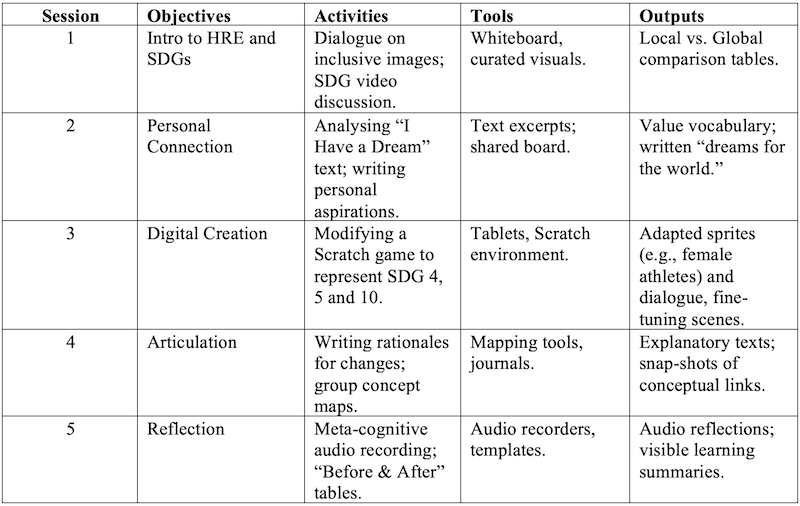
The intervention followed a structured implementation over five 45-minute sessions (Table 1), designed to shift agency from the teacher to the students (Tsikalakis et al., 2023).
Table 1: Session-by-Session Learning Sequence
Data collection was organised as follows:
Strict ethical standards for research with minors were maintained. Informed parental consent was obtained for all 17 participants, adhering to ethical research protocols (Asmayawati et al., 2024; UNESCO, 2023). Consistent with international guidelines, all student work, artefacts, and audio recordings were fully anonymised to protect the children’s privacy. Data were compiled and stored in a secure, encrypted environment, ensuring the confidentiality and protection of the participants throughout the study.
The results are presented according to the three research objectives. For each objective, the analysis draws explicitly on the corresponding data sources and session phases identified in the Methods section, thereby ensuring a transparent link between the research design and the findings.
To address RO1, the analysis focused on the digital artefacts produced in Session 3. Student-created Scratch modifications were examined using the CEPs framework (Fagerlund et al., 2021) to identify patterns of abstraction, decomposition and algorithmic reasoning. Evidence of CT emerged not primarily as technical mastery, but as a process of “critical creation” in which students decomposed complex global goals into manageable narrative elements (Navas-Bonilla et al., 2025).
Analysis of successive versions of the Scratch projects showed that students systematically broke down SDG 5 into concrete interactive scenes. One group, for example, added a female sprite to a sports-oriented scene and rewrote the dialogue so that the character could actively participate. During the modification process, students repeatedly paused to evaluate the ethical implications of their design choices, asking questions such as “Does this look fair?” and “What message are we giving?” These verbal exchanges, recorded through participatory observation, indicate that design decisions were treated as value-laden rather than purely technical. In this way, abstraction was used not only to simplify code, but to represent social justice values through digital means (Montiel & Gomez-Zermeño, 2021).
These findings extend previous research on Scratch and sustainability (Tsikalakis et al., 2023) by demonstrating that even basic block-based modifications can support the articulation of values when the task is deliberately framed around social justice rather than technical competence alone. Unlike studies that primarily categorise student projects according to technical complexity or genre progression (Funke et al., 2017), the present analysis reveals that Scratch can function as a pedagogical medium for ethical reasoning. The Scratch environment functioned as a “partner-to-think-with,” facilitating a shift from understanding code syntax to using code as a medium for ethical decision-making (Levin et al., 2025). This aligns with recent calls for moving computational thinking beyond narrow technical objectives towards broader cognitive and civic domains (Fagerlund et al., 2021; Levin et al., 2025). In doing so, the modification process confirmed that Scratch functions as a robust resource for inclusive reasoning, addressing the theoretical fragmentation often found in CT education (Cecchetti & Granone, 2026). The systematic saving of artefact versions across Session 3 further allowed the tracking of iterative refinement, showing that students progressively refined both the technical structure and the social message of their projects.
RO2 was addressed primarily through participatory observation conducted across all five sessions, with particular attention to Sessions 3-5. The observation focused on how interactive communication strategies (visual cues, simplified language and choice-based questioning) influenced the participation and self-confidence of students with SEN.
Observational data indicated that these strategies functioned as “accessibility mediators” (Anagnostopoulou et al., 2021; Cecchetti & Granone, 2026). A clear illustration emerged in the case of a student with diagnosed learning difficulties who typically remained passive during written tasks. During the digital modification phase (Session 3), this student assumed a leadership role, directing peers on sprite placement and dialogue changes. In a subsequent audio reflection the student stated: “I could show the idea better with the pictures than with writing.” This shift suggests that the multimodal nature of the Scratch task, combined with teacher scaffolding, enabled the student to participate across cognitive and communicative domains on a more equal basis with peers (Amalia et al., 2025; Navas-Bonilla et al., 2025).
Such evidence supports recent claims that Scratch can function as an inclusive digital resource when pedagogical mediation prioritises multiple modes of expression rather than written output alone (Anrango Yacelga & Sacoto Loor, 2026). It also responds directly to the theoretical fragmentation identified by Cecchetti and Granone (2026), who note that many CT interventions for students with disabilities focus on tools rather than on how CT itself is pedagogically adapted. In the present case, the combination of visual scaffolding and choice-based questioning appears to have operated as a robust accessibility mediator, enabling a student with learning difficulties to move from peripheral to central participation. The observational findings therefore indicate that interactive communication strategies had a tangible positive impact on both participation and self-efficacy among students with SEN. This impact was particularly visible in the transition from Sessions 1-2 (discussion-based) to Session 3 (digital production), where the same student moved from limited verbal contribution to active leadership in group decision-making.
RO3 was evaluated through the reflective data collected in Sessions 4 and 5 (written rationales, group concept maps and anonymised audio recordings). These materials were organised into a session-by-session matrix and analysed thematically to trace the transition from technology consumption to “critical creation” (Navas-Bonilla et al., 2025).
Student reflections revealed a clear movement from abstract knowledge of rights toward contextualised understanding and personal positioning. On SDG 5, one student stated:
SDG5 promotes the right to gender equality. In our daily lives, equality between boys and girls does not always exist. For example, when I express an opinion about football, I am told that I am a girl and should not be involved. We want, in the future, for there to be equality and respect between the two genders.
This statement illustrates not merely awareness of a global goal, but the capacity to identify gender-based exclusion in everyday life — a form of praxis that goes beyond traditional didactic approaches to HRE (Struthers, 2017). Rather than reproducing abstract definitions, the student recontextualised SDG 5 within personal experience, demonstrating the kind of critical consciousness that transformative HRE seeks to cultivate.
In relation to SDG 4, students added a refugee parent standing outside the school and explained:
We added the mother of a refugee student standing outside the school. She felt awkward because she was of a different race and believed she wouldn’t be treated as an equal. We believe that according to SDG4, not only children but also parents should have access to the school environment.
This design choice and accompanying rationale demonstrate perspective-taking and an expanded conception of quality education. By extending the notion of inclusion beyond the child to the family, students moved from a narrow understanding of access to a more systemic reading of educational equity.
Finally, group reflections on SDG 10 showed a conceptual shift from limited prior knowledge to critical questioning of local inequalities:
We didn’t know that the SDGs existed – We didn’t know there were so many rights – We thought there weren’t so many inequalities in the world – We learnt that we all have rights but also obligations – which sometimes are not respected – How do people in wheelchairs even move around on these broken sidewalks?
These statements indicate that the Scratch-mediated process enabled students to connect global frameworks to concrete local injustices in their own community. This finding extends previous research on CT and disabilities (Cecchetti & Granone, 2026) and on inclusive digital storytelling (Anrango Yacelga & Sacoto Loor, 2026) by showing how multimodal creation can foster critical human rights consciousness even among young learners with diverse needs. The progression from the initial awareness activities in Sessions 1-2 to the reflective outputs of Sessions 4-5 further demonstrates that the structured sequence of the intervention supported a gradual deepening of students’ critical awareness. Overall, the reflective data suggest that when students move from consumers to producers of digital messages about justice, they develop a more agentic and situated understanding of human rights — a central goal of transformative HRE (Struthers, 2017; UNESCO, 2023).
This case study demonstrates that the integration of digital storytelling with block-based programming offers a potent, non-technical pathway for primary learners to engage with complex human rights and SDG themes. Beyond technical skill acquisition, the project highlights how Scratch functions as an “object-to-think-with” (Levin et al., 2025), facilitating a constructionist environment in which interactive communication strategies act as “accessibility mediators” (Amalia et al., 2025; Cecchetti & Granone, 2026). In contrast to studies that treat Scratch primarily as a tool for developing programming skills or general creativity (Fagerlund et al., 2021; Funke et al., 2017; Montiel & Gomez-Zermeño, 2021), the present findings show that even basic block-based modifications can support the articulation of social justice messages when the task is deliberately framed around human rights and the SDGs. Moreover, the observed leadership of a student with learning difficulties during digital creation extends recent work on Scratch and inclusion (Anagnostopoulou et al., 2021; Anrango Yacelga & Sacoto Loor, 2026) by providing classroom-based evidence from a Greek primary setting. Taken together, these results address the research gap identified in the literature review concerning the limited empirical evidence on block-based programming as a medium for HRE praxis (Struthers, 2017), and respond to the theoretical fragmentation noted by Cecchetti and Granone (2026) regarding CT and disability.
While previous research often focused on the technical mastery of CT (Fagerlund et al., 2021), this study contributes an additional dimension by positioning CT as a medium for ethical reasoning and “critical creation” (Navas-Bonilla et al., 2025). In contrast to studies that treat Scratch primarily as a tool for developing programming skills or general creativity (Funke et al., 2017; Montiel & Gomez-Zermeño, 2021), the present findings show that even basic block-based modifications can support the articulation of social justice messages when the task is deliberately framed around human rights and the SDGs.
Importantly, this study addresses the research gap identified in the literature review concerning the limited empirical evidence on block-based programming as a medium for HRE praxis (Struthers, 2017). The observed ability of students to connect global goals (such as SDG 10) to local infrastructure inequalities further validates the transformative potential of HRE when combined with constructionist digital practices (UNESCO, 2023).
The results offer critical implications for educational policy and the design of ODL environments:
The original contribution of this study lies in providing empirical evidence that a short-duration, classroom-based Scratch intervention — conceptualised and implemented by a non-specialist teacher — can effectively bridge CT with inclusive participation and the emergence of critical human rights consciousness. Unlike previous studies that categorised student projects primarily by technical complexity or genre evolution (Funke et al., 2017), this research demonstrates how block-based programming serves as a “pedagogical medium” for “critical creation,” allowing students to move beyond passive technology use to become active “digital authors” of social justice messages (Navas-Bonilla et al., 2025). Furthermore, while traditional HRE often relies on didactic delivery, this study confirms that the combination of interactive communication strategies and constructionist practices acts as a catalyst for social empowerment. The evidence suggests that when diversity is treated as a strength, students with SEN can assume leadership roles in digital tasks, effectively bridging the “digital divide” (Amalia et al., 2025; Anagnostopoulou et al., 2021). These results reinforce the findings of Anagnostopoulou et al. (2021) regarding the effectiveness of digital tools for inclusion, while also providing tangible artefacts from an authentic Greek classroom setting. In doing so, the study directly addresses the theoretical fragmentation noted by Cecchetti and Granone (2026) regarding CT and disability, highlighting that pedagogical mediation through visual cues and choice-based questioning functions as a robust “accessibility mediator” for inclusive literacy (Amalia et al., 2025; Anrango Yacelga & Sacoto Loor, 2026; Cecchetti & Granone, 2026).
As this was an illustrative single-classroom case study, future research should explore the longitudinal impact of digital storytelling on students’ sustained “transformative praxis” and active citizenship (Struthers, 2017). A critical frontier for future inquiry is the transferability of this framework into diverse ODL settings, particularly focusing on how inclusive digital pedagogy can be maintained in low-bandwidth environments with limited device access (Navas-Bonilla et al., 2025; Tsikalakis et al., 2023). Finally, future research could also explore how emerging digital tools, including generative AI, might further support collaborative creation of social justice narratives and amplify student voice in distributed learning environments (Levin et al., 2025).
Amalia, E., Purwanta, E., Purbani, W., Kharisma, N.V.E., & Mufidah, Z.R. (2025). Interactive communication strategies to support the implementation of multidimensional literacy and language education in inclusive settings for achieving Sustainable Development Goals (SDGs). International Journal of Language Education, 9(3), 619-631. https://doi.org/10.26858/ijole.v1i1.77400
Anagnostopoulou, P., Lorentzou, G., & Drigas, A.S. (2021). ICTs in inclusive education for learning disabilities. Research, Society and Development, 10(9), e43410918230. http://dx.doi.org/10.33448/rsd-v10i9.18230
Anrango Yacelga, I., & Sacoto Loor, J. (2026). Accessible digital resources in Scratch to support inclusive learning. Revista InveCom, 6(2), e602038. https://doi.org/10.5281/zenodo.15875336
Asmayawati, Yufiarti, & Yetti, E. (2024). Pedagogical innovation and curricular adaptation in enhancing digital literacy: A local wisdom approach for sustainable development in Indonesia context. Journal of Open Innovation: Technology, Market, and Complexity, 10(1), 100233. https://doi.org/10.1016/j.joitmc.2024.100233
Butler, D., & Leahy, M. (2021). Developing preservice teachers' understanding of computational thinking: A constructionist approach. British Journal of Educational Technology, 52(3), 1060-1077. https://doi.org/10.1111/bjet.13090
Cecchetti, S., & Granone, F. (2026). Mapping emerging research on computational thinking and disabilities in early childhood and primary education. Frontiers in Education, 11, Article 1898052. https://doi.org/10.3389/feduc.2026.1898052
Fagerlund, J., Häkkinen, P., Vesisenaho, M., &Viiri, J. (2021). Computational thinking in programming with Scratch in primary schools: A systematic review. Computer Applications in Engineering Education, 29(1), 12-28, https://doi.org/10.1002/cae.22255
Funke, A., Geldreich, K., & Hubwieser, P. (2017). Analysis of Scratch projects of an introductory programming course for primary school students. In Proceedings of the IEEE Global Engineering Education Conference (EDUCON 2017), (pp. 1114-1121). https://doi.org/10.1109/EDUCON.2017.7943005
Levin, I., Semenov, A.L., & Gorsky, M. (2025). Smart learning in the 21st century: Advancing constructionism across three digital epochs. Education Sciences, 15(1), 45. https://doi.org/10.3390/educsci15010045
Montiel, H., & Gomez-Zermeño, M.G. (2021). Educational challenges for computational thinking in K-12 education: A systematic literature review of “Scratch” as an innovative programming tool. Computers, 10(6), 69. https://doi.org/10.3390/computers10060069
Navas-Bonilla, C.R., Guerra-Arango, J.A., Oviedo-Guado, D.A., & Murillo-Noriega, D.E. (2025). Inclusive education through technology: a systematic review of types, tools and characteristics. Frontiers in Education, 10, 1527851. https://doi.org/10.3389/feduc.2025.1527851
Resnick, M., & the Scratch Team. (2009). Scratch: Programming for all. Communications of the ACM, 52(11) (pp. 60-67). https://doi.org/10.1145/1592761.1592779
Scratch. (n.d.). Choose right — Defend human rights! Scratch. https://scratch.mit.edu/projects/1203596359
Silva, R., Fonseca, B., Costa, C., & Martins, F. (2021). Fostering computational thinking skills: A didactic proposal for elementary school grades. Education Sciences, 11(9), 518. https://doi.org/10.3390/educsci11090518
Struthers, A.E.C. (2017). The underdeveloped transformative potential of human rights education: English primary education as a case study. Journal of Human Rights Practice, 9(1), 68-84. https://doi.org/10.1093/jhuman/huw023
Tsikalakis, G., Neofotistou, E., Kontogiannakis, E., Pau, A-M., Caglayan, M.E., Fernández-Canez, R., & Pérez-Accino, M. (2023). Sustainable development as an education tool for primary school students through SCRATCH code. E3S Web of Conferences, 436, 06007. https://doi.org/10.1051/e3sconf/202343606007
UNESCO (2017). Education for Sustainable Development Goals: Learning objectives. UNESCO Publishing. https://unesdoc.unesco.org/ark:/48223/pf0000247444
UNESCO (2020). Education for sustainable development: A roadmap. UNESCO Publishing. https://unesdoc.unesco.org/ark:/48223/pf0000374802
UNESCO (2023). Human rights education—Key success factors. UNESCO Publishing. https://unesdoc.unesco.org/ark:/48223/pf0000388382
Author Notes
Vasiliki Christoforou is a primary school teacher at the 38th Primary School of Larissa, Greece. She holds degrees in Agronomy and Pedagogy from the Aristotle University of Thessaloniki. Her work focuses on inclusive digital pedagogy, computational thinking, and Human-Centered Artificial Intelligence (AI) in education. She serves as Ambassador for Human-Centered AI in Education at the Laboratory of Advanced Learning Technologies in Lifelong and Distance Education (E.D.I.V.E.A.), Department of Primary Education, University of Crete, and has contributed teaching scenarios to European and national educational repositories. Email: vchristofo@gmail.com (https://orcid.org/0009-0000-3552-9260)
Cite as: Christoforou, V. (2026). Integrating human rights and Sustainable Development Goals through scratch programming: A case study from a Greek elementary school. Journal of Learning for Development, 13(3), 541-551.
DOI: https://doi.org/10.56059/vp20wp31