Carolyne Simiyu, Kellen Kiambati and Franklin Wabwoba
2026 VOL. 13, No. 4
Abstract: The global uptake of e-learning has expanded access to higher education, however, at the same time it has exposed pedagogical gaps where, for example, many Kenyan faculty still use static lecture notes as compared to interactive designs. This study examined the nature of e-learning content, the challenges of faculty in developing interactivity, and the experiences of students in Kenyan universities. The study employed a convergent mixed-methods design that integrated a Preferred Reporting Items for Systematic Reviews and Meta-Analyses (PRISMA)-guided review, surveys, and interviews with 312 students and 58 faculty. Data was analysed through descriptive, inferential, and thematic approaches that found that only 27.6% of students perceived content as interactive, having a mean of 2.36/5 for preferring videos (78.6%) and for preferring quizzes (64.1%). Faculty barriers included inadequate instructional design training (81%), limited time (65.5%), and poor tool awareness (58.6%), compounded by infrastructural and policy gaps. ANOVA results showed no disciplinary differences. The study highlights techno-pedagogical deficiencies and urges structured faculty training, instructional design support, technology upgrades, policy reforms, and student feedback integration to enhance e-learning interactivity.
Keywords: game-based interactive content, faculty challenges, student experiences, instructional design, higher education
The rapid proliferation of e-learning platforms in the world has changed education delivery worldwide to provide better accessibility, flexibility and personalised learning. The rapid change was experienced after the Covid-19 pandemic when universities went into remote teaching virtually overnight (Dhawan, 2020). Unfortunately, there was no equal transition in infrastructural development and pedagogical adaptation. The faculty transferred in-person materials into digital repositories without modifying them for online interaction (Adedoyin & Soykan, 2020). According to Rapanta et al. (2020), the static content that included lecture notes/unedited PowerPoint presentations have raised concerns about the pedagogical value of e-learning as a means of supporting deep learning, critical thinking and learner engagement. This has been especially acute in Kenya and other developing countries, where infrastructural constraints, policy gaps, and a lack of institutional investment in instructional design support are prevalent (Eze & Bello, 2026; Ouma et al., 2022). Technical issues, lack of interaction, and low motivation are the primary factors hindering effective online learning engagement (Aldosari, 2025).
While Kenyan universities have made significant investment in e-learning infrastructure, the gap between infrastructure and pedagogical use is still very large. Kenyan institutions have reported high bandwidth congestion straining the available infrastructure and creating scaling challenges (Soko et al., 2026). Faculty continue to rely on static content and students express their dissatisfaction. The exact nature of the problem, the degree of interactivity, faculty barriers and the students’ experience, remain unknown in Kenyan higher education. This study aims to fill this gap.
The study objectives were:
The study’s independent variables were faculty-related factors (instructional design training, time availability, knowledge of authoring tools, digital competence, institutional support, ICT infrastructure), and institutional factors (policy frameworks, incentives, LMS platform capabilities, internet bandwidth). Student perception of the interactivity of content, student satisfaction, content types and faculty attitude towards interactive content creation were the main dependent variables considered.
The study was based on Technological Pedagogical Content Knowledge (TPACK) (Koehler & Mishra, 2009) which states that effective e-learning content development should be based on technological knowledge (TK), pedagogical knowledge (PK), and content knowledge (CK). Teaching faculty have to be knowledgeable about these areas to develop interactive, learner-centred digital content. This study demonstrated TPACK with measures of faculty digital competence, instructional design skills, and knowledge of authoring tools. The study was also grounded in Constructivist Learning Theory (Mayer, 2020) that states that learning is a process of knowledge-building in which learners’ knowledge is constructed by acquiring, arranging and integrating information (Mayer, 2020). The interactive nature of quizzes, simulations, multimedia explanations, and peer feedback to engage and interact enables learning through cognitive processing and scaffolds understanding. This framework guided the study to investigate students’ experiences and preferences.
E-learning ranges from static text to multimedia, simulations, and virtual labs. Mayer (2020) argued that integrated words and visuals activate visual and auditory channels, improving learning. Sibia & Liut (2022) found reflective prompts improved engagement and self-regulation, with interactivity promoting deeper learning, while Bervell et al. (2021) found quizzes, forums, and video annotations were integral to satisfaction in Ghanaian universities. Muthuprasad et al. (2021) and Peramunugamage et al. (2025) found Indian students valued flexibility but content relied on PDFs and slides.
Holtgrave et al. (2026) found interactive microlearning, simulations, and text-based lessons improved engagement and retention among undergraduates, especially visual or hands-on learners. Sun et al. (2020) found 74% preferred interactive videos and quizzes, revealing a desired–delivered gap. Baleni (2015) found interactive formative assessments improved engagement and performance in South Africa, while Ouma et al. (2022) noted uploaded notes were insufficient for complex scientific concepts requiring videos, animations, and quizzes.
Leung and Zou (2025) emphasised community in research-based learning, noting interactive digital environments facilitate engagement. However, Ayhan (2024) and Amaniampong et al. (2026) showed developing countries lag in interactive content due to infrastructure and faculty constraints.
Faculty encounter several obstacles when developing interactive e-learning content (Kebritchi et al., 2017). Abgaz (2026) identifies technological, pedagogical and institutional challenges. Young (2026) observes that even institutions investing in e-learning infrastructure often lack instructional design mentorship, and faculty fail to use interactive tools when they are available. Technological concerns include a lack of user-friendly authoring tools and limited internet bandwidth for uploading multimedia. Academic challenges stem from insufficient knowledge of instructional design principles required for interactive materials. Hung et al. (2020) found that faculty development programmes integrating hands-on training and peer coaching increased confidence and adoption of authoring tools.
Rapanta et al. (2020) and Watuleke et al. (2026) argue that many faculty are subject matter experts but lack the pedagogical and technological skills to create high-quality online resources. Sarma & Saikia (2026) suggest that generative AI tools may partially mitigate the technical skill barrier. Online courses often become digital archives of lecture notes rather than interactive learning environments. Adedoyin and Soykan (2020) found that 68% of Nigerian professors cited time constraints as a major obstacle to developing engaging online materials.
Digital-first students expect interactive, engaging and visually rich learning experiences, hence a lack of interactivity leads to cognitive overload and decreased retention as students have to read a lot of text without being scaffolded. Schmidt & DeSchryver (2022) found that e-learning courses with peer feedback activities led to higher learner motivation and participation than static note-based courses. Further, Al-Fraihat et al. (2020) and Mackatiani et al (2026) found that learner satisfaction is greatly influenced by perceived interactivity, ease of use, and quality of learning resources. In Kenya, Ouma et al. (2022) found that students preferred courses with integrated discussion forums, formative quizzes, and multimedia explanations.
Technology limitations, like limited bandwidth, unreliable LMS infrastructure and device incompatibility, remain significant barriers to the use of interactive content (Comia et al., 2026; Dhawan, 2020). Interactive multimedia files are large and need stable internet connections, making it difficult for students to access mobile data in rural areas (Muthuprasad et al., 2021). Institutional barriers include the absence of clear policies on interactive content development, lack of recognition or incentives for faculty to spend time on developing such resources and insufficient investment in instructional design teams (Panda & Mishra, 2007). Ayhan (2024) showed that institutional policy frameworks that have even minimal interactivity standards significantly improved the quality of online courses and student satisfaction in South Korean universities.
Despite the growing literature on e-learning, there are still many gaps:
A convergent parallel mixed-methods design (Creswell & Plano Clark, 2018) combined a systematic literature review (SLR), quantitative surveys, and qualitative interviews and the results were integrated while interpreting the research.
Participants were 312 undergraduate students from three public universities in Kenya (using stratified random sampling to ensure diversity across disciplines and levels of education) and 118 faculty members who were directly involved in e-learning delivery (purposively selected), with the purpose of targeting lecturers who had been involved in the development and delivery of e-learning content. Based on the survey responses, 12 faculty members and 20 students were chosen for semi-structured interviews (different levels of digital competence, discipline, and interactivity levels).
The study employed Preferred Reporting Items for Systematic Reviews and Meta-Analyses (PRISMA) for the literature review. The Student Questionnaire assessed interactivity, content satisfaction, and preferred learning materials using a five-point Likert scale (1 = Strongly Disagree, 5 = Strongly Agree; Cronbach’s α = 0.89). The Faculty Questionnaire assessed digital competency, challenges in developing e-learning content, and knowledge of authoring tools (α = 0.87). A semi-structured interview guide, refined with two faculty and three students, explored experiences and recommendations. Expert review established validity, with insights incorporated before data collection.
An SLR following PRISMA (Moher et al., 2009) addressed faculty and student challenges in developing and using interactive e-learning content in higher education. Searches of Scopus, Web of Science, and ERIC (2015–2024) yielded 462 articles; 78 remained after title/abstract screening and 41 after full-text screening. Thematic analysis identified faculty challenges, student experiences, technological barriers, and institutional policies. These 41 studies informed questionnaire items and interview guides; triangulation of survey, interview, and SLR evidence strengthened credibility and grounded recommendations on TPACK gaps, infrastructure, policy, training, instructional designers, LMS upgrades, and interactivity standards.
Quantitative data were collected via self-administered online and classroom questionnaires (15–20 minutes) and analysed in SPSS (Version 26) using descriptive statistics, one-way ANOVA (disciplinary differences), and Pearson correlation (faculty digital competence and interactive content adoption; p < 0.05). Qualitative data were transcribed verbatim and thematically analysed in NVivo 14 following Braun and Clarke’s (2006) six-step process.
Ethics included informed consent, confidentiality, institutional approval, and the right to withdraw. Trustworthiness was ensured through triangulation (credibility), rich context descriptions (transferability), an audit trail (dependability), and reflexivity (confirmability).
The PRISMA-guided review identified 462 records from Scopus, Web of Science and ERIC (2015–2024); after screening, 41 studies met inclusion, yielding four themes:
The review established a consistent cross-contextual pattern: infrastructure investment has outpaced pedagogical adaptation, producing static content, capacity-constrained faculty, dissatisfied students, and weak institutional policy. Notably, no reviewed study integrated faculty and student perspectives in a convergent mixed-methods design in Kenyan universities—the gap this study addresses.
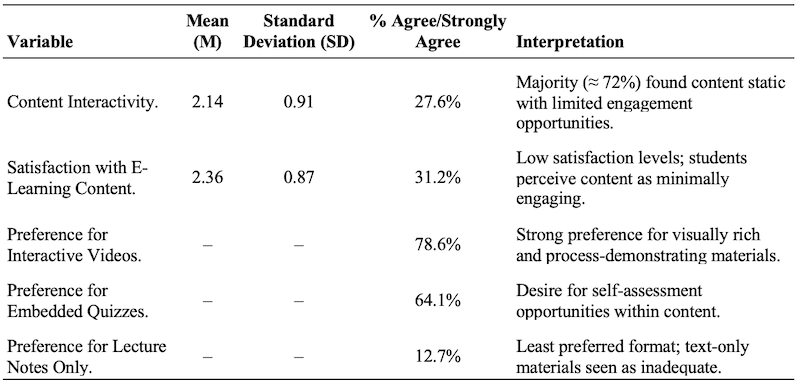
Student perceptions of content interactivity, satisfaction and format preference are presented in Table 1.
Table 1: Students’ Perceptions of E-Learning Content Interactivity and Preferences (N = 312)
The findings in Table 1 reveal the mean rating for content interactivity to be 2.14 (SD = 0.91) on a five-point scale, with only 27.6% of students agreeing or strongly agreeing that e-learning content was interactive. This suggests that over 70% of students found the content to be predominantly static.
A one-way ANOVA to determine whether perceptions differed by academic discipline produced the findings in Table 2.
Table 2: One-Way ANOVA Results on Perceived Content Interactivity across Disciplines (N = 312)
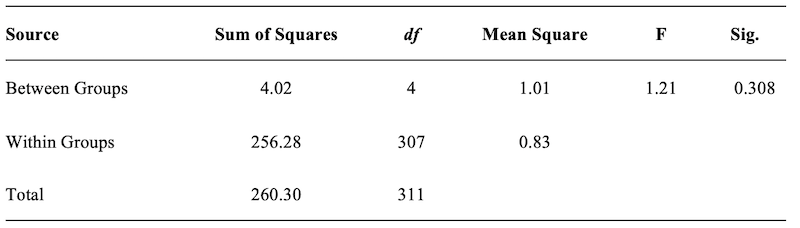
The results show no statistically significant difference between groups, F(4, 307) = 1.21, p value of 0.308. This suggests that students across all disciplines shared similar perceptions consistent with Saifuddin et al.’s, (2025) findings.
A dominant theme from both the literature and the interviews was reliance on static content. Faculty acknowledged that uploading lecture notes was hurriedly done due to the time constraints and skills gap:
I upload the notes on the system. It shows me that someone has downloaded it but not whether the person has read it. There is no time to make a phone call to ascertain.
Students corroborated this:
It feels like I am reading a digital textbook with no engagement at all.
Survey, interview and SLR findings converge in content quality being perceived as low, interactivity as minimal and perceptions uniform across disciplines. The SLR confirms this characteristic of developing contexts (Muthuprasad et al., 2021; Ouma et al., 2022) and interview data confirm the mechanism as being transmission-based upload rather than design interaction.
The faculty reported barriers were as presented in Table 3.
Table 3: Faculty-Reported Barriers to Developing Interactive E-Learning Content (N = 116)
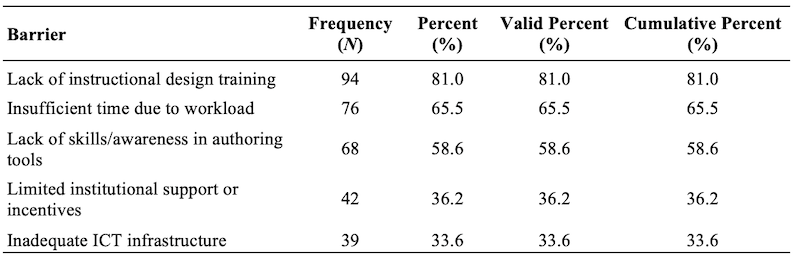
The majority (81.0%) cited lack of instructional design training as the primary challenge, and 65.5% indicated insufficient time due to competing teaching, research, and administrative responsibilities. Additionally, 58.6% reported a lack of awareness or skills in using authoring tools such as H5P, Articulate Storyline, or Camtasia.
Faculty's self-rating of digital competence is presented in Table 4.
Table 4: Faculty Self-Rated Digital Competence (N = 116)

Based on the findings in Table 4, the faculty digital competence rating was found to be 3.28 (SD = 0.74) which suggests a moderate self-perceived proficiency. Most lecturers were found to be familiar with basic digital operations and LMS navigation but few demonstrated high proficiency in interactive content authoring.
Interviews with faculty revealed their frustration with institutional support structures:
We are expected to teach, research, and publish. There is no training or time allocated for creating videos or interactive quizzes. Uploading notes is what works for us.
Another commented:
Creating interactive content requires skills we were never trained on. Uploading notes is easy and fast. Plus, there is no recognition or incentive for developing interactive materials. Research outputs are what matter for promotion.
The sentiments demonstrated a systemic mismatch between expectations of the institution and faculty capacity/incentives for pedagogical innovation. Few faculty were aware of authoring tools such as Articulate Storyline, H5P, or Moodle’s advanced interactive plugins.
The survey, interview and SLR agree on the dominant barriers being instructional-design training deficits and workload, compounded by low tool awareness and weak incentives. This supports Kebritchi et al.’s (2017) findings on digital competence as a critical determinant of online teaching quality, Hidayat et al. (2026) on TPACK framing, and Koehler and Mishra (2009) and George (2020) on structured training and community of practice as remedies.
From Table 1’s findings, we can see that preferences inclined strongly towards interactive multimedia, with 78.6% of respondents preferring interactive videos that demonstrate processes and practical applications, 64.1% of learners preferring embedded quizzes as self-assessment and only 12.7% preferring lecture notes alone.
Students expressed dissatisfaction with static content, particularly those in STEM:
Reading PDF notes is not enough to understand thermodynamics or circuits. We need videos showing practical applications or simulations to visualise these concepts.
Another said:
I miss the immediate feedback in the face to face class. I feel isolated.
The qualitative findings align with Rapanta et al. (2020) that transferring lecture notes to an LMS does not result in effective online teaching, and with Sun et al. (2020) and Ouma et al. (2022) that students prefer interactive videos, quizzes, and multimedia explanations. Survey results (78.6% preferred interactive videos and 64.1% preferred embedded quizzes) and interview accounts converge on the conclusion that students largely use content as passive reading material and want scaffolded, feedback-rich interaction especially for complex STEM concepts.
Table 3’s findings indicate that 36.2% of faculty viewed limited institutional support or incentives as a barrier, while 33.6% cited inadequate ICT infrastructure, indicating that technological and institutional constraints compounded pedagogical challenges.
Respondents identified limited bandwidth as a key factor that hindered uploading and streaming of multimedia, affecting videos, animations, and other rich media. Students from rural areas had access challenges due to limited mobile data or incompatible devices. Outdated LMS platforms, in some cases, lacked appropriate features for embedding interactive videos or quizzes thereby limiting participatory learning. Device incompatibility (laptops or smartphones unable to handle bandwidth-heavy materials) exacerbated inequalities in access to quality e-learning. Institutionally, respondents reported the absence of policies mandating interactive content development, no incentives to integrate interactivity, heavy workload limiting their time for developing multimedia resources and no monetary or promotional recognition for investing in instructional design innovations.
This aligns with Ayhan’s (2022) claim that policy frameworks play a pivotal role in institutionalising interactive content development, and even minimal interactivity standards improve quality and satisfaction. As well, Dhawan (2020) and Muthuprasad et al.’s (2021) findings indicate that infrastructure imposes limits even where interactivity content exists. The survey findings of this study and its interview accounts converge on bandwidth limitations, outdated LMS platforms, and device incompatibility as a persistent mutually reinforcing barrier.
Triangulating the SLR, survey, and interview data across all five ROs yielded four convergent conclusions:
This study examined e-learning content, faculty challenges, and student experiences across three Kenyan public universities. Four findings emerged. First, content remains predominantly static: only 27.6% of students perceived it as interactive (M = 2.14, SD = 0.91); satisfaction was low (M = 2.36, SD = 0.87); 78.6% preferred interactive videos and 64.1% wanted embedded quizzes. Second, faculty barriers were interconnected: lack of instructional design training (81.0%), insufficient time (65.5%), and limited authoring-tool awareness (58.6%), against moderate digital competence (M = 3.28, SD = 0.74). Third, technological and institutional constraints—low bandwidth, outdated LMS platforms, device incompatibility, absent policies, weak incentives—compounded these deficits. Fourth, one-way ANOVA found no disciplinary differences in perceived interactivity, F (4, 307) = 1.21, p = 0.308, indicating a systemic rather than discipline-specific problem.
These findings show that infrastructural investment has not produced pedagogical transformation. The persistence of transmission-oriented content indicates ‘emergency remote teaching residue': crisis-mode habits institutionalised as normal practice. Interactivity deficits are therefore a stable, structurally reproduced equilibrium, not residual teething problems.
The confirmed desired–delivered gap implies universities should prioritise interactive content design over further infrastructure investment, since demand is not the constraint. The faculty competence score (M = 3.28) implies that recruitment of subject experts alone cannot improve online instruction; structured TPACK-based training (Koehler & Mishra, 2009) is required, as Romero-García et al. (2025) show the deficit is remediable. The self-reinforcing barrier system implies that training alone will fail unless institutional incentives and policy (Ayhan, 2024) reward interactive design and offset time constraints (Adedoyin & Soykan, 2020). The absence of disciplinary differences (p = 0.308) implies interventions should target institutions, not disciplines (Saifuddin et al., 2025). Finally, faculty unawareness of authoring tools (H5P, Articulate Storyline, Camtasia) implies awareness-raising must precede skills training.
The results support constructivist perspectives. In line with Mayer (2020), learning is active selection, organisation, and integration of information; static materials demand metacognitive skills many students lack. This study provides new evidence that interactive content engages multiple cognitive pathways improving comprehension and retention. Mayer and Moreno’s (2003) dual-channel assumptions explain the low satisfaction scores: static notes impose high extraneous load through weak pedagogical integration of technology. In ODL, interactivity is not an enhancement but the condition for parity with face-to-face instruction.
The competence is a significant obstacle aligning with Rapanta et al.’s (2020) finding that online teaching proficiency is as essential as technical skills. Faculty without instructional design principles cannot align interactive material with learning objectives, assessments, and cognitive load. The mean score (3.28) reveals insufficiency in multimedia authoring. Faculty in this study demonstrated partial TPACK, largely limited to LMS navigation rather than the design and delivery of interactive content aligned with learning objectives and assessments. This contradicts the TPACK framework (Koehler & Mishra, 2009), which emphasises the integration of technological, pedagogical, and content knowledge for effective digital teaching. In this regard, Hung et al. (2020) advocate for structured communities of practice to bridge TPACK gaps among faculty through collaborative learning design. George (2020) proposed communities of practice to bridge this gap. In ODL, faculty competence directly determines learner support, retention and completion. Technological and Infrastructural Constraints
Consistent with Al-Fraihat et al. (2020) on the relationship between technological quality and learner satisfaction, outdated LMS platforms hinder interactive learning. The Kenyan TVET study findings concur that infrastructure limitations (70.8%) and inadequate training (62.5%) are principal barriers (Kaje et al., 2026). Device limitations in rural Kenya compound barriers with inequities. For ODL, technological resilience (stable infrastructure, inclusive access policies, and adaptive LMS) is a prerequisite for equitable delivery. Without it, interactive content remains inaccessible to the students who most need it (Muthuprasad et al., 2021; Soko et al., 2026).
Absent interactivity standards or recognition in promotion frameworks, faculty rationally prioritise research over unrewarded pedagogical labour (Ayhan, 2024). The study’s originality lies in reframing interactivity from peripheral enhancement to a quality-assurance imperative for ODL parity. Clear policies coupled with capacity building yield measurable improvements.
Three policy actions follow. First, there should be mandatory minimum interactivity standards for all e-learning courses (Ayhan, 2024). Second, recognise content development in workload models and promotion criteria; without this, faculty will continue to prioritise research. Third, invest in instructional design teams, since co-created courses yield greater satisfaction and cognitive outcomes (Kebritchi et al., 2017).
For practice, professional development should integrate TPACK (Koehler & Mishra, 2009) with authoring-tool training and cognitive load management (Mayer & Moreno, 2003). Communities of practice offer a cost-effective route to collective capacity (Bakar et al., 2026; George, 2020). Faculty should begin with low-threshold interventions, for example, embedding quizzes before engaging in full video production. For technology, universities should upgrade LMS platforms, expand bandwidth, and subsidise devices and data plans; otherwise, interactive content will widen rather than narrow inequities (Muthuprasad et al., 2021; Soko et al., 2026).
Several questions remain unanswered. First, cross-sectional design cannot track whether faculty capacity and institutional policies improve over time; longitudinal studies should map the trajectory of interactivity adoption across academic years. Second, this study relied on self-reported data; future research should triangulate with LMS analytics, content audits, and learning outcome measures to establish the relationship between perceived and actual interactivity. Third, the absence of disciplinary differences warrants investigation using observational and experimental designs; self-reporting instruments may mask discipline-specific variation. Fourth, intervention studies are needed to test whether TPACK-based training, instructional design partnerships, and policy mandates produce measurable gains in interactivity and student outcomes, building on Romero-García et al.’s (2025) finding that TPACK training significantly improves lecturers’ digital competence. Finally, comparative research across East African universities could clarify whether these findings reflect a Kenyan or a regional pattern and would strengthen the evidence base for policy harmonisation in ODL delivery.
Acknowledgements: The authors acknowledge Karatina University and Kibabii University for the time to undertake this study.
Abgaz, Y. (2026). An integrated framework for interactive and inclusive asynchronous online learning at scale: Data literacy in higher education. Education Sciences, 16(4), 639. https://doi.org/10.3390/educsci16040639
Adedoyin, O.B., & Soykan, E. (2020). Covid-19 pandemic and online learning: The challenges and opportunities. Interactive Learning Environments, 31(2), 1–13. https://doi.org/10.1080/10494820.2020.1813180
Aldosari, M.S. (2025). Exploring the impact of digital learning platforms on student engagement and performance. Research Journal in Advanced Humanities, 6(4). https://doi.org/10.58256/6ga6bm44
Al-Fraihat, D., Joy, M., Masa’deh, R., & Sinclair, J. (2020). Evaluating e-learning systems success: An empirical study. Computers in Human Behavior, 102, 67–86. https://doi.org/10.1016/j.chb.2019.08.004
Amaniampong, A., Nantwi, W.K., Birago, B., Ofori, F., & Atuahene, E. (2026). Access and utilization of technological infrastructure in colleges of education in Ghana. Discover Education, 5(1), 369. https://doi.org/10.1007/s44217-026-01533-7
Ayhan, İ. (2024). South Korea’s educational leap forward: Fostering reforms in pedagogy and curriculum through digitalization and innovation. In B. Akgün, & Y. Alpaydın (Eds.), Global agendas and education reforms. Maarif Global Education Series. Palgrave Macmillan. https://doi.org/10.1007/978-981-97-3068-1_8
Bakar, S.A., Yasin, N.E., & Zabidi, N.A. (2026). Engaging and empowering open and distance learning learners: Open University Malaysia experience in leveraging H5P. Journal of Education and Learning (EduLearn), 20(2), 1202-1211. https://doi.org/10.11591/edulearn.v20i2.22030
Baleni, Z.G. (2015). Online formative assessment in higher education: Its pros and cons. Electronic Journal of e-Learning, 13(4), 228–236. https://academic-publishing.org/index.php/ejel/article/view/1730
Bervell, B., Umar, I.N., Kumar, J.A., Asante Somuah, B., & Arkorful, V. (2021). Blended learning acceptance scale (BLAS) in distance higher education: Toward an Initial development and validation. Sage Open, 11(3). https://doi.org/10.1177/21582440211040073
Braun, V., & Clarke, V. (2006). Using thematic analysis in psychology. Qualitative Research in Psychology, 3(2), 77–101. https://doi.org/10.1191/1478088706qp063oa
Comia H.R., Alberto M., & Guerra, A. (2026) Student satisfaction with Google Classroom during the COVID-19 pandemic: Examining challenges and acceptance factors at the Faculty of Engineering—Lúrio University, Mozambique. Frontiers in Education 10:1742339. https://doi.org/10.3389/feduc.2025.1742339
Creswell, J.W., & Plano Clark, V.L. (2018). Designing and conducting mixed methods research (3rd ed.). Sage Publications.
Dhawan, S. (2020). Online learning: A panacea in the time of COVID-19 crisis. Journal of Educational Technology Systems, 49(1), 5–22. https://doi.org/10.1177/0047239520934018
Eze, C.G., & Bello, A.M. (2026). Assessing the impact of interactive e-learning platforms on the academic engagement of accountancy undergraduates in Nigerian universities. International Journal of Research in Education and Humanities, 11(2), 1–10. https://doi.org/10.5281/zenodo.19975253
George, M.L. (2020). Effective teaching and examination strategies for undergraduate learning during COVID-19 school restrictions. Journal of Educational Technology Systems, 49(1), 23-48. https://doi.org/10.1177/0047239520934017
Hidayat, D.N., Defianty, M., Kultsum, U., Lee, J.Y., & Ramadhan, S. (2026). Determinants of digital competence among English language teachers in Indonesian madrasahs. Indonesian Journal of Applied Linguistics, 15(3), 510-522. https://doi.org/10.17509/n68yf650
Holtgrave, V., Good, J., & Fazakerley, J. (2026). Bringing lessons to life: Media-driven approaches in online learning. International Journal of Technology in Education (IJTE), 9(1), 1-17. https://doi.org/10.46328/ijte.5064
Hung, M.L., Chou, C., Chen, C.H., & Own, Z.Y. (2020). Learner readiness for online learning: Scale development and student perceptions. Journal of Educational Technology Systems, 49(2), 224–244. https://doi.org/10.1177/0047239520934017
Kaje, D.M., Wanjala, A., & Kendi, C. (2026). Evaluating the current state of e-learning at KeMU TVET Institute and developing a framework for scalable, inclusive adoption. International Journal of Professional Practice, 14(2), 15–27. https://doi.org/10.71274/ijpp.v14i2.633
Kebritchi, M., Lipschuetz, A., & Santiague, L. (2017). Issues and challenges for teaching successful online courses in higher education: A literature review. Journal of Educational Technology Systems, 46(1), 4–29. https://doi.org/10.1177/0047239516661713
Koehler, M. J., & Mishra, P. (2009). What is technological pedagogical content knowledge (TPACK)? Contemporary Issues in Technology and Teacher Education, 9(1), 60–70. https://citejournal.org/volume-9/issue-1-09/general/what-is-technological-pedagogicalcontent-knowledge/
Leung, L.Y.Y., & Zou, T.X.P. (2025). The role of community in research-based learning: Undergraduate perspectives. Educational Research, 67(1), 60–78. https://doi.org/10.1080/00131881.2025.2451893
Mackatiani, N.I., Majanga, E., & Amwayi, B. (2026). Examining students’ perceptions of online and HyFlex teaching modalities and their influence on learning engagement at University X. African Journal of Empirical Research, 7(4), 528-538. https://doi.org/10.51867/ajernet.7.4.42
Mayer, R.E. (2020). Multimedia learning (3rd ed.). Cambridge University Press. https://doi.org/10.1017/9781316941355
Mayer, R.E., & Moreno, R. (2003). Nine ways to reduce cognitive load in multimedia learning. Educational Psychologist, 38(1), 43–52 https://www.uky.edu/~gmswan3/544/9_ways_to_reduce_CL.pdf
Moher, D., Liberati, A., Tetzlaff, J., Altman, D.G., & The PRISMA Group. (2009). Preferred reporting items for systematic reviews and meta-analyses: The PRISMA statement. PLoS Medicine, 6(7), e1000097. https://doi.org/10.1371/journal.pmed.1000097
Muthuprasad, T., Aiswarya, S., Aditya, K.S., & Jha, G.K. (2021). Students’ perception and preference for online education in India during COVID-19 pandemic. Social Sciences & Humanities Open, 3(1), 100101. https://doi.org/10.1016/j.ssaho.2020.100101
Panda, S. & Mishra, S. (2007). E-learning in a mega open university: Faculty attitude, barriers and motivators. Educational Media International, 44(4), 323-338. https://api.semanticscholar.org/CorpusID:56084864
Peramunugamage, A., Ratnayake, U., Karunanayaka, S., Francine, E., Simão de Deus, W., Jayawardena, C., & De Silva, J. (2025). Monitoring collaborative interactions in online learning: Insights from Moodle log records. Journal of Learning for Development, 12(2). 290-312. https://doi.org/10.56059/jl4d.v12i2.1554
Rapanta, C., Botturi, L., Goodyear, P., Guàrdia, L., & Koole, M. (2020). Online university teaching during and after the Covid-19 crisis: Refocusing teacher presence and learning activity. Postdigital Science and Education, 2(3), 923–945. https://doi.org/10.1007/s42438-020-00155-y
Romero-García, C., Buzón-García, O., & Parra González, E. (2025). Evaluation of a program to enhance online lecturers’ digital competence: TPACK and artificial intelligence. Online Learning, 29(4), 109-132. https://doi.org/10.24059/olj.v29i4.5016
Saifuddin, M.Z., Asnawi, A., Kamarulzaman, M.H., Zakaria, S.F., & Rani, N.L.M. (2025). Exploring students’ perceptions on online learning environment across disciplines. ESTEEM Journal of Social Sciences and Humanities, 9(1), 32–52. https://doi.org/10.24191/ejssh.v9i1.5445
Sarma, I.D. & Saikia, D. (2026) Instructor-led design, interactive delivery, assessment, and Loop (iDIAL) method for teaching with gamification based assessment. Scientific Reports, 16, Article 37191. https://doi.org/10.1038/s41598-026-66424-1
Schmidt, L.J., & DeSchryver, M. (2022). The role of digital application literacy in online assessment. Journal of Educational Technology Systems, 50(3), 356-378. https://doi.org/10.1177/00472395211052644
Sibia, N., & Liut, M. (2022). The positive effects of using reflective prompts in a database course. In Proceedings of the 1st International Workshop on Data Systems Education (DataEd ‘22). Association for Computing Machinery, New York, NY, USA, 32–37. https://doi.org/10.1145/3531072.3535323
Soko, J., Alcaide, J.C.N., Dzinekou, J.Y., & Tombe, C.Z. (2026). Digital readiness and infrastructure gaps for e-learning in conflict-affected East African universities. Asian Journal of Distance Education. https://asianjde.com/ojs/index.php/AsianJDE/article/view/852
Sun, L., Tang, Y., & Zuo, W. (2020). Coronavirus pushes education online. Nature Materials, 19(6), 687. https://doi.org/10.1038/s41563-020-0678-8
Wanjara, A.O., & Ogembo, P.O. (2024). Institutional and students’ factors influencing adoption of e-learning in higher educational institutions in Kenya: A case of public universities. Indonesian Journal of Educational Research and Review, 7(2), 253–262. https://doi.org/10.23887/ijerr.v7i2.67963
Watuleke, J., Onen, D., & Muyinda , P.B. (2026). Ground-up innovation in blended learning: Faculty experiences toward digital transformation at Makerere University: Toward sustainable digital transformation in a resource-constrained higher education context. Journal of Learning for Development, 13(1), 175-185. https://doi.org/10.56059/jl4d.v13i1.2019
Young, K. (2026). The ECHO instructional framework: Guiding faculty to create transformative, student-centered online courses in higher education. Online Journal of Distance Learning Administration, 29(1). https://doi.org/10.67695/KLQQ5618
Author Notes
Dr Carolyne Simiyu is a senior lecturer in curriculum and education technology at Kibabii University. She is extensively involved in open and digital teaching and learning and has published in peer reviewed and refereed journals. She holds a PhD and MED in Curriculum and Instruction and a BED (Hons, Arts). Email: cnabwoba@kibu.ac.ke (https://orcid.org/0000-0001-9817-6714)
Prof Kellen Kiambati, PhD is an Associate Professor of Strategic Management and Director of Resource Mobilisation and International Programmes at Karatina University, where she is also Acting Director of Research, Innovation and Extension. She holds a PhD and an MBA in Business Administration and a BA in Human Resource Management, and is a Certified Microsoft Educator, a certified Human Resource Consultant, Psychometric Assessor and Certified Governance Secretary. Email: kkiambati@karu.ac.ke (https://orcid.org/0000-0002-1876-1786)
Prof Franklin Wabwoba is a professor of Information Technology and the Deputy Vice Chancellor (Academics, Research and Student Affairs) at Karatina University. He holds a PhD in Information Technology, an MSc (Computer Applications) and a BED (Science). He is highly trained in digital content design for ODL, with has wide experience in both the public and private sector. He has many years of experience in secondary school, National Polytechnic and university education, and his research interests include open learning, green computing, AI, Education and software engineering. He has been a resource person for university quality assurance in Kenya and elsewhere. Email: fwabwoba@karu.ac.ke (https://orcid.org/0000-0002-5026-7884)
Cite as: Simiyu, C., Kiambati, K., & Wabwoba, F. (2026). Challenges in development and use of e-learning content: Faculty and student perspectives. Journal of Learning for Development, 13(4), 621-635.
DOI: https://doi.org/10.56059/rgsqmr48