Alfan Rifai, Andri Nirwana AN, Waston, Muh. Nur Rochim Maksum and Viky Nur Vambudi
2026 VOL. 13, No. 4
Abstract: This study examines whether blended learning improves educational access, promotes equity, and enhances academic success in Indonesian higher education. A sequential mixed-methods design combined a quasi-experimental comparison of 500 undergraduates from five universities with interviews of 15 students and five lecturers. Eighteen intact classes were assigned to blended learning (nine classes) or conventional instruction (nine classes) after a Week 1 pretest, were taught for a 16-week semester, and assessed in Week 16. Data were analysed using analysis of covariance (ANCOVA), interaction regression, and thematic analysis. Access scores rose 11.02 points in the blended group and 1.33 points in the conventional group, an adjusted difference of 9.85 points (p < 0.001). Interaction regression showed larger participation gains among lower-income students (2.59 points), students in rural and peripheral regions (2.18), and students with low digital literacy (4.40), all significant after Holm adjustment. Achievement rose 4.41 points against 0.53 points, an adjusted difference of 4.06 (p < 0.001), while attendance (84.84% versus 79.72%) and course completion (91.6% versus 76.4%) were also higher. Completion required a final GPA of at least 3.00 and attendance of at least 75%. Interviews explained these patterns: downloadable materials, recorded lectures, flexible schedules, peer support, and timely feedback enabled participation and progress, whereas unstable connectivity, shared devices and data costs, reduced concentration, and delayed feedback limited them. It is suggested that blended learning can widen access and support more equitable participation, but gains depend on accessible digital resources, inclusive instructional design, meaningful interaction, and sustained institutional support, especially for students facing socioeconomic and geographical disadvantage.
Keywords: blended learning, equity in education, inclusive design, digital divide, socio-economic status (SES)
Higher education access and academic outcomes in Indonesia remain unequal, shaped by socioeconomic status (SES), geographical location, and digital infrastructure (Al Saad et al., 2026; Fitriana et al., 2024; Khadafie, 2023; Nirwana AN et al., 2025; Tasniwati, 2021). Disparities in device ownership, connectivity, and digital literacy were evident during the Covid-19 pandemic (Aini, 2025; BPS, 2022; Hidayah et al., 2022; Makumane et al., 2023; Valentia, 2023). Blended learning can expand access (Panda et al., 2024; Senanayake & Sandanayake, 2021), but equity depends on inclusive design, accessible platforms, low-bandwidth resources, and institutional support (Ayeni & Eden, 2024; Murphy et al., 2026; Porkodi & Tabash, 2024; Sain et al., 2024). Recent studies address digital inequality (Kastorff et al., 2026; Abbasi & Yang, 2026), engagement (Mahmud et al., 2026; Wang et al., 2026), and differentiated instruction in Indonesia (Hasan et al., 2026; Renaldi et al., 2026). However, evidence integrating SES, location, digital access, inclusive design, participation, and academic outcomes remains limited in Indonesian higher education. This study examined access, academic success, participation, and equity-related factors across five universities, using a framework linking SES, location, digital accessibility, inclusive design, and student outcomes. It also examined the SES–inclusive design interaction in relation to academic success.
This study’s conceptual framework draws on educational equity, emphasising learning opportunities, technological resources, and institutional support that address students’ diverse needs (Balán, 2020; Kalantari et al., 2024). Equity requires more than equal provision: students from disadvantaged socioeconomic backgrounds and underserved regions may need additional support to participate and succeed. In blended learning, socioeconomic status (SES), geographical location, and digital accessibility shape students’ experiences.
Device ownership, internet connectivity, and affordability influence participation. Socioeconomic differences remain associated with digital competence and educational opportunities (Abbasi & Yang, 2026; Kastorff et al., 2026). Similarly, instructional arrangements and interaction support engagement (Mahmud et al., 2026; Wang et al., 2026). However, digital access alone does not guarantee equitable outcomes.
Inclusive learning design can reduce barriers through flexible schedules, downloadable or offline materials, and accessible learning management systems (Makumane et al., 2023; Porkodi & Tabash, 2024). Equity-focused frameworks, differentiated instruction, and institutional planning support engagement and academic performance (Murphy et al., 2026; Panda et al., 2024; Renaldi et al., 2026). As digital inequality relates to wellbeing and learning experiences (Hasan et al., 2026; Pritiprada et al., 2024), educational equity should be understood through student backgrounds, digital access, inclusive practices, academic success, and retention.
The literature review identifies four irrelated research gaps. First, previous studies have predominantly examined digital inequality, student engagement, and inclusive learning design as separate dimensions (Fang et al., 2025; Kastorff et al., 2026; Kleftodimos et al., 2023; Mahmud et al., 2026). Consequently, their interconnected relationship with educational equity and academic outcomes remains insufficiently understood. Second, although research has established the relevance of socioeconomic status (SES) and geographical disparities in digital learning access, limited empirical attention has been given to examining how these factors interact with digital accessibility and inclusive learning design within a single analytical framework, particularly in Indonesian higher education (Hasan et al., 2026; Renaldi et al., 2026). Third, existing studies have highlighted the importance of inclusive and differentiated instruction, but further investigation is needed into whether its association with academic success varies across socioeconomic groups. Fourth, the relationship between these educational conditions and both academic success and student retention requires further empirical examination in the Indonesian blended learning context. To address these gaps, the present study examined data from 500 students across five Indonesian universities using an explanatory sequential mixed-methods design. Unlike studies focusing on individual dimensions, this research integrates SES, geographical location, digital accessibility, and inclusive learning design into a unified analytical framework to examine educational access, student participation, academic success, and retention. Qualitative interviews with students and lecturers further provide contextual explanations of digital barriers, instructional flexibility, and institutional support. Thus, the study contributes empirical evidence on the interconnected dimensions of educational equity and the differential relevance of inclusive learning design across socioeconomic groups, offering insights for developing more equitable blended learning practices in Indonesian higher education.
To address this gap, the present study investigated three interconnected objectives:
By employing an explanatory sequential mixed-methods approach, this research combines quantitative evidence with qualitative explanations from student and lecturer interviews to provide a contextual understanding of educational access, equity, and academic success in Indonesian higher education.
This study employed an explanatory sequential mixed-methods design (QUAN → QUAL) to examine the effectiveness of blended learning in improving educational access, promoting educational equity, and enhancing academic success in Indonesian higher education. The quantitative phase used a quasi-experimental approach with pretest-posttest comparison between students receiving blended learning and those receiving conventional face-to-face instruction. Quantitative data were analysed using descriptive statistics, Analysis of Covariance (ANCOVA), interaction regression, and logistic regression. These analyses examined differences in educational access, participation disparities, academic success, and student retention. The qualitative phase employed thematic analysis to explain and contextualise the quantitative findings. Both datasets were integrated through a joint display approach to provide a comprehensive interpretation of blended learning effectiveness (Abidin et al., 2024; Sukmawati et al., 2020; Susanti et al., 2024).
The study was conducted from January to August 2025 at five Indonesian universities: Universitas Andalas, Universitas Muhammadiyah Surakarta, Universitas Cenderawasih, Universitas Sebelas Maret, and Universitas Hasanuddin. All participants were enrolled in the same compulsory course Development of Educational Teaching Materials in the 2024/2025 academic year. Because instruction was organised by class, the class was the unit of assignment. Eighteen intact classes of 30 students were selected from a population of 2,239. Five hundred of these were analysed (250 per condition—conventional learning, and blended learning), exceeding Slovin’s minimum of 340.
Each class was taught by one lecturer each, already assigned to it by the department before data collection, and no lecturer taught both conditions. A pretest was administered in Week 1, before any content was delivered; the classes were then assigned to blended learning (nine classes) or conventional learning (nine classes). The blended group completed 16 sessions, ten face-to-face and six online; the conventional group completed all 16 face-to-face. Both used an identical syllabus, learning outcomes, and rubric. The posttest was administered in Week 16. Forty students were excluded due to incomplete posttests. Effectiveness was estimated as the between-condition difference in change from Week 1 to Week 16.
Quantitative data were collected using a 25-item questionnaire covering student characteristics and digital accessibility (12 items), inclusive learning design (four items), student engagement (five items), and blended learning integration (four items). The 13 perception items used a five-point Likert scale. The questionnaire was adapted from Han and Ellis (2020), Abidin et al. (2024), and Susanti et al. (2024). A pilot test involving 50 respondents showed acceptable reliability, with Cronbach’s Alpha values of 0.833, 0.866, and 0.848 for the three learning constructs, respectively. All corrected item-total correlations exceeded 0.30 (Prijowuntato et al., 2022; Rahmayanti et al., 2021; Taley, 2022). The questionnaire covered 16 observed variables, including SES, geographical location, device ownership, internet access, learning engagement, attendance, GPA, academic success, and student retention. Academic success was defined as a GPA of at least 3.00 and attendance of at least 75%, while retention referred to continued enrolment in the following semester. Qualitative data were collected through semi-structured interviews with students and lecturers to explore digital access, learning experiences, instructional practices, and institutional support. Interview findings were used to explain the quantitative results.
Data collection took place between January and August 2025. First, baseline questionnaire data and relevant student characteristics were collected. Second, the intervention was implemented over one 16-week semester. The blended-learning group received approximately 60% face-to-face instruction and 40% online activities, including classroom discussions, recorded lectures, digital materials, online assignments, and collaborative learning. Downloadable resources and low-bandwidth alternatives were provided for students with connectivity limitations. The control group received conventional face-to-face instruction covering comparable course content and learning objectives. Third, post-intervention questionnaire data and institutional records were collected, including GPA, attendance, and subsequent-semester enrolment. The 20 qualitative participants were interviewed about access, participation, learning experiences, and institutional support. Interview data were coded thematically and compared with quantitative results to explain how socioeconomic and technological conditions shaped educational access, equity, academic success, and retention.
The overarching research project received ethical approval from the Ethics Committee/Institutional Review Board (IRB), Faculty of Islamic Religion, Universitas Muhammadiyah Surakarta, Indonesia (Reference No. 2501/A.1/PDPAI-FAIUMS/I/2025, dated 23 January 2025).
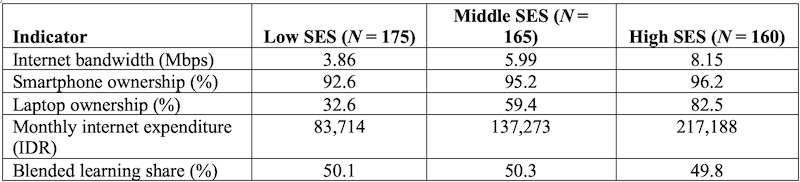
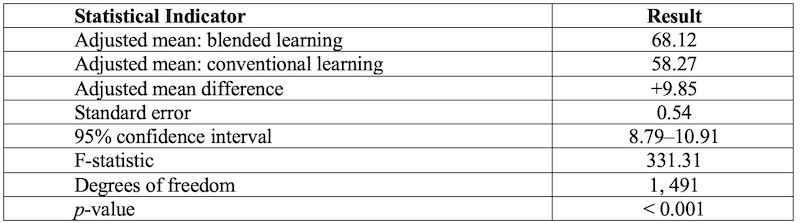
Educational access was measured with a ten-item composite (0–100) in Week 1, before any content was delivered, and in Week 16, after the final session. Table 1 shows that digital resources differed sharply by SES (bandwidth 8.15 vs 3.86 Mbps; laptop ownership 82.5% vs 32.6%) while blended learning exposure was comparable across groups (49.8%–50.3%), indicating that disadvantage stemmed from resources rather than dosage. Table 2 shows that the conditions began at similar levels (56.45 vs 57.59) then diverged by Week 16 (67.47 vs 58.92), with gains of 11.02 and 1.33 points, respectively. Table 3 confirms this difference after adjustment (68.12 vs 58.27; adjusted difference 9.85; 95% CI 8.79–10.91; F (1, 491) = 331.31; p < 0.001), meaning the effect persists after controlling for baseline access, SES, location, digital literacy, and university. Blended learning contributed through three mechanisms absent from the conventional condition: temporal decoupling of materials from class hours, continuity during absence, and redundancy of format through low-bandwidth alternatives. Interviews with S02, S03, S04, and S06 define the boundary conditions of this effect: gains were largest where minimum device and connectivity thresholds were met.
Table 1: Digital Learning Access by Socioeconomic Status (N = 500)
Table 2: Educational Access Before and After the Intervention

Table 3: ANCOVA Results for Educational Access
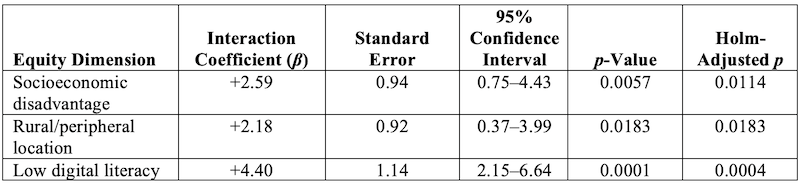
Educational equity was defined as a relational property and tested as a conditional effect. For each dimension of disadvantage, participation was regressed on condition, disadvantage, their interaction, and covariates; β1 is the blended-conventional difference among non-disadvantaged students and β3 is the additional difference among disadvantaged students, so equity requires both to be positive. Table 4 shows the blended-conventional difference was 2.59 points larger for lower-income students (95% CI 0.75–4.43), 2.18 points larger for students in rural and peripheral areas (0.37–3.99), and 4.40 points larger for students with low digital literacy (2.15–6.64), all remaining significant after Holm adjustment. On a common 0–100 scale and with β2 negative, these coefficients equal the narrowing of the between-group gap by 2.59, 2.18 and 4.40 points respectively. Unequal exposure is ruled out, as blended activity was 50.1%–50.3% across socioeconomic groups. Interviews identify the mechanism: S06’s data cost was relaxed by downloadable materials, S13’s rigid schedule by asynchronous access, and D02 confirms these adjustments were targeted at students with connectivity problems, while D04 and D05 described the scaffolding most relevant to low digital literacy, the dimension with the largest gain. No equivalent adjustment existed in the conventional condition. The gap narrowed but did not close, indicating improved equity rather than equalisation.
Table 4: Interaction Regression Results for Educational Equity
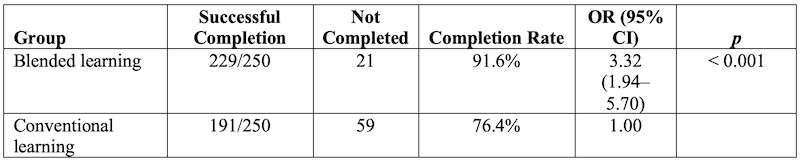
After the Week 1 pretest, nine intact classes were assigned to blended learning and nine to conventional learning and taught for the full 16-week semester; the posttest and institutional records were collected in Week 16 and at the end of the semester. Improvement and effect are distinguished throughout: improvement is the within-group change from Week 1 to Week 16, while the effect is the adjusted between-group difference in that change. Academic achievement improved by 4.41 points in the blended group (62.88 to 67.29) and by 0.53 points in the conventional group (63.29 to 63.82) (Table 5), and the groups began at comparable levels; ANCOVA adjusting for baseline achievement and student characteristics yielded an adjusted mean difference of 4.06 points (SE = 0.56, 95% CI 2.97–5.15, F (1,491) = 53.41 F (1,491) = 53.41, p < 0.001 p < 0.001) (Table 6). Attendance, recorded across the sixteen weeks, was 84.84% in the blended group against 79.72% in the conventional group (t(498) =7.99 t(498) =7.99, p < 0.001 p < 0.001) (Table 7), and completion, recorded after final grades were released, was 91.6% against 76.4% (OR = 3.32, 95% CI 1.94–5.70, p < 0.001 p < 0.001) (Table 8); since both were recorded during or at the end of the same semester, neither predates the intervention. Interviews locate the mechanism in features operating during those weeks: S08’s peer support and S10–S11’s downloadable materials and recorded lectures allowed content to be revisited, whereas no equivalent existed in the conventional condition; S14’s loss of concentration in online sessions and S12’s delayed feedback mark the limits of that advantage. As a non-equivalent control group quasi-experiment, these are adjusted conditional estimates rather than the effects of an individually randomised treatment.
Table 5: Academic Achievement Before and After the Intervention
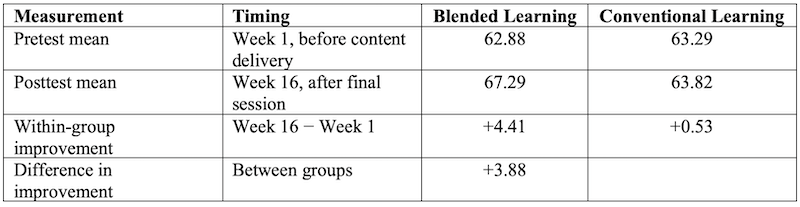
Table 6: ANCOVA Results for Academic Achievement
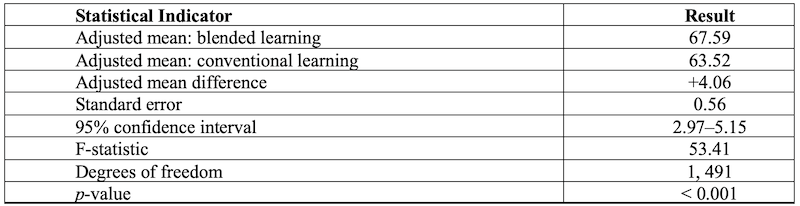
Table 7: Student Attendance Results

Table 8: Course Completion Results
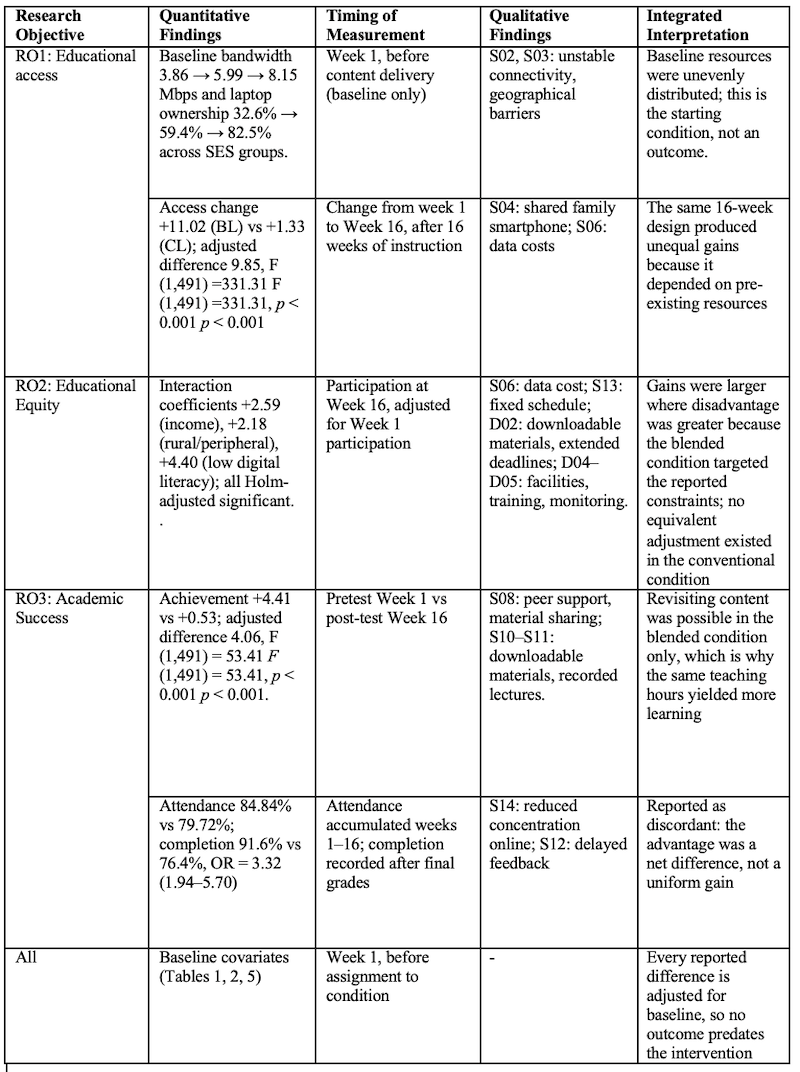
All quantitative results reported here were produced by one sequence: in Week 1, before content delivery, all 500 students completed baseline measurement; nine intact classes were then assigned to blended learning and nine to conventional learning; both ran for the full 16-week semester; and in Week 16, after the final session, the post-test, institutional records and interviews were obtained. No outcome reported below predates the intervention, apart from the baseline covariates used as controls. Over those sixteen weeks, access rose by 11.02 points in the blended group and 1.33 points in the conventional group (adjusted difference 9.85, F (1,491) = 331.31 F (1,491) = 331.31, p < 0.001 p < 0.001), and the interviews specify why those gains were uneven: S02–S04 and S06 described connectivity, device and cost constraints that existed before the semester began.
The equity interactions (+2.59 income, +2.18 rural, +4.40 digital literacy, all Holm-adjusted) pair with S06’s and S13’s reported barriers and with D02’s downloadable materials, extended deadlines and monitoring, indicating that the differential gain arose because the blended condition targeted the constraints that disadvantaged students themselves reported, with no equivalent adjustment in the conventional condition. For academic success, achievement improved by 4.41 against 0.53 points (adjusted difference 4.06, F (1,491) = 53.41 F (1,491) = 53.41, p < 0.001 p < 0.001), attendance recorded across Weeks 1–16 was 84.84% against 79.72%, and completion recorded after final grades was 91.6% against 76.4% (OR = 3.32, 1.94–5.70).
The interviews explain the mechanism (S08, S10, S11) and mark its limits (S14, S12), the latter reported as discordant rather than absorbed. The integrated conclusion is that the mechanism was instructional rather than technological, and that blended learning narrowed the participation gap without removing the resource gap that produced it; as a quasi-experiment, these are the effects of studying under the blended condition for one semester, conditional on the covariates.
Table 9: Joint Display of Quantitative and Qualitative Findings
The findings indicate that blended learning can improve educational access by providing flexible opportunities to access learning materials and maintain learning continuity. The adjusted mean difference of 9.85 points demonstrates greater improvement in the blended learning group than in conventional learning. However, differences in internet connectivity, device ownership, and affordability remained evident, particularly among students from lower socioeconomic backgrounds. Interviews with S02, S03, S04, and S06 confirmed that these barriers continued to influence students’ learning experiences. These findings support previous research emphasising the importance of accessible digital resources and inclusive learning design (Gronseth, 2023; Hamman et al., 2025; Murphy et al., 2026; Soicher et al., 2024; Wanti et al., 2024).
Regarding educational equity, the interaction effects demonstrate greater participation improvements among students experiencing socioeconomic, geographical, and digital literacy disadvantages. The largest improvement occurred among students with low digital literacy. Interviews with S13 and D02 highlighted the importance of flexible schedules, downloadable materials, and additional assignment time in reducing participation barriers. These findings reinforce the argument that educational equity requires differentiated instructional support rather than equal provision of learning resources (Mahmud et al., 2026; Panda et al., 2024).
Blended learning was also associated with better academic outcomes, including achievement, attendance, and course completion. Peer support, recorded lectures, and downloadable materials helped students maintain their learning activities (S08, S10, and S11). Nevertheless, reduced concentration and delayed lecturer feedback remained challenges (S12 and S14). This suggests that academic success depends not only on technological access but also on meaningful interaction and continuous instructional support (De Bruijn-Smolders & Prinsen, 2024; Gupta & Raj, 2024; Liu et al., 2024; Panda et al., 2024).
Overall, blended learning offers opportunities to improve educational access, participation equity, and academic success. However, its effectiveness requires inclusive instructional design, accessible digital infrastructure, and sustained institutional support. The findings should be interpreted within the limitations of the quasi-experimental design and one-semester implementation. Implications for Educational Policy and Practice
These findings support policies integrating digital accessibility and inclusive blended-learning design (Hamman et al., 2025; Murphy et al., 2026). Universities should provide low-bandwidth LMS, downloadable/recorded materials, asynchronous learning, flexible deadlines, and timely feedback. Lecturer training, peer support, monitoring, and technical assistance should target students with limited devices, connectivity, or digital skills. Governments should improve affordable internet infrastructure in rural and 3T (Frontier, Outermost, and Disadvantaged) regions and embed accessibility, flexibility, and student support in quality standards. These measures could promote equitable participation across socioeconomic and geographical groups
This study has several limitations. Institutions and classes were selected purposively, so the findings describe these five universities rather than Indonesian higher education as a whole. Classes were also not randomised, which limits causal inference. Finally, motivation and psychological factors were not measured. Future research should use longitudinal or experimental designs, draw on institutional academic records and validated engagement measures, and examine student wellbeing and institutional support. Including more public and private universities, especially in disadvantaged regions, would strengthen the generalisability and practical relevance of the findings.
Abbasi, B.N., & Yang, C. (2026). Assessing the impact of digital equity initiatives and government policies on university access, student achievement, and retention in low-income countries. Telematics and Informatics, 107, 102398. https://doi.org/10.1016/j.tele.2026.102398
Abidin, N.L.F., Dwiningsih, K., Jehwae, P., & Sari, C.K. (2024). Leveraging technology to improve learning independence in chemistry: A study on Moodle integration. Indonesian Journal on Learning and Advanced Education, 6(3), 365–386. https://doi.org/10.23917/ijolae.v6i3.23706
Aini, M.A. (2025). Bridging the digital divide: Ensuring equitable access to education technology. Assoeltan: Indonesian Journal of Community Research and Engagement, 3(1), 11–22. https://doi.org/10.70610/edujavare.v3i1.800
Al Saad, L.S.A., Albahiri, M.H., & Alhaj, A.A.M. (2026). Integrating artificial intelligence technologies into the teaching of Islamic studies at the intermediate level in Saudi Arabia: Teachers’ perceptions. QiST: Journal of Quran and Tafseer Studies, 5(1), 33–58. https://doi.org/10.23917/qist.v5i1.16033
Ayeni, O.O., & Eden, C.A. (2024). Equity and access in higher education: Legal perspectives and management strategies. International Journal of Science and Research Archive, 11(2), 199–206. https://doi.org/10.30574/ijsra.2024.11.2.0391
Balán, J. (2020). Expanding access and improving equity in higher education: The national systems perspective. In S. Schwartzman (Ed.), Higher education in Latin America and the challenges of the 21st century (pp. 59–75). Springer International Publishing. https://doi.org/10.1007/978-3-030-44263-7_5
BPS. (2022). Digital infrastructure and access in Indonesia: A regional perspective. Badan Pusat Statistik.
De Bruijn-Smolders, M., & Prinsen, F.R. (2024). Effective student engagement with blended learning: A systematic review. Heliyon, 10(23), e39439. https://doi.org/10.1016/j.heliyon.2024.e39439
Fang, X., Xu, H., Tsz, D., & Ng, K. (2025). Exploring the influence of sociodemographic and socioeconomic factors on the digital divide in higher education. Education Sciences, 15(12), 1–16.
Fitriana, T.A., Nur, M., Maksum, R., Salim, H., & Andhim, M. (2024). Bibliometric analysis of the development map and research directions of blanded learning on Scopus database (2013-2024). Proceedings ISETH (International Summit on Science, Technology, and Humanity), 2266–2282.
Gronseth, S. (2023). Strategically inclusive e-learning design. Journal of Technology-Integrated Lessons and Teaching, 2(1), 68–77. https://doi.org/10.13001/jtilt.v2i1.7673
Gupta, A., & Raj, M. (2024). Learners’ experience, satisfaction and voice in blended learning: A case study in an Indian higher education institution. In A. Gupta, & M. Raj (Eds.), Case studies on blended learning in higher education (pp. 155–170). Springer Nature. https://doi.org/10.1007/978-981-97-9388-4_9
Hamman, N., Hodgkinson-Williams, C., Karassellos, L., Nwanze, I., & Small, J. (2025). Enabling design: Creating an equity-focused framework for blended learning. Progressio, 45. https://doi.org/10.25159/2663-5895/16177
Hasan, M., Tahir, T., Supatminingsih, T., & Handayani, A.A. (2026). Hybrid learning, digital inequalities, and student wellbeing: Evidence from rural higher education in emerging economies. The Internet and Higher Education, 70, 101090. https://doi.org/10.1016/j.iheduc.2026.101090
Hidayah, N.A., Utami, M.C., & Zukri, P.A. (2022). Analysis of the use of information technology in distance learning during a pandemic using the IS Success Model in Islamic boarding school. 2022 10th International Conference on Cyber and IT Service Management, CITSM 2022. https://doi.org/10.1109/CITSM56380.2022.9935900
Kalantari, F., Eslampanah, M., Laei, S., & Mohammadi, S. (2024). Presenting and validating an educational equity model based on information and communication technology with a blended learning approach in education. Journal of Technology in Entrepreneurship and Strategic Management, 3(4), 172–187. https://doi.org/10.61838/kman.jtesm.3.4.11
Kastorff, T., Scherer, R., Müller, M., Booij, G., Kennedy, A., Strietholt, R., & Greiff, S. (2026). Do schools narrow the socioeconomic digital divide? Meta-analytic evidence from ICILS 2023. Large-scale Assessments in Education, 14(1), 57. https://doi.org/10.1186/s40536-026-00330-w
Khadafie, M. (2023). Construction of Islamic Religious education in the era of The Covid-19 pandemic. Profetika: Jurnal Studi Islam, 24(01), 94–102. https://doi.org/10.23917/profetika.v24i01.1690
Kleftodimos, A., Evagelou, A., Triantafyllidou, A., Grigoriou, M., & Lappas, G. (2023). Location-based augmented reality for cultural heritage communication and education: The Doltso District application. Sensors, 23(10). https://doi.org/10.3390/s23104963
Liu, Y., Ma, S., & Chen, Y. (2024). The impacts of learning motivation, emotional engagement and psychological capital on academic performance in a blended learning university course. Frontiers in Psychology, 15. https://doi.org/10.3389/fpsyg.2024.1357936
Mahmud, M.M., Teh, J.K.L., & Azizan, S.N. (2026). Hyflex learning and student engagement in higher education: A systematic literature review. Frontiers in Education, 11. https://doi.org/10.3389/feduc.2026.1773704
Makumane, M., Mataka, T.W., Sengai, W., & Ngcobo, S. (2023). Neutralising the digital divide: Is blended learning a viable solution? International Journal of Research in Business and Social Science (2147- 4478), 12(7), 511–522. https://doi.org/10.20525/ijrbs.v12i7.2740
Murphy, P., Chapman, S., & Lambert, K. (2026). Equity in blended learning through the CABLS + E framework. Discover Education, 5(1), 890. https://doi.org/10.1007/s44217-026-02126-0
Nirwana AN, A., Rifai, A., Ali, M., Ali Mustofa, T., Nur Vambudi, V., Nur Rochim Maksum, M., & Umar Budihargo, M. (2025). SWOT Analysis of AI Integration in Islamic Education: Cognitive, affective, and psychomotor impacts. Qubahan Academic Journal, 5(1), 476–503. https://doi.org/10.48161/qaj.v5n1a1498
Panda, S., Mishra, S., & Misra, P.K. (Eds). (2024). Case studies on blended learning in higher education. Springer Nature. https://doi.org/10.1007/978-981-97-9388-4
Porkodi, S., & Tabash, B.K.H. (2024). A comprehensive meta-analysis of blended learning adoption and technological acceptance in higher education. International Journal of Modern Education and Computer Science, 16(1), 47–71. https://doi.org/10.5815/ijmecs.2024.01.05
Prijowuntato, S.W., Widharyanto, B., & Julie, H. (2022). The influence of literacy and numeracy skills on the success of college students in the faculty of teacher training and education. Jurnal Pendidikan Ilmu Sosial, 32(2), 173–188. https://doi.org/10.23917/jpis.v32i2.20338
Pritiprada, P., Satpathy, I., Patnaik, B.C.M., & Thaichon, P. (2024). Fostering women’s empowerment in Europe: Case studies of innovation in AI, Blockchain, and the metaverse. In Technology and Luxury Hospitality: AI, Blockchain and the Metaverse (pp. 80–92). Taylor and Francis. https://doi.org/10.4324/9781003488248-7
Rahmayanti, D., Wirdianto, E., Arief, I., Zahra, A.F., & Ahmad, H. (2021). Factors affecting customer satisfaction in e-commerce. Jurnal Ilmiah Teknik Industri, 20(2), 164–172. https://doi.org/10.23917/jiti.v20i2.15635
Renaldi, R., Abidin, A.R., Syafrani, & Aryantiningsih, D.S. (2026). A culturally responsive digital differentiated learning framework is associated with greater engagement and narrower learning disparities in higher education: A quasi-experimental mixed-methods study. Frontiers in Education, 11. https://doi.org/10.3389/feduc.2026.1865489
Sain, Z.H., Aziz, A.L., & Sain, S.H. (2024). Blended learning in post-COVID-19 education: Evaluating benefits, challenges, and long-term impacts on students. International Journal of Education, Management, and Technology, 2(3), 309–326. https://doi.org/10.58578/ijemt.v2i3.3992
Senanayake, S.H.D., & Sandanayake, T.C. (2021). The readiness of teachers in adopting flipped classrooms and open educational resources in undergraduate blended learning. 2021 Moratuwa Engineering Research Conference (MERCon), 101–106. https://doi.org/10.1109/MERCon52712.2021.9525683
Soicher, R.N., Baker, A.R., & Thomas, R.C. (2024). A mixed-methods research design to advance inclusive and equitable teaching. Innovative Higher Education, 49(6), 1105–1125. https://doi.org/10.1007/s10755-024-09741-5
Sukmawati, R.A., Pramita, M., Santanapurba, H., & Utami, B. (2020). The use of blended cooperative learning model in introduction to digital systems learning. Indonesian Journal on Learning and Advanced Education, 75–81. https://doi.org/10.23917/ijolae.v2i2.9263
Susanti, S., Putra, R.P., Agustina, R.D., Quy, N.P., Siregar, H.S., & Silva, J. da. (2024). Exploring the educational landscape: The impact of post-Covid online learning on physics education undergraduates’ academic engagement and achievement. Indonesian Journal on Learning and Advanced Education, 86–104. https://doi.org/10.23917/ijolae.v6i1.22179
Taley, I.B. (2022). College students’ perceived teaching presence in emergency remote online mathematics teaching. JRAMathEdu (Journal of Research and Advances in Mathematics Education)), 7(3), 116–129. https://doi.org/10.23917/jramathedu.v7i3.17589
Tasniwati, T. (2021). Implementation of blended learning in Islamic religious education (PAI) at MAN 4 Pasaman Barat during the COVID-19 pandemic. Profetika: Jurnal Studi Islam, 40–52. https://doi.org/10.23917/profetika.v22i1.14764
Valentia, T.R. (2023). Digital divide and digital literacy during the Covid-19 pandemic. Scriptura, 13(1), 69–78. https://doi.org/10.9744/scriptura.13.1.69-78
Wang, L., van der Rijst, R., Wilfried, A., & de Jonge, M. (2026). Factors related to student engagement in blended learning in higher education: A narrative synthesis based on a systematic review. Computers & Education, 250, 105625. https://doi.org/10.1016/j.compedu.2026.105625
Wanti, M., Wesselink, R., Biemans, H., & Den Brok, P. (2024). Further insight into social factors affecting access to and equity for low-SES students in higher education. European Journal of Inclusive Education, 3(1), 61–82. https://doi.org/10.7146/ejie.v3i1.140295
Author Notes
Alfan Rifai, Lc., M.Pd., is a doctoral candidate in Islamic Religious Education at Universitas Muhammadiyah Surakarta (UMS), Indonesia, and a lecturer in Islamic studies at PPTQ Ibnu Abbas Klaten. He earned a bachelor’s degree in Ushul Fiqh from Yarmouk University, Jordan, and a master’s degree in Islamic Religious Education from UMS. His teaching experience in pesantren and universities has driven his research interest in technology-based pedagogical innovations, especially flipped classrooms, artificial intelligence in religious education, character education, and developments in learning technology. This interest is relevant to the development of more flexible learning and supports the expansion of access to education. Email: ar637@ums.ac.id (https://orcid.org/0009-0000-6338-5102)
Prof. Andri Nirwana AN, S.Th., M.Ag., Ph.D., is a Professor of Tafsir Science and a lecturer in the Qur’anic and Tafsir Studies Program, Faculty of Islamic Religion, Universitas Muhammadiyah Surakarta (UMS), Indonesia. He earned a doctorate in Tafsir and Ulumul Qur’an from the Islamic University of Omdurman, Sudan, in 2013. His academic career includes teaching, research, and the development of Qur’anic and Tafsir education through dialogical and interdisciplinary approaches that connect Qur’anic studies with social sciences and public policy. His contributions focus on strengthening contextual Islamic learning that is relevant to societal needs. Email: an140@ums.ac.id (https://orcid.org/0000-0002-5793-7203)
Prof. Dr. Waston, M.Hum., is a Professor in Religion and Philosophy at the Faculty of Islamic Studies, Universitas Muhammadiyah Surakarta (UMS), Indonesia, as well as the Head of the Doctoral Program in Islamic Education at UMS. His academic studies focus on philosophy, Islamic studies, and Islamic education, especially the relationship between Islamic thought and education, character building, social change, and the dynamics of modern society. Email: was277@ums.ac.id (https://orcid.org/0000-0001-8495-9822)
Dr Muh. Nur Rochim Maksum, S.Pd.I., M.Pd.I., is a lecturer and researcher in Islamic Religious Education at the Faculty of Islamic Studies, Universitas Muhammadiyah Surakarta (UMS), Indonesia, as well as the Head of the Master’s Program in Islamic Education at UMS. He completed his undergraduate, master’s, and doctoral studies in Islamic Education at UMS. His teaching and research fields include educational research methodology, curriculum innovation, inclusive education, character development, digital literacy, and the application of blended learning. His research results have been published in national and international journals and proceedings. Email: mnr127@ums.ac.id (https://orcid.org/0000-0002-2268-0487)
Viky Nur Vambudi, S.Pd., M.Pd., is a doctoral candidate in Islamic Religious Education and a lecturer and researcher at Universitas Muhammadiyah Surakarta (UMS), Indonesia. He earned his bachelor’s and master’s degrees in Islamic Religious Education from UMS. His research interests include the digital learning environment, artificial intelligence in religious education, and Islamic worldview, as well as the bibliometric analysis of contemporary education, including the development of distance learning. Email: o300250005@student.ums.ac.id (https://orcid.org/0009-0006-1696-3313)
Cite as: Rifai, A., Nirwana AN, A., Waston, Maksum, M.N.R., & and Vambudi, V.N. (2026). Effectiveness of blended learning on student access, equity, and academic success — A case study from Indonesia. Journal of Learning for Development, 13(4), 749-762.
DOI: https://doi.org/10.56059/4jfsdt82