Albina Kazanbayeva, Kainizhamal Iklassova, Akerke Akanova, Sayat Moldakhmetov and Nurbol Kaliaskarov
2026 VOL. 13, No. 4
Abstract: This study examined a Moodle-based automated assessment configuration for university students with disabilities. A quantitative, one-group, quasi-experimental, pretest-posttest design combined a historical comparison of 30 students with a descriptive review of nine platforms. Mean module grades increased from 72.3 to 81.7, task completion rose from 62% to 85%, and technical-support requests decreased from 15 to 5. Satisfaction, autonomy, and perceived interface accessibility were also higher after implementation. The findings describe improved academic participation and a more manageable assessment experience within the cohort. Interpretation remains specific to the small purposive sample, historical comparison, and study-specific experience indicators. The study connects Universal Design for Learning (UDL) with accessible assessment, feedback, and implementation support. Practical priorities include student participation in accessibility testing, staff training, flexible assessment arrangements, and continuous monitoring of learning and support needs.
Keywords: adaptive interface, digital educational environment, educational analytics, pedagogical support, students with special educational needs
The growing demand for inclusive higher education gives particular importance to accessible and timely assessment for students with disabilities. In Kazakhstan, educational access remains uneven. UNICEF (2023) reported that 102,000 of 153,230 children with disabilities received education, including 61,336 enrolled in inclusive schools. These figures provide a national context for barriers encountered along educational pathways. Human Rights Watch (2019) also documented barriers to educational inclusion. Automated assessment offers flexible timing, adapted materials, and immediate feedback. Effective implementation depends on accessible infrastructure, appropriate learning resources, and trained educators. The present study examines academic participation and student experience following the introduction of an accessible Moodle assessment configuration in one university cohort.
Recent research shows that formal commitments to inclusion have advanced more rapidly than practical implementation in Kazakhstan. Allan and Omarova (2022) identified persistent social and institutional barriers, while Assanbayev and Makoel (2024) emphasised physical accessibility, curriculum adaptation, and staff readiness. Aubakirova et al. (2025) highlighted individualised psychological and pedagogical support, and Uyzbayeva et al. (2025) reported constraints involving staff training, software access, and compatibility with existing infrastructure. Zhanarstanova (2026) associated meaningful inclusion with flexible learning, support mechanisms, and elements of Universal Design for Learning (UDL). Collectively, this evidence connects inclusive higher education with usable digital systems and sustained pedagogical support.
International research presents online learning as an opportunity that also introduces accessibility challenges for students with disabilities. Meleo-Erwin et al. (2021), Petretto et al. (2021), Reyes et al. (2022), and Lomellini et al. (2025) have described benefits involving flexible participation and organised digital materials alongside requirements for accessible course design, instructor support, and assistive technology compatibility. Bartolo et al. (2025) emphasise individualised accommodations and student participation in the design of inclusive university environments. Rajapakshe et al. (2026) identify screen-reader usability, platform design, and institutional guidance as continuing concerns among visually impaired undergraduates. Inclusive digital delivery therefore requires deliberate design and sustained support.
Technological approaches address accessibility through screen-reader compatibility, text-to-speech functions, adjustable interfaces, mobile access, flexible formats, and adaptive learning options. Li et al. (2021) demonstrated the potential of online collaboration technologies for students with learning disabilities. Systematic reviews by Zárate-Rueda et al. (2025) and Navas-Bonilla et al. (2025) connected technological support with personalisation, participation, independence, and inclusive pedagogy. Uyzbayeva et al. (2025) similarly link assistive technology use in Kazakhstan with institutional capacity and educator competence. Much of this literature focuses on technology availability, accessibility characteristics, and user perceptions. Evaluation of academic and operational changes following a specific assessment implementation remains an important empirical task.
Assessment has increasingly been recognised as a central inclusion issue. Nieminen et al. (2024) identified assessment practices as a source of barriers for students with disabilities. Nieminen (2026), drawing on 139 qualitative survey responses and nine narrative interviews, proposes student-informed principles for inclusive assessment design. Khalil et al. (2024) described the potential of learning analytics for inclusive and personalised support and identified limited disability-focused empirical research. Zhao (2025) examined student experiences of generative artificial intelligence, including accessibility benefits and concerns about reliability, cost, academic integrity, and institutional guidance. Together, these studies establish a need for cohort-level evidence connecting automated assessment with academic performance, task completion, support needs, and student experience.
The present study addresses three linked contributions. RQ1 examines academic, operational, and experiential changes following implementation of the Moodle configuration. RQ2 descriptively connects the configured functions with student evaluations and observed outcomes. RQ3 integrates documented platform characteristics with cohort findings to identify conditions relevant to inclusive assessment.
The purpose of the study was to evaluate a Moodle-based automated assessment configuration for students with disabilities and connect the configured features with academic, operational, and experiential evidence. Three research questions were addressed:
(1) What changes in academic performance, task completion, technical-support requests, satisfaction, autonomy, and perceived interface accessibility were observed between pre-implementation and post-implementation measurement after the Moodle-based automated assessment configuration was introduced?
(2) How did the configured Moodle features relate descriptively to student-reported usability, accessibility, feedback quality, assessment objectivity, autonomy, motivation, satisfaction, and the observed academic and operational outcomes?
(3) How do the platform-level accessibility comparison and the student-level results jointly explain Moodle’s potential and limitations as an inclusive learning-support mechanism for students with disabilities?
A quantitative, one-group, quasi-experimental, pretest-posttest design with a historical baseline was combined with a descriptive comparison of assessment platforms. The empirical analysis examined within-cohort change, and the documentary comparison provided platform context. UDL guided the interpretation of accessibility, flexibility, and assessment support (CAST, 2018).
A criterion-based purposive sample comprised 30 students aged 18–24 with officially confirmed disabilities who studied pedagogical programmes at M. Kozybayev North Kazakhstan University. Eligibility required enrolment in the selected pedagogy course, participation in the preceding semester, and internet access. Exclusion criteria covered unstable access to a suitable device and temporary health conditions preventing participation. All 30 students had matched pre-implementation and post-implementation records and were analysed as one cohort. The sample supports conclusions about the participating students in this course setting.
For RQ1, academic records supplied individual module grades and cohort task-completion rates, while operational records supplied technical-support request counts. These administrative indicators represented academic achievement, participation, and support use. The eight-item questionnaire supplied the experiential outcomes for RQ1 and the student evaluations for RQ2. The configuration description supplied the corresponding feature information for RQ2. The questionnaire covered convenience, independent navigation, interface accessibility, feedback quality, perceived assessment objectivity, perceived motivation change, technical difficulties, and satisfaction. Satisfaction, autonomy, and perceived accessibility were expressed on a 0–100 scale for paired comparisons. The motivation item assessed perceived change at the end of the implementation. Items corresponded to the experience domains in RQ1 and RQ2. The questionnaire served as a study-specific indicator set whose psychometric properties require further evaluation. For RQ3, publicly available documentation for Moodle, Canvas LMS, Blackboard Learn, Google Forms, Microsoft Forms, Open edX, Classtime, Testportal, and Schoology was compared across assessment functionality, accessibility, settings flexibility, integration, and disability-related adaptation. The documentation provided contextual feature information for interpretation alongside the student outcomes.
Data collection combined the preceding-semester baseline with the autumn 2024 implementation period. Matched baseline grades, task-completion records, and support-request counts were compiled for the 30 students. Before activation of the automated functions, the baseline questionnaire referred to the preceding semester’s assessment process. Moodle was configured with multiple question formats, adjustable time limits, retakes, screen-reader-compatible content, scaling, high contrast, keyboard navigation, alternative formats, and automated module feedback. Platform orientation and a technical-support channel accompanied the configuration. During the semester, academic and operational records were collected. The post-implementation questionnaire was administered at the semester’s end, and anonymised identifiers matched the measurement points. Procedures followed the American Sociological Association’s Code of ethics (1997).
The documentary comparison applied the same five criteria to nine assessment platforms using the cited 2025 platform documentation. Google Drive, Google Sheets, Microsoft 365, Microsoft Teams, OneDrive, and Zoom were classified as supporting services (Google Drive, 2025; Google Sheets, 2025; Microsoft 365 Corporation, 2025; Microsoft Teams, 2025; OneDrive, 2025; Zoom, 2025). Moodle supplied the empirical course environment. The other platform profiles supplied the context for RQ3.
Microsoft Excel supported the analyses. For RQ1, means and standard deviations summarised grades and the three 0–100 experience indicators, with paired-samples t-tests at p < 0.05 and Cohen’s dz = t/√30 describing within-cohort change. Completion rates and support-request counts were compared descriptively. For RQ2, response percentages and a feature-to-outcome matrix summarised student experience. For RQ3, documented feature availability was scored 1 for full support and 0.5 for partial or limited support, with summed scores rounded down. Platform profiles were interpreted alongside the cohort results. Inferential findings were treated as exploratory.
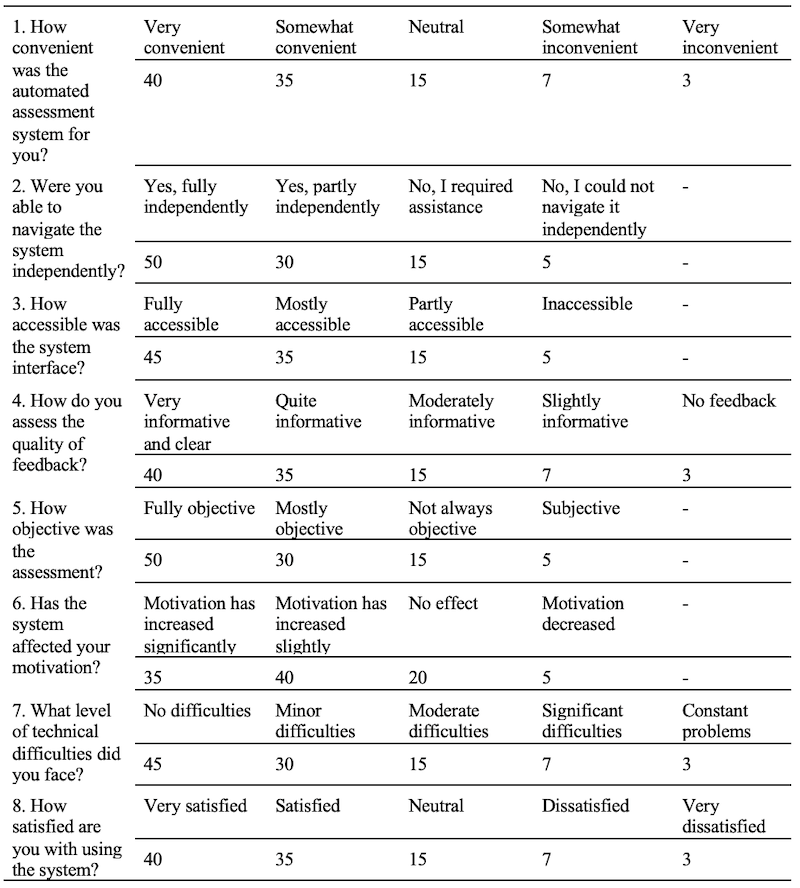
Following implementation, students obtained higher module grades and reported greater satisfaction, autonomy, and interface accessibility (Table 1). The mean grade increased by 9.4 percentage points, from 72.3 to 81.7. Satisfaction increased from 52 to 82, autonomy from 48 to 80, and perceived accessibility from 50 to 85 on the 0–100 scales. These changes describe a more favourable learning and assessment experience within the participating cohort. Paired effect sizes were dz = 0.75 for grades, 1.14 for satisfaction, 1.30 for autonomy, and 1.44 for accessibility.
Table 1: Paired Pre-implementation and Post-implementation Outcomes in the Main-Study Cohort (N = 30)
Source. Authors’ descriptive comparison based on Moodle (this is reported by Moodle, 2025), Canvas Learning Management System (LMS) (2025), Blackboard Learn (2025), Google Forms (2025), Microsoft Forms (2025), Open edX (2025), Classtime (2025), Testportal (2025), Schoology (2025).
Task completion increased by 23 percentage points, from 62% to 85%, and technical-support requests fell from 15 to 5 across the cohort. In practical terms, a larger share of assigned work was completed while fewer requests for technical assistance were recorded. The combined pattern suggests more manageable participation during implementation. Attribution remained bounded by the historical comparison and changing semester conditions.
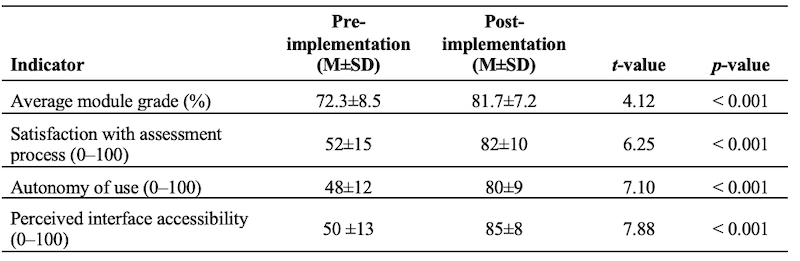
Most participants gave favourable evaluations of the assessment experience (Table 2). The reported positive shares were 75% for convenience, feedback, motivation change, and satisfaction, and 80% for navigation autonomy, accessibility, and perceived objectivity. A 75% share reported either smooth use or minor technical difficulties. For everyday course participation, the pattern indicated generally usable assessment and understandable feedback. The remaining responses identify continuing needs for navigation assistance, clearer feedback, and technical support.
Table 2: Post-implementation Responses (%) to Eight Questionnaire Items in the Study Cohort (N = 30)
Note. Values reproduce the reported descriptive response shares.
Source. Study questionnaire summaries.
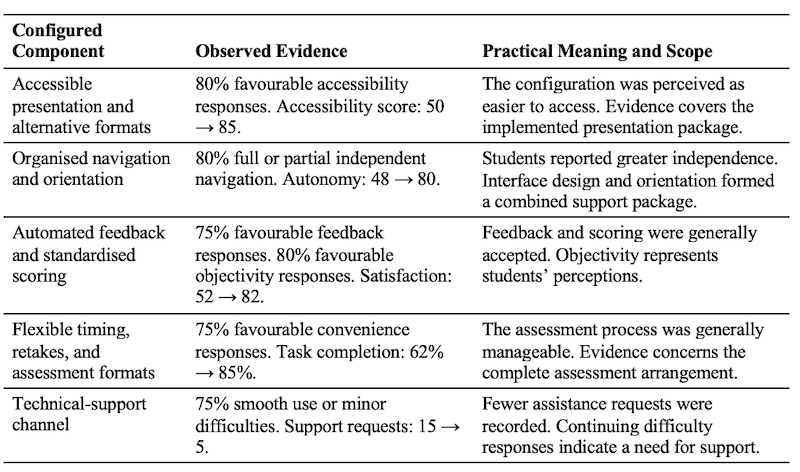
Table 3 explains the practical meaning of the feature-to-outcome pattern. Higher accessibility and autonomy ratings are consistent with the intended purposes of adaptable presentation, organised navigation, and orientation. Favourable feedback and objectivity responses indicate student acceptance of automated scoring and explanations. The evidence concerns the complete implementation package, with feature-specific contributions remaining a question for further evaluation.
Table 3: Configured Assessment Functions and the Practical Meaning of Observed Outcomes
Source. Authors’ synthesis of the configured Moodle components and the main-study results in Tables 1 and 2.
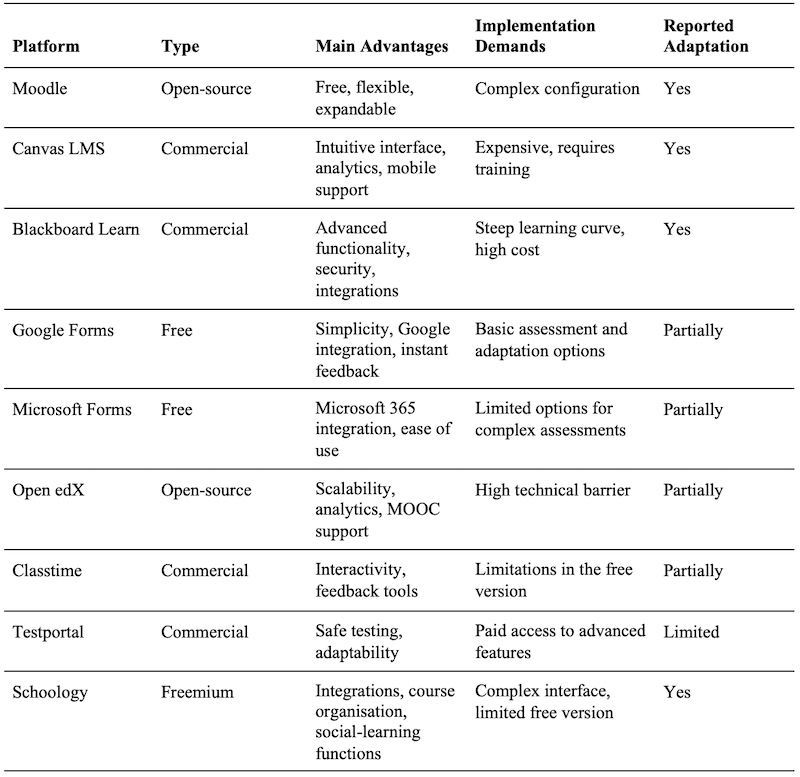
The platform comparison identifies choices relevant to university implementation (Table 4). Comprehensive learning management systems offer broad assessment and adaptation options alongside configuration and training demands. Form-based tools provide simpler deployment and more limited assessment options. The practical choice therefore depends on assessment requirements, accessibility needs, staff capacity, and available resources. The comparison represents documented platform profiles, while the cohort evidence concerns the implemented Moodle configuration.
Table 4: Documented Assessment Platform Characteristics Relevant to Implementation
Source. Authors’ descriptive comparison based on Blackboard Learn (2025), Canvas Learning Management System (LMS) (2025), Class Time (2025), Google Forms (2025), Microsoft Forms (2025), Moodle (2025), Open edX (2025), Schoology (2025), and Testportal (2025).
Moodle received the same maximum documented-feature score as Canvas LMS, Blackboard Learn, Open edX, and Schoology (Table 5). The cohort findings illustrate the use of Moodle’s configurable functions in one course setting. The combined evidence points to an implementation priority: accessible platform features need appropriately prepared course content, student orientation, and responsive support. Documented availability and experienced accessibility provide complementary information. Comparative effectiveness across platforms remains an empirical question.
Table 5: Documented Availability of Accessibility-Related Platform Features
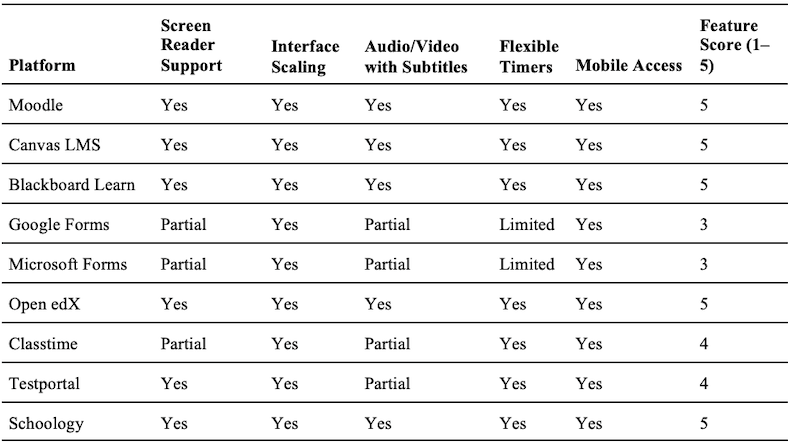
Note. Full support was scored 1 and partial or limited support 0.5; totals were conservatively rounded down to a whole-number score from 1 to 5. Source. Authors’ descriptive scoring based on Blackboard Learn (2025), Canvas Learning Management System (LMS) (2025), Classtime (2025), Google Forms (2025), Microsoft Forms (2025), Moodle (2025), Open edX (2025), Schoology (2025), and Testportal (2025).
The findings connect improved academic participation with a more manageable assessment experience. Higher grades, greater task completion, and reduced technical-support use occurred alongside favourable student evaluations. Lomellini et al. (2025) identified course design, institutional responsibility, and accessibility barriers as central concerns in online learning. Nieminen et al. (2024) place assessment practices at the centre of inclusion, while Nieminen (2026) emphasises student-informed assessment design. The present contribution is a contextual account of academic, operational, and experiential change within a course in Kazakhstan. Semester difficulty, maturation, instructor practices, and familiarity with the platform remain plausible contributors to the observed pattern. The small purposive cohort and historical baseline support an exploratory interpretation specific to this setting.
The joint movement in accessibility and autonomy suggests a useful distinction between access to assessment and ease of independent participation. UDL provides a framework for flexible representation, action, expression, and engagement (CAST, 2018). The Technology Acceptance Model connects adoption with perceived usefulness and ease of use (Davis, 1989). Herrera Nieves et al. (2025) applied a UDL-informed Moodle usability methodology combining accessibility, assistive technology, and student experience. This work supports evaluation of the actual course configuration alongside platform functionality. The present feature matrix identifies plausible alignments between configured functions and experience domains. The bundled implementation leaves the relative contribution of feedback, interface settings, timing, retakes, orientation, and human support open to further study. Favourable objectivity ratings represent perceived fairness, while grading quality requires separate scrutiny.
Student experience also depends on institutional conditions. Rajapakshe et al. (2026) identify platform-design barriers, screen-reader limitations, and gaps in institutional guidance through interviews with visually impaired undergraduates in Sri Lanka. Bartolo et al. (2025) emphasised individualised accommodations and student empowerment. These findings help interpret the residual assistance and technical difficulties reported in the Moodle cohort. Overall positive percentages can coexist with persistent barriers for particular learners. Ogunsakin et al. (2026), analysing large-scale online-platform reviews, similarly associate technical instability and structural access barriers with poorer engagement. That broader platform evidence offers contextual insight, with transfer to disability-specific university assessment requiring careful evaluation. The common implication is that documented platform capabilities need institutional support and testing with diverse students.
The findings support coordinated attention to accessible design, student agency, and responsive support. Utami et al. (2025) identified limited empirical UDL evidence in online disability education and highlighted professional development and resource allocation. The present study adds a small cohort account of implementation while maintaining distinctions between documentary features, administrative outcomes, and student perceptions. Khalil et al. (2024) similarly identified a limited evidence base for disability-focused learning analytics. The practical contribution is an implementation logic linking configurable assessment with orientation and support. A feature score alone supplies limited evidence about everyday accessibility. Independent participation, continuing support needs, and completion patterns provide additional criteria for institutional evaluation.
Institutional implementation should combine documented accessibility requirements with student-led testing of the actual course configuration. Priority checks include screen-reader compatibility, keyboard navigation, contrast, scaling, captioned media, and flexible assessment timing. Staff training and clear responsibility for accessibility review strengthen implementation. Student involvement in identifying persistent barriers provides a practical route from general platform specifications to usable assessment.
At the course level, transparent criteria, understandable feedback, alternative response formats, orientation, and rapid support should accompany automated assessment. Educator review and an accessible appeal route support appropriate interpretation of automated scores. Monitoring should track grades, task completion, accessibility concerns, support requests, and experience indicators together. Where sample size and confidentiality permit, evaluation across disability groups can identify uneven participation hidden within cohort averages. Individualised support also aligns with evidence-based disability education practices (Strnadova et al., 2023).
Further research should use larger multi-university cohorts, established measurement instruments, and prospective designs with contemporaneous comparison groups. Equivalent assessment conditions, confidence intervals, effect sizes, and transparent missing-data reporting would strengthen interpretation. Component-level designs, interviews, and accessibility walkthroughs could distinguish the roles of interface adaptation, timing, feedback, and support. Cross-platform evaluations should use equivalent tasks and assessment criteria.
Allan, J., & Omarova, T. (2022). Disability and inclusion in Kazakhstan. Disability & Society, 37(7), 1067–1084. https://doi.org/10.1080/09687599.2020.1867073
American Sociological Association. (1997). Code of ethics. https://www.asanet.org/about/ethics/
Assanbayev, A., & Makoel, T.M. (2024). Practices promoting the inclusion of adult students with disabilities in classes: A case study of the College of Technical Vocational Education and Training in Kazakhstan. Education Sciences, 14(5), 529. https://doi.org/ 10.3390/educsci14050529
Aubakirova, R., Zhomartova, A., Nurgalieva, M., Tulekova, G., Tursungozhinova, G., Skyba, M., & Belenko, O. (2025). Improvement of psychological and educational support for university students with disabilities in Kazakhstan. Qubahan Academic Journal, 5(1), 150–158. https://doi.org/10.48161/qaj.v5n1a1063
Bartolo, P.A., Borg, M., Callus, A-M., Camilleri, L., De Gaetano, A., Mangiafico, M., Mazzacano D’Amato, E., Sammut, C., Vidal, R.V., & Vincent, J. (2025). Students with disabilities in higher education call for personal empowerment, equitable inclusive systems, and individualized accommodations. Frontiers in Education, 10, 1432682. https://doi.org/10.3389/feduc.2025.1432682
Blackboard Learn. (2025). https://www.anthology.com/products/teaching-and-learning/learning-effectiveness/blackboard
Canvas Learning Management System (LMS). (2025). https://www.instructure.com/canvas
CAST. (2018). Universal design for learning guidelines version 2.2. CAST. https://udlguidelines.cast.org
Classtime. (2025). https://www.classtime.com/uk
Davis, F.D. (1989). Perceived usefulness, perceived ease of use, and user acceptance of information technology. MIS Quarterly, 13(3), 319–340. https://doi.org/10.2307/249008
Google Drive. (2025). https://workspace.google.com/intl/ru/products/drive/
Google Forms. (2025). https://docs.google.com/forms/u/0/
Google Sheets. (2025). https://docs.google.com/spreadsheets
Herrera Nieves, L., Crisol Moya, E., & Montes Soldado, R. (2025). Moodle usability assessment methodology using the universal design for learning perspective. Turkish Online Journal of Distance Education, 26(3), 238–255. https://doi.org/10.17718/tojde.1510242
Human Rights Watch. (2019, March 14). “On the Margins”: Education for children with disabilities in Kazakhstan. Human Rights Watch. https://www.hrw.org/report/2019/03/14/margins/education-children-disabilities-kazakhstan
Khalil, M., Slade, S., & Prinsloo, P. (2024). Learning analytics in support of inclusiveness and disabled students: A systematic review. Journal of Computing in Higher Education, 36(1), 202–219. https://doi.org/10.1007/s12528-023-09363-4
Li, L., Xu, L.D., He, Y., Vin, W., Pribesh, S., Watson, S.M., & Major, D.A. (2021). Promoting online learning with Zoom breakout room technology: An example of pair programming with students with learning disabilities. Communications of the Information Systems Association, 48, 88–100. https://doi.org/ 10.17705/1CAIS.04812
Lomellini, A., Lowenthal, P.R., Snelson, C., & Trespalacios, J.H. (2025). Accessible and inclusive online learning in higher education: A review of the literature. Journal of Computing in Higher Education, 37(3), 1306–1329. https://doi.org/10.1007/s12528-024-09424-2
Meleo-Erwin, Z., Collia, B., Fera, J., Jaren, A., & Bash, K. (2021). Information on online support for students with disabilities in colleges and universities during the COVID-19 pandemic. Disability and Health Journal, 14(1), 101013. https://doi.org/ 10.1016/j.dhjo.2020.101013
Microsoft 365 Corporation. (2025). https://www.microsoft.com/uk-ua/microsoft-365
Microsoft Forms. (2025). https://forms.office.com/
Microsoft Teams. (2025). https://www.microsoft.com/uk-ua/microsoft-teams/log-in
Moodle. (2025). Moodle learning management system. https://moodle.org/?lang=uk
Navas-Bonilla, C. del R., Guerra-Arango, J.A., Oviedo-Guado, D.A., & Murillo-Noriega, D.E. (2025). Inclusive education through technology: A systematic review of types, tools and characteristics. Frontiers in Education, 10, 1527851. https://doi.org/10.3389/feduc.2025.1527851
Nieminen, J.H. (2026). Inclusive assessment design: Students with disabilities speak out. Higher Education Research & Development, 45(4), 1047–1062. https://doi.org/10.1080/07294360.2025.2564995
Nieminen, J.H., Moriña, A., & Biagiotti, G. (2024). Assessment as a matter of inclusion: A meta-ethnographic review of the assessment experiences of students with disabilities in higher education. Educational Research Review, 42, 100582. https://doi.org/10.1016/j.edurev.2023.100582
Ogunsakin, R., Okonu, D., & Nwokeocha, P. (2026). Beyond MOOCs: How technical and structural factors shape learner engagement, retention and inclusivity across online learning platforms. British Journal of Educational Technology, 57(5), 1348–1373. https://doi.org/10.1111/bjet.70066
OneDrive. (2025). https://www.microsoft.com/uk-ua/microsoft-365/onedrive/online-cloud-storage
Open edX. (2025). https://openedx.org/
Petretto, D.R., Karta, S.M., Cataudella, S., Masala, I., Massia, M.L., Penna, M.P., Piras, P., Pistis, I., & Masala, K. (2021). Use of distance and e-learning in students with learning disabilities: An overview of the effects and some hint of usage analysis during the COVID-19 outbreak. Clinical Practice and Epidemiology in Mental Health, 17, 92–102. https://doi.org/ 10.2174/1745017902117010092
Rajapakshe, W., Wickramaarachchi, C., Alwis, M.K.S., Amarasinghe, A.A.M.L., Jayasekara, P.N., & Jayasekara, P.T. (2026). Accessibility and usability of virtual learning platforms: Lived experiences of visually impaired undergraduates in Sri Lanka. Social Sciences & Humanities Open, 13, 102621. https://doi.org/10.1016/j.ssaho.2026.102621
Reyes, J., Menezes, J., & Melian, E. (2022). A systematic review of academic interventions for students with disabilities in online higher education. European Journal of Special Needs Education, 37(4), 569–586. https://doi.org/ 10.1080/08856257.2021.1911525
Schoology. (2025). https://app.schoology.com/login?destination=home
Strnadova, I., Danker, J., Dawse, L., & Tso, M. (2023). Supporting students with disabilities to improve academic, social, and emotional, as well as self-determination and life skills outcomes: A general review of evidence-based practices. International Journal of Inclusive Education, 28(14), 3606–3622. https://doi.org/ 10.1080/13603116.2023.2221239
Testportal. (2025). https://www.testportal.net/
UNICEF. (2023). 75% of children with disabilities in Eastern and Central Europe and Central Asia are left out of education. UNICEF. https://www.unicef.org/kazakhstan/en/press-releases/75-children-disabilities-eastern-and-central-europe-and-central-asia-left-out
Utami, I.S., Ghufron, A., & Ishartiwi, I. (2025). Universal design for learning in online education: A systematic review of evidence-based practice for supporting students with disabilities. International Journal of Learning, Teaching and Educational Research, 24(3), 94–116. https://doi.org/10.26803/ijlter.24.3.5
Uyzbayeva, A., Abdina, A., Zhanarstanova, M., & Kospakov, A. (2025). The philosophy of equal opportunities: Assistive technologies in the context of inclusive higher education in Kazakhstan. Journal of Philosophy, Culture and Political Science, 92(2). https://doi.org/10.26577/jpcp20259221
Zárate-Rueda, R., Lésmez Peralta, J.C., & Beltrán Villamizar, Y.I. (2025). Technological tools and inclusive pedagogy for students with disabilities in higher education: A systematic review. Revista de Investigación Educativa, 43. https://doi.org/10.6018/rie.590831
Zhanarstanova, M. (2026). Beyond formal equality: Institutionalizing inclusion in Kazakhstan’s higher education through policy and student perceptions. Frontiers in Education, 11, 1893012. https://doi.org/10.3389/feduc.2026.1893012
Zhao, S. (2025). The use of generative AI by students with disabilities in higher education. The Internet and Higher Education, 66, 101014. https://doi.org/10.1016/j.iheduc.2025.101014
Zoom. (2025). https://zoom.us/download
Author Notes
Albina Kazanbayeva, PhD, teaches at the Department of Science, M. Kozybayev North Kazakhstan University, Petropavlovsk, Republic of Kazakhstan. Her research focuses on inclusive digital education and automated assessment for students with disabilities. Email: kazanbayevaalbina@gmail.com (https://orcid.org/0000-0002-3077-3499)
Kainizhamal Iklassova, PhD, is an Associate Professor at the Department of Information and Communication Technologies, M. Kozybayev North Kazakhstan University, Petropavlovsk, Republic of Kazakhstan. Her research interests include educational technologies and digital tools that support accessible online learning. Email: K.Iklassova@outlook.com (https://orcid.org/0000-0002-8330-4282)
Akerke Akanova, PhD, is a Senior Lecturer at the Department of Computer Science, S. Seifullin Kazakh Agro Technical Research University, Astana, Republic of Kazakhstan. Her research interests include computer science applications in education and adaptive learning environments. Email: A-Akanova@outlook.com (https://orcid.org/0000-0002-7178-2121)
Sayat Moldakhmetov, PhD, is an Associate Professor at the Department of Energetic and Radioelectronics, M. Kozybayev North Kazakhstan University, Petropavlovsk, Republic of Kazakhstan. His research interests include technical and engineering aspects of digital systems used in online education. Email: sayat_moldakhmetov@hotmail.com (https://orcid.org/0000-0003-2432-7983)
Nurbol Kaliaskarov, PhD, is the Acting head, Department of Technology of Communication Systems, Abylkas Saginov Karaganda Technical University, Karaganda, Republic of Kazakhstan. His research interests include communication technologies and their use in supporting distance learning. E Email: nurbolkaliaskarov@hotmail.com (https://orcid.org/0000-0003-3684-1488)
Cite as: Kazanbayeva. A., Iklassova. K., Akanova, A., Moldakhmetov, S., & Kaliaskarov, N. (2026). Moodle-based automated assessment in online education for university students with disabilities. Journal of Learning for Development, 13(4), 691-703.
DOI: https://doi.org/10.56059/869cv838