Ulpan Toikenova, Serik Kenesbayev, Kamalbek Berkimbayev, Indira Salgozha and Zhadyra Kazhiakparova
2026 VOL. 13, No. 3
Abstract: This study examined the value of integrating gamification into lower-secondary computing education. A mixed-methods design combined theoretical analysis, student surveys, interactive lesson development, and a three-month school-based quasi-experiment. The sample comprised 120 students from three schools in Kazakhstan, equally divided into experimental and control groups. The experimental group received gamified computing instruction, whereas the control group followed conventional teaching. Students exposed to gamification showed stronger outcomes across motivation, subject knowledge, and problem-solving: 45% reached a high motivation level compared with 20% in the control group, 40% achieved a high level of subject knowledge compared with 25%, and 50% attained a high level of problem-solving compared with 30%. The findings also indicate that gamification supported teamwork, critical thinking, and algorithmic reasoning. The study concludes that interactive tasks, reward systems, and collaborative and competitive learning formats can increase the effectiveness and attractiveness of computing instruction when aligned with educational objectives for students.
Keywords: pedagogical approach, game-based methods, computing education, motivation, digital competence, secondary education
Computing education at the lower-secondary level requires students to understand abstract concepts, apply algorithmic reasoning, and solve practical problems. However, students may perceive computing tasks as difficult or insufficiently engaging, which can reduce motivation, participation, independence, and learning performance. Gamification offers a potential response by integrating points, badges, narratives, progress levels, immediate feedback, competition, and collaboration into curriculum-based instruction. The research problem addressed in this study was the limited empirical evidence regarding the effectiveness of a coherent gamified instructional model within Kazakhstan’s nationally regulated lower-secondary computing curriculum. The independent variable was the instructional approach, comprising gamified instruction in the experimental group and conventional instruction in the control group. The dependent variables were student motivation, engagement, attitudes towards computing, perceived task accessibility, independence in task completion, conceptual understanding, practical application of knowledge, and creative performance.
Accordingly, this study examined whether a three-month gamified computing intervention produced stronger motivational, behavioural, and academic outcomes than conventional teaching among students in Grades 5–7.
Gamification has been used to integrate game-design elements into education to improve motivation, engagement, and learning. Earlier studies generally reported positive outcomes, although their settings and methods differed considerably.
Recent evidence has made the picture more critical. Simsek and Karakus Yilmaz (2025) found generally positive cognitive and affective effects but substantial variation across online-learning studies. Gini et al. (2025), Papadakis et al. (2026), and Niyazova et al. (2026) further indicated that outcomes depended on pedagogical alignment, personalisation, feedback, and context rather than rewards alone. Pereira Perez et al. (2026) also showed that learner responses to competition and cooperation differed, questioning the assumption that identical game elements motivate all students equally.
Three gaps, therefore, remained. First, much previous evidence came from higher, vocational, informal, or online education rather than lower-secondary computing. Second, many studies examined isolated platforms or outcomes rather than coherent curriculum-level models. Third, evidence from Kazakhstan remained limited, particularly studies assessing motivational, behavioural, and academic outcomes together. The present study addressed these gaps by implementing a three-month curriculum-aligned gamification model in three Kazakhstani schools. It compared gamified and conventional instruction and assessed motivation, engagement, attitudes, independence, conceptual understanding, practical application, and creative performance within the same quasi-experimental design.
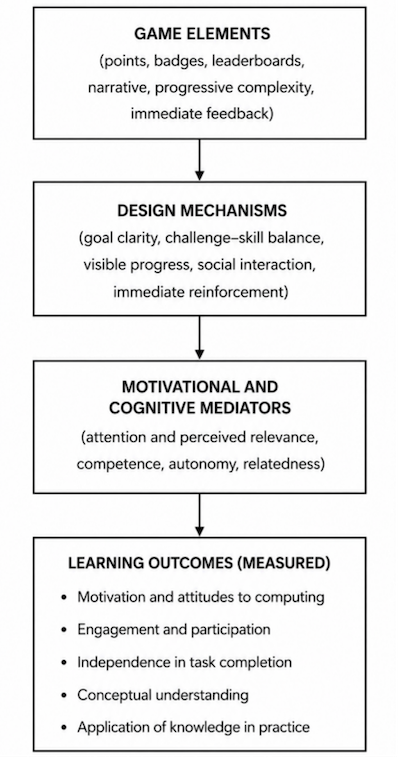
The conceptual framework integrated Self-Determination Theory and Flow Theory to explain how gamification elements influenced learning through motivational and cognitive mechanisms. Points, badges, leaderboards, and immediate feedback were intended to strengthen perceived competence by making progress visible, while narrative tasks and clear goals supported attention and relevance. Progressive complexity maintained the balance between challenge and ability associated with flow, whereas collaborative and competitive activities supported relatedness and participation, and opportunities for independent task completion supported autonomy. Through these mechanisms, gamified instruction was expected to enhance motivation, engagement, attitudes towards computing, independence, conceptual understanding, practical application, and creative problem-solving.
The current study aimed to develop and evaluate a curriculum-aligned model of gamification for lower-secondary computing education and to compare gamified and conventional instruction in terms of students’ motivational, behavioural, attitudinal, and academic outcomes. To attain the stated objective, the study addressed the following questions:
The study used a mixed-methods quasi-experimental design to evaluate a curriculum-aligned gamification intervention conducted from September to November, 2024. The sample comprised 120 students aged 11–13 years from three Kazakhstani schools, with 60 students in the experimental group and 60 in the control group. Intact classes were allocated by cluster because individual randomisation was not feasible. Quantitative evidence was obtained from questionnaires and diagnostic assessments, while qualitative evidence came from student assignments, classroom observations, teacher checklists, and post-intervention feedback. Self-Determination Theory and Flow Theory informed the intervention design.
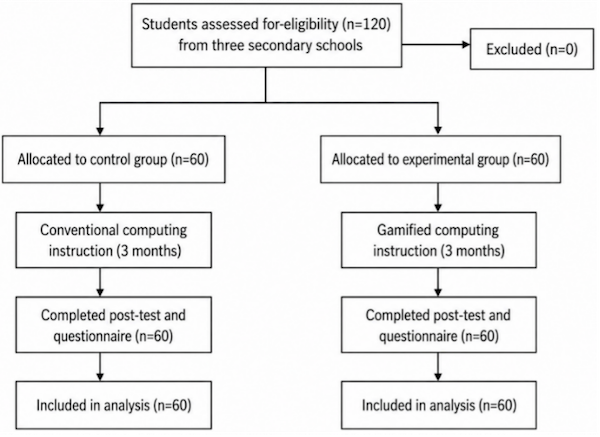
The sample comprised 120 students aged 11–13 years in Grades 5–7 from three Kazakhstani schools: Lyceum No. 24, Secondary School named after Zhamenke Batyr, and Gymnasium No. 15 in Almaty. Cluster sampling was used to select intact classes representing different school types and urban/semi-urban contexts. Participants included 50 boys and 70 girls and were divided equally between the experimental and control groups (n = 60 each). Baseline records, diagnostic assessments, and questionnaires showed no significant group differences in prior achievement, grade level, gender composition, or motivation (p >.05). Participant flow is shown in Figure 1.
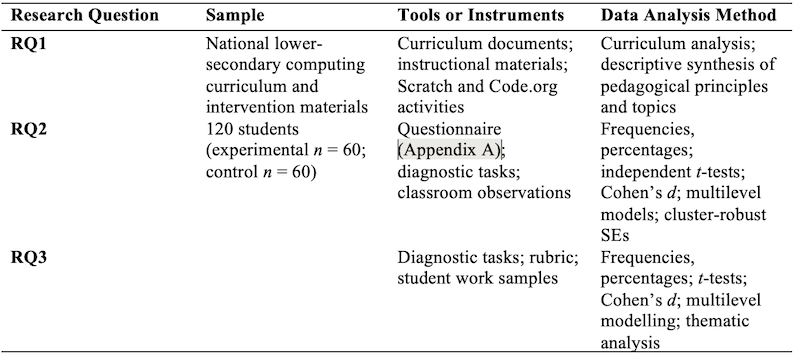
The tools, instruments, and analytical procedures were selected according to the three research questions. RQ1 was addressed through curriculum and instructional-design analysis, while RQ2 and RQ3 were addressed through quantitative comparisons supported by qualitative evidence. Table 1 summarises the alignment between research questions, samples, instruments, and data-analysis methods.
Table 1: Alignment of Research Questions, Samples, Instruments, and Data-Analysis Methods
A researcher-developed questionnaire was administered before and after the intervention via Google Forms. Learning outcomes were assessed using curriculum-aligned diagnostic tasks covering understanding, application, creativity, engagement, and independence. Common rubrics ensured consistency across schools. Creativity was scored using an analytic rubric (correctness, complexity, originality, completion). Two trained raters independently scored samples after calibration. Additional data came from classroom observations, teacher checklists, student work, and feedback, used to assess fidelity, engagement, independence, and problem-solving. Scratch and Code.org were the main platforms. Gamified activities included levels, points, badges, leaderboards, feedback, and collaborative tasks. The links between game elements, instructional mechanisms, and outcomes are shown in Figure 2.
Before data collection, the protocol was approved by the participating schools’ ethics committee in accordance with requirements. Participation was voluntary, withdrawal was permitted, written consent was obtained from students and their parents or guardians, and all data were anonymised, confidential, and used for academic purposes. The study proceeded in three stages:
RQ1 examined which pedagogical principles, instructional approaches, and computing topics provided an appropriate framework for curriculum-aligned gamification. The curriculum and instructional-design analysis produced three principal findings. First, seven pedagogical principles were identified: motivation and encouragement, individualised learning, competition and collaboration, immediate feedback, progressive complexity, interactivity, and sustained engagement. These principles defined how gamification was incorporated into instruction rather than treating points or rewards as isolated additions. Second, five complementary instructional approaches were identified as suitable for implementing these principles: project-based, problem-based, thematic, computer-assisted, and scenario-based learning. They enabled game elements to be linked directly to learning objectives through progressively structured, interactive, and collaborative tasks. Third, algorithms and loops, programming, database management, multimedia technologies, and computer networks were identified as the most suitable curriculum areas because they allowed students to produce visible outputs, test solutions, receive immediate feedback, and revise their work through iterative problem-solving. The analysis also identified Scratch, Code.org, CodeCombat, Tynker, and Minecraft: Education Edition as potentially suitable digital environments; the intervention itself principally used Scratch and Code.org.
These findings collectively answered RQ1 by establishing a framework in which pedagogical principles determined the design of instruction, instructional approaches determined how activities were organised, and computing topics provided the curricular contexts in which gamification was implemented. This framework was subsequently operationalised in the experimental intervention through narrative tasks, progressive challenges, feedback, rewards, and collaborative or competitive activities. RQ1 therefore established what was implemented and how it was pedagogically structured, while RQ2 and RQ3 evaluated the outcomes of that framework. RQ2 examined whether the intervention was associated with differences in motivation, engagement, attitudes, task accessibility, and independence, whereas RQ3 examined differences in conceptual understanding, practical application, creative performance, and overall computing achievement. Thus, the findings for RQ2 and RQ3 provided the empirical evaluation of the curriculum-aligned framework identified under RQ1.
To establish whether the experimental and control groups entered the study with comparable attitudes towards computing, baseline questionnaire responses were summarised using frequencies and percentages. Table 2 presents students’ initial interest in computing, perceptions of task difficulty, preferences for engaging and varied instructional formats, participation, attitudes towards group work, and views of interactive learning. Particular attention was given to whether either group displayed a clear pre-intervention advantage that could account for subsequent differences.
Table 2: Questionnaire Results at the Beginning of the Experiment
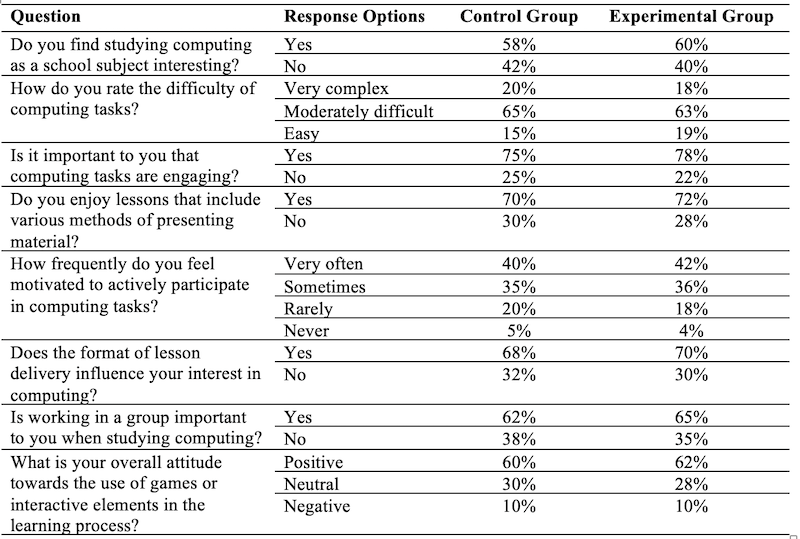
The groups showed similar baseline distributions across interest, task difficulty, participation, lesson-format preferences, and attitudes towards games and group work. Motivation also did not differ significantly (p = .67), indicating broadly comparable starting conditions. Table 3 presents the distributions for conceptual understanding, practical and creative application of knowledge, engagement, and independence. The table was used to determine whether gamified instruction produced an overall upward shift in performance rather than an isolated improvement in a single outcome.
Table 3: Test Results Following the Experiment

Note: the assessments are curriculum-aligned, teacher-administered diagnostic tasks, and reliability was ensured through shared task specifications, structured scoring rubrics, acceptable internal consistency for questionnaire measures, and satisfactory inter-rater agreement for performance scoring.
The most salient behavioural pattern was the redistribution of the experimental group towards the high and sufficient levels of engagement and independence. At the same time, fewer experimental-group students remained at the average and basic levels. This pattern suggests a broad group-level improvement rather than a benefit confined to students who were already highly engaged. The findings for independence were especially important. Students exposed to gamified instruction were more frequently able to progress through tasks, respond to feedback, and correct errors without continuous teacher intervention. Classroom observations and assignment analysis supported this interpretation: experimental-group students persisted more often after unsuccessful attempts, assumed clearer responsibility for collaborative roles, and relied less heavily on direct guidance.
Table 4 presents the final distributions for interest, perceived task accessibility, participation, lesson-format preferences, group work, and attitudes towards interactive elements.
Table 4: Results of the Questionnaire at the End of the Experiment
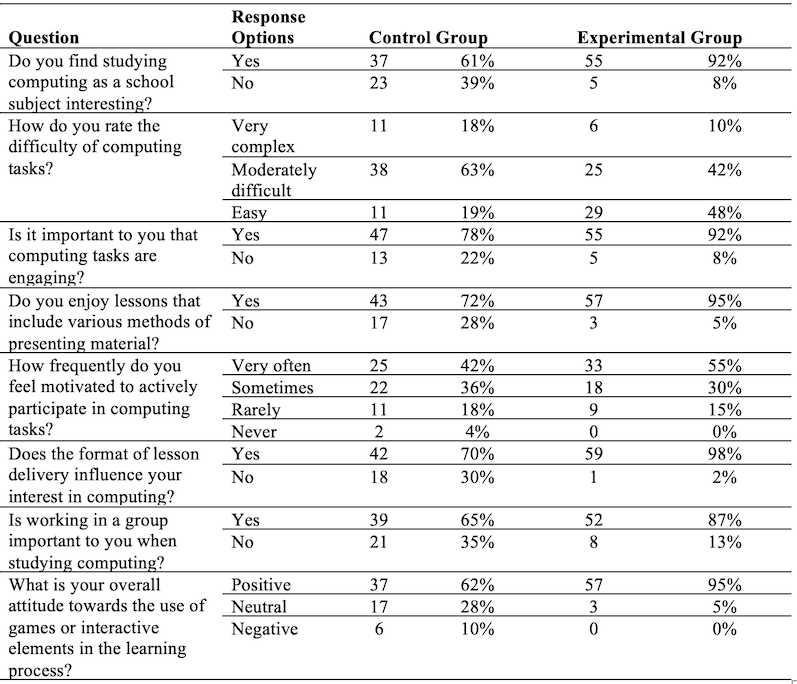
Table 4 presents a clear descriptive pattern in the experimental group following the intervention. A greater proportion of students reported more positive attitudes towards computing, higher perceived task accessibility, stronger preferences for varied lesson formats and collaborative work, as well as more favourable views of games and interactive learning elements. In contrast, the control group exhibited only minor changes across the same indicators. These results describe the post-intervention response patterns and provide context for the subsequent analysis, while the statistical significance of these differences is examined in Table 5.
Table 5: Independent-samples t-Test Results for Post-Intervention Outcomes
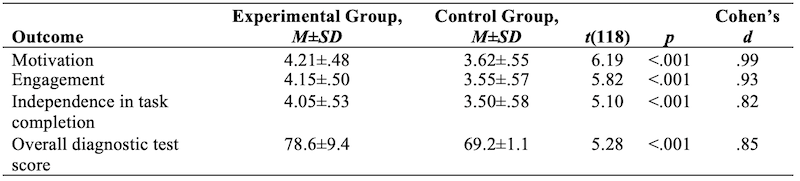
Table 5 confirms that the experimental group performed significantly better across all tested outcomes. Motivation showed the largest between-group difference, followed by engagement, and independence in task completion. The consistently large effect sizes indicate that the intervention was associated with a broad motivational and behavioural advantage rather than an isolated improvement in one outcome. The descending pattern from motivation to engagement and independence suggests that the strongest difference concerned students’ willingness to participate, accompanied by substantial differences in active involvement and autonomous task completion. The same pattern extended to overall diagnostic performance: the experimental group achieved a higher mean score than the control group. Thus, the inferential results showed that the differences were not limited to students’ perceptions or participation but were also evident in overall academic performance. The motivation, engagement, and independence findings directly addressed RQ2, while the diagnostic-score difference provided inferential evidence relevant to RQ3.
RQ3 was addressed using descriptive distributions for conceptual understanding, practical application, and creative performance, alongside an independent-samples t-test of the overall diagnostic score, Cohen’s d, and thematic analysis of assignments. The experimental group showed a consistent shift towards higher performance levels, particularly in practical and creative application. Assignment analysis likewise indicated more frequent use of alternative solutions, error correction, and original elements. These dimension-specific findings were descriptive. The overall diagnostic score provided inferential evidence: the experimental group scored significantly higher (M = 78.6, SD = 9.4) than the control group (M = 69.2, SD = 1.1), t(118) = 5.28, p < .001, d = .85, indicating a large between-group difference in overall computing achievement.
Taken together, the three RQs produced a coherent set of findings. RQ1 identified a curriculum-aligned framework based on seven pedagogical principles, five complementary instructional approaches, and computing topics suited to interactive and iterative learning. RQ2 showed significant and large differences in motivation, engagement, and independence in favour of the experimental group. RQ3 showed a significant advantage in overall diagnostic performance, alongside descriptive improvements in conceptual understanding, practical application, and creativity. In practical terms, the findings suggest that a structured gamified computing model was associated not only with more positive and active participation but also with stronger overall learning performance.
The findings indicated that the gamified group outperformed the control group in motivation (d = .99), engagement (d = .93), independence (d = .82), and overall diagnostic performance (d = .85). These large between-group differences were consistent with evidence that game-based computing activities can support terminology learning, programming knowledge, critical thinking, and problem-solving (Kaldarova et al., 2023; Srinivasa et al., 2024; Videnovik et al., 2023). Singh (2023) reported similar practice-based observations, although this non-peer-reviewed source provided weaker evidence than controlled empirical studies. Importantly, the present results suggested that the intervention was associated not only with greater interest but also with more independent task completion and stronger academic performance.
The pattern was better interpreted as an effect of the overall instructional configuration than of rewards alone. Visible progress, immediate feedback, progressive complexity, narrative tasks, and collaborative challenges were implemented together and may have made difficult computing tasks more manageable while increasing opportunities for error correction and peer support. This interpretation was consistent with work on virtual robotics and cybersecurity (Kilic & Gökoğlu, 2022; Starnari et al., 2024) and with research linking interactive and collaborative gamification with engagement (Szabó & Kopinska, 2023). It also agreed with recent studies arguing that gamification is most effective when game elements are pedagogically aligned with learning objectives, active learning, personalisation, and collaboration rather than treated as stand-alone incentives (Almufarreh, 2026; Gini et al., 2025; Niyazova et al., 2026; Papadakis et al., 2026).
The experimental group also showed stronger practical and creative application, consistent with research on interactive and simulated learning environments (Kilic & Gökoğlu, 2022; Videnovik et al., 2023). However, these domain-specific differences were descriptive, while inferential testing concerned the overall diagnostic score. The quasi-experimental design also limited inference. Allocation by intact classes, the three-month intervention, and the three-school sample mean that residual class or school effects, long-term persistence, and broader generalisability cannot be established.
The study nevertheless added context-specific evidence from Kazakhstan, where infrastructure, connectivity, teacher readiness, and workload can influence implementation (Katyetova, 2023; Sanmugam, 2021). Gamification should therefore be treated as a curriculum-design strategy rather than a universal solution. Scale-up should depend on teacher preparation, common assessment criteria, technical support, and monitoring of implementation fidelity. This caution is reinforced by Palmquist and Gunnars (2026), who found that increased learner autonomy might also increase teachers’ monitoring and feedback demands.
The findings have potential relevance for ODeL because visible progress, structured sequences, immediate feedback, and independent task completion can support self-regulated participation when direct teacher contact is limited. This interpretation is compatible with evidence from online gamification (Nieto-Escámez & Roldán-Tapia, 2021; Simsek & Karakus Yilmaz, 2025). However, ODeL was not directly tested; these implications should therefore be treated as transferable design principles rather than demonstrated effects. Online implementations should retain pedagogical support, accessible alternatives to competition, low-bandwidth materials, and formative feedback.
Future studies should use larger multicentre samples, randomised or matched designs, longer follow-up, and component-level comparisons. Mediation analysis could test whether motivation, engagement, or independence explains academic improvement, while objective platform data could complement self-report measures. Further work should also examine learner differences, teacher workload, implementation fidelity, and the equity, transparency, privacy, and bias implications of adaptive or AI-supported gamification.
Data Availability: The data that support the findings of this study are available on request from the corresponding author.
Almufarreh, A. (2026). Gamification in education and its impact on student academic performance: A conceptual model based on systematic literature review and PLS-SEM analysis. Algorithms, 19(2), Article 143. https://doi.org/10.3390/a19020143
Alsadoon, E., Alkhawajah, A., & Bin Suhaim, A. (2022). Effects of a gamified learning environment on students‘ achievement, motivations, and satisfaction. Heliyon, 8(8), Article e10249. https://doi.org/10.1016/j.heliyon.2022.e10249
Andrunyk, V., & Shestakevych, T. (2023). Designing an educational project with a social impact. In Proceedings of the 18th International Conference on Computer Science and Information Technologies (pp. 1-5). IEEE. https://doi.org/10.1109/CSIT61576.2023.10324227
Dahalan, F., Alias, N., & Shaharom, M.S. (2024). Gamification and game-based learning for vocational education and training: A systematic literature review. Education and Information Technologies, 29, 1279-1317. https://doi.org/10.1007/s10639-022-11548-w
Ermakan, N.A., Ualikhanova, B.S., Rakhashev, B.K., & Ramazanova, S.A. (2024). Effectiveness of the gamification method in the process of phenomenon-based learning in secondary school (in the example of Kazakhstan). Journal of Ecohumanism, 3(8), 1330–1344. https://doi.org/10.62754/joe.v3i8.4814
Gatzoulis, C., Andreou, A.S., Zaharias, P., & Chrysanthou, Y. (2022). Using epistemic game development to teach software development skills. In Research anthology on agile software, software development, and testing (pp. 861–883). IGI Global. https://doi.org/10.4018/978-1-6684-3702-5.ch043
Gini, F., Bassanelli, S., Bonetti, F., Mogavi, R.H., Bucchiarione, A., & Marconi, A. (2025). The role and scope of gamification in education: A scientometric literature review. Acta Psychologica, 259, Article 105418. https://doi.org/10.1016/j.actpsy.2025.105418
Kaldarova, B., Omarov, B., Zhaidakbayeva, L., Tursynbayev, A., Beissenova, G., Kurmanbayev, B., & Anarbayev, A. (2023). Applying game-based learning to a primary school class in computer science terminology learning. Frontiers in Education, 8, Article 1100275. https://doi.org/10.3389/feduc.2023.1100275
Katyetova, A. (2023). Teaching computer science in Kazakhstan primary schools: Current state, problems and perspectives. In Proceedings of the 17th International Technology, Education and Development Conference (pp. 2524-2531). IATED. https://doi.org/10.21125/inted.2023.0710
Kilic, S., & Gökoğlu, S. (2022). Exploring the usability of virtual robotics programming curriculum for robotics programming teaching. Informatics in Education, 21(3), 523-540. https://doi.org/10.15388/infedu.2022.20
Lakhonmoon, T., Rutanatarntong, Y., & Noisombut, T. (2025). Developing the Kid-Bright board for controlling lamps and fans as game-based learning for twelfth-grade students. Journal of Education and Learning, 19(2), 1074-1082. https://doi.org/10.11591/edulearn.v19i2.21060
Ministry of Justice, Republic of Kazakhstan (2018). Order of the Minister of Education and Science of the Republic of Kazakhstan No. 604 "On Approval of State Compulsory Educational Standards for All Levels of Education". https://adilet.zan.kz/eng/docs/V1800017669
Nieto-Escámez, F.A., & Roldán-Tapia, M.D. (2021). Gamification as online teaching strategy during COVID-19: A mini-review. Frontiers in Psychology, 12, Article 648552. https://doi.org/10.3389/fpsyg.2021.648552
Niyazova, G.Z., Duisekeyeva, B.M., Berdi, D.K., Usembayeva, I.B., & Mindetbayeva, A.A. (2026). The effects of gamified AI-supported digital learning environments on personalized learning and student engagement in school education: A systematic review and meta-analysis. Frontiers in Education, 11, Article 1754080. https://doi.org/10.3389/feduc.2026.1754080
Palmquist, A., & Gunnars, F. (2026). Teacher framing of educational gamification in online learning environments: A longitudinal case study. Technology, Knowledge and Learning. Advance online publication. https://doi.org/10.1007/s10758-026-10004-9
Papadakis, S., Karaköse, T., Yirci, R., Tülübaş, T., & Demir, I. (2026). From gamification to student achievement: A longitudinal conceptual structure analysis of a research field. Computers, 15(4), Article 242. https://doi.org/10.3390/computers15040242
Pereira Perez, F., Oliveira, W., Corrêa de Lima, A., de Castro Junior, A.A., & Hamari, J. (2026). “I was more wanting to stay first”: Competition-and cooperation-based gamification as a computing education pedagogy. Technology, Knowledge and Learning. https://doi.org/10.1007/s10758-026-09997-0
Salaberri, M., Gil, M., & Sylla, C. (2021). GamAll: Playing beyond boundaries – Gamification and multimodal literacy. In E.I. Brooks, A. Brooks, C. Sylla, & A. Kalsgaard Møller (Eds.), Design, learning, and innovation (pp. 109-118). Springer. https://doi.org/10.1007/978-3-030-78448-5_10
Sanmugam, M. (2021). Sustainability and aptness of game elements in a gamified learning environment. In Proceedings of the 9th International Conference on Information and Communication Technology (pp. 500-505). IEEE. https://doi.org/10.1109/ICoICT52021.2021.9527499
Simsek, E., & Karakus Yilmaz, T. (2025). A systematic review of the effects of gamification in online learning environments on learning outcomes. Open Praxis, 17(1), 166-183. https://doi.org/10.55982/openpraxis.17.1.692
Singh, S. (2023, September 16). Gamification in computer science education: A fun and engaging way to learn. LinkedIn. https://www.linkedin.com/pulse/gamification-computer-science-education-saumya-singh
Srinivasa, K.G., Singh, A., & Chauhan, K.K. (2024). A gamified learning framework to cultivate critical thinking skills in students. IEEE Transactions on Education, 67(6), 931-943. https://doi.org/10.1109/TE.2024.3431872
Starnari, B.F., Suárez, G., Queiruga, C., & Venosa, P. (2024). The CTFd tool adapted to cybersecurity teaching in schools. In Latin American Computer Conference (pp. 1-7). IEEE. https://doi.org/10.1109/CLEI64178.2024.10700203
Szabó, F., & Kopinska, M. (2023). Gamification in foreign language teaching: A conceptual introduction. Hungarian Educational Research Journal, 13(3), 418-428. https://doi.org/10.1556/063.2023.00202
Videnovik, M., Vold, T., Kiønig, L., Bogdanova, A., & Trajkovik, V. (2023). Game-based learning in computer science education: A scoping literature review. International Journal of STEM Education, 10, Article 54. https://doi.org/10.1186/s40594-023-00447-2
Yazdi, A., Karimi, A., & Mystakidis, S. (2024). Gamification in online education: A visual bibliometric network analysis. Information, 15(2), Article 81. https://doi.org/10.3390/info15020081
Zhang, F., Brynildsrud, H., Papavlasopoulou, S., Sharma, K., & Giannakos, M. (2023). Experiverse: Exploring an experiment-based gamification application for motivating children to science learning in an informal setting. In LDT ‘23: Proceedings of the 2023 Symposium on Learning, Design and Technology (pp. 70-78). Association for Computing Machinery. https://doi.org/10.1145/3594781.3594799
Zhao, Q. (2021). Research on the influence of computer information technology on rural preschool education. Journal of Physics: Conference Series, 1915, Article 032066. https://doi.org/10.1088/1742-6596/1915/3/032066
Zsigmond, I., Bocicor, M., & Molnar, A. (2020). Gamification based learning environment for computer science students. In Proceedings of the 15th International Conference on Evaluation of Novel Approaches to Software Engineering (pp. 556-563). ENASE. https://doi.org/10.5220/0009579305560563
Author Notes
Ulpan Toikenova is a Doctoral Student at the Department of Computer Science, Kazakh National Women’s Teacher Training University, Almaty, Republic of Kazakhstan. Her research focuses on innovative teaching methods in computer science education, including the integration of gamification in secondary schools. Email: toikenovaulpan@gmail.com (https://orcid.org/0009-0000-5574-825X))
Dr Serik Kenesbayev is a Professor at the Department of Computer Science, Kazakh National Women’s Teacher Training University, Almaty, Republic of Kazakhstan. He works on pedagogical approaches and digital technologies in computing education. Email: s-kenesbayev@outlook.com (https://orcid.org/0000-0002-0629-4383)
Dr Kamalbek Berkimbayev is a Professor at the Department of Computer Engineering, Khoja Akhmet Yassawi International Kazakh-Turkish University, Turkestan, Republic of Kazakhstan. His interests include computer engineering education and the application of interactive methods in teaching computing. Email: k_berkimbayeva@hotmail.com (https://orcid.org/0009-0006-9014-2345)
Dr Indira Salgozha is a Professor of Education, Abai Kazakh National Pedagogical University, Almaty, Republic of Kazakhstan. She focuses on the informatization of education and modern approaches to teaching informatics. Email: i.salgozha@outlook.com (https://orcid.org/0000-0002-0377-0401)
Zhadyra Kazhiakparova, PhD, is an Associate Professor at the Department of Physical Culture and Informatics, West Kazakhstan Innovative and Technological University, Uralsk, Republic of Kazakhstan. Her work involves informatics education and the use of innovative pedagogical technologies. Email: zkazhiakparova@hotmail.com (https://orcid.org/0000-0002-2347-911X
Cite as: Toikenova, U., Kenesbayev, S., Berkimbayev, K., Salgozha, I., Kazhiakparova, Z. (2026). Gamifying lower-secondary school computing: A quasi-experimental study with implications for open and distance e-learning. Journal of Learning for Development, 13(3), 483-496.
DOI: https://doi.org/10.56059/w4m7em94