Folake Ruth Aluko
2026 VOL. 13, No. 3
Abstract: Open Schooling has been touted as a panacea to confront the challenge of Out-of-School Children (OOSC). However, there is a dearth of studies on the accessibility and success of OOSC through open schooling despite the grim statistics on the number of affected children — especially in the African Commonwealth (AC) countries. If there are accessibility challenges within the open schooling system, this spells double tragedy for OOSC with dire consequences for implementation. Based on Jasper’s (2013) reflective cycle (ERA), the current literature and guided by the Capabilities Approach (CA), this reflective paper argues that for this schooling method to yield positive results, stakeholders should focus on accessibility and equity matters. We need a dual approach: improving access, retention, and success in traditional schooling, and providing flexible and supportive learning pathways back into schooling through distance education for those who have left the traditional system. Therefore, the paper suggests a holistic and contextualised model in which CA serves as a foundation for not only providing access to students but leading them to meaningful and fulfilled lives. The constitutive elements should embrace a transparent definition of equity, an understanding of the target audience, an adaptive curriculum, contextualised infrastructure, measurement and evaluation, and research, among others.
Keywords: access, African Commonwealth Countries, Capabilities Approach, equity, Open Schooling (OS), Open Schooling Model, Out-of-School Children (OOSC), reflection, retention, Sub-Saharan Africa; success
The UNESCO Institute for Statistics (UIS, 2015, p. 21) defines the term Out-of-School Children (OOSC) as “children of primary or lower secondary school age who are not enrolled in primary or secondary education”, including “a small number of children in pre-primary education and in non-formal education (NFE)”. Available statistics indicate that 128 million boys and 122 million girls are currently excluded from schooling (UNESCO, 2026) while on average, 21.78% of young people are not in employment, education, or training in 2023 (Statista, 2025). This emphasises the urgency to reverse these losses and avoid greater educational inequality that has grave consequences for both economic and social equality (Daniel, 2022).
Ecsite (2024, p. 5) defines open schooling/learning as “learning which is ‘open’ in terms of timing, location, teaching roles, instructional methods, modes of access, and any other factors related to learning processes”. As a variant of distance education, the two significant elements of open schooling (OS) are openness and flexibility (Hamaluba, 2023). Unfortunately, research shows that two of the most important but most neglected areas in research regarding OS are access and equity, and the effectiveness of OS (Kumar, 2018). Although the strongest argument for OS is its ability to expand access to education and even complement traditional schooling, many OS models still fail to reach marginalised learners, who often reside in rural areas and the most disadvantaged sectors of society, and most often, consist of girls or people with disabilities (Mays & Singh, 2020). Thus, if there are challenges of accessibility within the OS system, this spells double tragedy for OOSC.
Twenty countries in Sub-Saharan Africa are members of the Commonwealth. Although the overall number of OOSC has declined in comparison to the 400 million reported in 2000, more than 40%, or 98 million OOSC, live in Sub-Saharan Africa, with highest number in Nigeria (20.2 million), while efforts to reduce these numbers in AC countries have largely plateaued (UNESCO, 2026). Factors that keep children out of school are both structural and sociocultural (COL, 2022), and they include poverty (monetary and non-monetary), disabilities, gender inequality, language barriers, cultural beliefs, and geographical crisis (Burns & Santally, 2019; UNICEF, 2021a). Other factors are child marriages and the death of guardians (Mays, 2020), and school culture (Rajasekaran & Reyes, 2019). For OS to work in AC countries, it needs to overcome obstacles such as venality, inconsistent programmes, inadequate or no electricity supply, limited access to the internet, inadequate funds and labour force, high poverty levels, low school enrolment, gender inequality, poor programme quality and relevance, poor facilities and learning conditions, and political insecurity (Lawal, 2019; Mays & Singh, 2020).
Accessibility in the context of this study refers to the daily actual practice of providing equal access to and opportunities for education to everyone, irrespective of their geographical, physiological, and learning style differences (Halpin, 2025). Although, according to the OECD (2018), equity in education means that equal learning opportunities are made available to all students at all schools, scholars (Ainscow, 2020; Levinson et al. 2022) argue that defining equity is not a straightforward matter due to a lack of a comparable meaning for the term, which has caused further confusion. Therefore, the call for transparency to avoid this.
In a dated study (yet still very relevant to this discussion), Abrioux (2009, p. 5) stressed the need to ask the right questions (different from traditional education), namely, if governments/practitioners want to address the challenge of access to OS. Some of these questions are:
The inability to answer these questions makes it difficult for education systems to adopt more open education policies and practices, and provide equal educational chances for citizens (Hollings & Naidu, 2020; Mitra, 2014). Therefore, the issues to be addressed in OS remain “the quality and breadth of access”, and the “openness of access”, among others (Abrioux, 2009, p. 4). The aim of this reflective paper is to address these gaps by proposing a holistic and contextualised model to address the challenges and guide policymakers, practitioners and researchers. The model was guided by Jasper’s (2013) reflective cycle, field experience, current literature and the Capabilities Approach.
Capabilities Approach (CA), developed by Amartya Sen (1980) and expounded by Nussbaum (2011), framed this paper. CA focuses on “evaluating human well-being and has been used extensively to compare and measure equality among individuals within given societies” (Przybylinski & Sidortsov, 2023, p. 124). Its main concepts are freedoms, capabilities, and functioning. Functioning refers to “beings and doings”, which in the context of this paper means being formally educated. Capability, on the other hand, is “the alternative combinations of functionings that are feasible for a person to achieve” (Sen, 1999, p. 75). “A functioning is an achievement, whereas a capability is the ability to achieve” (Sen, 1988, p. 36). Living thus becomes a set of interrelated functionings (Sen, 1992) with beings and doings. The presence of a capability implies that individuals have the freedom to choose between alternatives, rather than because they have no choice or are forced to do so (Kimhur, 2020).
CA also considers conversion factors introduced by Robeyns (2005) in recognition of humans’ diverse abilities (personal, social, and environmental) to convert resources into capabilities (Kimhur, 2020). The onus is on the State and its policies to make available the needed functionings, as these make real opportunities into the measurement of justice (Kimhur, 2020). Although the CA has not developed a normative theory of justice, its value for studying and conceptualising justice is clear (Przybylinski & Sidortsov, 2023). Kimhur (2020, p. 257) asserts that “[f]rom its perspective, understanding the sources and nature of capability deprivation and inequity is central to removing existing injustice in our society, and to re-establishing ethics at the centre of policy discussions”.
The CA is very relevant to this paper given the value of formal education to individuals and society at large. The world has moved beyond the Stone Age and exposing OOSC to education at least equals giving them a chance at life. Individuals make up societies; it is those with substantive freedoms to be and to do that will be empowered to build a prosperous continent grounded on comprehensive growth, sustainable development and resilience, which is the Africa we all want (African Union, 2015).
The aim of this reflective paper is to assess the challenges and propose a holistic and contextualised model to address the challenges confronting out-of-school children’s access through open schooling. The following objectives emanated from this aim:
The following primary and secondary questions are linked to the aim and objectives:
Primary question: What model can be proposed to address the challenges confronting out-of-school children access to open schooling?
Secondary question: What are the challenges militating against OOSC access?
Given the multifaceted challenges confronting OOSC access, what model can be proposed guided by CA?
This reflective article emanated from facts from the field (i.e., findings of a project conducted on behalf of COL by the researcher) (COL, 2022), which, in summary, show that despite some inroads, there remain critical challenges with OOSC and a growing NEET population in most AC. The facts were also corroborated with relevant literature in the field.
Although reflection was not part of the initial COL (2022) research project, the disturbing generated data prompted the researcher’s reflection. Therefore, the reflection was on-action, not in action (Schön 2011). The reflection process, which has its roots in John Dewey’s (1938) and Kolb’s (1984) experiential learning, involved Jasper’s (2013) ERA Reflective Cycle: Experience (what we have gone through), Reflection (recalling and mulling over the experience), and Action (that comes from the new perspective). Jasper describes reflective practice as “taking our experiences as a starting point for learning” (p. 1).
The researcher’s aim was not to conduct a systematic literature review that provides exactness and reproducibility, but rather an inductive review, which did not aim to be exhaustive (Covidence, n.d.). The focus was on developing themes using Braun and Clarke’s (2026) six thematic steps to create the suggested model.
Based on the reflection on facts from the field and other literature, the following six themes, which resulted in the development of a suggested model to improve OOSC access emerged: access, retention, alternative flexible pathways, community awareness and advocacy, bridging the school and home environments, and transitioning. Framed by the CA, these are discussed in the section that follows.
A major reason for proposing Capabilities Approach as a stratagem to address the issue of accessibility in OOSC is due to its focus on evaluating the varied conditions of human well-being, including preferences and values (Kimhur, 2020; Przybylinski & Sidortsov, 2023; Robeyns, 2003). Three of its major aspects focused on in this section are the attention it pays to freedoms to achieve (in general), the capabilities to function (in particular), and the value of human diversity (Robeyns, 2003; Sen, 1995). Based on the CA, the most important questions to ask are, “To what extent do citizens have the freedom to achieve their heart’s desire or maximise their potential?” and, “What are the militating factors to this?”
Enabled, freedoms (capabilities), according to Robeyns (2003), help people to live the kind of lives they want to live and to act on what they want to act on to be the person they want to be. Statistics by UNICEF (2021b) show that most of the more than 175 million children — nearly half of all pre-primary-age children globally not enrolled in pre-primary education — are from the developing world. Research findings (Needham & Ülküer, 2020; Pholphirul, 2017) have stressed the importance of pre-primary education as the foundation of success in all other forms of education, coupled with its ability to stem the tide of children dropping out of school. However, a lack of access invariably means there is little to no freedom for such children to ever attain their full potential, because they have not been given the opportunity to be optimally prepared for formal schooling.
Although findings from the available research show that member States have made massive gains in primary school enrolment, nearly one in three children still do not complete primary school (Aluko & Mays, 2022; Evans & Acosta, 2021). Similarly, evidence from The Global Economy.com (2026) indicates that although in many countries there has been slow but sustained improvement over time, some countries have seen a decline in recent years. Except for South Africa, Mauritius, and Botswana, most countries struggle to ensure that learners complete primary school. Particularly, the estimates from the data indicate that both male and female learners in Malawi, Mozambique, Rwanda, and Uganda struggle to complete their primary education, with 2020 data for the remaining countries reporting that a significant numbers of girls and boys (up to 40%) do not complete primary school and boys in several countries have a more difficult time (The Global Economy.com, 2026).
A major implication of the above for children of primary school age is that they will be unlikely to have the necessary literacy, numeracy, and study skills for independent learning (Aluko & Mays, 2022). Therefore, the author of this paper argues that any intervention needs to make explicit provision for the development of these foundational skills as well as for support and assessment strategies that bridge the school and home environments. As well, any OS intervention targeted at the primary level should consider the fact that many learners may be under-prepared for formal learning, hence, the need for appropriate bridging interventions.
This is because a report by UIS (2022) on progress towards the achievement of SDG4 indicates that Africa has among the lowest proportions of children achieving minimum proficiency reading levels at the end of primary schooling. The continent also has the lowest primary education completion rates (regardless of socio-economic status), the lowest proportion of primary schools with access to electricity and drinking water, and, lastly, the lowest percentage of trained teachers at both primary and secondary levels.
Even in instances where children get into primary school, many fail to transition from primary to secondary school. Transitioning at this level is problematic for children at this age, because they are beginning to move from childhood into adulthood (Spernes, 2020), therefore, any challenges at school will only compound their problems and often lead to school dropout. For most countries, enrolment rates in lower secondary education are much lower than those in primary schooling. This is indicative of the problem in providing free and compulsory education for all. Similarly, in most countries, the relatively low rates of enrolment and education completion at the secondary level (UIS, 2022; UNESCO, 2026) indicate the need to develop or strengthen existing OS interventions at this level, especially in Cameroon, Ghana, Gambia, Eswatini, Lesotho, Malawi, Mozambique, Nigeria, Rwanda, Sierra Leone, Tanzania, Uganda, and Zambia.
Ultimately, all the above boils down to youths Not-in-Education, Employment or Training (NEET). In most Commonwealth member states in Africa, the OOSC number is quite high (and recent literature suggests that official figures might be underestimated) (StatsSA, 2025). Unfortunately, the literature (e.g., Cieslik et al., 2021) generally confirms this trend in Sub-Saharan Africa and suggests that the majority of those in the category are female — a fact also confirmed by the literature (Aluko & Mays, 2022; Lannoy & Gibson, 2019).
As earlier indicated, the challenges militating against OOSC access are multifaceted. For instance, the literature (UNICEF, 2021b) shows these include a lack of proper budgeting and planning, a lack of infrastructure, the limited education level of the parents, and a lack of well-trained teachers, to mention a few. With respect to this, the CA takes into consideration the hindrances that may stop individuals’ functioning (i.e., achievement) (Nussbaum, 2006; Sen, 1988; Terzi, 2008). Robeyns (2005) regards these hindrances as conversion factors, which could be personal (internal to a person, e.g., intelligence and disability), social (e.g., public policies, social norms, and power relations), or environmental (e.g., the physical or built environment). The findings from a study by the author of this paper (Aluko & Mays, 2022) show that the factors (grouped into economic, socio-cultural, and structural factors) contributing to high rates of OOSC are not greatly different from those identified by CA proponents.
To mitigate the above, Szekely and Mason (2019, p. 682) argue that the scope of freedom for OOSC should be widened to encourage the advent of “alternatives committed to global and local sustainability”. According to the authors, this will involve empowering the self-sustainability capacity of education initiatives to exercise and create such alternatives, the removal of what hinders this capacity and the enhancement of the conditions for its maturation at all systemic scales of education” (Szekely & Mason, 2019, p. 682). Unterhalter et al. (2013) agreed and asserted that poverty and inequalities can be eliminated by placing a critical focus on education.
In addition, open and flexible learning systems provide alternative and complementary opportunities for out-of-school children and youth (Mays, 2020). This mode of delivery makes use of technologies, which are of relevance to the CA because they are freedom-enhancing (Haenssgen & Ariana, 2018; Oosterlaken & van den Hoven, 2012; Sen, 2010). Some AC Member States already have open schools or are piloting OS models of various kinds (e.g., Botswana, Eswatini, Malawi, Mozambique, Namibia, Nigeria, Tanzania, and Zambia). Despite some pockets of implementation of a variety of measures to reach out-of-school youth, not all countries are actively exploring open, distance, or flexible learning strategies (Aluko & Mays, 2022). Moreover, even where alternative pathways into or back into schooling exist, they are not necessarily accessible to (or even known to) the target learners and their families. Efforts concerning both provision and outreach are not always made systematically. Thus, the author of this paper argues that there is a need not only for more systematic planning and implementation of second-chance education and alternative flexible learning pathways, but also for greater community awareness and advocacy.
Finally, the CA acknowledges the difference/link between commodities (referring to goods and services — in this instance, education) and functionings. According to Robeyns (2003, p. 12), “a commodity has certain characteristics, which make it of interest to people”. This is especially because of the value it can offer, which is influenced by the conversion factors mentioned earlier. Nonetheless, the factors do not take away from the commodities’ value. Education and society are eternally linked due to the value education adds to the latter and its centrality to the achievement of the Sustainable Development Goals (SDGs) (United Nations, 2017) and the African Union’s Agenda 2063 (African Union, n.d.). Therefore, we are compelled to keep exploring how quality access to it can be improved, especially for the less privileged.
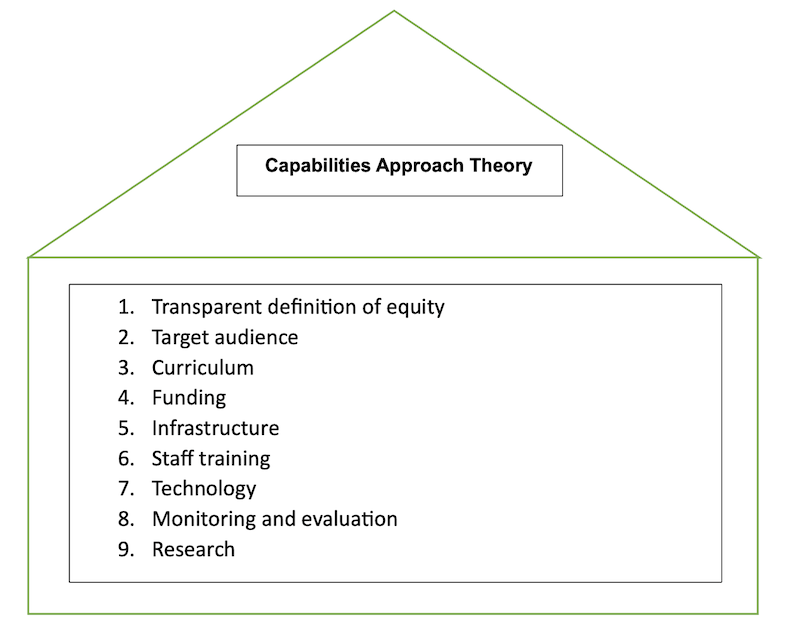
In the suggested model, the CA adopted for the study serves as a foundation for the identified elements needed to improve access to and equity in OS. The theory focuses not only on providing access to students, but access must lead to meaningful and fulfilled lives to be recognised as functionings. Based on this, nine major elements were identified that stakeholders must work on and improve.
The first element is the need for transparency in the definition of the term “equity”, which should guide the aim of each project. The second element is a full description of the target audience, for instance, their age, socio-economic characteristics, geographical context, demography, fresh starters, traditional school students, stop-over, and language of instruction. The third and fourth elements should provide an adaptive curriculum (fit for the context) and make provision for funding. Other elements are contextualised infrastructure; staff training fit for purpose; contextualised technology to reflect flexible learning environments (OER, offline and online access, context-based technology); monitoring and evaluation; and research (of which there is a dearth). More research (guided by the theory) into these nine elements would go a long way to improve access and equity in OS. Although Abrioux (2009), Aluko & Mays (2022) and COL (2023) mention these elements, some are yet to be fully explored. The author of this article believes that bringing them together holistically would assist stakeholders in being better focused on each project at hand.
This reflective paper has drawn from the CA framework mooted by Sen Amartya and popularised by Martha Nussbaum to suggest a holistic and contextualised model for open schooling.
CA is a general descriptive framework useful for evaluating individual well-being (regarding, e.g., inequality and poverty), social arrangements, and the design of policies (Robeyns, 2003). The paper adopted the CA because of its emphasis on using education as a tool to limit the hindrances to citizens’ full participation in their society in the 21st century. Owing to its huge potential, OS has been touted as a way to mitigate the diverse challenges confronting education in AC countries. However, over the decades, the persistent challenges of accessibility and success of OOSC through OS, and a dearth of studies on the same issues remain a huge concern.
Consequently, some conclusions that can be drawn from this paper include: firstly, despite the success stories of the OS model in other parts of the world, the grim statistics on OOSC from AC countries shows either the potential is not being maximised or the model has not been adopted. Secondly, primary education, generally, is a special level because children at this stage are not prepared for formal learning, thus requiring more attention. Thirdly, opening access without effective support systems for student success is a waste of effort and resources as indicated by the high attrition rates, especially at the primary school level. Fourthly, it is necessary to strengthen the existing structures of OS, where the model exists, and adopt it where it does not; also, inasmuch as it is applaudable to increase the education budget, there are other important aspects to be considered. Lastly, AC countries need to invest in open and flexible learning systems that are relevant to their contexts.
The available relevant literature shows that the elements mentioned in the suggested model have previously been handled haphazardly. Although this paper’s major limitation is that the elements may not be all-encompassing, the author advises that future OOSC practices guided by policy and research should focus on a holistic and contextualised model. Glocalised tailor-made approaches are needed for success. This is expected to help us mitigate what keeps our school children from accessing schooling provision that can help give them the freedom to achieve and develop their capabilities to function. Improving access and equity for OOSC will eventually result in improving society’s human capital needs while improving individuals’ development needs and desires, which is what CA advocates.
Abrioux, D. (2009). Special issues and practices in open schooling. In D.A.M.X. Abrioux, & F. Ferreira (Eds.), Open schooling in the 21st century (pp. 3-10). Commonwealth of Learning. http://oasis.col.org/bitstream/handle/11599/81/pub_PS_OpenSchooling_web.pdf?sequence=1&isAllowed=y
African Union. (n.d.). Our aspirations for the Africa we want. https://au.int/en/agenda2063/aspirations#:~:text=Goals:,of%20Africa's%20blue/ocean%20economy;
Ainscow, M. (2020). Promoting inclusion and equity in education: Lessons from international experiences. Nordic Journal of Studies in Educational Policy, 6(1), 7-16. https://doi.org/10.1080/20020317.2020.1729587
Aluko, F.R., & Mays, T. (2022). Promoting equity and inclusion: The dire state of out-of-school-children in African Commonwealth countries. https://doi.org/10.56059/pcf10.5400
Braun V., & Clarke V. (2006). Using thematic analysis in psychology. Qualitative Research in Psychology, 3(2), 77–101. https://doi.org/10.1191/1478088706qp063oa
Burns, M., & Santally, M.I. (2019). Information and communications technologies and secondary education in Sub-Saharan Africa: Policies, practices, trends and recommendations. https://doi.org/10/gg5f2b
Cieslik, K., Barford, A., & Vira, B. (2021). Young people not in Employment, Education or Training (NEET) in Sub-Saharan Africa: Sustainable Development Target 8.6 missed and reset. Journal of Youth Studies, 25(8), 1126-1147. https://doi.org/10.1080/13676261.2021.1939287
Commonwealth of Learning (COL). (2023). Increasing access to open schooling through an e-Learning intervention: A case study from Zambia. https://oasis.col.org/server/api/core/bitstreams/4a43015d-ccae-41ec-8d51-4656fc0724a2/content
Commonwealth of Learning (COL). (2022). Out-of-school children and youth: A contemporary view from selected African Commonwealth countries. https://oasis.col.org/entities/publication/4a51e37a-7117-4542-ae61-63e2e5e542a9
Covidence. (n.d.). The difference between a systematic review and a literature review. https://www.covidence.org/blog/the-difference-between-a-systematic-review-and-a-literature-review/
Daniel, J. (2022). Open schooling: New era, new relevance, new methods. International Journal of Open Schooling, 1(1). https://nios.ac.in/media/documents/IJOS/Ch-1_New.pdf
Dewey, J. (1938). Experience and education. Collier Books/Macmillan.
Ecsite (2024). What is open schooling? https://www.ecsite.eu/activities-and-services/news-and-publications/what-open-schooling#:~:text=Open%20learning%20and%20open%20schooling,factors%20related%20to%20learning%20processes
Evans, D.K., & Acosta, A.M. (2021). Education in Africa: What are we learning? Journal of African Economies, 30(1), 13–54. https://doi.org/10.1093/jae/ejaa009
Halpin, M. (2025). The importance of accessibility in education. https://reciteme.com/news/accessibility-in-education/
Hamaluba, T. (2023). Advancing vocationalization of open schooling in Botswana: Addressing critical skills gaps and alleviating unemployment. Education, Society and Human Studies, 4(3). http://dx.doi.org/10.22158/eshs.v4n3p1
Haenssgen, M.J., & Ariana, P. (2018). The place of technology in the Capability Approach. Oxford Development Studies, 46(1), 98-112. https://doi.org/10.1080/13600818.2017.1325456
Hollings, M., & Naidu, S. (2020). Developing practice in the Pacific. In T. Mays & R.K. Singh (Eds.), Addressing the learning needs of out-of-school children and youths through expansion of open schooling, (pp. 235–256). Vancouver, BC: Commonwealth of Learning (COL). http://oasis.col.org/handle/11599/3731
Jasper, M. (2013). Beginning reflective practice. Cengage Learning.
Kimhur, B. (2020). How to apply the capability approach to housing policy? Concepts, theories and challenges. Housing, Theory and Society, 37(3), 257–277. https://doi.org/10.1080/14036096.2019.1706630
Kolb, D.A. (1984). Experiential learning: Experience as the source of learning and development. Prentice-Hall.
Kumar, Y. (2018). Research areas in open schooling: A NIOS perspective. International Journal for Research in Applied Science & Engineering Technology, 6(V). http://doi.org/10.22214/ijraset.2018.5370
Lannoy, A., & Gibson, M. (2019). A profile of young NEETs: Unpacking the heterogeneous nature of young people not in employment, education or training in South Africa. http://www.opensaldru.uct.ac.za/handle/11090/963
Lawal, I. (2019). Open schooling as panacea for Nigeria’s army of out-of-school children. The Guardian. https://www.proquest.com/newspapers/open-schooling-as-panacea-nigeria-s-army-out/docview/2296995338/se-2?accountid=14717
Levinson, M., Geron, T., & Brighouse, H. (2022). Conceptions of educational equity. American Educational Research Association (AERA) Open, 8. https://doi.org/10.1177/23328584221121344
Mays, T. (2020). The need for and nature of open schooling. In T. Mays & R.J. Singh (Eds.), Addressing the learning needs of out-of-school children and youths through expansion of open schooling (pp. 9-26). Commonwealth of Learning.
Mays, T., & Singh, R.K. (2020). (Eds.). Addressing the learning needs of out-of-school children and youths through expansion of open schooling. Commonwealth of Learning. http://oasis.col.org/bitstream/handle/11599/3731/2020_OIS_PS_Addressing_Learner_Needs_1.pdf?sequence=4&isAllowed=y
Mitra, S. (2014). Feasibility of open schooling in disturbed societies: The case of Afghanistan. Journal of Learning for Development, 1(2). https://jl4d.org/index.php/ejl4d/article/view/13/37
Needham, M., & Ülküer, N. (2020). A growing interest in early childhood’s contribution to school readiness. International Journal of Early Years Education, 28(3), 209-217. https://doi.org/10.1080/09669760.2020.1796416
Nussbaum, M.C. (2011). Creating capabilities: The human development approach. Harvard University Press.
Nussbaum, M.C. (2006). Frontiers of justice: Disability, nationality, species membership. Belknap Press of Harvard University Press.
OECD. (2018). Equity in education: Breaking down barriers to social mobility. PISA Book Series. OECD Publishing. https://doi.org/10.1787/9789264073234-en
Oosterlaken, I., & van den Hoven, J. (2012). Introduction. In I. Oosterlaken & J. van den Hoven (Eds.), The capability approach, technology and design (1st ed., pp. 3–26). Dordrecht: Springer.
Pholphirul, P. (2017). Pre-primary education and long-term education performance: Evidence from Programme for International Student Assessment (PISA), Thailand. Journal of Early Childhood Research, 15(4), 410-432. https://doi.org/10.1177/1476718X15616834
Przybylinski, S., & Sidortsov, R. (2023). The capabilities approach. In J. Ohlsson & S. Przybylinski (Eds.), Theorising justice: A primer for social scientists (pp. 124-138). Bristol University Press. https://doi.org/10.56687/9781529232233-012
Rajasekaran, S., & Reyes, J.E. (2019). Back to school: Pathways for reengagement of out-of-school youth in education. World Bank. http://hdl.handle.net/10986/31593
Robeyns, I. (2005). The capability approach: A theoretical survey. Journal of Human Development, 6(1), 93-117. https://doi.org/10.1080/146498805200034266
Robeyns, I. (2003). Sen’s capability approach and gender inequality: Selecting relevant capabilities. Feminist Economics, 9(2/3), 61-92. https://doi.org/10.1080/1354570022000078024
Sen, A. (1988). The standard of living. [Book review.] The Economic Journal, 98(392), 852-853. https://doi.org/10.2307/2233923
Sen, A. (1992). Inequality re‐examined. Harvard University Press.
Sen, A. (1995). Rationality and social choice. The American Economic Review, 85(1), 1–24
Sen, A. (1999). Development as freedom. Oxford University Press.
Sen, A. (2010). The mobile and the world. Information Technologies and International Development, 6(Special Issue), 1-3. https://itidjournal.org/index.php/itid/article/download/614/614-1653-2-PB.pdf
Spernes, K. (2020). The transition between primary and secondary school: A thematic review emphasising social and emotional issues. Research Papers in Education, 37(3), 303-320. https://doi.org/10.1080/02671522.2020.1849366
Statista. (2025). Countries with highest youth NEET rate worldwide. https://www.statista.com/statistics/1449106/countries-youth-neet-rate-world-highest/?srsltid=AfmBOopNGcCv6n2fu7JLxCf0plqAuFGjfmnelndaWncJp928uebcoqBW#google_vignette
StatsSA. (2025). South Africa’s youth in the labour market: A decade in review. https://www.statssa.gov.za/?p=18398
Szekely, E., & Mason, M. (2019). Complexity theory, the capability approach, and the sustainability of development initiatives in education. Journal of Education Policy, 34(5), 669-685. https://doi.org/10.1080/02680939.2018.1465999
Terzi, L. (2008). Justice and equality in education: A capability perspective on disability and special educational needs. Continuum International Publishing Group.
The Global Economy.com. (2026). Primary school completion rate — Country rankings. https://www.theglobaleconomy.com/rankings/Primary_school_completion_rate/Africa/
UIS. (2022). Education in Africa. http://uis.unesco.org/en/topic/education-africa#:~:text=Over%20one%2Dfifth%20of%20children,17%20are%20not%20in%20school
UNESCO Institute for Statistics (UNESCO-UIS). (2015). Fixing the broken promise of Education for All: Findings from the global initiative on out-of-school children. http://www.unicef.org/malaysia/Fixing-the-BrokenPromise-of-Education-For-All-full-report.pdf
UNICEF. (2021a). UNICEF Cameroon humanitarian situation, Report No. 7. https://reliefweb.int/report/cameroon/unicef-cameroon-humanitarian-situation-report-no-7-01-july-2021
UNICEF. (2021b). Pre-primary. https://data.unicef.org/topic/education/pre-primary-education/
United Nations. (2017). The 17 goals. https://sdgs.un.org/goals
Unterhalter, E., Vaughan, R.P., & Smail, A. (2013). Secondary, post-secondary and higher education in the post-2015 discussions. British Council. https://baice.ac.uk/secondary-and-higher-education-in-the-post-2015-framework/
Author Notes
Folake Ruth Aluko is a researcher at the Unit for Distance Education at the University of Pretoria. She manages the quality of the institution’s Distance Education (DE) programmes in the Faculty of Education. Her research expertise includes quality management of ODL programmes, mobile learning, access, social justice, programme evaluation, student support, teacher professional development, pedagogy of care, and evidence-informed practice. Email: ruth.aluko@up.ac.za (https://orcid.org/0000-0003-0499-042X)
Cite as: Aluko, F.R. (2026). Mitigating the challenges confronting out-of-school children in African Commonwealth countries through improving access to open schooling. Journal of Learning for Development, 13(3), 552-562.
DOI: https://doi.org/10.56059/00d3da06