Joel B. Jalon, Jr. and Lydia S. Roleda
2026 VOL. 13, No. 3
Abstract: This study examined the effectiveness of a challenge-based learning (CBL) robotics environment on students’ conceptual understanding and experiences. Using a mixed-methods, pre-experimental, one-group, pretest-posttest case-study design, this study involved 22 senior high school students, a pretest and posttest, engineering notebooks, and a feedback questionnaire. Results showed a significant improvement in conceptual knowledge of students [t(13) = -2.97, p = 0.011, Cohen’s d = -0.793], but their procedural knowledge diverged from their declarative knowledge, which the conceptual test did not fully capture. A hermeneutic phenomenological analysis revealed tensions between hands-on hardware and programming, differing pacing needs among novice and experienced learners, and a desire for both autonomy and structure. CBL is effective for teaching robotics, but educators should shift from decontextualised multiple-choice testing and adopt a dual-track assessment model. Implications for the design of innovative STEM learning environments are discussed, including transferable principles for open, distance, and blended learning contexts.
Keywords: Arduino, challenge-based learning, educational robotics, STEM education
Twenty-first-century education emphasises critical thinking, collaboration, creativity, and digital literacy for a rapidly changing society and workforce. International policy frameworks (e.g., National Science Foundation, 2019; Organisation for Economic Co-operation and Development, 2023; United Nations Educational, Scientific and Cultural Organisation, 2023) emphasise problem-solving, lifelong learning, innovation, and digitally mediated competencies as critical for modern education and work readiness. Within this context, educational robotics (ER) has emerged as a powerful pedagogical approach for integrating Science, Technology, Engineering, and Mathematics (STEM) (Conde et al., 2020), often utilising learner-centred pedagogies such as challenge-based learning (CBL), which positions students as active problem solvers addressing real-world challenges (Nichols et al., 2016). Research confirms that CBL robotics environments enhance student motivation, engagement, collaboration, and interest, especially in STEM (Bano et al., 2024; Ouyang & Xu, 2024; Selcuk et al., 2024; Tang et al., 2025).
Despite these benefits, empirical data remains limited on how learners simultaneously develop declarative (knowing explicit facts) and procedural knowledge (how to do something) in open-ended robotics contexts. This gap is critical in secondary education, where educators must balance learner autonomy with structured guidance and measurable learning outcomes. Consequently, it is unclear whether students in CBL robotics environments are developing robust declarative knowledge or primarily acquiring context-dependent procedural knowledge.
This study examines how a CBL robotics environment influences senior high school (SHS) students’ conceptual understanding and lived experiences. It is grounded in constructivist and constructionist perspectives, which posit that knowledge is constructed through environmental interaction and the creation of meaningful artefacts (Papert, 1993; Piaget, 1970). These theories provide a lens for interpreting how learners develop declarative and procedural knowledge in authentic, challenge-driven contexts.
Using a mixed-methods approach, this study integrated quantitative measures of conceptual understanding with qualitative insights into students’ experiences. By doing so, it aims to provide a more comprehensive account of knowledge construction in ER and to inform the design of pedagogically sound assessment-aligned STEM learning environments.
ER originated with Seymour Papert’s pioneering work, demonstrating that children could learn programming by using robots to solve problems (Papert, 1993). Today, ER has become a global pedagogical trend fostering social and cognitive growth (Bano et al., 2024; Chatzichristofis, 2023). In addition, recent studies continue to frame robotics learning as a constructionist process (Cayetano-Jiménez et al., 2024; Selcuk et al., 2024; Tang et al., 2025).
Systematic reviews found that ER enhances students’ computational, algorithmic, and logical thinking, as well as their problem-solving and analytical skills through real-world visualisation (Bai & Tian, 2025; Bano et al., 2024). It promotes creativity, teamwork, communication, and respect for diverse perspectives, integrating theoretical knowledge with practical experience. ER supports integrated STEM education by making learning engaging, encouraging independent learning, fostering positive STEM attitudes, and offering a comprehensive understanding of STEM concepts through multidisciplinary activities and inquiry-based learning. Newer studies continue to report benefits for achievement, motivation, and attitude (Ouyang & Xu, 2024; Selcuk et al., 2024). These findings support the use of ER as a meaningful instructional medium in secondary STEM education.
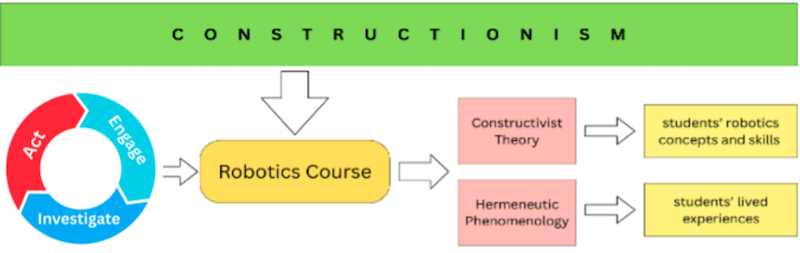
CBL, alongside Problem-based learning (PBL) and Project-based learning (PjBL), is a prominent learner-centred approach in ER (Conde et al., 2020). While PBL and PjBL often focus on structured academic problems, CBL connects learners to real-world issues and industry partners through the Engage, Investigate, and Act phases (Membrillo-Hernández et al., 2019; Nichols et al., 2016).
In robotics contexts, CBL has been associated with increased engagement, collaboration, and problem-solving opportunities (Conde et al., 2020; Gandini & Morselli, 2026; Vasquez-Lopez et al., 2024). Recent CBL work shows that successful implementation depends on real-world challenges, collaboration, guided discovery, and course milestones, all of which are especially relevant when students must build functioning robotics artefacts (Gandini & Morselli, 2026; Vasquez-Lopez et al., 2024).
Despite ER’s potential, its K-12 integration remains emergent, and CBL specifically receives less attention than traditional models (Bano et al., 2024; Conde et al., 2020). Furthermore, existing research often relies on self-reported data rather than validated assessments (Conde et al., 2020). Significant gaps remain regarding how students develop distinct declarative and procedural knowledge in open-ended robotics challenges and how educators effectively balance learner autonomy with instructional structure.
The literature indicates that while ER and CBL hold significant potential to foster student engagement in authentic STEM learning, critical questions about assessment, instructional support, and students’ experiences in self-directed learning environments remain unresolved. Notably, the limited empirical evidence on the development of declarative and procedural knowledge within robotics-based CBL contexts impedes educators from providing clear guidance for designing and evaluating such interventions. Addressing these gaps is imperative for informing evidence-based practice in secondary STEM education.
This study investigated the effectiveness of a CBL framework in an SHS basic robotics course. It sought to move beyond simply measuring engagement by simultaneously examining students’ conceptual gains and the qualitative richness of their lived experiences, providing a more holistic understanding of how they construct knowledge when learning with robotics. The following research questions guided this study:
Figure 1 outlines the study’s conceptual framework based on Constructionist Learning Theory, which posits that effective knowledge construction occurs when learners create tangible, shareable artefacts (Papert, 1993). This theory emphasises that making is a primary means of learning. The robotics course demonstrated this by having learners design, program, and build robots to address real-world problems. Learning took place through iterative artefact creation, reflection, and refinement, promoting the integration of robotics concepts, problem-solving strategies, and collaboration, with physical artefacts anchoring abstract ideas. Teachers acted as facilitators and co-learners, providing scaffolding in a studio-like environment to enhance conceptual understanding.
The course’s pedagogical structure was built upon the CBL framework. In this robotics course, the CBL cycle ensured that the act of making was always purposeful; robots were not constructed in isolation but as solutions to meaningful challenges grounded in local or global contexts.
Constructivist theory was also adopted to frame its perspective, which posits that learning occurs when individuals actively construct their own understanding by interacting with their environment (Piaget, 1970). In this study, this theory transformed the classroom into a student-centred environment where knowledge was actively negotiated. The principle of ‘active construction through interaction’ was applied as students used robotics components to address real-world challenges. Instructors became facilitators, offering support during critical moments of student exploration. Constructivism also provided an analytical lens for understanding the distinction between declarative and procedural knowledge, emphasising that learning was ‘contextually situated’, with conceptual understanding linked to the success of physical artefacts rather than abstract recall.
Finally, van Manen’s (2023) Hermeneutic Phenomenology guided the interpretation of students’ lived experiences within the CBL robotics environment, focusing on understanding and interpreting the essence of lived experiences through reflective engagement with participants’ narratives. The analysis of these experiences was structured through van Manen’s four lived existentials: lived body (corporeality), lived time (temporality), lived space (spatiality), and lived human relations (relationality), offering a deep and detailed insight into the personal aspects of this educational programme.
This mixed-methods case study utilised a pretest-posttest design alongside an in-depth qualitative analysis of a bounded instructional setting (Creswell & Creswell, 2023). It focused on a 13-week SHS robotic course within a CBL framework, exploring knowledge construction mechanisms in a naturalistic learning context. A single cohort of learners was examined to assess learning gains during authentic robotics activities. The pre-posttest design measured students’ declarative knowledge with the Arduino Conceptual Test, which helped assess learning gains in the CBL environment. The analysis of engineering notebooks and course feedback through hermeneutic phenomenology highlighted the learning journey’s procedural and subjective aspects. This framework offers insights into how action-oriented knowledge is constructed in a CBL robotics environment, moving beyond simple outcome measures.
The participants consisted of 22 students: four Grade 11 and 18 Grade 12 students, with 14 males and eight females, aged 16 to 18 years (M = 17, SD = 0.69), who planned to integrate robotics into their capstone projects. Six students had experience with robotics. They were selected through purposive sampling to align with the research objectives, ensuring a participant pool with high interest, and facilitating a robust dataset for assessing learning experience (Memon et al., 2025).
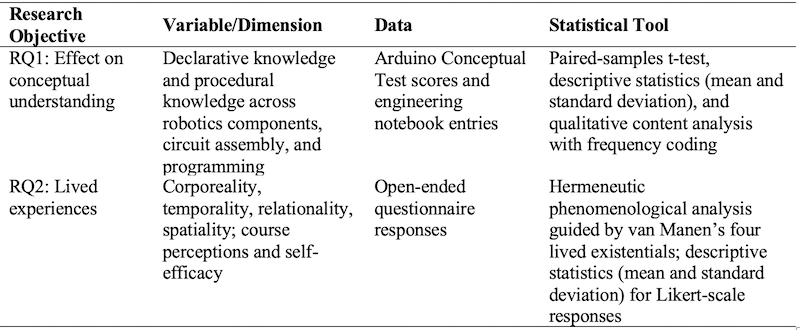
Table 1 presents the study’s instruments and techniques, specifying the research objective addressed by each tool and clarifying the role of each measure across the quantitative and qualitative strands.
Table 1: Alignment of the Research Objective, Variable/Dimension, Data, and Statistical Tool
Arduino Robotics Kit
This study used an Arduino kit for its cost-effectiveness and accessibility, enabling customisation and integration into students’ CBL projects.
Rise Challenge Planner (RCP)
This study used the RCP from Challenge-Based Learning (n.d.), a tool that guides participants through the three CBL phases with questions that promote a deep, personal connection to the learning process.
Student Course Feedback Questionnaire (SCFQ)
This tool was used to measure students’ experiences, which demonstrated acceptable reliability (Cronbach’s α = 0.702). The SCFQ comprises two sections: four-point Likert-scale items adapted from Avsec et al. (2014) that assess course implementation, interactions, and self-efficacy, and a qualitative section consisting of the following prompts:
Assessment of students’ robotics learning
Course improvement suggestions
Arduino Conceptual Test (ACT)
This test consisted of 36 multiple-choice and three two-tier items, assessing robotics core concepts, such as programming, circuit assembly, and the Arduino Uno board, rather than knowledge of various components, encouraging students to explore and apply their skills to novel situations independently. The instrument’s content validity was confirmed by four teachers, who rated all items as well-structured with good internal consistency (McDonald’s ω = 0.827). The two-tier items required students to provide written explanations for their answers, which were scored using a three-point rubric to assess higher-order thinking and conceptual understanding.
Student Engineering Notebook
ACT emphasises declarative knowledge, which may not fully encompass procedural knowledge in robotics. To address this, students’ engineering notebooks were analysed as a qualitative method, documenting their design processes through ideas, experiment logs, and observations. This provided quantitative and qualitative insights into robotics concepts in their CBL projects and served as an authentic assessment tool, highlighting the transition from abstract concepts to functional artefacts, an aspect often missed by traditional tests. The analysis focused on three key areas in robotics education: robotics components (RC), circuit assembly (CA), and programming concepts (PC), as noted in recent studies (e.g., Boya-Lara et al., 2022; Castro et al., 2023; Coufal, 2022).
Learning Context
The robotics course lasted 13 weeks with 3-hour meetings, directed by the RCP alongside the CBL. Students began with the Engage phase, where they were introduced to Arduino and the kit and defined their project’s core challenge. Guided by the teacher, they collaborated on a beginner module, learning essential skills in hardware, soldering, and programming, including I/O pin control and sensor integration, across two sessions. The Investigate phase focused on independent, student-driven learning, where students explored advanced concepts such as servo motors, sensors, and complex programming. They sourced additional components and online resources to support their projects over four dedicated sessions. The process culminated in the Act phase, where students developed their projects over six sessions, documented their work, and presented their solutions to a panel of STEM teachers in the 12th session. In the last session, a final reflection, guided by the RCP, concluded the course.
Ethical Clearance
Participants were informed of their voluntary involvement and could withdraw at any time without consequence. Informed consent was obtained from parents and students. Data was anonymised, stored securely with restricted access, and reported in aggregate to ensure confidentiality.
The students’ six CBL projects included an aerial weather monitoring drone, an educational robot for waste segregation, a remotely operated search and rescue robot, a musical synthesiser, a temperature-controlled drone delivery container for medical supplies, and a heart rate monitor with a hospital locator.
To address RQ1, the study evaluated students’ conceptual understanding through both quantitative measures of declarative knowledge and qualitative assessments of procedural knowledge. Table 2 showcases the statistical analysis of ACT results for the 14 students who completed both assessments. A paired t-test showed a significant improvement in conceptual knowledge after the 13-week intervention [t(13) = -2.97, p = 0.011], with a moderate-to-large effect size (Cohen’s d = -0.793) (see Table 2). However, analysis of engineering notebooks revealed a significant gap between test performance and practical application. Qualitative content analysis of students’ engineering notebooks revealed high procedural accuracy across the three primary themes (see Table 3).
Table 2: Statistical Analysis of Conceptual Knowledge (Pretest vs. Posttest)

Significant gains were most evident in PC and CA: 11 of the 14 students improved their PC scores, and seven improved their CA scores, with five remaining the same. Qualitative content analysis of engineering notebooks corroborated this, showing an 89% accuracy rate in PC and 86% in CA. Students documented complex tasks such as controlling the project using a joystick and integrating short message service communication, demonstrating that they could successfully translate coding and circuit concepts into functional robotic systems.
Table 3: Frequency of Entries in Engineering Notebooks by Themes
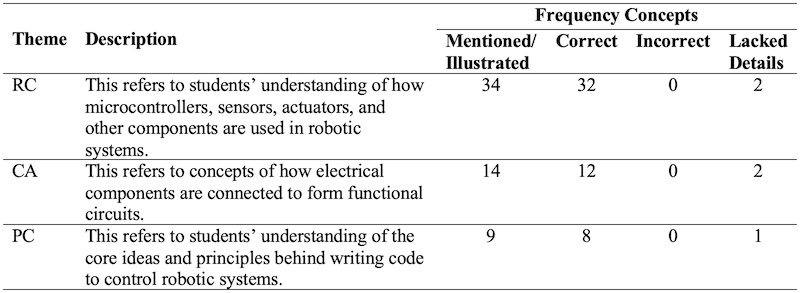
In contrast, RC showed limited improvement, with four students scoring zero on both tests and three scoring lower in the posttest. This indicates a lack of a strong understanding of concepts like pulse-width modulation (PWM) in a decontextualised format. However, notebook analysis revealed that 94% of the 34 references to robotics components were correctly coded, and students successfully applied PWM across various project contexts, including motor control. These findings suggest that while students may struggle with formal assessments, they can effectively apply concepts to practical situations.
From a constructivist perspective, these findings highlight a gap between declarative knowledge and procedural knowledge. In the CBL environment, students developed strong procedural skills through collaborative projects. However, performance in the RC domain indicates that some students struggled to articulate this knowledge in decontextualised tests. Since knowledge was often shared within teams, individuals may not have developed a solid foundational understanding. Thus, the conceptual tests reveal that CBL primarily promotes contextually situated, procedural knowledge rather than a lack of understanding.
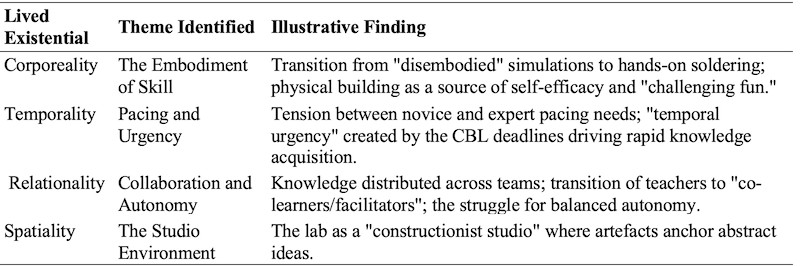
To address RQ2, students’ experiences were examined through qualitative responses from the SCFQ. Using van Manen’s (2023) hermeneutic-phenomenological approach, the data analysis focused on the four lived existentials. Table 4 summarises the insights regarding students’ experiences of learning, collaboration, pacing, autonomy, and engagement in the CBL robotics environment.
Table 4: Summary of Phenomenological Insights Based on van Manen’s Four Lived Existentials
Corporeality: The Embodiment of Skill
The theme of corporeality explored how students physically and emotionally engaged in robotics learning through hands-on interaction with tools and components. Participants shared that their experiences were deeply corporeal, with soldering noted as a key challenge; Student 12 described it as “challenging but fun,” highlighting the enjoyment and difficulty of robotics building. This process bridged the gap between simulations and reality, with Student 2 emphasising that real Arduino components entail factors absent in Tinkercad (a free, web-based 3D design and coding app). The high mean scores for the physical learning environment (M = 3.92, SD = 0.29) indicated the significance of tangible interactions with well-equipped tools. Students’ narratives suggested that learning robotics combines cognitive and physical elements, where confidence develops through hands-on experience. This finding aligns with the literature highlighting the experiential nature of CBL as beneficial for motivation and skill development (Félix-Herrán et al., 2019; Hernandez et al., 2020). From a constructionist perspective, embodied experience is essential for learning, as knowledge strengthens when ideas are turned into artefacts, leading students to describe robotics as “hard fun” and embrace the challenges of taking ownership of their creations (Papert, 1993, 2002). Thus, the body serves as an active site of knowing, with confidence and understanding arising from physical interaction rather than verbal explanation alone.
Pacing and Urgency
This theme in the robotics course highlighted how students navigated pacing, deadlines, and the balance between autonomy and instructional structure. Experienced students felt the course limited them to basic concepts, while novices benefited from a slower pace to master foundational skills. This temporal dissonance led to a demand for structured milestones, as expressed by Student 5, who sought “a more structured and stricter format… so that all members are in the same step….” The lower mean self-efficacy score, particularly regarding the balance of learning time (M = 3.33, SD = 0.65), highlights this imbalance. Research suggests that students in CBL environments struggle to adapt to autonomous learning (Helker et al., 2025; Vasquez-Lopez et al., 2024). This study emphasises the novice-expert continuum as a key source of temporal dissonance. From a constructionist perspective, Papert (1993) asserted that while learners should own their pathways, teachers should scaffold experiences without over-directing. Thus, the demand for clearer milestones underscores the need for adaptive scaffolding to support learner agency and help novices manage open-ended challenges.
Relationality: Collaboration and Autonomy
This theme explored how collaboration, peer interaction, teacher facilitation, and shared problem-solving impact students’ learning experiences. Positive instructional interactions were reflected in high mean scores (M = 3.92, SD = 0.29), while lower scores for peer knowledge exchange (M = 3.67, SD = 0.65) indicated a desire for more engagement with experienced peers. This suggests that effective collaboration, as highlighted by Conde et al. (2020), must be intentionally integrated into learning design.
Students also faced programming challenges (for example, Student 4 noted that searching for code without fully understanding it led to a disconnect) making code seem opaque compared to their confidence with hardware. This aligns with research showing that limited programming support can hinder learning (Anđić et al., 2024; Lee & Yi, 2021). Such issues reflect Constructionist Learning Theory, which emphasises the teacher's role as a facilitator and co-learner, guiding problem-solving and reflection rather than simply providing solutions (Papert, 1993).
Spatiality: The Studio Environment
This theme in the course was both empowering and a source of tension, as the user-friendly lab (M = 3.92, SD = 0.29) facilitated embodied learning but left some students feeling “stuck” (Student 4) or “lagging behind” (Student 5). This reflects broader findings that open and CBL environments require intentional scaffolding and support for learner autonomy (Helker et al., 2025; Vasquez-Lopez et al., 2024). Students suggested creating a more collaborative and structured psychological space, connecting robotics to other fields, or showcasing advanced projects. From a constructionist perspective, the lab served as a “studio” for grounding knowledge in physical artefacts. Papert (1993) noted that learning environments should allow learners to externalise ideas as tangible forms. While students had a favourable perception of the lab, the psychological tension emphasises the need for intentional facilitation in open learning spaces.
This study demonstrates that the value of a CBL robotics environment goes beyond just test gains and positive experiences. It emphasises that learning in CBL robotics is cognitive, embodied, social, and materially situated. The pretest-posttest results indicated support for conceptual development, while the phenomenological approach revealed experiences through making, troubleshooting, negotiating, and reflecting in a studio-like setting. The findings contribute to the evidence that CBL robotics enhances conceptual understanding, computational thinking, and motivation in STEM, influenced by task design and assessment methods, aligning with Bano et al. (2024), Ouyang and Xu (2024) and Tang et al. (2025).
The central theoretical contributions lie in the divergence between declarative and procedural knowledge. This observed divergence is not a failure of the CBL framework but rather a limitation of the decontextualised assessment tools. Scholarly discourse should shift toward “dual-track” assessment models that value situated, action-oriented knowledge as much as verbal articulation. Constructivist theory helps explain how students can build understanding through interactions with components, code, peers, and constraints rather than through the direct transmission of concepts (Piaget, 1970). Constructionist theory helps explain why that understanding became visible through the creation of tangible artefacts that anchored abstract ideas in practical work (Papert, 1993). The students were not merely learning about robotics; they were learning through robotics, and the making process itself became a medium of cognition. This interpretation is consistent with recent work, such as that of Cayetano-Jiménez et al. (2024) and Selcuk et al. (2024), which shows that robotics learning becomes more meaningful when learners actively construct and manipulate physical systems rather than only consume information.
The study also indicates that while hands-on making can foster the practical application of ideas, it does not guarantee strong conceptual understanding, as evidenced by students’ success in applying concepts without being able to express them in traditional test formats. This suggests that CBL robotics can develop situated, action-oriented knowledge that might remain tacit unless explicitly addressed in the instruction. This aligns with research such as that of Yousef and Ayyoub (2024), which advocates evaluating design, programming, and implementation skills alongside conceptual knowledge, as conventional tests may overlook key learning aspects. Additionally, it aligns with findings that learners often excel at practical tasks but require support in connecting theory to practice, as supported by Munoz Ubando et al. (2025).
The phenomenological findings highlight that robotics learning is embodied and affective rather than solely intellectual. Students described soldering, building, and testing as both challenging and enjoyable, indicating that physical engagement fostered confidence and meaning. This aligns with the constructionist view that knowledge becomes powerful when learners externalise it materially and experience the outcomes of their design choices in real time (Papert, 1993, 2002). Additionally, the lived-time theme reveals that pacing is crucial: novice and experienced learners perceived the same course differently, suggesting that CBL requires scaffolding to support learners at varied paces while engaging in a common challenge. This emphasises that structured and supported CBL is more effective than an unstructured approach, strengthening the claims of Helker et al. (2025) and Vasquez-Lopez et al. (2024).
The lived relation theme adds another layer to the theoretical story. Collaboration aids progress but may result in uneven knowledge distribution. While some students relied on peers or resources, this led to functional outcomes but not necessarily individual conceptual mastery. Furthermore, students expressed discomfort with programming, indicating that the relationship between hardware and code was asymmetrical; the tangible side of robotics was more understandable than the abstract component. This complexity supports and complicates claims of Conde et al. (2020) and Hernandez et al. (2020) that CBL deepens understanding through teamwork and problem-solving. Effective collaboration must be intentionally structured to foster conceptual negotiation rather than mere task completion.
The lived space theme brings these threads together by showing that the robotics laboratory functioned as more than a physical space; it was a constructionist studio for testing and revising ideas. Students appreciated the material aspects of the environment but sought clearer milestones, more structure, and stronger intellectual guidance. Thus, open learning spaces function best when designed to balance autonomy with support. This result corroborates the work of Budiarto et al. (2025), Jasmin and Ongcoy (2024), and Zou and Jiang (2025), that adaptive scaffolding, structured feedback, and reflection enhance engagement and self-regulation.
Ultimately, this study shows that CBL thrives as an ecology of making, pacing, relation, and space. By synthesising quantitative gains with qualitative depth, it concludes that conceptual understanding in CBL robotics is a situated accomplishment produced through the continuous interaction of body, tool, task, and social context.
The findings have significant implications for assessment and curriculum design in robotics education. First, assessment should not rely solely on decontextualised multiple-choice tests. While conceptual tests detected learning gains, engineering notebooks revealed broader procedural competence that traditional assessments overlooked. A dual-track assessment approach is recommended, incorporating conceptual tests, engineering notebooks, and performance tasks to evaluate both declarative and procedural knowledge, in agreement with Yousef and Ayyoub (2024).
Second, CBL should not be seen as entirely self-regulating. Students require pacing support and guidance to navigate the learning process; without structure, autonomy can lead to disorientation. Curriculum designers should scaffold autonomy rather than assume it. Effective CBL relies on purposeful facilitation and course structures that help manage complexity, as echoed by Conde et al. (2020), Helker et al. (2025), Hernandez et al. (2020), and Vasquez-Lopez et al. (2024).
Third, robotics curricula should include opportunities for conceptual articulation alongside product construction. Students need spaces to explain circuit functionality, programming, and design decisions. Reflection prompts and peer explanations can help connect procedural actions to formal understanding, reinforcing that making, explaining, and reflecting are complementary phases of learning.
The study’s findings in a face-to-face robotics setting offer transferable principles for open and distance learning (ODL). The key implication is that technology-mediated robotics learning should include authentic challenges, structured conceptual support, and reflective documentation. While learners may have access to simulations and digital resources, the experience can remain fragmented without connecting action to explanation.
The distinction between procedural and declarative knowledge is crucial in ODB learning, as students may engage in digital tasks without fully grasping the underlying concepts. To address this, robotics education should integrate simulation-based learning with performance tasks that require students to demonstrate, document, and explain their solutions. This approach aligns with research (e.g., Budiarto et al., 2025; Jasmin & Ongcoy, 2024; Zou & Jiang, 2025) showing that effective instructional design in blended and tech-enhanced contexts enhances engagement, reflection, and self-regulation.
The findings highlight the importance of relational and spatial dimensions in technology-mediated learning. Students appreciated the presence of peers and teachers, indicating that online designs should incorporate synchronous mentoring, peer feedback, and collaborative problem-solving instead of focusing solely on asynchronous individual work. Even if the physical studio cannot be replicated, its relational aspects can be maintained through interactive design, pacing, and reflective exchange, thereby preserving the effective qualities of the robotics course.
Future research directions should include comparative studies on how varied robotics pedagogies affect procedural and declarative learning. Longitudinal studies could also assess if procedural gains from challenge-based robotics lead to better conceptual understanding over time. This is critical, as the current study indicates that learners may first achieve situated competence before acquiring the necessary vocabulary and abstraction to articulate it.
Future research should also explore effective scaffolding for novices in open-ended robotics environments, such as guided reflection, structured peer explanation, and iterative design journals. Additionally, mixed-methods studies can combine achievement metrics with phenomenological analyses to better understand the dynamics of robotics learning, which involve cognition, embodiment, collaboration, space, and purposeful making, rather than relying solely on test scores.
Acknowledgment: This study is part of the first author’s PhD dissertation. The authors thank De La Salle University and the Department of Science and Technology – Science Education Institute for their valuable support.
Conflict of Interest: The authors declare no competing interests.
AI Use Disclosure: The authors used Gemini and Grammarly to improve the manuscript’s coherence and clarity. They reviewed and edited the content as needed and are responsible for its content.
Anđić, B., Maričić, M., Mumcu, F., Prodromou, T., Leoste, J., Saimon, M., & Lavicza, Z. (2024). Direct and indirect instruction in educational robotics: A comparative study of task performance per cognitive level and student perception. Smart Learning Environments, 11(1), Article 12. https://doi.org/10.1186/s40561-024-00298-6
Avsec, S., Rihtarsic, D., & Kocijancic, S. (2014). A predictive study of learner attitudes toward open learning in a robotics class. Journal of Science Education and Technology, 23(5), 692-704. https://doi.org/10.1007/s10956-014-9496-6
Bai, S., & Tian, P. (2025). Educational robotics may enhance students’ conceptual knowledge, applied skills, and learning attitude in STEM education: A meta-analysis. Educational Technology & Society, 28(4), 271-300. https://doi.org/10.30191/ETS.202510_28(4).SP06
Bano, S., Atif, K., & Mehdi, S.A. (2024). Systematic review: Potential effectiveness of educational robotics for 21st century skills development in young learners. Education and Information Technologies, 29(9), 11135-11153. https://doi.org/10.1007/s10639-023-12233-2
Boya-Lara, C., Saavedra, D., Fehrenbach, A., & Marquez-Araque, A. (2022). Development of a course based on BEAM robots to enhance STEM learning in electrical, electronic, and mechanical domains. International Journal of Educational Technology in Higher Education, 19(1), 7. https://doi.org/10.1186/s41239-021-00311-9
Budiarto, M.K., Asrowi, Gunarhadi, Sunardi, & Rahman, A. (2025). Effect of ICT-based learning media on student learning outcomes: A scoping review. Journal of Learning for Development, 12(2). https://doi.org/10.56059/jl4d.v12i2.1354
Castro, A., Medina, J., Aguilera, C.A., Ramirez, M., & Aguilera, C. (2023). Robotics education in STEM units: Breaking down barriers in rural multigrade schools. Sensors, 23(1), 387. https://doi.org/10.3390/s23010387
Cayetano-Jiménez, I.U., Bustamante-Bello, R., & Ramírez-Cadena, M. (2024). Bridging the gap: Bioinspired robotics as catalyst for interdisciplinary education. Frontiers in Education, 9, 1375487. https://doi.org/10.3389/feduc.2024.1375487
Challenge-Based Learning. (n.d.). CBL process canvas. https://www.challengebasedlearning.org/project/cbl-process-canvas/
Chatzichristofis, S. A. (2023). Recent advances in educational robotics. Electronics, 12(4), 925. https://doi.org/10.3390/electronics12040925
Conde, M.A., Sedano, F.J.R., Fernandez-Llamas, C., Goncalves, J., Lima, J., & Garcia-Penalvo, F.J. (2020). RoboSTEAM project systematic mapping: Challenge based learning and robotics. 2020 IEEE Global Engineering Education Conference (EDUCON), 214-221. https://doi.org/10.1109/EDUCON45650.2020.9125103
Coufal, P. (2022). Project-based STEM learning using educational robotics as the development of student problem-solving competence. Mathematics, 10(23), 4618. https://doi.org/10.3390/math10234618
Creswell, J.W., & Creswell, J.D. (2023). Research design: Qualitative, quantitative, and mixed methods approaches (6th ed.). Sage
Félix-Herrán, L.C., Rendon-Nava, A.E., & Nieto Jalil, J.M. (2019). Challenge-based learning: An I-semester for experiential learning in mechatronics engineering. International Journal on Interactive Design and Manufacturing, 13(4), 1367-1383. https://doi.org/10.1007/s12008-019-00602-6
Gandini, M.F., & Morselli, D. (2026). Challenge-based learning implementation in K-12 education: A systematic literature review. Frontiers in Education, 10, 1680347. https://doi.org/10.3389/feduc.2025.1680347
Helker, K., Bruns, M., Reymen, I.M.M.J., & Vermunt, J.D. (2025). A framework for capturing student learning in challenge-based learning. Active Learning in Higher Education, 26(1), 213-229. https://doi.org/10.1177/14697874241230459
Hernandez, J.L., Roman, G., Saldana, C.K., & Rios, C.A. (2020). Application of the challenge-based learning methodology, as a trigger for motivation and learning in robotics. 2020 X International Conference on Virtual Campus (JICV), 1-4. https://doi.org/10.1109/JICV51605.2020.9375671
Jasmin, D.R., & Ongcoy, P.J. (2024). Study on school students’ blended learning experiences and mathematical self-concept during COVID-19. Journal of Learning for Development, 11(3). https://doi.org/10.56059/jl4d.v11i3.1136
Lee, H-J., & Yi, H. (2021). Development of an onboard robotic platform for embedded programming education. Sensors, 21(11), 3916. https://doi.org/10.3390/s21113916
Membrillo-Hernández, J., Ramírez-Galván, J.C., González-Covarrubias, I.A., Valdivieso, E.D.C., Castillo, L.G.Z., Elizalde, J.E., Zaldívar-Colado, I., & Muñoz, V.M.G. (2019). Challenge based learning: The importance of world-leading companies as training partners. International Journal on Interactive Design and Manufacturing, 13(3), 1103-1113. https://doi.org/10.1007/s12008-019-00569-4
Memon, M.A., Thurasamy, R., Ting, H., & Cheah, J.H. (2025). Purposive sampling: A review and guidelines for quantitative research. Journal of Applied Structural Equation Modelling, 9(1), 1-23. https://doi.org/10.47263/JASEM.9(1)01
Munoz Ubando, L.A., Amigud, A., & Sirazitdinova, E. (2025). Computer simulation and hands-on labs: A case study of teaching robotics and AI. International Journal of Mechanical Engineering Education, 53(2), 451-469. https://doi.org/10.1177/03064190241240416
National Science Foundation. (2019). STEM education overview. https://www.nsf.gov/attachments/117957/public/STEM_Education_Overview_2019.pdf
Nichols, M., Cator, K., & Torres, M. (2016). Challenge based learner user guide. Digital Promise.
Organisation for Economic Co-operation and Development. (2023). OECD skills outlook 2023: Skills for a resilient green and digital transition. OECD Publishing. https://doi.org/10.1787/27452f29-en
Ouyang, F., & Xu, W. (2024). The effects of educational robotics in STEM education: A multilevel meta-analysis. International Journal of STEM Education, 11, 7. https://doi.org/10.1186/s40594-024-00469-4
Papert, S. (1993). The children’s machine: Rethinking school in the age of the computer. Basic Books.
Papert, S. (2002). Hard fun. Bangor Daily News. https://dailypapert.com/hard-fun/
Piaget, J. (1970). Science of education and the psychology of the child. Orion Press.
Selcuk, N.A., Kucuk, S., & Sisman, B. (2024). Does really educational robotics improve secondary school students’ course motivation, achievement and attitude? Education and Information Technologies, 29, 23753-23780. https://doi.org/10.1007/s10639-024-12773-1
Tang, H., Xu, W., Feng, Y., & Cao, W. (2025). Global effects of robot-based education on academic achievements, computation, motivation, and performance. Humanities and Social Sciences Communications, 12, 1296. https://doi.org/10.1057/s41599-025-05546-9
United Nations Educational, Scientific and Cultural Organization. (2023). Global education monitoring report 2023: Technology in education: A tool on whose terms? UNESCO Publishing. https://unesdoc.unesco.org/ark:/48223/pf0000385723
van Manen, M. (2023). Phenomenology of practice: Meaning-giving methods in phenomenological research and writing (2nd ed.). Routledge. https://doi.org/10.4324/9781003228073
Vasquez-Lopez, V.V., Millan-Ramos, M.M., & Maldonado-Carrillo, R.M. (2024). Strategies for effective CBL implementation: From company selection to course evaluation. Frontiers in Education, 9, 1413974. https://doi.org/10.3389/feduc.2024.1413974
Yousef, A., & Ayyoub, A. (2024). Rubric development and validation for assessing educational robotics skills. Frontiers in Education, 9, 1496242. https://doi.org/10.3389/feduc.2024.1496242
Zou, J., & Jiang, S. (2025). Adaptive instructional designs in blended learning to enhance student engagement and self-regulation. Computers and Education Open, 9, 100299. https://doi.org/10.1016/j.caeo.2025.100299
Author Notes
Dr Joel B. Jalon, Jr. is a STEM teacher at De La Salle University – The Academy. He holds a PhD in Science Education with a major in Physics. His primary research interest is improving the teaching and learning experience through innovative educational practices. His work focuses on STEM integration, robotics, and enhancing problem-solving skills through instructional designs such as Challenge-Based Learning. Email: joel.jalon@dlsu.edu.ph (https://orcid.org/0009-0005-2465-3764)
Professor Lydia S. Roleda Bteaches in the Department of Science Education at the Br. Andrew Gonzalez FSC College of Education, De La Salle University. She serves as the Assistant Dean for External Affairs and Lasallian Mission. Her current interests include research on gamification, culturally responsive teaching, and technological innovations in science teaching, such as virtual reality and apps. She has led three Erasmus+ projects – Action Research to Innovate Science Teaching (ARTIST–573533-EPP-1-2016-1-DE-EPPKA2-CBHE-JP,2016-2019), Internationalisation of Higher Education in the Philippines Network (ANTENA,598612-EPP-1-2018-1-ES-EPPKA2-CBHE-SP, 2018-2022), and Educating Science Teachers for All(ESTA, 609719-EPP-1-2019-1-DE-EPPKA2-CBHE-JP, 2020-2024). Email: lydia.roleda@dlsu.edu.ph (https://orcid.org/0000-0002-9412-7744)
Cite as: Jalon, J.B., Jr., & Roleda, L.S. (2026). Effectiveness of a challenge-based learning (CBL) robotics environment on high school students’ conceptual understanding and lived experiences. Journal of Learning for Development, 13(3), 455-469.
DOI: https://doi.org/10.56059/ye9j7b92