
Bijaya Shrestha and Virginia Clinton-Lisell
2026 VOL. 13, No. 2
Abstract: This study examined factors shaping school teachers’ intention to adopt Digital Educational Resources (DER) in Kathmandu Valley, Nepal, based on the Unified Theory of Acceptance and Use of Technology (UTAUT). Factors included were performance expectancy, effort expectancy, social influence, facilitating conditions, and behavioural intention. Fifty-six (56) teachers completed an online survey measuring those factors. Among all the factors, facilitating conditions were the marginally significant positive predictor of behavioural intention to adopt DER. Male teachers reported marginally higher behavioural intention (p =.05) to adopt DER compared to female teachers. However, gender was not a significant moderator in relationship between behavioural intention and its predictors. These findings highlight the role of infrastructural support in encouraging teachers to adopt DER and suggest that gender differences in intention may benefit from further exploration to help guide more inclusive approaches.
Keywords: DER, UTAUT, facilitating conditions, gender differences, Kathmandu Valley
Education is a constantly evolving field shaped by ongoing struggles, practical demands, and broader social debates (Dewey, 1986). Emerging pedagogies, collaborative leadership approaches, and increasingly accessible learning technologies are converging to create more engaging and effective learning experiences for both students and teachers (Fullan & Langworthy, 2014). Reflecting this dynamic and the complex demands of contemporary teaching and learning, education systems worldwide are undergoing widespread integration of digital tools in teaching, which was accelerated significantly during the coronavirus pandemic (Organisation for Economic Co-operation and Development [OECD], 2023).
With such integration, Digital Educational Resources (DER) are integral components for fostering meaningful, technology-enhanced learning within school systems (Ertmer & Ottenbreit-Leftwich, 2013). DER encompass digital resources (e.g., learning management systems, multimedia content, instructional videos, interactive applications) designed to support instructional and learning processes (Kirkwood & Price, 2014; OCED, 2023), which can open up significant possibilities for supporting learners (National Academies of Sciences, Engineering, and Medicine, 2018) by enhancing teaching and learning (Cavalcante & Araújo, 2022; Kirkwood & Price, 2014). For instance, interactive simulations and gamified tools make abstract concepts more tangible in science and mathematics (Wang et al., 2022).
Recognising the potential of DER, the Government of Nepal (GoN) took steps to promote digital learning by introducing the Information Communication Technology (ICT) in Education Master Plan (Ministry of Education, 2013) and follow-up plans to integrate DER into the education system. But the successful integration of DER requires more than just policy; it depends on teachers’ confidence in using DER, ongoing support, and their beliefs about how DER can meaningfully enhance teaching and learning (Ertmer & Ottenbreit-Leftwich, 2013). Thus, the current study investigates the factors shaping teachers’ intentions to adopt DER in the schools of Kathmandu Valley, guided by the Unified Theory of Acceptance and Use of Technology (UTAUT) (Venkatesh et al., 2003), mean differences across gender, and the moderating role of gender.
The UTAUT model has four main predictors of behavioural intention to use technology: performance expectancy, effort expectancy, social influence, and facilitating conditions. Additionally, these relationships are moderated by user-specific characteristics such as age, gender, experience, voluntariness of use (Venkatesh et al., 2003). Performance expectancy refers to the degree to which teachers believe that using DER will help improve performance. Effort expectancy represents the perceived ease of use of DER. Social influence denotes the degree to which teachers perceive that people important to them, colleagues, administrators, or parents, believe they should use DER. Facilitating conditions are teachers’ perceptions of the availability of resources, infrastructure, and support needed to use DER effectively. In addition, behavioural intention is teachers’ willingness to adopt DER.
In earlier studies, performance expectancy significantly predicted the intention of high school teachers to use e-learning platforms in Oman (Almaki et al., 2024). Chinese teachers' positive perceptions of technology, including beliefs about its instructional value, shaped their motivation and readiness to integrate it into the classroom (Li et al., 2025). In Spain, among pre-service teachers using immersive virtual reality (iVR) videos in a primary education course, performance expectancy and effort expectancy were the strongest factors determining their intention to use the technology (Rodríguez-Gil, 2024). In rural schools of India, too, effort expectancy was a key predictor of teachers’ intention to adopt education technologies (Rawal, D.M., 2024).
Similarly, prior studies highlight the important role of social influence in shaping teachers’ behavioural intention. For instance, there was a positive link between social influence and educators’ behavioural intention to use technology (Demuyakor et al., 2023). Social influence was the major factor facilitating the adoption of learning analytics technology (Tzimas & Demetriadis, 2025). In Nigeria, both social influence and the facilitating conditions significantly guided secondary school teachers’ use of mobile technologies for instruction (Buraimoh et al., 2023). Facilitating conditions played a significant role in affecting the use of digital technology among teachers in Ghanaian distance learning institutions (Bervell & Arkorful, 2020). The availability of support staff and an adequate digital infrastructure (facilitating conditions) significantly shaped technology usage among teachers in Norway (Cabellos et al., 2024).
Together, these empirical findings support UTAUT as an appropriate theoretical framework for the present study because its core constructs have consistently explained teachers’ behavioural intention to use a wide range of educational technologies across diverse national, institutional, and technological contexts. Furthermore, its continued application in combining with complementary theoretical frameworks, such as the Technological Pedagogical Content Knowledge (TPACK) model, Self-Determination Theory (SDT), and Control Value Theory (CVT) to provide a more holistic understanding of adoption behaviours (Anthony et al., 2023; Hsu 2023; Mafa & Govender, 2025; Wu et al., 2021) demonstrates that UTAUT provides a stable and well-established structure for examining technology acceptance. Therefore, UTAUT offers a strong conceptual basis for explaining teachers’ intention to adopt DER in this study.
As briefly stated above, GoN introduced the ICT in the Education Master Plan (2013-2017) and subsequent plans to promote DER (Government of Nepal, 2019; Ministry of Education, 2013; Ministry of Education, 2016). While these plans show a progressive shift towards digital education, critiques rooted in postcolonial theory argue that such plans are based on a Global North context and are borrowed by Global South nations without sufficient consideration of local needs, knowledge, and the realities on the ground (Escobar, 2011). In Nepal, the influence of international donors and development partners has resulted in the implementation of ICT initiatives that do not fully align with the empirical context (Dhital, 2018). For instance, several donor-funded computer labs have remained non-functional due to power outages, insufficient teacher training, and the use of software and learning materials that are not localised in language or pedagogy (Rana et al., 2020). From the postcolonial perspective, there seems a disconnect between globally influenced policy and the practical conditions. Therefore, to generate contextual realities, there is a clear need to examine the factors shaping the intention of the teachers from the schools of Kathmandu Valley to adopt DER. Hence the primary research question of this study was, How do performance expectancy, effort expectancy, social influence, and facilitating conditions shape behavioural intention of teachers to adopt DER?
Furthermore, although the ICT in Education Master Plan and broader education plans highlight the importance of teacher training and professional development, they do not outline targeted strategies to address gender-based disparities (Government of Nepal, 2019; Ministry of Education, 2013; Ministry of Education, 2016). But in Nepal, gender dynamic is shaped by deep-rooted patriarchal structures (Khadka et al., 2025). Even in urban centres like Kathmandu Valley, these cultural constraints affect female teachers’ participation in training programmes, and overall access to digital technology (Gautam, 2023; Poudel, 2019). Feminist theorists argue that technology is not gender-neutral; rather, it is embedded within social structures that privilege men and marginalise women (Weiner, 1994). Studies from Sub-Saharan Africa, Southeast Asia, and Latin America reveal how gendered perceptions frame digital tools as a masculine domain (Berrío-Zapata et al., 2018; Nwajiuba & Ukwandu, 2021; Wignall et al., 2024). Tzafilkou et al. (2023) observed that male teachers expressed greater confidence in experimenting with digital tools. Gender differences among school teachers moderate the effect of their intention to use mobile learning based on its actual usage (Esawe et al., 2024). Neglecting these gender differences can lead to ineffective interventions. For instance, standardised teacher training programmes might overlook the specific needs of female educators, who could need more foundational support to build confidence.
In such contexts, gender sensitive analysis can inform the development of more effective and inclusive digital education strategies (Rawal, S., 2024). Thereby, understanding how gender dynamics affect teachers' engagement with DER is essential. Accordingly, the secondary research questions were: Is there a mean difference in behavioural intention to adopt DER and its predictors between male and female teachers?, and, Does gender moderate the relationship between predictors and behavioural intention to adopt DER?
This research study had the following three objectives:
An online survey was administered to teachers from schools located in the Kathmandu Valley, Nepal, for data collection. Using the convenience sampling technique, emails and messages over social media chat applications were sent to the participants that, along with the survey link, included a brief note requesting a response to the survey and emphasising the confidentiality of the collected data. No reminder messages were sent in order to minimise participant burden and prevent duplication of responses. While this approach respected teachers’ limited availability, it might have contributed to a lower response rate.
The study participants were 56 teachers from the region who had completed a confidential online survey in December 2024. Of them, 26 (46.4%) were men, and 30 (53.6%) were women. The mean age of participants was 34.40 years (SD = 5.07). The average teaching experience was 10.81 years (SD = 5.34). In terms of school level, 17 teachers (30.4%) were from elementary schools, 11 (19.6%) from middle schools, and 28 (50.0%) from high schools. Regarding courses taught, 11 teachers (19.6%) taught math, 18 (32.1%) taught science or technology, 14 (25.0%) taught social science, 9 (16.1%) taught language, and 4 (7.1%) taught other courses.
This study measured five constructs, adapting the items from Venkatesh et al. (2003). Performance expectancy, effort expectancy, social influence, and facilitating conditions were rated on a 5-point Likert scale, (1 = Strongly Disagree, 2 = Disagree, 3 = Neutral, 4 = Agree and 5 = Strongly Agree). Behavioural intention was rated as 1 = Not This Term, 2 = In 15 - 30 Days, 3 = In 8 - 14 Days, 4 = In 4 - 7 Days, 5 = In 0 - 3 Days. The time-to-adoption scale was employed to assess behavioural intention by capturing the immediacy of intended adoption, rather than general agreement measured with Likert scales. The descriptive statistics, correlation and the reliability of the constructs are presented in Table 1.
Table 1: Descriptive Statistics, Correlations, and Reliability of UTAUT Constructs
**p < .01; *p < .05.
Performance expectancy, effort expectancy, social influence, and facilitating conditions were measured using four items, while behavioural intention was measured using three items. Detailed descriptive statistics for all items are presented in Table 2.
Table 2: Descriptive Statistics of UTAUT Construct Items
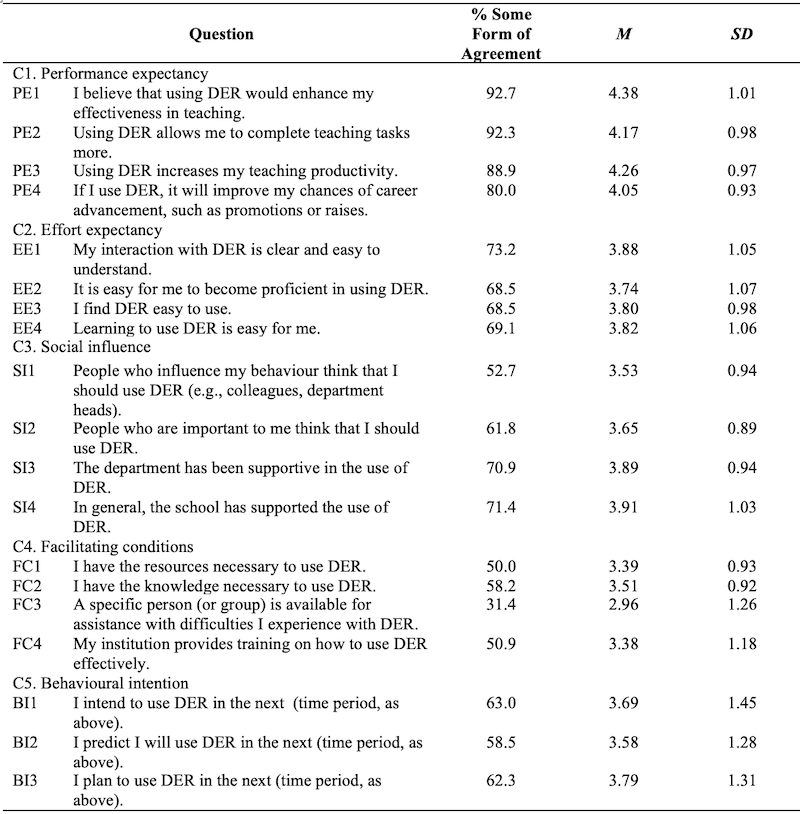
M = Mean, SD = Standard deviation
This study received approval from the Institutional Review Board (IRB) of the researchers’ institution. Participation was entirely voluntary, and informed consent was obtained electronically at the beginning of the survey. Teachers were provided with a brief description of the study’s purpose, associated risk-benefits, confidentiality protocols, and their right to withdraw at any time. No personally identifiable information was collected. Participants were assured that all data would remain confidential, stored securely on a password-protected computer, and be accessible only to the research team.
The first step in the analysis involved examining the missing values. The percentage of missing data was less than 7%, which is generally considered minimal (Warner, 2013). To assess internal consistency, reliability analysis was conducted using Cronbach’s alpha. The summated rating approach was adopted to calculate the average score across items using the MEAN function. To assess data normality, skewness values were examined and confirmed to be within the acceptable range of ±1. Then the descriptive statistics, and bivariate correlations were computed. To understand the research questions, independent samples t-tests, multiple linear regression and hierarchical multiple regression were conducted. In the hierarchical regression, mean centred predictors were entered in the first block, the dummy-coded gender variable in the second block, and the interaction terms in the third block.
For the first research objective, independent samples t-tests were conducted. Results showed marginally significant (p = .05, d = 0.54) mean differences in behavioural intention, where male teachers reported a higher intention to adopt DER compared to female teachers (Table 3). However, mean differences in predictors of behavioural intention to adopt DER were not significant across gender.
Table 3: Mean Differences in Study Measures Across Gender
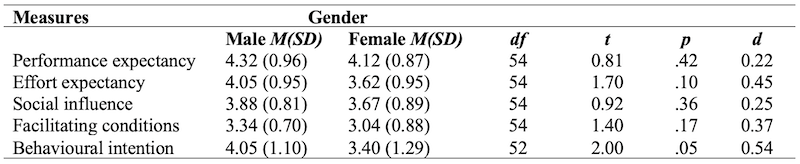
t = t-test value; p = significance level; d = Cohen’s d effect size; df = degree of freedom
For the second research objective, multiple linear regression was conducted. The results illustrated that the overall model was statistically significant, accounting for 25% of the variance in behavioural intention to adopt DER (Table 4). Among the four predictors, facilitating conditions emerged as the strongest predictor of behavioural intention, approaching marginally significant (p = .07, β = 0.33). Performance expectancy, effort expectancy, and social influence were non-significant.
Table 4: Predictors of Behavioural Intention to Adopt DER
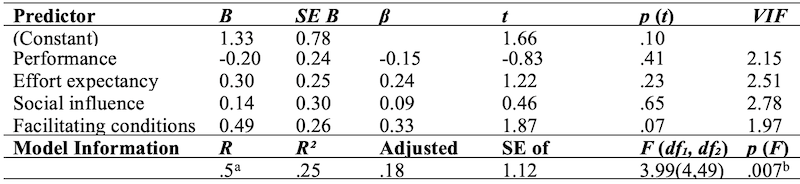
R = correlation coefficient; R² = coefficient of determination; SE = standard error; F (df₁, df₂) = F statistic with degrees of freedom; B = unstandardised regression coefficient; SE B = standard error of B; β = standardised coefficient.
For the third research objective, hierarchical multiple regression was conducted. Results showed that all three models remained significant (Table 5). Model 1 included the mean centred main effects. Model 2 added a dummy coded gender variable resulting in a small increase (2%) in the explained variance. Finally, Model 3 included the interaction terms, which again increased the explained variance, and the overall model accounted for 31% of the variance in behavioural intention to adopt DER.
Table 5: Moderating Role of Gender in Relationship Between Predictors and Behavioural Intention
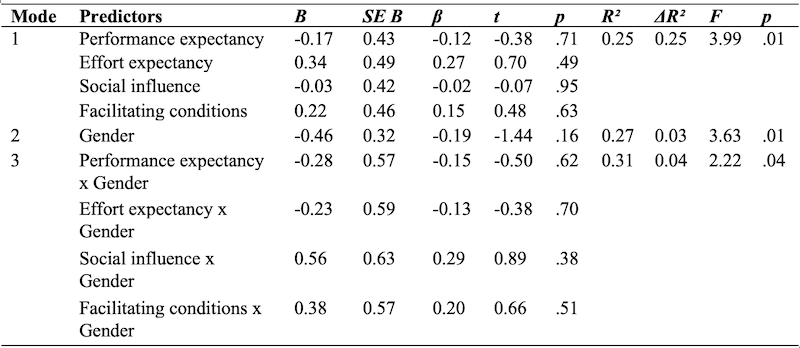
B = unstandardised regression coefficient; SE B = standard error of B; β = standardised beta coefficient; R² = proportion of variance explained; ΔR² = R² change from previous block.
The marginally significant positive predictive role of facilitating conditions indicated that infrastructural supports, training, and technical guidance were vital enablers to adopting DER among teachers in the current sample. This is consistent with studies in Ghana, Nigeria, and India, where facilitating conditions were found to drive teachers’ intention to use technologies (Bervell & Arkorful, 2020; Buraimoh et al., 2023; Rawal, S., 2024). This means, teachers are more likely to adopt DER when they have proper infrastructure, training, and technical support. Interestingly, performance expectancy did not emerge as a significant predictor in contrast with some of the previous studies from Oman, China, and Spain (Almaki et al., 2024; Liu et al., 2025; Rodríguez-Gil, 2024). This difference could be due to the mismatch of available DER that did not align with the curriculum and Nepal’s exam-oriented teaching practices (Adhikari et al., 2023). Such a contradiction indicates that if DER are not aligned with the curriculum and education system, teachers might not believe these will improve their performance. Another reason could be the legacy of donor-driven technology interventions in Nepal without them being tailored to local needs (Bhatta, 2011). Such finding further strengthens the argument from the postcolonial perspective that digital education policies borrowed from the Global North (Mudaly & Chirikure, 2023) might not succeed in the Global South.
Effort expectancy showed a non-significant effect, in line with an earlier study by Daniali et al. (2022). In Nepal teachers are generally familiar with basic technology but lack confidence to integrate it fully into teaching (Laudari & Maher, 2019), and find it challenging to use new technology (Shrestha et al., 2016). In Pakistan, too, perceived ease of use was helpful but not decisive (Nandwani & Khan, 2016). This suggests that teachers do appreciate tools that are easy to use, but this is not enough if they do not feel confident in infrastructural support. Consistent with our study, the research finding from a previous study completed in Nigeria also showed that social influence was not a significant predictor of behavioural intention (Adigun et al., 2025). This suggests that while peer encouragement and school leadership support are helpful, they are not decisive unless teachers feel equipped with the necessary resources.
The analysis of gender differences, though marginally significant, deserves attention. The result showed that male teachers reported higher behavioural intention to adopt DER compared to female teachers, with a moderate to large effect size. The pattern is consistent with feminist critiques that men often have more access to, confidence in, and freedom to use technology in patriarchal societies (Harding, 2001; Weiner, 1994). In Nepal, female teachers encounter barriers when engaging with digital tools (Khadka et al., 2025). The finding that male teachers reported higher behavioural intention likely reflects the structural barriers confronting female teachers in patriarchal societies. Constraints such as restricted mobility, disproportionate domestic responsibilities, and limited access to professional training may have diminished female teachers’ engagement with DER. This gender gap reinforces the need for gender-responsive digital education policies in Nepal. Although the moderating role of gender was not statistically significant, this subtle difference in behavioural intention across gender points and the underlying sociocultural structure may still disadvantage female teachers in Kathmandu Valley.
This study has important theoretical, practical, and policy implications. Theoretically, the study shows that the UTAUT model is a useful baseline framework in the Nepali educational context but its core constructs should be analysed in conjunction with other critical theories like postcolonial and feminist perspectives. In this study the postcolonial standpoint helped explain how teachers might reject DER that do not match their local educational context (Dhital, 2018). Similarly, the feminist viewpoints highlighted how even in urban schools, gender inequalities in digital education exist (Khadka et al., 2025; Poudel, 2019). Practically, these results suggest that the adoption of DER is accompanied by strong facilitating conditions that include robust infrastructure, meaningful training, contextual digital content, and technical support. School leaders in Nepal may benefit from placing greater emphasis on investing in these. Finally, at the policy level, it is important for the ICT in Education Master Plan and associated plans to be re-evaluated in order to embed inclusive, gender-responsive, and locally relevant implementation strategies. Targeted programmes for female teachers, and the co-design of training programmes could better match the contextual diversity of Nepali classrooms. Also, the remaining performance expectancy nonsignificant predictor of teachers’ behavioural intention to adopt DER supports the necessity for decolonising digital education implementation by tailoring it to local realities.
Despite its multiple implications, this study has a few limitations to acknowledge. The study’s sample was limited to teachers in the relatively well-resourced schools from Kathmandu Valley, potentially limiting disadvantaged groups. The modest sample size (N = 56) may have reduced the statistical power and generalisability of the findings. This study examined only a single time point and could not capture how teachers’ intentions might change over time. Gender differences were analysed only at a statistical level; deeper interviews of teachers could reveal more about female teachers’ lived experiences. Other moderating variables such as age, experience, voluntariness of use, as explained by the UTAUT model, were not included.
This study investigated the factors shaping the behavioural intention of teachers from Kathmandu Valley to adopt DER. It also examined mean differences in behavioural intention and its predictors across gender, and the moderating role of gender. The facilitating conditions were the marginally significant positive predictor of teachers’ intention to adopt DER. There was marginally significant and higher behavioural intention of male teachers to adopt DER compared to female teachers. Although gender as moderator remained nonsignificant, its inclusion in the model increased the explained variance.
This study offers three notable contributions. First, it extends UTAUT to Nepali Grades 1 to 12 teachers, a group largely underexplored in quantitative research, moving beyond the frequent university-based and qualitative studies. Second, it advances a theoretical integration of UTAUT using postcolonial and feminist lenses, adding fresh perspectives to the literature in the domain. Finally, the study offered evidence to guide policymakers in prioritising facilitating conditions, acknowledging realities on the ground, and incorporating gender-targeted interventions.
Future research could build on this in several ways. Studies including rural and semi-urban teachers may provide a broader understanding of how context shapes adoption of DER in Nepal. Longitudinal designs might help explain how context-specific interventions could change teachers’ behavioural intention to adopt DER in Nepal. Integrating Social Cognitive Theory, Flow Theory, and digital literacy frameworks with a larger sample could unpack self-efficacy, engagement, and competency beyond UTAUT predictors and help understand how these factors interact with UTAUT constructs. Exploring the intersectionality of gender with caste, ethnicity, and class, could further generate context-relevant insights of gender in adopting DER among teachers in Nepal.
Adhikari, K.P., Joshi, D.R., Belbase, S., Sharma, L., & Khanal, B. (2023). Mathematics teachers’ self-reported practices of formative assessments in teaching mathematics online. International Journal of Online Pedagogy and Course Design (IJOPCD), 13(1), 1-19. https://doi.org/10.4018/IJOPCD.324603
Adigun, O.T., Tijani, F.A., Haihambo, C.K., & Enock, S.L. (2025). Understanding pre-service teachers’ intention to adopt and use artificial intelligence in Nigerian inclusive classrooms. Frontiers in Education, 10(2025). https://doi.org/10.3389/feduc.2025.1519472
Almaki, S.H., Al Mazrouei, A.K., Mafarja, N., Naseem, W., Sial, M.A., & Naveed, R.T. (2024). Factors influencing inclusive teachers’ acceptance to adopt eLearning platforms in classroom: A case study in Oman. Frontiers in Education, 9(2024). https://doi.org/10.3389/feduc.2024.1477659
Anthony, B., Kamaludin, A. & Romli, A. (2023). Predicting academic staffs behaviour intention and actual use of blended learning in higher education: Model development and validation. Technology, Knowledge and Learning, 28(3), 1223-1269. https://doi.org/10.1007/s10758-021-09579-2
Berrío-Zapata, C., Berrío Gil, D.S., Marín Arraiza, P., & Ferreira da Silva, E. (2018). Gender digital divide in Latin America: Looking for a helping hand in the BRICS. Digital Icons, 19, 143-160. https://doi.org/10.5281/zenodo.14710011
Bervell, B., & Arkorful, V. (2020). LMS-enabled blended learning utilization in distance tertiary education: Establishing the relationships among facilitating conditions, voluntariness of use and use behaviour. International Journal of Educational Technology in Higher Education, 17(1), 6. https://doi.org/10.1186/s41239-020-0183-9
Bhatta, P. (2011). Aid agency influence in national education policy-making: A case from Nepal’s ‘Education for All’ movement. Globalisation, Societies and Education, 9(1), 11-26. https://doi.org/10.1080/14767724.2010.513283
Buraimoh, O.F., Boor, C.H.M., & Aladesusi, G.A. (2023). Examining facilitating condition and social influence as determinants of secondary school teachers’ behavioural intention to use mobile technologies for instruction. Indonesian Journal of Educational Research and Technology, 3(1), 25-34. https://doi.org/10.17509/ijert.v3i1.44720
Cabellos, B., Siddiq, F., & Scherer, R. (2024). The moderating role of school facilitating conditions and attitudes towards ICT on teachers’ ICT use and emphasis on developing students’ digital skills. Computers in Human Behavior. https://doi.org/10.1016/j.chb.2023.107994
Cavalcante, E., & Araújo, A.C.D. (2022). Digital educational resources in school physical education: An exploratory study on the MEC RED platform. Motriz: Revista de Educação Física. https://doi.org/10.1590/S1980-6574202200002222
Daniali, S.M., Barykin, S.E., Zendehdel, M., Kalinina, O.V., Kulibanova, V.V., Teor, T.R., Ilyina, I.A., Alekseeva, N.S., Lisin, A., Moiseev, N., & Senjyu, T. (2022). Exploring UTAUT model in mobile 4.5 G service: Moderating social–economic effects of gender and awareness. Social Sciences, 11(5), 187. https://doi.org/10.3390/socsci11050187
Demuyakor, J., Doe, V.A., Tachie-Djan, C., Bhatti, M.A., & Avenyo, S.J. (2023). Predicting university teachers’ behavior intentions toward digital technologies: An extension of the unified theory of acceptance and use of technology model (UTAUT). Journal of Intelligent Communication, 3(1), 23-34. https://doi.org/10.54963/jic.v3i1.208
Dewey, J. (1986). Experience and education. The Educational Forum, 50(3), 241–252. https://doi.org/10.1080/00131728609335764
Dhital, H. (2018). Opportunities and challenges to use ICT in government school education of Nepal. International Journal of Innovative Research in Computer and Communication Engineering, 6(4), 3215-3220.
Ertmer, P.A., & Ottenbreit-Leftwich, A. (2013). Removing obstacles to the pedagogical changes required by Jonassen’s vision of authentic technology-enabled learning. Computers and Education, 64, 175-182. https://doi.org/10.1016/j.compedu.2012.10.008
Esawe, A.T., Esawe, K.T., & Esawe, N.T. (2024). Evaluating schoolteachers’ acceptance of m-learning during Covid-19 using the Technology Acceptance Model: The moderating role of gender and age. SN Social Sciences, 4(2), 43. https://doi.org/10.1007/s43545-024-00830-y
Escobar, A. (2011). Encountering development: The making and unmaking of the Third World. Princeton University Press.
Fullan, M., & Langworthy, M. (2014). A rich seam: How new pedagogies find deep learning. Pearson.
Gautam, K. (2023). Teachers’ experience of ICT training for professional development. Kalika Journal of Multidisciplinary Research, 1(1), 14-25. https://doi.org/10.3126/kjmr.v1i1.61494
Government of Nepal. (2019). Digital Nepal framework. Government of Nepal.
Harding, S. (2001). Introduction: Standpoint theory as a site of political, philosophic, and scientific debate. In S. Harding (Ed.), The feminist standpoint theory reader: Intellectual and political controversies (pp. 1-15). Routledge.
Hsu, L. (2023). EFL learners’ self-determination and acceptance of LMOOCs: The UTAUT model. Computer Assisted Language Learning, 36(7), 1177-1205. https://doi.org/10.1080/09588221.2021.1976210
Khadka, S., Pathirana, N.L., Sethi, V., Andreev-Jitaru, D., Nair, A., & Backholer, K. (2025). Closing the digital gender divide could help improve adolescent girls’ health and nutrition across South Asia. BMJ, 388. https://doi.org/10.1136/bmj-2024-080812
Kirkwood, A., & Price, L. (2014). Technology-enhanced learning and teaching in higher education: What is ‘enhanced’ and how do we know? A critical literature review. Learning, Media and Technology, 39(1), 6-36. https://doi.org/10.1080/17439884.2013.770404
Laudari, S., & Maher, D. (2019). Barriers to ICT use in EFL teacher education courses in Nepal: An activity theory perspective. Journal of NELTA, 24(1-2), 77-94. https://doi.org/10.3126/nelta.v24i1-2.27681
Li, M., Vale, C., Tan, H., & Blannin, J. (2025). Factors influencing the use of digital technologies in primary mathematics teaching: Voices from Chinese educators. Education and Information Technologies, 30(9), 12573-12608. https://doi.org/10.1007/s10639-024-13309-3
Liu, J., Dai, Q., & Chen, J. (2025). Factors affecting teachers’ use of digital resources for teaching mathematical cultures: An extended UTAUT-2 model. Education and Information Technologies, 30(9), 7659-7688. https://doi.org/10.1007/s10639-024-13105-z
Mafa, R.K., & Govender, D.W. (2025). Exploring teachers’ technology adoption: Linking TPACK knowledge and UTAUT-3 constructs. Discover Education, 4(88). https://doi.org/10.1007/s44217-025-00480-z
Ministry of Education. (2016). School sector development plan 2016-2023. Government of Nepal.
Ministry of Education. (2013). Information and communication technology (ICT) in education master plan 2013-2017. Government of Nepal.
Mudaly, R., & Chirikure, T. (2023, October). STEM education in the Global North and Global South: Competition, conformity, and convenient collaborations. Frontiers in Education, 8. https://doi.org/10.3389/feduc.2023.1144399
Nandwani, S., & Khan, S. (2016). Teachers’ intention towards the usage of technology: An investigation using UTAUT model. Journal of Education and Social Sciences, 4(2), 95-111. https://web.archive.org/web/20180723154836id_/https://geistscience.com/JESS/issue2-16/Article2/JESS1604202.pdf
National Academies of Sciences, Engineering, and Medicine. (2018). How people learn II: Learners, contexts, and cultures. The National Academies Press.
Nwajiuba, C.A., & Ukwandu, E. (2021). Female ICT participation in South-Eastern Nigerian tertiary institutions: Inhibiting factors. https://doi.org/10.48550/arXiv.2103.13391
Organisation for Economic Co-operation and Development. (2023). OECD digital education outlook 2023: Towards an effective digital education ecosystem. OECD.
Poudel, M. (2019). Gender in equality in Nepal: Challenges faced by educated working women in professional. NORD University. https://nordopen.nord.no/nord-xmlui/bitstream/handle/11250/2617433/PoudelMahendra.pdf?sequence=1
Rana, K., Greenwood, J., & Fox‐Turnbull, W. (2020). Implementation of Nepal’s education policy in ICT: Examining current practice through an ecological model. The Electronic Journal of Information Systems in Developing Countries, 86(2). https://doi.org/10.1002/isd2.12118
Rawal, D.M. (2024). Mapping of school teachers’ digital competency in the context of digital infrastructure: A systematic review and empirical study of India. Journal of Professional Capital and Community, 9(3), 173-195. https://doi.org/10.1108/JPCC-01-2024-0016
Rawal, S. (2024). Gender and digital engagement in Panchkhal Municipality, Kavre, Nepal. Tribhuvan University Journal, 39(1), 112-123. https://doi.org/10.3126/tuj.v39i1.66678
Rodríguez-Gil, M.E. (2024). Factors influencing 360-degree video adoption in e-learning: A UTAUT2 case study with pre-service primary education teachers in Spain. Journal of E-Learning and Knowledge Society, 20(1), 27-36. https://doi.org/10.20368/1971-8829/1135881
Shrestha, B., Gautam, N., & Shakya, M. (2016). Flipped class: New e-learning object in Nepal and perspective of teachers. Third International IT Conference on ICT for Intelligent Computing.
Tzafilkou, K., Perifanou, M., & Economides, A.A. (2023). Assessing teachers’ digital competence in primary and secondary education: Applying a new instrument to integrate pedagogical and professional elements for digital education. Education and Information Technologies, 28, 16017-16040. https://doi.org/10.1007/s10639-023-11848-9
Tzimas, D., & Demetriadis, S. (2025). K-12 teachers’ acceptance and resistance perceptions of learning analytics adoption: A mixed-methods approach. TechTrends, 69, 385-399. https://doi.org/10.1007/s11528-025-01045-5
Venkatesh, V., Morris, M.G., Davis, G.B., & Davis, F.D. (2003). User acceptance of information technology: Toward a unified view. MIS Quarterly, 27(3), 425-478. https://doi.org/10.2307/30036540
Wang, LH., Chen, B., Hwang, G.J., Guan, J.Q., & Wang, Y.Q. (2022). Effects of digital game-based STEM education on students’ learning achievement: A meta-analysis. International Journal of STEM Education, 9(1), 26. https://doi.org/10.1186/s40594-022-00344-0
Warner, R.M. (2013). Applied statistics: From bivariate through multivariate techniques. Sage Publications.
Weiner, G. (1994). Feminisms in education: An introduction. Taylor & Francis Group.
Wignall, L., Roberts, A., Brown, J., & Ahmed, S.K. (2024). Gender barriers to basic digital skills for employment in the ASEAN region: A review of promising practices. Australian Council for Educational Research. https://doi.org/10.37517/978-1-74286-741-0
Wu, C., Gong, X., Luo, L., Zhao, Q., Hu, S., Mou, Y., & Jing, B. (2021). Applying control-value theory and unified theory of acceptance and use of technology to explore pre-service teachers’ academic emotions and learning satisfaction. Frontiers in Psychology, 12. https://doi.org/10.3389/fpsyg.2021.738959
Author Notes
Bijaya Shrestha is a PhD student in Educational Foundations and Research at the University of North Dakota. His research focuses on the psychology of digital technology use in education. Email: bijaya.shrestha@und.edu (https://orcid.org/0009-0007-4450-789X)
Virginia Clinton-Lisell is an associate professor in Educational Foundations and Research at the University of North Dakota. Her current research focuses on the psychology of reading comprehension and open education. She is a primary researcher for the Open Education Group. Email: virginia.clinton@und.ed (https://orcid.org/0000-0002-4705-2217)
Cite as: Shrestha, B., & Clinton-Lisell, V. (2026). Facilitating conditions and gender gaps: Predicting intention to adopt digital education resources among teachers. Journal of Learning for Development, 13(2), 258-269.