Ademola Olatide Olaniyan, Olubusayo V. Fakuade and Bolanle Susan Olaniyan
2026 VOL. 13, No. 3
Abstract: This study investigated the relationships between teacher ICT competencies, laboratory resources, teacher workload, and perceived student science performance in Open and Distance Learning (ODL) within Universal Secondary Education (USE) schools in Kampala, Uganda. Employing a mixed-methods design, quantitative data from 76 randomly selected teachers was analysed using descriptive statistics, Pearson correlation, and multiple regression, while qualitative insights were gathered from 10 purposively sampled participants. The results revealed significant positive correlations between each predictor and perceived student science performance, while the combined regression model explained 40.3% of the variance in perceived student science performance. However, only teacher workload significantly predicted perceived student science performance. Qualitative findings highlighted challenges including insufficient ICT training, limited laboratory resources, and instructional pressures from dual-mode delivery. The study concludes that, while ICT skills and laboratory resources are vital, their effectiveness depends on manageable teacher workloads. It recommends integrated policies to enhance teacher capacity, infrastructure, and workload management to improve science outcomes in ODL settings across Sub-Saharan Africa.
Keywords: Open and Distance Learning (ODL), science education, teacher ICT competencies, laboratory resources, teacher workload, perceived student science performance
Science education remains central to national development; however, persistent underperformance in Uganda’s secondary schools, despite investments in infrastructure and teacher training, raises critical concerns (Kyle, 2020; UNEB, 2023, 2024). The growing adoption of open and distance learning (ODL), accelerated by policy shifts and global disruptions, has further transformed instructional contexts, requiring a re-examination of key school-level factors influencing science performance (Makonye, 2025; UNESCO, 2023).
Uganda’s Universal Secondary Education (USE) programme has increasingly adopted ODL and blended learning approaches to expand access and strengthen continuity of education, particularly following the Covid-19 pandemic. Although face-to-face instruction remains the dominant mode of delivery, many secondary schools now complement classroom teaching with digital platforms, mobile technologies, and virtual learning resources. This transition has reshaped science education by requiring teachers to integrate ICT, laboratory-based learning, and online instructional practices while managing additional teaching responsibilities, creating new challenges that may influence students’ academic performance (Uganda National Examinations Board [UNEB], 2024; UNESCO, 2023).
For this study, the focus was on three key variables: teacher ICT competencies, laboratory resources, and teacher workload. The study employed the theoretical framework of Walberg (1981) and his Theory of Educational Productivity to explore how these factors work together to affect the performance of students in secondary school science education (Reynolds & Walberg, 1992). Recent research indicates that while the development of teachers’ ICT competence is important (Agyei, 2021; Awuor & Okono, 2022), laboratory quality also plays a role (Bazie et al., 2024; Gitira, 2025), and teacher workload may hinder student performance (Kraft et al., 2021; Ogundare et al., 2022; Pan et al., 2023). Most of the literature available on these three variables is based on higher education environments or traditional educational environments. There has been very limited research on how these three variables work together in a secondary school ODL context in Sub-Saharan Africa, thus the purpose of this study was to investigate the combined effects of these three variables on students’ performance in their respective science subjects in USE schools, located in and around Kampala, as an important area of focus to fill this gap in the research.
In ODL contexts, teachers’ ICT competencies become even more pivotal. They influence not only instructional quality but also students’ engagement and persistence in online learning environments. Laboratory experiences have been long held as crucial to science learning; this is the reason they, too, face the challenges unique to ODL, so the discourse on whether virtual labs and simulations can be effective alternatives to physical facilities has been initiated (Bazie et al., 2024). Workload issues have always been at the centre in the traditional environment; however, complexity presents an all-new version in ODL, which includes content development and online student support besides dual-mode teaching (Kraft et al., 2021; Mugyenyi et al., 2025; Pan et al., 2023).
Major knowledge gaps remain regarding the interaction of these critical variables and their influence on student outcomes in hybrid and fully online secondary school settings in Uganda. Although there is growing literature on ODL in science education, most of the key issues remain significantly under-researched. It is common for studies conducted in sub-Saharan Africa to have addressed ODL in secondary science education at the university level. To compound the situation, much of the research regarding laboratory infrastructure, teacher ICT skills, and workload has not considered how these factors collectively influence science performance in an ODL setting.
This study examined three interrelated school variables in relation to perceived student science performance in ODL environments: teacher ICT competencies, laboratory resources, and teacher workload. Teacher ICT competency is defined as a teacher’s ability to utilise various digital tools, learning management systems, and online instructional methods in teaching science (Makonye 2025; UNESCO, 2023). Laboratory resources refer to physical and virtual laboratories that support experiential science learning (Bazie et al., 2024; Gitira, 2025). Teacher workload is made up of instructional, administrative, and digital teaching requirements that can influence the effectiveness of instruction (Kraft et al., 2021; Pan et al., 2023). The current study’s framework assumes that these three variables interact within ODL settings to establish the overall science performance of students attending USE secondary schools.
The foundation of the research is Walberg’s Theory of Educational Productivity, which explains how students’ academic performance is a function of how various instructional factors and various environmental factors work together (Reynolds & Walberg, 1992; Walberg, 1981). In ODL, many of these variables will increasingly be technological and therefore, teachers’ digital readiness and institutional support will be key elements for the effective learning outcomes of students (UNESCO, 2023). In this study, ICT competencies were instructional variables which influenced the effectiveness of teachers when they delivered science content using digital means, through online assessments and engaging with students virtually (Makonye, 2025). The laboratory resources, in both physical and virtual laboratories, were environmental variables that assisted students with practical experiences and scientific inquiry (Bazie et al., 2024; Gitira, 2025).
The workload of teachers is a structural condition that influences the extent to which teachers can effectively apply ICT tools and laboratory resources to ODL settings (Kraft et al., 2021; Pan et al., 2023). The theory explains how school-level conditions collectively influence students’ performance in science and thus align with research objectives, research methods, research results and discussion points. Additionally, the findings expand Walberg’s theory, by illustrating how, in ODL settings, an excessive workload on teachers could limit the effective use of instructional resources/variables. Therefore, the theory is appropriate for explaining science performance in resource-limited contexts in ODL settings specifically in Sub-Saharan Africa.
Research on science education has traditionally focused on face-to-face learning environments, however, the rise of ODL has reshaped how key school-related factors influence student performance. Variables such as teacher ICT competencies, laboratory resources, and teacher workload remain central, but their roles are increasingly mediated by technology in ODL contexts. Globally, the expansion of ODL across regions such as Asia and Latin America has provided insights into factors influencing learning effectiveness. While students often report satisfaction with online learning, challenges persist in platform use and interaction quality (Kamila et al., 2024). Evidence from the UAE similarly shows that student engagement is more strongly influenced by the quality and continuity of teacher interaction than by mere access to digital tools. These findings suggest that effective ODL requires not only access to technology but also strong pedagogical support and institutional readiness. In Latin America, ODL has improved access to digital resources, but students often report reduced instructional support compared to face-to-face learning, highlighting a trade-off in dual-mode delivery (Antoninis et al., 2023; Ferreira Brito & Bonai et al., 2024; Valencia et al., 2023). This reinforces the need for balanced systems that combine technological access with effective instructional support.
Teacher ICT competencies are widely recognised as a key determinant of effective science teaching in ODL. Evidence shows a strong positive relationship between teachers’ ICT skills, instructional quality, and student achievement (Makonye, 2025). In these environments, competencies extend beyond basic digital literacy to include the effective use of learning management systems, digital assessments, and interactive tools (UNESCO, 2023). Studies in Sub-Saharan Africa further indicate that ICT-trained teachers are better able to deliver interactive instruction (Awuor & Okono, 2022), although their effectiveness is often constrained by infrastructural limitations, inadequate professional development, and weak policy support (Agyei, 2021; Pan et al., 2023). Despite this, there has been limited research to examine how ICT competencies interact with other school-level variables in secondary ODL contexts.
Laboratory resources remain essential for science learning. In traditional settings, well-equipped laboratories are strongly associated with improved student achievement (Gitira, 2025; Ogunbanwo et al., 2025). In ODL environments, however, reliance on virtual laboratories has increased due to limited access to physical facilities. While virtual labs can produce comparable outcomes, particularly in higher education (Bazie et al., 2024), their effectiveness in secondary education is constrained by infrastructural challenges such as poor internet connectivity, high data costs, and limited digital literacy (Makonye, 2025).
Teacher workload is another critical factor influencing instructional quality and student outcomes. In traditional contexts, excessive workload reduces time for lesson preparation and learner support (Ogundare et al., 2022; Pan et al., 2023). In ODL environments, workload is further intensified by additional responsibilities such as digital content development, online interaction, and technical support (Kraft et al., 2021). Evidence from Uganda and Nigeria indicates that dual-mode teaching increases workload, leading to teacher stress and reduced instructional effectiveness (Ogundare et al., 2022; Olaniyan et al., 2024; Pan et al., 2023; UNESCO, 2023).
Despite the growing body of literature on ICT integration, virtual laboratories, and teacher workload, most studies focus on higher education or conventional settings. There remains limited empirical evidence on how these variables interact to influence science performance in secondary school ODL contexts, particularly in Sub-Saharan Africa. In response to these gaps, this study examines the combined influence of teacher ICT competencies, laboratory resources, and teacher workload on students’ science performance in USE secondary schools in Uganda, providing context-specific evidence to inform policy and practice in resource-constrained ODL environments.
The study was guided by the following three research objectives:
The study adopted a correlational, convergent mixed methods design to examine relationships between teacher ICT competencies, laboratory quality, teacher workload, and perceived student science performance. Quantitative and qualitative data were analysed separately and integrated during interpretation to identify convergence and complementarity. This enabled the qualitative evidence to provide contextual explanations for the statistical relationships observed in the quantitative findings.
The study population comprised 80 science teachers from five senior secondary schools in Kampala Central Division, from which 76 teachers were selected using simple random sampling. The slight reduction from the total population was due to non-response and availability constraints, although the sample remained highly representative. For the qualitative component, a purposive sample of 10 teachers was drawn from the same population based on criteria including leadership roles (e.g., Heads of Science Departments), teaching experience, and involvement in ICT or ODL practices. These criteria ensured the selection of participants with relevant experience to provide in-depth insights into ICT integration, laboratory use, and workload challenges. The unit of analysis was the science teacher. Accordingly, student science performance was assessed from participating teachers’ ratings of their students’ learning outcomes using the questionnaire. This teacher-reported measure was used as the dependent variable and examined in relation to teacher ICT competencies, laboratory quality, and teacher workload.
Quantitative Instrument (Questionnaire)
A structured questionnaire comprising 40 items was used to measure four constructs: teacher ICT competencies (10 items), laboratory quality (10 items), teacher workload (10 items), and perceived student science performance (10 items). Items were rated on a five-point Likert scale ranging from 1 (Strongly Disagree) to 5 (Strongly Agree). The first three constructs represented the independent variables, while perceived student science performance constituted the dependent variable. The questionnaire also contained limited open-ended items to allow respondents to elaborate on their responses.
Validity and Reliability
Content validity was achieved through advanced expert evaluation by faculty members with a specialisation in educational measurement and research methodology. Experts validated the relevance, clarity, and comprehensiveness of the questionnaire and semi-structured interview guides. Feedback from this review was mobilised in the fine-tuning of the instruments to ensure alignment with the traditional mode of teaching science and the direction of practice emerging in ODL.
The reliability of the quantitative tools was tested under internal consistency via Cronbach’s alpha. A pilot study was done on 10 science teachers, taken from a USE school outside the study location. Results indicated high internal consistency among the three independent variables, as shown by Cronbach’s alpha coefficients for teacher ICT competencies (α = 0.84), quality of laboratory facilities (α = 0.81), and teacher workload (α = 0.86). Reliability coefficients were therefore established for the three predictor scales used in the principal analyses.
The data collection lasted four weeks. Prior to its commencement, official permission was obtained from the school authorities, presenting all potential participants with an introductory letter from Kampala International University. The questionnaires for the quantitative component were distributed and returned on a face-to-face basis after completion. Qualitative data was collected through face-to-face semi-structured interviews scheduled in advance at the school premises. Data were collected using the face-to-face modality only, however there was an effort made to use instruments that could be adapted for use in an online application, particularly where there was an alignment with ODL contexts, and to provide examples of how instruments can be used in a fully digital format.
Quantitative data were analysed using SPSS (Version 22). Descriptive statistics, which include means and standard deviations, were measures by which the responses of the participants were summarised. The 5-point Likert scale used in the questionnaire ranged from 1 (Strongly Disagree) to 5 (Strongly Agree). To facilitate interpretation, responses were categorised into three threshold levels: Low agreement (1.00 – 2.49): Indicated disagreement or low perception of the factor. Moderate agreement (2.50 – 3.49): Indicated average or moderate satisfaction/competency. High agreement (3.50 – 5.00): Reflected strong agreement or high levels of satisfaction/competency. These ranges were used to determine the perceived adequacy of ICT skills, laboratory quality, and workload balance. For the workload scale, higher scores represented more manageable workload conditions, whereas lower scores indicated greater workload pressure. Inferential analyses, including Pearson correlation and multiple linear regression, were used to examine relationships and determine the extent to which teacher ICT competencies, laboratory quality, and teacher workload predicted perceived student science performance. To assess the potential presence of multicollinearity among the independent variables, Variance Inflation Factor (VIF) and tolerance statistics were calculated. The verbatim transcribed qualitative data from interviews were systematically coded and subjected to thematic analysis to bring out core patterns and insights on teaching science as a challenge within the ODL integration context.
The study obtained ethical approval from the research ethics committee of Kampala International University. Prior to participation, the respondents were asked to provide informed consent to ensure confidentiality, anonymity, and voluntariness. The data were securely kept and used only for academic work.
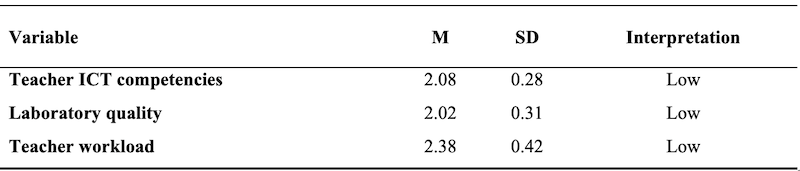
The findings are presented according to the three research objectives. Descriptive statistics first summarised the study variables (Table 1), after which Pearson correlation and multiple regression were used to examine the relationships and predictive effects for Research Objectives 1–3. Qualitative findings were subsequently integrated with the corresponding quantitative results to explain and triangulate the observed relationships.
Table 1: Descriptive Statistics of Study Variables
Note: N = 76. Questionnaire variables were measured on a five-point scale: 1.00 – 2.49 = Low; 2.50 – 3.49 = Moderate; 3.50 – 5.00 = High. Source: Field data (2025).
The descriptive results indicate relatively low levels of teacher ICT competencies and laboratory quality, alongside workload challenges. Student science performance is presented separately in Table 2 because it constitutes the dependent variable examined against the three predictor variables.
In the Perceived Student Science Performance Results, as shown in Table 2, teachers reported a relatively low level of student science performance (M = 2.43, SD = 0.41). This outcome was subsequently examined in relation to teacher ICT competencies, laboratory quality, and teacher workload (Tables 3–5) through Pearson correlation and multiple regression.
Table 2: Descriptive Statistics for Perceived Student Science Performance

Note: Student science performance represents participating teachers’ ratings of students’ science learning outcomes on the five-point questionnaire scale. Scores of 1.00 – 2.49 were interpreted as low, 2.50 – 3.49 as moderate, and 3.50 – 5.00 as high.
Table 3: Correlation and Regression Results for ICT Competencies (RO1)

Note: **p < .01. Source: Field data (2025).
Quantitative Interpretation
The Pearson correlation shows a strong positive relationship between teacher ICT competencies and student performance (r = .796, p < .01). However, regression analysis indicates that ICT competencies were not a significant predictor (p = .936). The strong bivariate association suggests that higher teacher ICT competency scores corresponded with higher perceived student science performance. However, ICT competency did not make a statistically significant independent contribution after the other predictors were controlled.
Qualitative Triangulation
The qualitative findings explain this result. Teachers reported limited ICT training and inadequate access to functional devices:
We want to use simulations and digital microscopes, but the computers are few and often not working.
Most of us didn’t receive enough training on digital tools; we rely on blackboards and textbooks.
These accounts suggest that limited training and access to functional digital resources might constrain teachers’ ability to translate ICT competencies into effective ODL science instruction, providing contextual explanation for the quantitative finding.
Table 4: Correlation and Regression Results for Laboratory Quality (RO2)

Note: **p < .01. Source: Field data (2025).
Quantitative Interpretation
Laboratory quality shows a strong positive correlation with student performance (r = .758, p < .01). However, regression results indicate that it is not a significant predictor (p = .240). The strong positive correlation indicates that higher laboratory-quality scores were associated with higher perceived student science performance. However, laboratory quality did not independently predict the outcome after controlling for the other variables.
Qualitative Triangulation
Qualitative findings support this interpretation by revealing infrastructural limitations:
Some chemicals are expired, and we don’t have basic apparatus.
Sometimes we combine students due to limited space and equipment.
These accounts indicate that limited and inconsistent access to laboratory resources may constrain their effective instructional use, providing contextual insight into the quantitative result.
Table 5: Correlation and Regression Results for Teacher Workload (RO3)

Note: **p < .01, *p < .05. Source: Field data (2025).
Quantitative Interpretation
Teacher workload conditions showed the strongest correlation with perceived student science performance (r = .808, p < .01) and remained the only significant predictor in the multivariable model (β = .431, p = .032). This indicates that more manageable workload conditions were associated with higher perceived student science performance after controlling for ICT competencies and laboratory quality.
Qualitative Triangulation
Qualitative evidence strongly reinforces this finding:
I teach over 200 students and handle multiple subjects; I don’t have time to prepare properly.
We teach, handle administration, and support students online at the same time.
These responses show that excessive workload directly limits instructional quality, ICT use, and laboratory engagement, confirming its dominant influence.
Before interpreting the combined regression results for Research Objectives 1–3, multicollinearity diagnostics were performed to determine whether teacher ICT competencies, laboratory quality, and teacher workload contributed independently to the model. Figure 1 presents the Variance Inflation Factor (VIF) values for the three predictor variables.
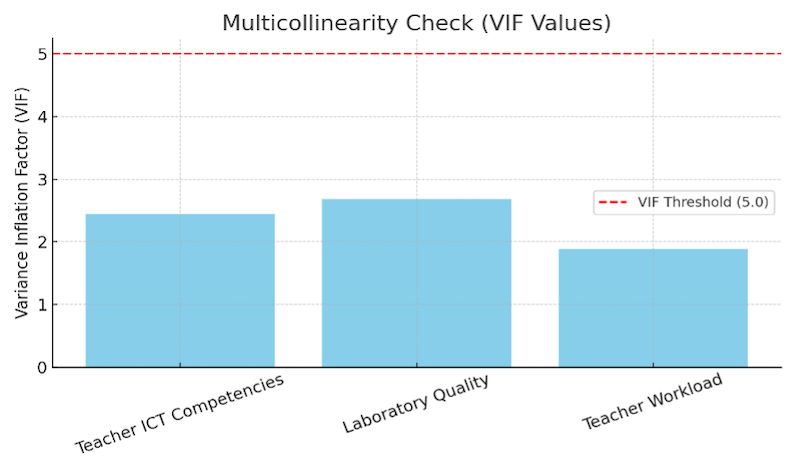
The VIF values for teacher ICT competencies (2.45), laboratory quality (2.68), and teacher workload (1.89) were all below the recommended threshold of 5.0, while the corresponding tolerance values exceeded 0.30. These results indicate that multicollinearity was not a concern, confirming that the regression results reported for Research Objectives 1–3 were not influenced by excessive overlap among the predictor variables. These results indicate that multicollinearity was not a major concern and that the non-significant regression coefficients for ICT competencies and laboratory quality are unlikely to be explained by excessive overlap among the predictors. The qualitative findings provide additional contextual insight into conditions that may have constrained their effective application (Ogundare et al., 2022).
Overall, the findings across the three research objectives indicate that teacher ICT competencies and laboratory quality were positively associated with students’ science performance but do not independently predict performance after controlling for other variables. Teacher workload emerged as the only statistically significant predictor. The qualitative findings further explain these results by showing that limited ICT infrastructure, inadequate laboratory resources, and excessive workload constrain teachers’ ability to apply ICT and laboratory resources effectively in ODL science teaching. Together with the multicollinearity assessment, these findings demonstrate that the observed relationships are statistically reliable and provide a coherent basis for the discussion and implications of the study (Hirose & Creswell, 2023).
The findings provide context-specific evidence on the relationships between teacher ICT competencies, laboratory quality, teacher workload, and perceived student science performance in secondary school ODL settings in Uganda. While ICT competencies and laboratory quality showed strong bivariate associations with perceived performance, teacher workload emerged as the only significant independent predictor. Previous studies have looked at each of these variables independently and this study builds on earlier work by showing that these relationships are context-dependent, with teacher workload emerging as the strongest independent predictor, and that workload of teachers was the primary structural limitation to science performance.
Consistent with prior studies, the ICT competencies of teachers positively influence instructional quality and engagement of students in ODL environments (UNESCO, 2023). However, the lack of evidence for a significant predictive influence of ICT competencies in this study suggests that ICT competencies alone do not provide enabling conditions like infrastructure, institutional support, and continual professional development to positively affect science achievement. This finding represents an advancement over previous studies of Sub-Saharan Africa that have tended to focus primarily on access to ICT and did not examine the relationship between teacher competence and effective pedagogical implementation of the use of ICT (Agyei, 2021; Awuor & Okono, 2022; Pan et al., 2023).
Laboratory quality showed a strong positive association with perceived student science performance, consistent with previous evidence linking practical resources with science learning (Gitira, 2025; Ogunbanwo et al., 2025). Nonetheless, this study found that both physical laboratory and virtual laboratory effectiveness in ODL settings were limited due to inadequate infrastructure and low levels of digital readiness. While virtual laboratories have been positively evaluated in the context of higher education (Bazie et al., 2024), the limited applicability of virtual laboratories in secondary schools represents important contextual evidence from this study.
The most notable finding was that teacher workload conditions emerged as the only significant independent predictor of perceived student science performance. This finding is consistent with the literature documenting the negative consequences of excessive workloads on teacher quality (Kraft et al., 2021; Ogundare et al., 2022) but extends this research by showing that teacher workload may constrain the effective use of ICT and laboratory resources in ODL environments, which is consistent with the global literature indicating that teacher workload is a much greater barrier to effective ODL implementation than poor access to technology (UNESCO, 2023). These results are consistent with Walberg’s (1981) Theory of Educational Productivity in that the outcome of learning is dependent upon the interaction of instructional and environmental variables (Reynolds & Walberg, 1992).
However, this study extends this theory by defining workload as a structural condition in ODL environments that limits all other contributing variables. From a policy and practice perspective, these findings imply a need for integrated ODL strategies. Specifically, as ODL development increasingly relies on the use of ICT, the priority for investment in ICT should be to provide teachers with quality sustained training and institutional support. Also, while developing laboratories, blended development should be adopted that is appropriate to the context.
Finally, it is imperative that policies be put into place to remedy teacher workload by administrative support and redistribution of teacher workload, otherwise, all of the other improvements may not be effective. If these recommendations are not considered, the expansion of ODL will exacerbate the existing educational inequities rather than improve student learning outcomes (Adigun et al., 2024; UNESCO, 2023). Generally, this study adds to the limited literature in the area of ODL academic achievement in secondary schools in Sub-Saharan Africa and provides context-specific evidence that supplements higher education-focused studies. Future research should explore student-level factors such as motivation and digital readiness, longitudinal effects of ODL interventions, and comparative studies of outcomes in diverse educational settings to build a stronger evidence base for policies and practices (Makonye, 2025; UNESCO, 2023).
Teacher workload limits effective ICT and laboratory use in ODL. A coordinated system-level strategy is essential, prioritising continuous, practice-based ICT professional development for teachers. Developing a blended laboratory model combining physical and virtual resources, supported by reliable digital infrastructure, would ensure equitable student access. Policy interventions should address workload redistribution and administrative support to enable effective implementation. Routine ICT and resource use, alongside regular monitoring, is vital for sustainable science learning improvements in ODL settings.
Future research should examine learner factors, such as motivation and digital readiness, that influence science achievement in ODL. Comparative rural-urban studies are needed to identify resource disparities and inform equitable interventions. Longitudinal studies should evaluate the sustained impact of ODL on learning outcomes. Further investigation into school leadership, policy, teacher workload, and students’ experiences with virtual laboratories will strengthen evidence for effective online science education.
Adigun, O.P., Gimba, R.W., Hassan, A.A., & Ezekiel, P.N. (2024). Mathematics teachers’ workload and motivation as determinants of secondary school students performance and attitude in mathematics in Federal Capital Territory, Nigeria. Bilsel International Sumela Scientific Research Congress 06-07 April 2024, Trabzon/Türkiye.
Agyei, D.D. (2021). Integrating ICT into schools in Sub-Saharan Africa: From teachers’ capacity building to classroom implementation. Education and Information Technologies, 26(1–2), 125–144. https://doi.org/10.1007/s10639-020-10253-w
Antoninis, M., Alcott, B., Al Hadheri, S., April, D., Fouad Barakat, B., Barrios Rivera, M., ... & Weill, E. (2023). Global Education Monitoring Report 2023: Technology in education: A tool on whose terms? UNESCO.
Awuor, F. M., & Okono, E. (2022). ICT integration in learning of physics in secondary schools in Kenya: Systematic literature review. Open Journal of Social Sciences, 10(9), 421–461. https://doi.org/10.4236/jss.2022.109027
Bazie, H., Lemma, B., Workneh, A., & Estifanos, A. (2024). The effect of virtual laboratories on the academic achievement of undergraduate chemistry students: Quasi-experimental study. JMIR Formative Research, 8, e64476. https://doi.org/10.2196/64476
Ferreira Brito, M. & Bonal, X. (2024). Beyond the pandemic: Mapping learning recovery programmes in Latin America and the Caribbean. [Master’s Thesis. Universitat Autònoma de Barcelona.] https://ddd.uab.cat/record/308736
Gitira, C.B. (2025). School-based variables’ influence on performance in the Kenya Certificate of Secondary Education in Sub-County Schools in Kakamega County, Kenya. East African Journal of Education Studies, 8(3), 180–190. https://doi.org/10.37284/eajes.8.3.3454
Hirose, M., & Creswell, J.W. (2023). Applying core quality criteria of mixed methods research to an empirical study. Journal of Mixed Methods Research, 17(1), 12-28. https://doi.org/10.1177/15586898221086346
Kamila, Wilujeng, I., Jumadi, J., & Ungirwalu, S.Y. (2024). Analysis of integrating local potential in science learning and its effect on 21st century skills and student cultural awareness: Literature review. Jurnal Penelitian Pendidikan IPA, 10(5), 223–233. https://doi.org/10.29303/jppipa.v10i5.6485
Kraft, M.A., Simon, N.S., & Lyon, M.A. (2021). Sustaining a sense of success: The protective role of teacher working conditions during the COVID-19 pandemic. Journal of Research on Educational Effectiveness, 14(4), 727–769. https://doi.org/10.1080/19345747.2021.1938314
Kyle, W.C., Jr. (202018). Expanding our views of science education to address sustainable development, empowerment, and social transformation. Disciplinary and Interdisciplinary Science Education Research, 1, Article 2. https://doi.org/10.1186/s43031-019-0018-5
Makonye, J. (2025). Transitions in ICT-integrated teaching and learning in trans-disciplinary STEM education: A systematic review. Teacher Education through Flexible Learning in Africa, 7(1). https://doi.org/10.35293/tetfle.v7i1.5309
Mugyenyi, E., Otyola, W.R., & Lucy, A.C. (2025). Analyzing the challenges and opportunities in implementing Uganda’s National Teacher Policy (NTP) in higher education. International Journal of Multidisciplinary Research and Growth Evaluation, 6(3), 523–532. https://doi.org/10.54660/IJMRGE.2025.6.3.523-532
Ogunbanwo, A.S., Owoade, A.A., & Uwakala, G.C. (2025). Evaluating the effectiveness of adaptive simulations on science education outcomes in secondary schools: A case study of secondary schools in Ogun State, Nigeria. Journal of Science and Information Technology, 19(1), 89–98.
Ogundare, A.A., Ambode, A.B., & Babalola, F.E. (2022). Relationship between teachers’ workload and students’ academic performance in senior secondary schools in Irepodun Local Government, Kwara State, Nigeria. Kashere Journal of Education, 3(2), 17–25. https://doi.org/10.4314/kje.v3i2.3
Olaniyan, A.O., Fakuade, O.V., Kanyana R., & Balyejusa G. (2024). Distance learning and challenges of technologies by students in Uganda. International Journal of Current Science Research and Review, 7(10), 7971-7979. https://doi.org/10.47191/ijcsrr/V7-i10-57
Pan, H-L.W., Chung, C-H., & Lin, Y-C. (2023). Exploring the predictors of teacher well-being: An analysis of teacher training preparedness, autonomy, and workload. Sustainability, 15(7), 5804. https://doi.org/10.3390/su15075804
Reynolds, M.C., & Walberg, H.J. (1992). A structural model of science achievement and attitude: An extension of the educational productivity model. School Psychology Review, 21(2), 300-312. https://doi.org/10.1080/02796015.1992.12085391
Uganda National Examinations Board (UNEB). (2023). Report on students’ performance in sciences. UNEB.
Uganda National Examinations Board (UNEB). (2024). Performance trends in secondary school science subjects. UNEB.
UNESCO. (2023). ICT competency framework for teachers. UNESCO. https://www.unesco.org/en/articles/unesco-ict-competency-framework-teachers
Valencia, A., Drinkwater, M., & Deane, P. (2024). The future of higher education in Latin America and the Caribbean: A foresight reflection. In The Bloomsbury handbook of context and transformative leadership in higher education (pp. 302-332). Bloomsbury Academic.
Walberg, H.J. (1981). A psychological theory of educational productivity. In F. Farley & N. Gordon (Eds.), Psychology and education (pp. 81-110). McCutchan Publishing.
Author Notes
Ademola Olaniyan Ademola Olatide Olaniyan, PhD, is a Science and STEM Education scholar at the University of Botswana. His interdisciplinary scholarship spans science education, STEM education, educational technology, curriculum and pedagogy, digital learning, sustainability, and educational equity. His research examines innovative, technology-enhanced, and context-responsive approaches to teaching and learning, with particular emphasis on African educational contexts. His work also involves emerging intersections between science, technology, education, and sustainable development. He has published in peer-reviewed international journals and contributes to scholarship aimed at advancing inclusive, innovative, and sustainable educational practice. Email: olaniyana@ub.ac.bw (https://orcid.org/0000-0001-6571-4758)
Olubusayo V. Fakuade holds a PhD in Educational Technology and is an E-Learning Specialist with expertise in digital pedagogy, learning management systems, instructional design, learning analytics, and AI-driven educational innovation. He has experience in higher education leadership, faculty development, competency-based curriculum development, and digital transformation across African universities. His work focuses on leveraging artificial intelligence, adaptive technologies, and evidence-based strategies to enhance teaching, learning, and institutional innovation. Email: olubusayo.fakuade@kiu.ac.ug (https://orcid.org/0000-0002-2140-0260)
Bolanle Susan Olaniyan holds a PhD in Science Education, she is an interdisciplinary scholar whose research focuses on Indigenous Knowledge Systems, education, sustainability, climate change, and culturally responsive knowledge production. Her scholarship examines the integration of Indigenous knowledge into education and environmental sustainability, emphasizing African contexts, climate-change adaptation, epistemic diversity, and equitable approaches to knowledge production and application. Email: bolaniyan@kcu.ac.ug (https://orcid.org/0000-0002-6121-7911)
Cite as: Olaniyan, A.O., Fakuade, O.V., & Olaniyan, B.S. (2026). Effect of school variables on perceived students’ performance in science delivered through open and distance learning. Journal of Learning for Development, 13(3), 470-482.
DOI: https://doi.org/10.56059/wtjn3v06