Ronel B. Amorin and Gesila M. Gallaron
2026 VOL. 13, No. 4
Abstract: Understanding the factors that shape students’ cognitive growth, particularly the impact of social media on critical thinking skills, is essential in today’s digital learning environment. This study used a cross-sectional, quantitative design to analyse the mediation of social media usage (SMU) on critical thinking skills (CTS) through STS (Science, Technology, and Society) learning engagement (SLE) and information literacy (IL). The study surveyed 300 undergraduate students from a Philippine state university (selected via stratified random sampling) who completed the STS course. The study applied a covariance-based structural equation modeling (CB-SEM) approach to analyse the data. The direct effect of SMU on CTS was not statistically significant, but both SLE and IL were positively associated with CTS, and SMU was indirectly associated with CTS through two parallel paths, one through SLE and the other through IL. Educators and policymakers should integrate real-world projects, social media, and digital literacy into the STS curriculum to enhance engagement and critical thinking, contributing valuable insights for inclusive, future-ready higher education.
Keywords: critical thinking skills, higher education, information literacy, social media usage, STS engagement
Social media has become integral to global communication, information exchange, and interaction. DataReportal (2025) reported a 4.1% annual growth, adding 206 million users in the preceding year. With the Philippines among the world’s most active social media users, examining its educational implications, particularly for critical thinking and collaboration, is increasingly relevant. This aligns with UNESCO (2025) which highlights technology’s potential to transform higher education and advance SDG 4. In higher education, social media facilitates access, engagement, expression, and knowledge sharing (Garcés-Fuenmayor et al., 2023), while digital literacy, encompassing cognitive, attitudinal, and technological competencies, is essential in today’s knowledge-based society (Gallego-Arrufat et al., 2019).
Critical thinking is essential for 21st-century problem-solving and decision-making. In Philippine higher education, NSCI 110 or STS (Science, Technology, and Society) promotes ethical decision-making, informed choices, societal welfare, democratic participation, and higher-order thinking (Autieri et al., 2016; Commission on Higher Education, 2013). Social media can further support critical thinking through collaboration and diverse knowledge sources (Pattanapichet & Wichadee, 2015). Consistently, CMO No. 20, s. 2013 emphasises digital literacy and critical thinking, while CMO No. 4, s. 2020 promotes flexible, student-centred instruction (CHED, 2013, 2020).
Educational social-media use can support critical thinking, discussion, and expert interaction (Duterte, 2025), particularly through sophisticated learning tasks, information literacy, and student participation (Abd Halim et al., 2024; Galindo-Domínguez et al., 2025). UNESCO (2023) highlights STS and information literacy in developing technology-society awareness and evaluating online information. In the Philippines, a projected 81.9% social-media penetration by 2026 (Howe, 2026) and the CHED-mandated STS course provide a relevant context for examining social media’s influence on learning and critical thinking.
Although prior studies have linked Social Media Usage (SMU) to Critical Thinking Skills (CTS) (Abbas et al., 2024; Duterte, 2025; Garcés-Fuenmayor et al., 2023; González-Cacho & Abbas, 2022), the mechanisms underlying this relationship warrant further investigation. Philippine studies have examined ICT learning (Navales & Dequito, 2022) and information skills (Soriano & Bastida, 2024) as mediators in related contexts. However, the parallel mediating roles of STS Learning Engagement (SLE) and Information Literacy (IL) in the SMU-CTS relationship remain insufficiently examined.
This study applies a parallel mediation model to examine whether SMU influences CTS directly and indirectly through SLE and IL. It also examines the direct effects of SMU on SLE and IL, positioning SMU as the antecedent, SLE and IL as parallel mediators, and CTS as the outcome. These relationships form the study’s conceptual framework and basis for its research questions and hypotheses. The Gratifications Theory (Katz et al., 1973) explains purposeful social-media use for learning and information needs, potentially enhancing SLE and IL toward CTS. Cognitive Load Theory (Sweller, 1988) highlights the importance of well-designed activities for cognitive processing and information evaluation, while Transformative Learning Theory (Mezirow, 1978) emphasises reflection and diverse perspectives in strengthening SLE, IL, and CTS. Together, these theories underpin the proposed relationships among SMU, SLE, IL, and CTS.
This study examined the direct and indirect relationships between SMU and CTS, with SLE and IL as parallel mediators. Specifically, it addressed the following research questions:
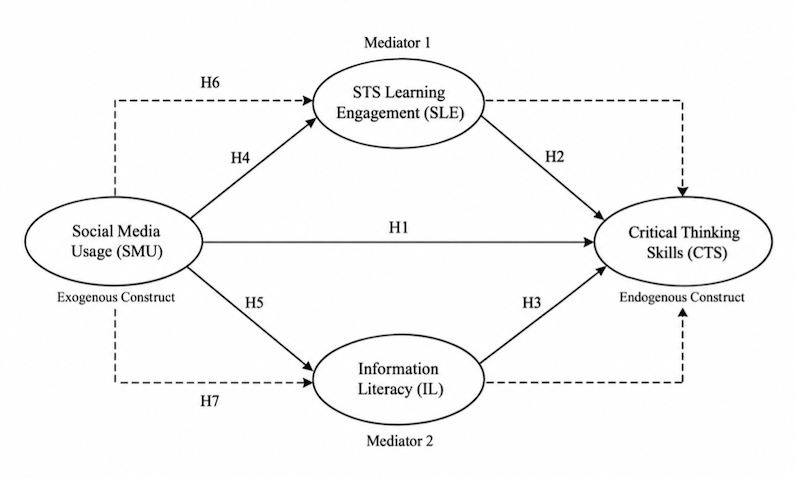
Grounded in scholarship on digitally mediated learning, student engagement, information literacy, and critical thinking, the conceptual framework (Figure 1) positions SMU as the exogenous construct, SLE and IL as parallel mediators, and CTS as the endogenous construct. The model proposes both direct and indirect relationships between SMU and CTS. The SLE-mediated pathway represents an engagement-oriented mechanism involving students’ participation, interaction, and cognitive engagement in STS learning, whereas the IL-mediated pathway reflects an information-processing mechanism involving the critical evaluation, verification, interpretation, and use of digital information. These theoretically distinct yet complementary pathways provide a basis for examining the parallel mediating roles of SLE and IL in the relationship between SMU and CTS within the STS educational context.
Recent research identifies how the consumption of social media affects critical thinking, particularly for college students. Critical thinking—essential in the digital age—involves analysing and evaluating information (Shcheglova et al., 2019). Social media can support this by fostering idea comparison, debate, and problem-solving (Garcés-Fuenmayor et al., 2023), along with content analysis and trend critique (Byers Reid & Mang, 2023). It is positively linked to critical thinking when tied to academic engagement (Abbas et al., 2024; Duterte, 2025). However, its impact depends on purposeful use (Abd Halim et al., 2024) and self-regulation (Galindo Domínguez et al., 2025), not on usage alone. Building upon the aforementioned premise, the following hypothesis is proposed:
H1: SMU has a significant direct effect on CTS.
The STS course promotes critical thinking by connecting scientific knowledge to social contexts, increasing student engagement. Learning engagement consists of emotional, cognitive, and behavioural components (Yan, 2021). Studies indicate that STS engagement is a good predictor of enhanced critical thinking. Mulyanti et al. (2021) discovered that STS activities produced improved post-test scores and higher-order thinking. Likewise, Setiawan et al. (2023) demonstrated that an integration of Problem-Based Learning and STS markedly enhanced critical thinking. Lastly, Yang et al. (2005) stressed that Socratic questioning environments increase critical thinking, and STS teaching practices offer students real-world experiences that challenge and engage them, leading to higher-order thinking. Based on the above discussion, the following hypothesis was formulated:
H2: SLE has a significant direct effect on CTS.
As the information environment becomes increasingly complicated, the skill of finding, evaluating, and utilising information becomes vital in order to become a critical thinker. Information literacy is about managing and using information and assessing it ethically (Johnston & Webber, 2003). Borjali et al. (2024) established a strong relationship between the two, and information literacy acts as a mediator between self-esteem and critical thinking. Additionally, Wertz et al. (2020) mentioned that good information skills assist in the handling of enormous amounts of information. Cheng et al. (2024) further asserted that media information literacy enhances critical thinking. Furthermore, Naveed et al. (2023) found a positive effect of information literacy on creativity, which linked it further to critical thinking. Building on this critical relationship, the following hypothesis was formulated:
H3: IL has a significant direct effect on CTS.
Social media has transformed student engagement and is now a key educational tool, enabling real-time interaction and adaptive learning. Platforms like Facebook support academic communication (Knowles & Dixon, 2016), while in STS courses, social media fosters collaboration, critical thinking, and soft skills (Gonzalez-Cacho& Abbas, 2022). Thus, enhancing peer feedback, overcomes classroom barriers, and improves teacher-student interaction. Engagement increases when social media is used in structured, collaborative settings (Assefa et al., 2023). Purposeful use boosts involvement (Du & Wang, 2024), with platforms like Twitter (now X) and Telegram aiding learning engagement (Mahdiuon et al., 2019 ; Williams &Whiting, 2016). These studies show that social media boosts engagement, especially in STS contexts focused on collaboration and real-world application. Expanding on the stated premise, the subsequent hypothesis was developed:
H4: SMU has a significant direct effect on SLE.
Current research indicates an intricate interaction between the use of social media and information literacy. Wendt et al. (2023) discovered that heavy users of social media cultivate enhanced social media literacy, which enhances their capacity to analyse sources. Ozor and Toner (2022) noted social media’s ability to develop critical evaluation skills. Sirlin et al. (2021) indicated that digital literacy helps in locating credible information on social media. Cheng et al. (2024) reported that purposeful, academic-minded engagement enhances information literacy, a perspective supported by the World Literacy Foundation (2022), which asserts that meaningful social media use supports critical thinking and verification of information. Based on the above discussion, the following hypothesis was formulated:
H5: SMU has a significant direct effect on IL.
H6: SLE mediates the relationship between SMU and CTS.
Information literacy enables students to critically evaluate and apply information, a necessary ingredient for digital-age academic achievement. Soriano and Bastida (2024) established that information skills partly mediate the relationship between social media use and critical thinking, highlighting the significance of information literacy. Habiba and Koli (2024) demonstrated that health information literacy acts as a mediator between web resource utilisation and health information evaluation. Hicks (2019) proposed information literacy as a mediator in transition, facilitating cognitive and social adjustment. Based on the above discussion, the following hypothesis was formulated:
H7: IL mediates the relationship between SMU and CTS.
Figure 1 represents the hypothesised mediation model.
Figure 1 illustrates the hypothesised parallel mediation model, positioning SMU as the exogenous construct, CTS as the endogenous construct, and SLE and IL as parallel mediators. The model specifies direct pathways among the constructs and indirect pathways linking SMU to CTS through SLE and IL, providing a basis for examining their hypothesised mediating roles.
Although existing studies recognise the importance of SMU, IL, and SLE in students’ cognitive development, there has been limited research to examine their interconnected relationships with CTS within Philippine higher education. This gap is particularly relevant to Science, Technology, and Society (STS) education, which emphasises critical engagement with complex scientific, technological, and societal issues. Moreover, the parallel mediating roles of IL and SLE in the SMU-CTS relationship remain insufficiently explored. To address this gap, the present study examines the direct association between SMU and CTS alongside the distinct indirect pathways through IL and SLE, providing a more integrated understanding of critical thinking within the Philippine STS educational context.
This study employed a quantitative research design using covariance-based structural equation modelling (CB-SEM) to examine the direct and indirect relationships among SMU, SLE, IL, and CTS among university students. CB-SEM enabled the simultaneous estimation of relationships among latent constructs while accounting for measurement error. Specifically, the model assessed the direct associations of SMU with SLE, IL, and CTS, and of SLE and IL with CTS, alongside the parallel mediating roles of SLE and IL in the SMU-CTS relationship.
The eligible population comprised 443 undergraduate students enrolled in the Science, Technology, and Society (STS) course at a state university in Western Visayas (Region VI), Philippines, during the first and second semesters of the 2024 – 2025 academic year. Before data collection, the researchers set a target sample size of 300, informed by Wolf et al.’s (2013) findings on sample size requirements for structural equation modelling (SEM). Proportionate stratified random sampling was employed, with students categorised into strata according to their respective degree programmes. The number of respondents allocated to each stratum was determined proportionally based on its share of the total eligible population, after which students were randomly selected from each stratum to obtain the required sample size. Data were collected through online and face-to-face survey administration to facilitate participant accessibility.
The research employed a self-report survey questionnaire, both online through Google Forms and on paper. It consisted of two sections: demographics and measures for SMU, SLE, IL, and CTS, employing established scales. SMU was measured using five items adapted from the questionnaire utilised by Tin et al. (2024); SLE was measured using nine items from Handelsman et al. (2005); IL was measured using five items from Adeoye and Adeoye (2017); and CTS was measured using six items from the GE Foundation Workplace Skills Programme (n.d.). All used a five-point Likert scale. The pilot test revealed high reliability of the variables, with Cronbach’s alpha coefficients of 0.823, 0.901, 0.861, and 0.907 for SMU, SLE, IL, and CTS, respectively.
Data collection was authorised by university officials and STS faculty. Informed consent ensured confidentiality and anonymity. A self-administered survey questionnaire was distributed online and onsite from November 2024 to February 2025. Confidentiality and anonymity were upheld in line with the Republic Act No. 10173 (2012) (Data Privacy Act). Respondents gave informed consent and were assured of their rights. Data was encrypted, coded, and stored in a password-protected database for three years. No physical risk was involved, and all information was used solely for educational research.
Data were analysed using SPSS (Version 20) and AMOS (Version 18) through covariance-based structural equation modelling (CB-SEM). A two-step approach was employed, involving confirmatory factor analysis (CFA) to evaluate the measurement model, followed by structural model estimation to test the hypothesised relationships. Model fit was evaluated using multiple indices at p < 0.05.
Table 1 presents the reliability and convergent validity of the measures assessing SMU, SLE, IL, and CTS. All constructs exceeded the recommended thresholds for reliability (α and CR > 0.70) and convergent validity (AVE > 0.50), indicating that the questionnaire items consistently and adequately measured their intended constructs. Figure 2 illustrates the CFA measurement model, showing the strength of the relationships between the items and their respective constructs. Factor loadings ranged from 0.611–0.861 for SMU, 0.690–0.837 for SLE, 0.760–0.866 for IL, and 0.785–0.829 for CTS. Although SMU_1 (0.691), SMU_2 (0.611), and SLE_3 (0.690) had loadings below 0.70, they were retained based on satisfactory overall reliability and convergent validity (Gaskin et al., 2025). Overall, these findings support the adequacy of the measurement model for examining the hypothesised relationships.
Table 1: CFA Results
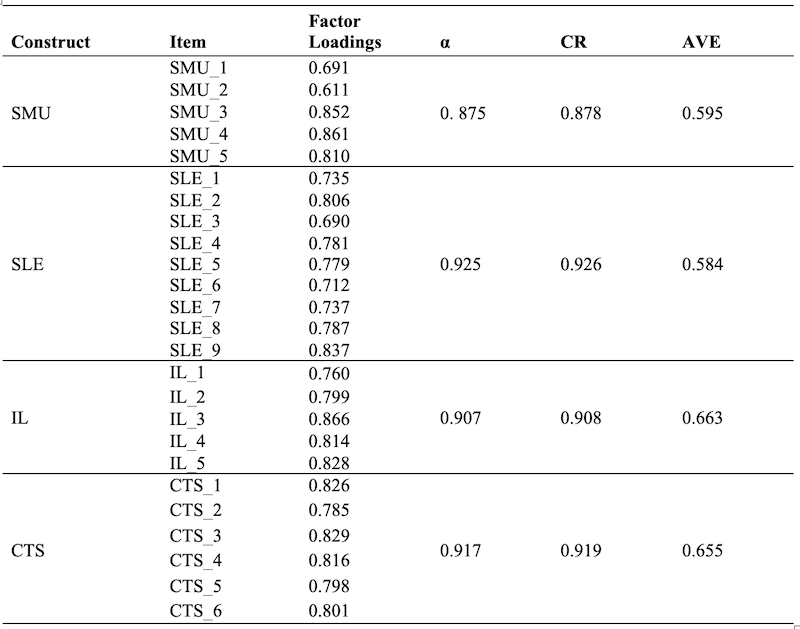
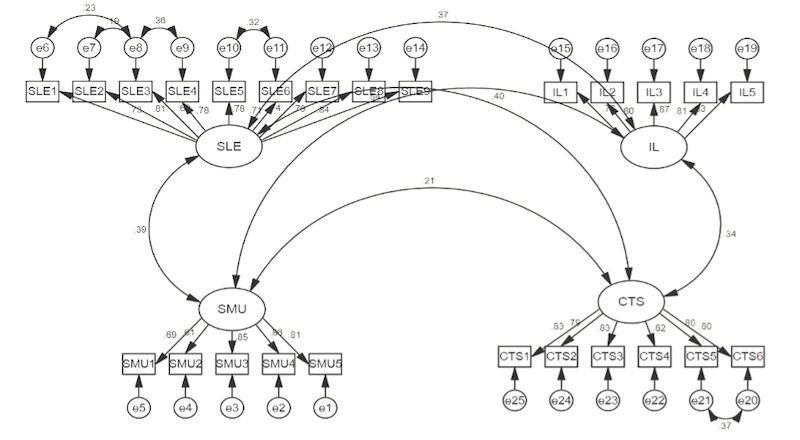
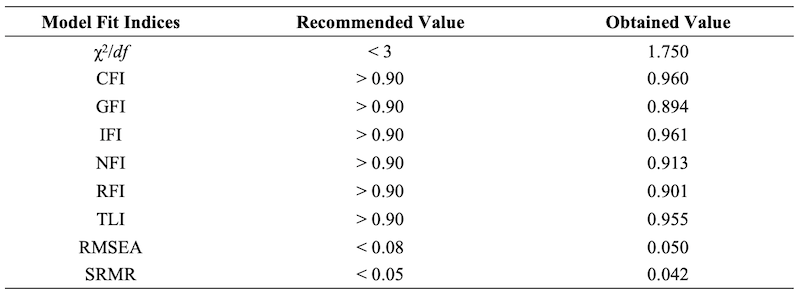
Table 2 presents the CFA results assessing how well the measurement model represented the observed data across the four study constructs. Overall, the findings indicated an acceptable fit, suggesting that the proposed measurement structure adequately reflected students’ responses. Although the chi-square test was significant (χ² = 462.001, df = = 264, p < .001), the χ²/df = ratio (1.750) and incremental fit indices (CFI = 0.960, IFI = 0.961, NFI = 0.913, RFI = 0.901, TLI = 0.955) supported satisfactory fit. Although GFI (0.894) fell slightly below the 0.90 threshold, RMSEA (0.050) and SRMR (0.042) were within acceptable limits, providing further support for the model’s overall fit. These results support the adequacy of the measurement model for subsequent structural analysis.
Table 2: The Model Fit Indices
The structural model examined the direct and indirect associations between SMU and CTS through SLE and IL. Using maximum likelihood estimation and 5,000 bootstrap resamples, the results in Table 3 show no significant direct association between SMU and CTS (B = −0.061, p = .351). However, SMU was positively associated with SLE and IL, both of which were significantly associated with higher CTS. Significant indirect effects through SLE (B = 0.127, 95% CI [0.065, 0.189]) and IL (B = 0.134, 95% CI [0.065, 0.202]) indicate that SMU was indirectly associated with CTS through these two variables, despite the nonsignificant direct association.
Table 3: Summary of Structural Model Results
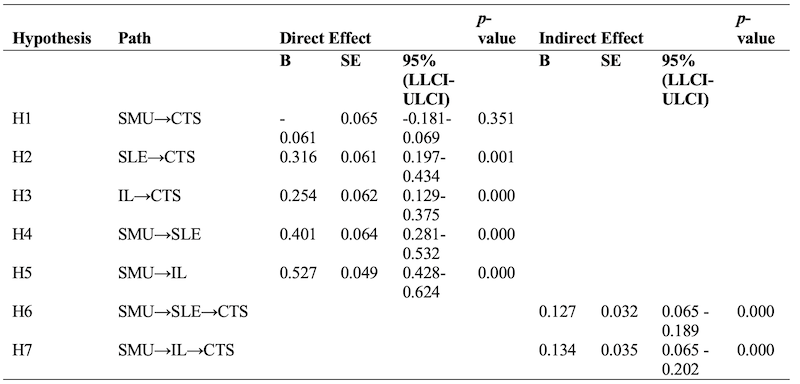
The structural model revealed that SMU had no statistically significant direct effect on CTS (B = −0.061, p = .351); thus, H1 was not supported, as shown in Table 3. The small negative coefficient and non-significant result suggest that SMU alone does not significantly predict students’ critical thinking skills in the present sample. However, this does not necessarily indicate an absence of association, as the influence of SMU might operate indirectly through STS learning engagement and information literacy. These findings underscore the potential importance of cognitive and learning processes in explaining the relationship between social media use and critical thinking.
The results revealed that SLE significantly and positively predicted CTS (B = 0.316, SE = 0.061, 95% CI [0.197, 0.434], p < .001), supporting H2, as reported in Table 3. This indicates that greater engagement in STS learning was associated with stronger critical thinking skills, particularly in analysing information, evaluating evidence, considering alternative perspectives, and forming reasoned judgments. The finding further highlights SLE as a significant predictor of CTS, underscoring the importance of meaningful STS learning experiences in fostering higher-order thinking.
As indicated in Table 3, the results revealed that IL significantly and positively predicted CTS (B = 0.254, SE = 0.062, 95% CI [0.129, 0.375], p < .001), supporting H3. This indicates that higher levels of information literacy were associated with stronger critical thinking skills, even after accounting for other constructs in the model. The finding highlights the importance of students’ ability to locate, evaluate, interpret, and effectively use information in analysing arguments, assessing evidence, and forming reasoned judgments. Overall, IL emerged as a significant predictor of CTS, emphasising its role in supporting higher-order thinking.
The results revealed that SMU significantly and positively predicted SLE (B = 0.401, SE = 0.064, 95% CI [0.281, 0.532], p < .001), supporting H4, as reflected in Table 3. This indicates that greater social media use was associated with higher engagement in STS learning. The finding suggests that social media may provide an additional learning environment where students access STS-related information, exchange perspectives, engage in discussions, and connect academic concepts with contemporary issues. Overall, SMU emerged as a significant predictor of SLE, highlighting the potential contribution of digitally mediated interactions to meaningful STS learning engagement.
As detailed in Table 3, the results revealed that SMU significantly and positively predicted IL (B = 0.527, SE = 0.049, 95% CI [0.428, 0.624], p < .001), supporting H5. This indicates that greater social media use was associated with higher information literacy. The finding suggests that social media could provide opportunities to access, compare, evaluate, and interpret diverse information sources, potentially enhancing students’ ability to identify and utilise credible information. The comparatively strong positive coefficient further highlights SMU as an important predictor of IL, emphasising its potential role in supporting students’ information literacy development.
The mediation analysis revealed a significant positive indirect effect of SMU on CTS through SLE (B = 0.127, SE = 0.032, 95% CI [0.065, 0.189], p < .001), supporting H6 (Table 3). This indicates that greater social media use was indirectly associated with stronger critical thinking skills through increased STS learning engagement. The finding suggests that social media might contribute to critical thinking when online interactions foster meaningful engagement with STS-related concepts and issues. Thus, SLE emerged as a significant mediator, highlighting the importance of active learning engagement in explaining the indirect relationship between SMU and CTS.
The mediation analysis revealed a significant positive indirect effect of SMU on CTS through IL (B = 0.134, SE = 0.035, 95% CI [0.065, 0.202], p < .001), supporting H7 (Table 3). This indicates that greater social media use was indirectly associated with stronger critical thinking skills through higher information literacy. The finding suggests that social media engagement may support critical thinking when students effectively access, evaluate, interpret, and utilise online information. Thus, IL has emerged as a significant mediator, highlighting the importance of information-processing skills in explaining the indirect relationship between SMU and CTS.
The structural relationships among the study variables are illustrated in Figure 3.
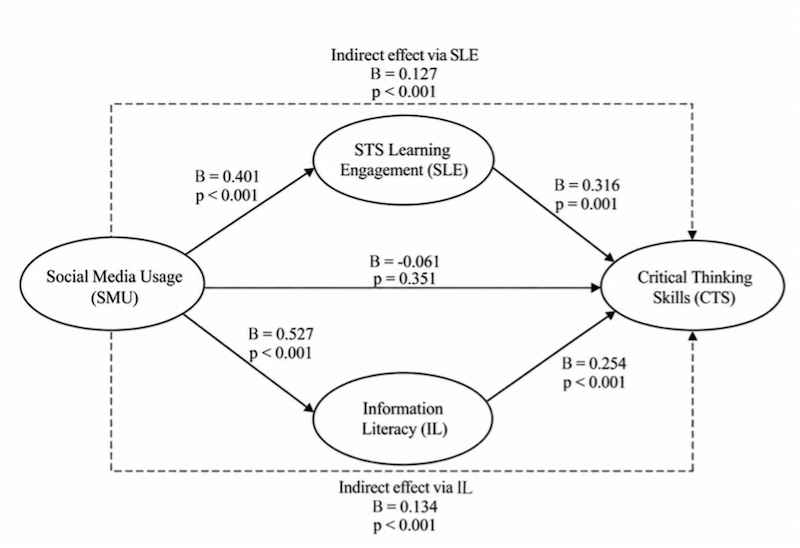
Figure 3 visually summarises the structural relationships examined in Hypotheses 1–7, complementing the statistical results in Table 3 by illustrating the direction and pattern of the relationships among the study variables.
Overall, social media use (SMU) was not directly associated with critical thinking skills (CTS). However, SMU was positively associated with STS learning engagement (SLE) and information literacy (IL), both of which were positively associated with CTS. Furthermore, SLE and IL significantly mediated the relationship between SMU and CTS, suggesting that their roles may help explain how social media use relates to critical thinking skills.
The nonsignificant direct association between SMU and CTS challenges the assumption that social media use inherently enhances critical thinking (Abbas et al., 2024; Byers Reid & Mang, 2023; Duterte, 2025; Garcés-Fuenmayor et al., 2023). Drawing on Uses and Gratifications Theory (Katz et al., 1973) and Cognitive Load Theory (Sweller, 1988), this finding suggests that usage motivations and cognitive demands may shape its educational relevance. Conversely, the significant positive associations of SLE and IL with CTS corroborate research linking inquiry-based engagement, reflective dialogue, and information evaluation to higher-order thinking (Borjali et al., 2024; Cheng et al., 2024; Mulyanti et al., 2021; Setiawan et al., 2023). Consistent with Transformative Learning Theory (Mezirow, 1978), these relationships highlight the potential importance of reflection and critical appraisal in refining reasoning. Furthermore, the positive associations of SMU with SLE and IL align with evidence supporting social media’s role in collaborative learning, academic engagement, and information literacy (Du & Wang, 2024; Gonzalez-Cacho & Abbas, 2022; Ozor & Toner, 2022; Wendt et al., 2023).
Notably, SLE and IL significantly mediated the SMU-CTS relationship, establishing two complementary indirect pathways. The mediating role of SLE aligns with research linking learning engagement to cognitive outcomes (Abbas et al., 2024; Alshuaibi et al., 2018), while IL mediation corroborates evidence emphasising critical information appraisal in digital environments (Habiba & Koli, 2024; Hicks, 2019; Navales & Dequito, 2022; Soriano & Bastida, 2024). Theoretically, Transformative Learning Theory (Mezirow, 1978) emphasises reflective reassessment, whereas Cognitive Load Theory (Sweller, 1988) highlights selective information processing. Although these mechanisms were not directly tested, the significant indirect effects and nonsignificant direct association underscore the explanatory roles of SLE and IL in linking SMU with CTS. These findings underscore the need for STS educators and policymakers to integrate inquiry-based activities, critical source evaluation, and media analysis into instruction. Faculty development in digital pedagogy and curriculum integration of digital literacy may further strengthen learning engagement, information literacy, and critical thinking.
The findings have important implications for higher-education policy, STS curriculum design, and instructional practice. At the policy level, universities should avoid treating SMU as an independent strategy for developing CTS. The nonsignificant direct association between SMU and CTS suggests that social media exposure alone does not adequately explain variations in critical thinking. Instead, institutional policies should emphasise purposeful, pedagogically structured social media integration that strengthens SLE and IL. Curriculum guidelines should establish explicit learning outcomes emphasising evidence evaluation, source credibility, argument analysis, and reasoned judgment rather than online participation alone. For STS instruction, the findings support transforming social media content into opportunities for critical inquiry. Educators may incorporate structured activities involving the verification of scientific and technological claims, comparison of conflicting evidence, identification of misinformation, evaluation of source credibility, and examination of the societal implications of technological developments. These practices align with the significant positive associations of SLE and IL with CTS, providing a stronger pedagogical rationale for social media integration than increased usage frequency alone.
The significant indirect effects through SLE and IL further underscore the importance of faculty development. Professional development programmes should extend beyond technical proficiency to emphasise instructional design that promotes engagement, critical information evaluation, and reflective inquiry. STS educators should be equipped to develop activities requiring students to critically examine claims, integrate evidence from multiple perspectives, and justify conclusions. Such training would align digital pedagogy with the significant mediating pathways identified in the study. Assessment practices should likewise prioritise critical inquiry over passive information consumption. Rather than rewarding the mere retrieval, reproduction, or summarisation of digital content, assessment criteria should evaluate source credibility, evidence integration, comparative analysis, logical reasoning, and reflection on the societal implications of science and technology. Collectively, these findings highlight the importance of pedagogically structured social media engagement in supporting information-literate inquiry and evidence-based critical reasoning. Higher-education policies and instructional practices should therefore prioritise the quality of digital learning experiences over the frequency of SMU.
This study provides insights into the relationships among SMU, SLE, IL, and CTS. However, several limitations highlight opportunities for further investigation. Longitudinal or quasi-experimental studies are recommended to examine temporal relationships and provide stronger evidence regarding the proposed mechanisms, given the study’s cross-sectional design. Future research could also incorporate interviews, observations, and objective assessments to complement self-reported measures and minimise potential response bias. Comparative studies across universities and geographic regions would enhance the generalisability of the findings beyond the 300 students from a single state university campus. Furthermore, extending the mediation model to include academic motivation, stress, and learning environment could provide a more comprehensive understanding of the mechanisms linking social media usage, learning engagement, information literacy, and critical thinking within diverse educational contexts.
Abbas, A., Gonzalez-Cacho, T., Radovanović, D., Ali, A., & Benavides Rincón, G. (2024). Students’ use of social media and critical thinking: The mediating effect of engagement. In D. Radovanović (Ed.), Digital literacy and inclusion: Stories, platforms, communities (pp. 99–112). Springer. https://doi.org/10.1007/978-3-031-30808-6_7
Abd Halim, N.D., Mutalib, M.A., Zaid, N.M., Mokhtar, M., Majid, F.A., & Sharil, W.N.E.A.(2024). The use of social media to enhance critical thinking in online learning among higher education students. International Journal of Interactive Mobile Technologies, 18(06), 56–66. https://doi.org/10.3991/ijim.v18i06.48033
Adeoye, A.A., & Adeoye, B.J. (2017). Digital literacy skills of undergraduate students in Nigeria universities. Library Philosophy and Practice (e-journal). https://digitalcommons.unl.edu/libphilprac/1665
Alshuaibi, M.S.I., Alshuaibi, A.S.I., Shamsudin, F.M., & Arshad, D.A. (2018). Use of social media, student engagement, and academic performance of business students in Malaysia. International Journal of Educational Management, 32(4), 625-640. https://doi.org/10.1108/IJEM-08-2016-0182
Assefa, Y., Moges, B.T., & Kumar, T. (2023). Modelling the predictive effects of social media on the relationship between students’ engagement and academic achievement in higher education institutions. Cogent Education, 10(1). https://doi.org/10.1080/2331186X.2023.2207801
Autieri, S.M., Amirshokoohi, A., & Kazempour, M. (2016). The science-technology-society framework for achieving scientific literacy: An overview of the existing literature. European Journal of Science and Mathematics Education, 4(1), 75–89. https://doi.org/10.30935/scimath/9455
Borjali, A., Hoseini, M.S., & Tafazzoli, R. (2024). An investigation into the relationship between self-esteem and critical thinking with the mediating role of primary teachers’ information literacy. Quarterly Journal of New Thinking in Instruction and Learning, 1(1), 5. https://www.nteljournal.ir/article_209003.html?lang=en
Byers Reid, T., & Mang, T. (2023). Using social media to develop critical thinking in higher education. Journal of Digital Life and Learning, 3(2), 1–17. https://doi.org/10.51357/jdll.v3i2.223
Cheng, L., Fang, G., Zhang, X., Lv, Y., & Liu, L. (2024). Impact of social media use on critical thinking ability of university students. Library Hi Tech, 42(2), 642–669. https://doi.org/10.1108/LHT-11-2021-0393
Commission on Higher Education. (2013). General education curriculum: Holistic understandings, intellectual and civic competencies (CHED Memorandum Order No. 20, s. 2013). https://cms-cdn.e.gov.ph/CHED/pdf/2013-CMO-NO20.pdf
Commission on Higher Education. (2020). Guidelines on the implementation of flexible learning (CHED Memorandum Order No. 4, s. 2020). https://cms-cdn.e.gov.ph/CHED/pdf/2020-CMO-NO4.pdf
DataReportal. (2025). Digital 2025: The Philippines — Global digital insights. https://datareportal.com/reports/digital-2025-philippines
Du, J., & Wang, Y. (2024). High school students’ social media use predicts school engagement and burnout: The moderating role of social media self-control. Frontiers in Child and Adolescent Psychiatry, 3, 1269606. https://doi.org/10.3389/frcha.2024.1269606
Duterte, J. (2025). Social media use and critical thinking skills among senior high school learners: A quantitative correlational study. Journal of Tertiary Education and Learning, 3(1), 1–6. https://doi.org/10.54536/jtel.v3i1.3991
Galindo-Domínguez, H., Bezanilla, M.J., & Campo, L. (2025). Relationship between social media use and critical thinking in university students. Education and Information Technologies, 30, 6641–6665. https://doi.org/10.1007/s10639-024-12953-z
Gallego-Arrufat, M.J., Torres-Hernández, N., & Pessoa, T. (2019). Competence of future teachers in the digital security area. Comunicar, 61, 57–67. https://doi.org/10.3916/C61-2019-05
Garcés-Fuenmayor, J., García-Peña, E., Martínez-Garcés, J., & Escobar-Soto, R. (2023). Uso de redes sociales para fomentar el pensamiento crítico en estudiantes universitarios durante el COVID-19. Educación y Humanismo, 25(44). https://doi.org/10.17081/eduhum.25.44.5763
Gaskin, J.E., Lowry, P.B., Rosengren, W., & Fife, P.T. (2025). Essential validation criteria for rigorous covariance-based structural equation modelling. Information Systems Journal, 35(6), 1630–1661. https://doi.org/10.1111/isj.12598
GE Foundation. (n.d.). Workplace skills program: Module six. Critical thinking skills. https://www.eriesd.org/site/handlers/filedownload.ashx?moduleinstanceid=19511&dataid=24597&FileName=Module%206%20%20Critical%20Thinking%20Participant%20Booklet%20v4.pdf
González-Cacho, T., & Abbas, A. (2022). Impact of interactivity and active collaborative learning on students’ critical thinking in higher education. IEEE Revista Iberoamericana de Tecnologías del Aprendizaje, 17(3), 254–261. https://doi.org/10.1109/RITA.2022.3191286
Habiba, U., & Koli, F.S. (2024). The mediating role of students’ health information literacy skills: Exploring the relationship between web resource utilization and health information evaluation proficiency. Health Expectations, 27(4), e14176. https://doi.org/10.1111/hex.14176
Handelsman, M.M., Briggs, W.L., Sullivan, N., & Towler, A. (2005). A measure of college student course engagement. The Journal of Educational Research, 98(3), 184–192. https://doi.org/10.3200/JOER.98.3.184-192
Hicks, A. (2019). Mitigating risk: Mediating transition through the enactment of information literacy practices. Journal of Documentation, 75(5), 1190–1210. https://doi.org/10.1108/JD-11-2018-0184
Howe, S. (2026, March 30). Social media statistics in the Philippines [Updated 2026]. Meltwater. https://www.meltwater.com/en/blog/social-media-statistics-philippines
Johnston, B., & Webber, S. (2003). Information literacy in higher education: A review and case study. Studies in Higher Education, 28(3), 335–352. https://doi.org/10.1080/03075070309295
Katz, E., Blumler, J.G., & Gurevitch, M. (1973). Uses and gratifications research. The Public Opinion Quarterly, 37(4), 509–523. https://www.jstor.org/stable/2747854
Knowles, M., & Dixon, D. (2016). Guidance techniques to improve student engagement in critical reflection regarding the preparation of technical reports. Student Engagement and Experience Journal, 5(1). https://doi.org/10.7190/seej.v5.i1.104
Mahdiuon, R., Salimi, G., & Raeisy, L. (2019). Effect of social media on academic engagement and performance: Perspective of graduate students. Education and Information Technologies, 25, 2427–2446. https://doi.org/10.1007/s10639-019-10032-2
Mezirow, J. (1978). Perspective transformation. Adult Education Quarterly, 28(2), 100–110. https://doi.org/10.1177/074171367802800202
Mou, T.Y., Kao, C.P., Lin, K.Y., & Osborne, M. (2023). Exploring the mediator in science service learning: Analysis of university students’ behavioural intention to use digital platforms. Asia-Pacific Education Researcher, 32, 841–854. https://doi.org/10.1007/s40299-022-00700-2
Mulyanti, S., Halim, A., Murniati, Ilyas, S., Syukri, M., & Mursal. (2021). The impact of the science technology society (STS) approach on critical thinking ability and student learning outcomes. Journal of Physics: Conference Series, 1882(1), 012026. https://doi.org/10.1088/1742-6596/1882/1/012026
Navales, J.M.P., & Dequito, E.R. (2022). The mediating effect of information and communication technology learning on the relationship between social media usage and information-seeking behavior of students. European Journal of Education Studies, 9(3), 169–199. https://doi.org/10.46827/ejes.v9i3.4218
Naveed, M.A., Iqbal, J., Asghar, M.Z., Shaukat, R., & Kishwer, R. (2023). How information literacy influences creative skills among medical students? The mediating role of lifelong learning. Medical Education Online, 28(1), 2176734. https://doi.org/10.1080/10872981.2023.2176734
Ouyang, F., & Dai, X. (2022). Using a three-layered social-cognitive network analysis framework for understanding online collaborative discussions. Australasian Journal of Educational Technology, 38(1), 164–181. https://doi.org/10.14742/ajet.7166
Ozor, A., & Toner, J. (2022). Information literacy behavior and practice: An assessment of undergraduate students at Ada College of Education, Ghana. Journal of Library Administration, 62(1), 132–151. https://doi.org/10.1080/01930826.2021.2006992
Pattanapıchet, F., & Wıchadee, S. (2015). Using space in social media to promote undergraduate students’ critical thinking skills. Turkish Online Journal of Distance Education, 16(4), 38–49. https://doi.org/10.17718/tojde.94170
Republic Act No. 10173. (2012). Data privacy act of 2012. https://privacy.gov.ph/data-privacy-act/
Salman, F.H., Zimmerman, H.T., & Land, S.M. (2014). Collective engagement in a technologically mediated science learning experience: A case study in a botanical garden. Proceedings of the International Conference of the Learning Sciences (ICLS), 1(January), 378–385. https://doi.org/10.13140/2.1.4722.6240
Setiawan, F., Masitoh, S., & Mariono, A. (2023). The PBL-STS model for achieving critical thinking skills in elementary school students. International Journal of Social Learning (IJSL), 3(3), 293–307. https://doi.org/10.47134/ijsl.v3i3.193
Shcheglova, I., Koreshnikova, Y., & Parshina, O. (2019). The role of engagement in the development of critical thinking in undergraduates. Voprosy Obrazovaniya / Educational Studies Moscow, 2019(1), 264–289. https://doi.org/10.17323/1814-9545-2019-1-264-289
Sinatra, G.M., Heddy, B.C., & Lombardi, D. (2015). The challenges of defining and measuring student engagement in science. Educational Psychologist, 50(1), 1–13. https://doi.org/10.1080/00461520.2014.1002924
Sirlin, N., Epstein, Z., Arechar, A.A., & Rand, D.G. (2021). Digital literacy is associated with more discerning accuracy judgments but not sharing intentions. HKS Misinformation Review, 2(6). https://doi.org/10.37016/mr-2020-83
Soriano, H.B., & Bastida, G.L. (2024). Social media engagement and students’ critical thinking disposition influenced by their information skills. Journal of Interdisciplinary Perspectives, 2(12), 453-460. https://doi.org/10.69569/jip.2024.0579
Sweller, J. (1988). Cognitive load during problem solving: Effects on learning. Cognitive Science, 12(2), 257–285. https://doi.org/10.1207/s15516709cog1202_4
Tin, T.T., Ming, O.Y., Jin, Y.L., Sheng, N.W., Rou, K.Q., Husin, W.N. A-A. W., Aitizaz, A., Tiung, L.K., Afolalu, S.A., Khattak, U.F. (2024). A mediating analysis of mental health impacts in the relationship of digital device and digital communication with academic performance. Pakistan Journal of Life and Social Sciences, 22(2), 12423–12442. https://doi.org/10.57239/PJLSS-2024-22.2.00889
UNESCO. (2023). Media and information literacy. https://en.unesco.org/themes/media-and-information-literacy
UNESCO. (2025). Digital learning and transformation of education. https://www.unesco.org/en/digital-education
Wendt, R., Naderer, B., Bachl, M., & Rieger, D. (2023). Social media literacy among adolescents and young adults: Results from a cross-country validation study. Social Media + Society, 9(4). https://doi.org/10.1177/20563051231216965
Wertz, F.J., Charmaz, K., McMullen, L.M., Josselson, R., Anderson, R., & McSpadden, E. (2020). Five ways of doing qualitative analysis: Phenomenological psychology, grounded theory, discourse analysis, narrative research, and intuitive inquiry (2nd ed.). The Guilford Press.
Williams, D., & Whiting, A. (2016). Exploring the relationship between student engagement, Twitter, and a learning management system: A study of undergraduate marketing students. International Journal of Teaching and Learning in Higher Education, 28(3), 302–313. https://files.eric.ed.gov/fulltext/EJ1125099.pdf
Wolf, E.J., Harrington, K.M., Clark, S.L., & Miller, M.W. (2013). Sample size requirements for structural equation models: An evaluation of power, bias, and solution propriety. Educational and Psychological Measurement,73(6), 913–934. https://doi.org/10.1177/0013164413495237
World Literacy Foundation. (2022). The impact of social media on literacy skills: Positive or negative? World Literacy Foundation. https://worldliteracyfoundation.org/impact-of-social-media-on-literacy/
Yan, Z.G. (2021). English as a foreign language teachers’ critical thinking ability and L2 students’ classroom engagement. Frontiers in Psychology, 12, Article 773138. https://doi.org/10.3389/fpsyg.2021.773138
Yang, Y.T.C., Newby, T.J., & Bill, R.L. (2005). Using Socratic questioning to promote critical thinking skills through asynchronous discussion forums in distance learning environments. American Journal of Distance Education, 19(3), 163–181. https://doi.org/10.1207/s15389286ajde1903_4
Author Notes
Ronel B. Amorin is an Associate Professor in the Science and Mathematics Department, College of Education, West Visayas State University—Calinog Campus, Iloilo, Philippines. He also teaches graduate research courses and oversees the campus Statistical Data Processing Center (SDPC), providing statistical support for undergraduate and graduate student research. His research interests include teaching and learning, science and mathematics education, artificial intelligence in education, and educational management. Email: ronel.amorin@wvsu.edu.ph (https://orcid.org/0009-0007-3387-6550)
Gesila M. Gallaron is an Assistant Professor I at West Visayas State University—Calinog Campus, where she has served as an educator for 12 years. She holds a Bachelor of Secondary Education major in Biology, a Master of Arts in Biology, and a Doctor of Philosophy in Science Education major in Biological Science, which she pursued as a DOST-Science Education Institute (DOST-SEI) scholar. Email: gesila.gallaron@wvsu.edu.ph (https://orcid.org/0000-0003-2299-7756)
Cite as: Amorin, R.B., & Gallaron, G.M. (2026). Social media, STS engagement, and information literacy: A parallel mediation model for enhancing critical thinking in higher education. Journal of Learning for Development, 13(4), 605-620.
DOI: https://doi.org/10.56059/wyw31656