Zülal Ayar
2026 VOL. 13, No. 2
Abstract: Teachers' digital agency (DA), defined as their capacity to act purposefully to address challenges in online instruction, has been increasingly linked to the dynamic interplay between personal skills and the digitally mediated environments. Within this context, emotional labour (EL) can be seen as a regulatory process and as a resource through which DA is enacted. Building on this perspective, the present study explores how instructors mobilise EL as part of their agentic responses in online English teaching on a learning management system (LMS). The study draws on data from 30 Turkish instructors affiliated with a state university, collected through an online questionnaire and semi-structured interviews. The findings suggest that negative emotions (NEs) were more prevalent and often associated with their incompetence in exercising EL, which in turn constrained the enactment of DA. These results underscore the role of emotional processes in shaping agentic action and the need for strengthening teachers’ digital and pedagogical capacities. The study concludes by outlining implications for future research directions.
Keywords: digital agency, emotional labour, Learning Management System, teacher agency, teacher emotion
With the sudden transition to emergency remote teaching during the Covid pandemic, teachers were obliged to perform professionally by exerting agentive acts, disregarding personality-based antecedents or values, which necessitated activating autonomy and developing their identity. Moreover, lessons conducted largely through an LMS required instructors to adjust their teaching strategies and control their emotions. According to Hochschild’s (1983) EL theory, regulating these feelings while teaching may affect instructional quality, classroom interaction, and learner outcomes. For instance, building on this framework, Benesch’s (2012, 2017) critical EL model was applied by Nazari et al. (2024) to investigate Iranian English teachers’ EL in an online education context. Instructors reported conflicts in incorporating materials, challenges with learner engagement, and limitations in applying effective evaluation methods, as also reflected in recent work on emotion regulation in digital/home-based teaching contexts (Dong et al., 2026). These scholars also emphasised teacher agency (TA) in examining how teachers negotiate their emotions within established norms. Agency thus emerges as a key indicator of teachers' emotional states and their readiness to adapt actions in challenging circumstances (Biesta & Tedder, 2007; Fisher et al., 2006; Priestley et al., 2015; Uştuk et al., 2025; Wang et al., 2017). In parallel, as the other fundamental concept at the heart of this research alongside EL, DA represents teachers' sense of ownership and control over instructional practices and the technical components (Aagaard & Lund, 2019; Ehren et al., 2021). Consistent with post-structural and sociocultural perspectives (Zembylas, 2005), emotions and EL can enable teachers to exercise DA in online language instruction (see also Smith et al., 2025; Uştuk et al., 2025).
Some studies suggest that teachers' agency is strongly shaped by suppression and digital enforcement, highlighting the need to examine DA in-depth, especially during local or global crises and considering evolving job demands (Anand & Lall, 2021; Ehren et al., 2021; Gudmundsdottir & Hathaway, 2020; Passey et al., 2018). However, few studies have wedded EL and DA in practice, creating a gap in the literature that warrants investigation in e-tutoring contexts (e.g., Ashton, 2022; Priestley et al., 2015; White, 2016). To illustrate, Gudmundsdottir and Hathaway (2020) reported teachers' DA in using multiple resources and positive reflections on online teaching, despite limited virtual experience. Similarly, Miller and Gkonou (2018) noted that beyond cultural and sociocultural factors, teacher emotions were major influences on DA. Tao et al. (2024) inspected 12 Chinese teachers’ agency and emotions in online teaching, reporting both positive emotions (PEs) and NEs, and emphasising how agent-context interactions reshaped emotional experiences.
Beyond these previous analyses, some studies have expanded the scope using Bandura’s (1991) social cognitive theory and 21st-century skills, examining additional factors relevant to DA and EL. For example, Passey et al. (2018) highlighted the importance of teachers’ digital skills, computational thinking, self-efficacy, digital literacy, confidence, and competence in these contexts. Likewise, Ashton (2022) declared teachers' activation of DA noting both affordances (e.g., increased learner attendance, reduced lecturing, valuable professional learning) and constraints (e.g., feeling less like a teacher, limited rapport, concerns about school expectations) in exercising DA, while emphasising the role of culture, norms, and socio-structural factors. In contrast, Anand and Lall (2021) reported that teachers struggled with remote teaching and digital tools, encountering difficulties in activating DA due to insufficient digital autonomy, skills, confidence, and professional training, leading them to rely on one-way instruction as learner engagement declined.
As can be seen, a body of research on language teachers’ agency has examined whether or not teachers succeed, through using analytical, critical, and hypothetical lenses, often yielding contradictory results. However, intricate ways teachers attempt to exert agency following seismic disruptions of their routines remain underexplored (Ashton, 2022; Miller & Gkonou, 2018). Specifically, “pragmatic agency” (Hitlin & Elder, 2007, p. 176) requires a clearer definition in the context of virtual language education. In addition to this lacuna, the impact of emotions on DA in web-based teaching warrants careful investigation. Although chronological maps exist on this topic (Banegas, 2024), and research has examined students' emotions and agency (Dong & Han, 2025), to the researcher’s knowledge, studies exploring teachers’ emotions or how DA is influenced by their management in specific contexts remain scarce. Overall, although recent studies (e.g., Dong et al., 2026; Smith et al., 2025; Uştuk et al., 2025) have scrutinised EL and TA separately or in partial conjunction with in-service and pre-service contexts, there are no systematic accounts of how teachers enact or constrain DA through EL in LMS-based English teaching in higher education, particularly in the aftermath of a crisis-driven case, leaving no clear idea of how EL shapes agentic responses under such conditions. This study seeks to address this gap by examining teachers’ DA in relation to their EL within LMS-mediated instruction, while also offering a basis for further research into how they interact with key factors affecting online language education.
The research questions were as follows:
Drawing on Hochschild’s (1983) EL theory and its contextualised form as the critical EL model (Benesch, 2012, 2017) in language teaching, we can see this research investigates how teachers exercise their DA while managing emotions in e-courses. The conceptual framework clarifies the interplay between DA and EL by focusing on teachers’ practices in web-based language instruction.
Within this framework, EL is treated as a context-sensitive process that both shapes and is shaped by teachers’ agentic actions, thereby forming a reciprocal relationship with DA. Teachers’ capacity to enact DA is influenced by their emotion management, which in turn is affected by EL demands. This relationship is mediated by digital attributes, such as self-efficacy, confidence, and autonomy, which construct teachers’ actions. Moreover, demographic factors (e.g., age, teaching experience, and educational background) are considered as contextual conditions that may enable or constrain these processes by affecting emotional and agentic practices. In accordance with Benesch’s model, EL is not viewed as an individual trait but as situated practice, allowing the framework to account for how these variables interact to shape teachers’ responses to the demands of e-teaching.
This study employs a qualitative case study design to investigate teachers’ agentic experiences and emotional processes in online teaching. This approach was chosen as it enables a holistic, context-sensitive examination of participants’ behaviours and supports the development of data-driven themes.
The study population comprised English language instructors working at schools of foreign languages in Türkiye. The sample included 30 Turkish instructors teaching English as a foreign language (EFL) at a state university, who actively conducted e-courses via an LMS and voluntarily participated in this study. Criterion sampling was employed, and data were collected at the researcher’s institution for ease of access to participants. Most instructors were female and highly experienced, aged 37-39 with 16-17 years of teaching experience. One-third held a master's degree, and one participant (3.4%) had a PhD.
Data were collected through a three-part questionnaire and semi-structured interviews in Turkish, allowing an in-depth exploration of participants’ emotions and DA in e-teaching practices. The questionnaire included: (1) demographic questions, (2) selection of five emotions from a 21-item list adapted from Zembylas (2005) with an option to state two additional emotions, and (3) five open-ended questions on PEs and NEs adapted from Miller and Gkonou (2018), as follows:
During the adaptation, items from the data collection tools that were most relevant to the study context were selected. As for the semi-structured interviews, they focused on the reasons behind emotions, perceived emotion management, EL, activation of DA, and recommendations for colleagues. All instruments were approved by an English language teaching (ELT) expert for content validity and by a linguistics professor for wording and expression integrity. Methodological triangulation was achieved by combining questionnaire and interview data. Independent coding by two researchers was compared, and themes were identified through consensus, resulting in a high inter-rater reliability of 0.87 (Cohen, 1960).
The Google Form link of the questionnaire was distributed via email to all EFL instructors at the university, who provided consent before completing it. Instructors willing to participate in the interviews were asked to include their email addresses. One-to-one semi-structured interviews on Zoom were conducted immediately after the questionnaire, with 10 participants, to ensure accurate recall of selected emotion words and questions. The interview protocol, generated by the researcher, included eight questions, in the participants’ native language, about their: most and least liked aspects of teaching on BBC, reasons for selecting five specific emotions, perceived management of emotions in challenging and less demanding situations, activation of DA, coping with stress or anxiety amid the pandemic’s impact on language education, additional institutional responsibilities during the outbreak, and recommendations for colleagues on managing emotions in online instruction.
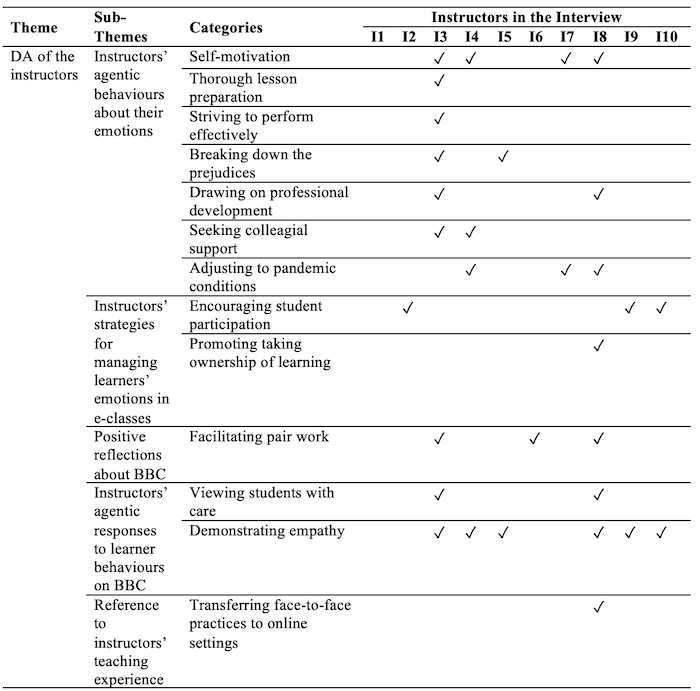
The researcher first identified the most frequently selected emotion words from the questionnaire. Following a procedure similar to the open-ended questions, excluding translation, the audio-recorded interviews were transcribed and translated into English by the researcher and a freelance ELT academic. The interviews lasted approximately 124 minutes, yielding a transcript of 7,142 words. Both raters individually coded the interviews without pre-determined criteria. Data-driven codes were then exchanged refined, grouped, and finalised into themes after two rounds of discussion (see Boyatzis, 1998; Merton, 1975). As a result, five sub-themes and 15 categories were generated through the thematic analysis method (Table 3). Each Instructor was assigned a reference number, thus, I1, I2, I3, and so on.
The author confirms that informed consent was obtained from all the involved participants.
For the first research question, participants’ word selections showed a tendency towards NEs, with 91 NE choices versus 62 PE words. The most frequently selected words were caring (N = 18), boredom (N = 17), and anxiety (N = 15). Among other PEs, happiness and enthusiasm were common, while disappointment and powerlessness ranked highest among NEs after the two above-mentioned words. Disgust, awe, and disillusion were not selected. Almost all instructors also chose additional words from the 21-word list, including NEs (helplessness, inadequacy, annoyance, inactivity, tiredness, nervousness, powerlessness, and frustration) and PEs (joy, comfort, satisfaction, optimism, peace, contentment, entertainment, and sympathy). Although NEs were more numerous overall, a considerable number of participants selected PE words.
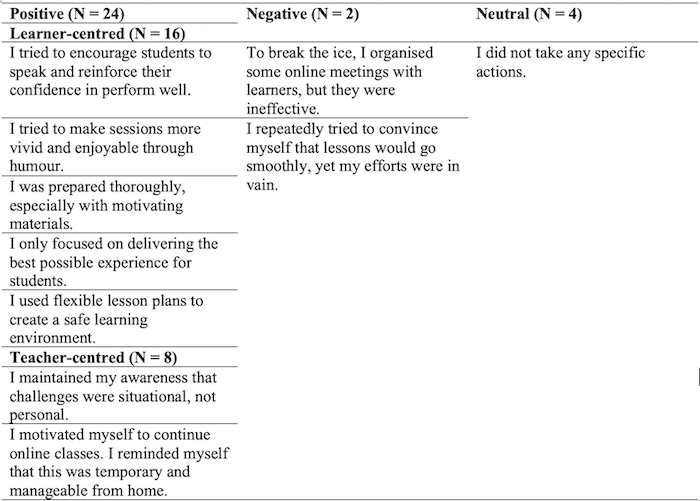
To analyse the second research question, participants' self-reflections on e-teaching were examined to understand their emotional experiences. The first open-ended question revealed that most instructors were dissatisfied with students' absenteeism and unresponsiveness, which they found frustrating, pointless, and demotivating. In addition to disrupted communication from students not turning on their cameras, lack of feedback, and technical issues, instructors noted mechanical interactions without natural bonds or eye contact. Regarding the second question, most instructors focused on supporting students' potential improvement during distance education (Table 1). Although positive comments outnumbered negative ones, other approaches (teacher-centred, negative, or neutral) suggested that only a minority of instructors appealed to EL or acted purposefully to exercise agency.
Table 1: Attempts to Experience PEs in the E-class
Similar to the second question, the fifth question posed what instructors did to avoid NEs in online settings as a control question (Table 2). As shown in Table 1, a student-centred approach predominated, while other factors (N = 14, in total) failed to offer rational solutions for the given situation. For instance, one instructor reported:
If I experience a negative feeling, I introduce a topic and have students discuss it. This helps me manage my confusion, as students provide support. I believe this is the only way I can conceal my difficulty.
Table 2: Attempts for Exerting EL
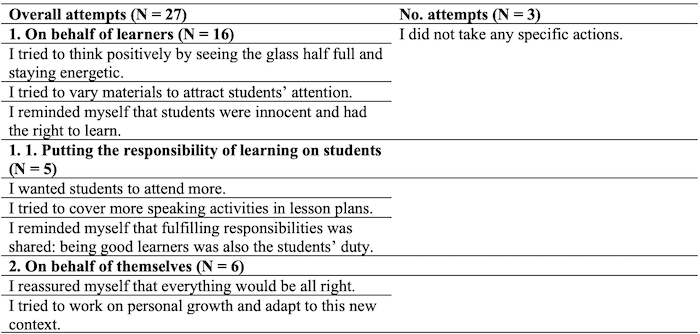
Analyses of responses to the third question regarding moments when instructors did not feel positive during e-lectures, revealed that some were indifferent to potential NEs, prioritising students' well-being. Others chose to discuss everyday issues with learners, or address problems by arranging make-up lessons. Conversely, some instructors resorted to ineffective strategies, such as finishing the course early or attempting to forget the experience, while others revealed taking no action. Regarding the fourth question on whether NEs were self-triggered, twelve instructors reported they were not, aside from negative influences from school management. However, most indicated that stress and anxiety, particularly during exams and the 'What if everything goes wrong?' concern, potentially increased their NEs. Overall, the top three emotions identified (i.e., caring, boredom, and anxiety) aligned with the questionnaire responses, reflecting common-sense reactions from learners without generating strong affirmative engagement in digital learning settings.
Regarding instructors’ reflections on whether teaching English online aligned with their opportunities to exercise DA via EL and their emotional experiences, nearly all highlighted negative aspects related to the universal crisis in foreign language education during the interviews. I1, I2, I6, I7, I8, I9, and I10 noted that the pandemic demonstrated the limitations of attempting to teach English in this format. In contrast, I3 and I4 realised they had internalised a biased perspective on online education after observing learners’ and instructors’ achievements. I5 shared a similar insight:
The pandemic provided useful opportunities to explore new approaches. Although the lessons cannot be fully delivered online, authorities should consider re-planning the education system using a hybrid or blended model.
The researcher then explored what instructors liked most about teaching English on the BBC platform. Five instructors reported that it facilitated pair and group work without causing disruption (Table 3). They also valued shorter, thirty-minute lessons with five-minute breaks, as students tended to become distracted in online settings. However, other instructors indicated that they did not enjoy teaching in this system, citing the lack of three-dimensional interaction among instructors, students, and materials, which limited authentic engagement. Overall, the former group’s adherence to short-term course policies and conventional classroom management reflects differences in digital competence and accountability compared to the latter group.
Table 3: DA of the Instructors
Each instructor commented on their emotional strains in reply to the succeeding question concerning the things they liked least while giving lessons on the LMS. Initially, I1 stated:
Teaching felt like speaking on the phone; I could not track who was doing what or how the lesson progressed. The system lacked flow and was almost at a standstill.
I2 and I7 highlighted technical issues, noting that the least enjoyable aspect was proctoring exams on the platform. They reported feeling anxious due to the high demands of this task, as the system occasionally disconnected them or students during exams. In contrast, I3 described the experience differently from the others:
This reflects self-awareness; even during on-site teaching, I focused on reading practices, which I consider a weakness. I conducted research, read extensively, and drew on collegial input to integrate ideas and develop original approaches.
As shown in Table 3, I3, who demonstrated the highest digital awareness of agency, prioritised personal values in professional life and acted purposefully during the pandemic, seeking help from colleagues and preparing thoroughly to address self-perceived weaknesses. Yet, I4 felt helpless, particularly when teaching grammar, struggling to adapt from board-based practices to slides and avoiding breakout rooms due to limited technical competence. I6 also revealed technical difficulties but emphasised students’ weaknesses, requiring extra time to explain basic tasks, which added to the workload. Meanwhile, I5, I9, and I10 noted that interaction on the digital platform was less effective and practical than the frontal interaction, whereas I8 did not perceive any negative aspects of LMS-based lessons.
Regarding the seventh question on instructors’ management of emotions, I3, I4, I5, I7, and I10 generally reported finding ways to overcome challenges in e-lecturing. I2 and I6 were less explicit about their strategies, while I8 reported coping by showing empathy and encouraging students that the target language can always be learned:
I aim to teach English as a hobby, rather than a phobia. The key to this is enabling students to take risks, realise their potential, and build self-confidence. Empathy plays a central role in achieving this goal.
Finally, I9, like I2 and I10, aimed to keep students engaged on the platform to exercise EL, without reflecting emotions to them. Overall, I1, I3, and I8 demonstrated digital awareness in evaluating their EL capacity and agentive practices. While I2 and I6 took a neutral approach, I4, I5, I7, I9, and I10 appeared to exercise agency through EL. However, Table 3 displays contrasting patterns in their emotional agentic behaviours. Notably, I5 and I6 declared that emotions had little impact on teaching, as they experienced them internally, highlighting a barrier to achieving DA.
In the analysis of five selected emotion words, I3 and I8 stood out by viewing students as their own and showing empathy, reflecting a strong sense of care. I8 did not select any NEs, like I7, despite differing reasons for their choices. Some instructors (I3, I4, and 15) disclosed experiencing both PEs and NEs, such as anxiety, boredom, disappointment, and happiness, pride, or enthusiasm. However, I1, I2, I9, and I10 selected only NEs. I2, I9, and I10 agreed that their interactions were inefficient and that learners shared the responsibility for language learning. Consequently, these three instructors appeared far from exercising DA despite their perceptions.
A critical point raised by I1 in response to question eight was the perceived advantage of face-to-face teaching experience. I1 noted that after 11 years with a fixed teaching style, adapting tasks to online education was frustrating. Similar observations were reported by roughly half of the participants with 16-20 years of teaching experience, except I8. The participants also offered suggestions for managing emotions in online English lessons. I1 emphasised the importance of involving instructors in selecting web-based platforms and in-class materials and recommended more flexible lesson planning to allow activities at any point. Based on I1’s responses, s/he held a negative view of online education (Table 3) while attributing responsibility to the school. Analysis of the first question indicated that I1’s irregular teaching to a specific proficiency level may have threatened DA. Likewise, I10 expressed concerns:
I suggest organising focus-group discussions and attending in-service training. By clarifying students’ expectations, goals, and needs, we can collaborate to deliver e-courses more effectively.
Similarly, I2 advised the administration to encourage online learners to turn on their cameras, as this would enhance communication in e-classes. The instructor also proposed conducting in-person exams to facilitate assessment, helping staff reduce NEs and engage more effectively in EL and digital agentive acts. I4 highlighted the importance of solidarity between instructors and students to overcome challenges in exercising EL, while I6 recommended that colleagues monitor their own performances and manage emotions. I5 and I7 suggested leveraging the advantages of online education to practise EL more easily, whereas I9 encouraged instructors to approach online teaching as if in traditional classes.
Most participants displayed NEs that appeared to constrain their DA, largely due to limited capacity to enact EL, aligning with Tao et al. (2024). This finding is consistent with Anand and Lall (2021) but contrasts with studies reporting more enabling relationships between emotions and agency (Benesch, 2012, 2017; Ehren et al., 2021; Gudmundsdottir & Hathaway, 2020; Miller & Gkonou, 2018). A plausible explanation lies in the sudden and externally imposed shift to online teaching, where external pressures limited pedagogical control and intensified emotional strain, thereby directly shaping TA. In this sense, emotions appear as outcomes and also mediating forces guiding how teachers respond to digitally constrained environments. Recent work supports this by highlighting how EL can affect teachers’ practices (Smith et al., 2025), depending on context, agency, and identity-related factors (Uştuk et al., 2025).
These findings underscore the need to strengthen teachers' digital attributes, such as confidence, self-efficacy, and autonomy to sustain agency under restrictive conditions (Aagaard & Lund, 2019; Passey et al., 2018). They also signal the importance of developing teachers' awareness of emotional demands and strategies to manage them in digitally mediated contexts (Wang et al., 2017), as these directly influence engagement and instructional choices (Dong et al., 2026). Finally, the study clarifies why supporting DA is essential for meaningful instructional outcomes by introducing how insufficient digital competence not only hinders technical performance but also actively limits agentic decisions (Nazari et al., 2024). Taken together, the findings extend current understanding of EL by showing that its role is not only regulatory but constitutive in shaping teachers’ DA under constraints.
The findings reveal that institutional policies should move beyond rigid, one-size-fits-all approaches since strict adherence to pre-defined curricula may reduce flexibility and opportunities for agentic practice, as also emphasised by Biesta and Tedder (2007). Given that a substantial proportion of participants demonstrated limited digital competence, there is a clear need for context-sensitive professional development that directly targets both pedagogical and emotional dimensions of online teaching (Ashton, 2022; Nazari et al., 2024). Explicitly integrating EL and DA into professional development ensures that teachers can navigate emotional pressures while enacting agency, thereby directly improving teaching quality rather than merely technical proficiency (Smith et al., 2025). Additionally, aligning assessment practices with internationally recognised frameworks (e.g., TOEFL or IELTS) can further enhance reliability and support agentic decision-making in digital assessment contexts.
Future research could extend this line of inquiry by examining a wider range of web-based language teaching platforms beyond the specific LMS context explored in this study, as different technological environments may afford or constrain agency in distinct ways. Investigating the bidirectional influence of teacher and learner emotions and agency could reveal how they coevolve in online contexts (Dong & Han, 2025). Building on “pragmatic agency” (Hitlin & Elder, 2007, p. 176) and extant research on DA, longitudinal studies can more explicitly probe the mechanisms through which EL enhances or inhibits agentic actions. Moreover, comparing pre-service and in-service teachers may clarify developmental trajectories of DA, while large-scale or comparative studies across educational levels could illuminate how contextual, cultural, and technological variables shape the EL and DA relationship (Dong et al., 2026; Uştuk et al., 2025). These directions are critical, as they indicate why understanding these mechanisms matters for designing interventions that strengthen DA.
By highlighting how DA and EL interact in LMS-based language teaching, this study offers a learning-for-development perspective relevant across international contexts. Revealing that teacher emotions affect agentic practices, it underscores the need for cross-cultural and cross-contextual investigations into how educational systems, technological infrastructures, and cultural norms influence the interplay of EL and DA, especially during major setbacks or crises. Future global research could examine language teaching across diverse educational systems, compare online and hybrid instructional environments, and reveal the interaction between local and global variables to influence both emotional and agentic dimensions (Anand & Lall, 2021; Dong et al., 2026). Such studies would inform curriculum design and professional development programmes aimed at sustaining TA in digitally mediated classrooms worldwide.
Aagaard, T., & Lund, A. (2019). Digital agency in higher education: Transforming teaching and learning. Routledge. https://doi.org/10.4324/9780429020629
Anand, K., & Lall, M. (2021). Teachers’ digital agency and pedagogy during the Covid-19 crisis in Delhi. NORRAG, Special Issue (6), 64-66.
Ashton, K. (2022). Language teacher agency in emergency online teaching. System, 105, 1-12. https://doi.org/10.1016/j.system.2021.102713
Bandura, A. (1991). Social cognitive theory of self-regulation. Organizational Behavior and Human Decision Processes, 50(2), 248-287. https://doi.org/10.1016/0749-5978(91)90022-L
Banegas, D.L. (2024). “I’ve just lived inside a tumble dryer”: A narrative of emotion labour, (de)motivation, and agency in the life of a language teacher. International Review of Applied Linguistics in Language Teaching, 62(3), 1169-1189.
Benesch, S. (2017). Emotions and English language teaching: Exploring teachers’ emotion labor. Routledge.
Benesch, S. (2012). Considering emotions in critical English language teaching: Theories and praxis. Routledge.
Biesta, G., & Tedder, M. (2007). Agency and learning in the life course: Towards an ecological perspective. Studies in the Education of Adults, 39(2), 132-149. https://doi.org/10.1080/02660830.2007.11661545
Boyatzis, R.E. (1998). Transforming qualitative information: Thematic analysis and code development. Sage.
Cohen, J. (1960). A coefficient of agreement for nominal scales. Educational and Psychological Measurement, 20(1), 37-46. https://doi.org/10.1177/001316446002000104
Dong, H., Zhou, X., & Huang, S. (2026). Between connection and withdrawal: How teachers choose to regulate their emotions in home-school scenarios. International Journal of Educational Research, 137, 102929. https://doi.org/10.1016/j.ijer.2025.102929
Dong, J., & Han, Y. (2025). “We feel excluded and isolated”: Multilingual international students’ emotions and agency in an EMI program. Linguistics and Education, 85, 101361.
Ehren, M., Madrid, R., Romiti, S., Armstrong, P., Fisher, P., & McWhorter, D. (2021). Teaching in the Covid-19 era: Understanding the opportunities and barriers for teacher agency. Perspectives in Education, 39(1), 61-76. https://doi.org/10.18820/2519593X/pie.v39.i1.5
Fisher, T., Higgins, C., & Loveless, A. (2006). Teachers learning with digital technologies: A review of research and projects. Futurelab.
Gudmundsdottir, G.B., & Hathaway, D.M. (2020). "We always make it work": Teachers' agency in the time of crisis. Journal of Technology and Teacher Education, 28(2), 239-250. https://doi.org/10.70725/839558bffbol
Hitlin, S., & Elder, G.H. (2007). Time, self, and the curiously abstract concept of agency. Sociological Theory, 25(2), 170-191. https://doi.org/10.1111/j.1467- 9558.2007.00303.x
Hochschild, A. (1983). The managed heart: Commercialization of human feelings. University of California Press.
Merton, R.K. (1975). Thematic analysis in science: Notes on Holton’s concept. Science, 188(4186), 335-338. https://doi.org/10.1126/science.188.4186.335
Miller, E.R., & Gkonou, C. (2018). Language teacher agency, emotion labor and emotional rewards in tertiary-level English language programs. System, 79, 49-59. https://doi.org/10.1016/j.system.2018.03.002
Nazari, M., Karimpour, S., & Xodabande, I. (2024). English language teachers’ emotion labor in response to online teaching: An interpretative phenomenological approach. Journal of Education, 204(2), 455-467. https://doi.org/10.1177/00220574221150000
Passey, D., Shonfeld, M., Appleby, L., Judge, M., Saito, T., & Smits, A. (2018). Digital agency: Empowering equity in and through education. Technology, Knowledge and Learning, 23(3), 425-439. https://doi.org/10.1007/s10758-018-9384-x
Priestley, M., Biesta, G., & Robinson, S. (2015). Teacher agency: An ecological approach. Bloomsbury Publishing.
Smith, K., Sheridan, L., Duursma, E., & Alonzo, D. (2025). Teachers’ emotional labour: The joys, demands, and constraints. Teachers and Teaching, 31(8), 1411-1435. https://doi.org/10.1080/13540602.2025.2466560
Tao, J., Xu, Y., & Gao, X.A. (2024). Teacher emotions and agency enactment in online teaching. Teaching and Teacher Education, 137, 104389. https://doi.org/10.1016/j.tate.2023.104389
Uştuk, Ö., Yazan, B., Uzum, B., Akayoglu, S., & Keleş, U. (2025). The nexus of identity, emotions, and agency in virtual exchanges between pre-service teachers from Türkiye and the United States. International Journal of Applied Linguistics, 35(4), 1625-1638. https://doi.org/10.1111/ijal.12707
Wang, Y., Mu, G.M., & Zhang, L. (2017). Chinese inclusive education teachers’ agency within temporal-relational contexts. Teaching and Teacher Education, 61, 115-123. https://doi.org/10.1016/j.tate.2016.10.009
White, C.J. (2016). Agency and emotion in narrative accounts of emergent conflict in an L2 classroom. Applied Linguistics, 1-21. https://doi.org/10.1093/applin/amw026
Zembylas, M. (2005). Teaching with emotion: A postmodern enactment. Information Age Publishing.
Author Notes
Zülal Ayar is currently an Associate Professor at Izmir Katip Celebi University in Türkiye. Dr. Ayar earned her BA, MA. and PhD in English Language Teaching (ELT). Her professional interests include EFL, continuing professional development, curriculum design, using literature in ELT, language teacher education, and teacher development. She has published several articles in international journals, contributed to international book chapters, and presented papers at national and international conferences. She teaches English language and literature courses to students at the tertiary level. Email: zulal.ayar@ikc.edu.tr (https://orcid.org/0000-0002-9029-7164)
Cite as: Ayar, Z. (2026). Exploring English as a Foreign Language (EFL) instructors’ digital agency through emotional labour on a Learning Management System in a post-secondary context. Journal of Learning for Development, 13(2), 270-281.