Anne Njogu Wachira
2026 VOL. 13, No. 2
Abstract: Despite widespread recognition of their importance, soft skills remain poorly integrated into IT undergraduate programmes across Sub-Saharan Africa. This mixed-methods study examined prevalence, barriers, and strategies for soft skills integration across ten Kenyan universities, grounded in Kolb's Experiential Learning Theory and Vygotsky's Constructivist Learning Theory. The findings reveal a stark recognition-provision gap: 87.2% of students consider soft skills essential, yet only 31.4% received formal training and 18.6% reported formal assessment. Five institutional barriers were identified — overloaded curricula, passive pedagogy, absence of assessment frameworks, weak industry-academia linkages, and no mandating policy — with inadequate faculty preparation as a cross-cutting constraint. Mentorship (79.53%) and curriculum integration (79.35%) were the most preferred strategies. No significant differences emerged by institution type or year of study. The study provided the first large-scale mixed-methods evidence base for this gap in Kenyan IT education, with direct implications.
Keywords: soft skills, IT education, Nairobi Metropolitan, curriculum reform, industry collaboration, pedagogy
The rapid expansion of digital economies has intensified demand for Information Technology (IT) graduates who combine technical expertise with transferable competencies — communication, teamwork, problem-solving, and adaptability — widely recognised in the literature as critical determinants of graduate employability (Heckman & Kautz, 2012; Osmani et al., 2019; Succi & Canovi, 2020). In Sub-Saharan Africa, this demand is especially acute: evidence from Kenya and comparable contexts indicates a persistent and widening mismatch between graduate capabilities and labour market expectations, with employers consistently identifying deficits in non-technical competencies as a primary barrier to hiring IT graduates (ATPS, 2024; Federation of Kenya Employers, 2023; Igwe et al., 2022).
The research problem is the gap between the recognised importance of soft skills and their limited formal integration within university IT curricula. In many institutions, soft skills are either absent from programme structures, informally delivered without systematic assessment, or treated as adjunct rather than core competencies (Manan et al., 2021; Ondieki et al., 2019). This creates a structural imbalance in graduate preparation in which technical proficiency is prioritised at the expense of workplace readiness. Existing studies largely focus on employer perceptions or general higher education contexts, and few examine the full range of provision, barriers, and strategies within a single empirical framework. Crucially, there is limited evidence at the IT programme level in Kenyan universities, a context characterised by rapid digital economy growth, expanded higher education enrolment, and significant resource constraints that have shaped the conditions for curriculum change.
The study addresses the following research objectives:
RO1: to assess students’ perceptions of soft skills importance and training provision,
RO2: to identify barriers to soft skills integration,
RO3: to evaluate preferred strategies for enhancing soft skills development,
RO4: to examine differences in perceptions across institutional type and year of study.
By providing the first large-scale, mixed-methods evidence base from Kenyan IT higher education, this study contributes to the literature in three ways. First, it empirically quantifies the provision gap within a unified framework linking perceptions, barriers, and strategies. Second, it extends existing findings on mentorship, assessment, and curriculum integration to a resource-constrained Sub-Saharan African context with specific reference to IT programmes. Third, it provides evidence relevant to the design and accreditation of both campus-based and open-blended learning programmes, an increasingly important consideration given Kenya’s rapidly growing distance and online education enrolment.
The study is grounded in two complementary theoretical frameworks. Kolb’s Experiential Learning Theory (ELT) (Kolb, 1984) conceptualises learning as a recursive cycle of concrete experience, reflective observation, abstract conceptualisation, and active experimentation. Applied to soft skills, ELT explains why passive lecture formats are insufficient: competencies such as communication, teamwork, and problem-solving can only be developed through structured participation in authentic or simulated practice, reflection, and iterative improvement. Vygotsky’s Constructivist Learning Theory (CLT) (Vygotsky, 1978) complements this by positioning social interaction and guided instruction as foundational to learning. The Zone of Proximal Development (ZPD) — the space between what learners can do independently and what they can achieve with expert scaffolding — is particularly relevant to soft skills, which require modelling, feedback, and are a progressive challenge to internalise. Together, ELT and CLT frame the study’s core argument: soft skills will not develop without deliberate, socially embedded, experiential pedagogical structures. This dual framework informs the operationalisation of key variables — training provision, pedagogical approaches, mentorship, and assessment — and guides the interpretation of both quantitative and qualitative findings.
Empirically, the literature identifies a persistent mismatch between labour market expectations and graduates’ preparedness in soft skills. Studies consistently show that employers prioritise competencies such as communication, teamwork, and adaptability, while graduates report lower levels of preparedness in these areas (Osmani et al., 2019; Succi & Canovi, 2020). In Sub-Saharan Africa, this gap is more pronounced, with evidence indicating that a substantial proportion of IT graduates lack workplace-ready soft skills due to curriculum structures and pedagogical limitations (Igwe et al., 2022; Wachira, Koros et al., 2024).
A central issue in the literature concerns the mode of integration. Evidence suggests that embedding soft skills within discipline-specific coursework yields stronger outcomes than treating them as standalone modules (Finch et al., 2013; Tran, 2015). However, many higher education institutions continue to prioritise technical content, with soft skills either marginalised or delivered informally (Manan et al., 2021; Ondieki et al., 2019). This is compounded by the dominance of passive, lecture-based pedagogies, which are poorly suited to developing interactive and experiential competencies.
Assessment represents a further gap. Although validated frameworks such as the AACU VALUE rubrics exist, their adoption in Sub-Saharan African higher education remains limited, resulting in weak accountability and inconsistent measurement of soft skills outcomes (Busaka et al., 2022; Rhodes, 2010). Without systematic assessment, the effectiveness of integration strategies cannot be reliably evaluated.
Industry-academia collaboration through internships, mentorship, and co-designed curricula aligns training with labour market needs, yet remains fragmented and unevenly implemented in resource-constrained contexts (Muyaka & Kitainge, 2021).
This study addresses four empirical gaps: limited IT-programme-level evidence in Kenya; the absence of studies jointly examining provision; barriers and strategies in a single framework; the untested predictive role of institutional type and year of study; and the unaddressed implications for open and blended learning delivery.
This study employed a mixed-method research design to analyse the development and acquisition of soft skills among IT undergraduates in universities within the Nairobi Metropolitan region. Quantitative data from a structured Likert-scale questionnaire were used to measure the prevalence of soft skills provision, barriers, and preferred strategies, while qualitative data from semi-structured interviews with heads of departments, lecturers, and IT technicians provided contextual explanation of the patterns identified in the survey findings.
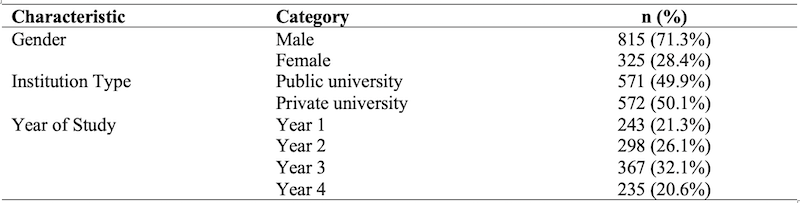
The target population comprised 3,814 IT undergraduates enrolled across ten purposively selected universities (five public, five private) in the Nairobi Metropolitan region, identified through cluster sampling from a frame of 20 IT-offering institutions registered with the Commission for University Education. Using Yamane’s (1967) formula at 95% confidence and a 0.05 margin of error, a proportionate stratified random sample of 1,144 students was identified, representing approximately 30% of the population. For the qualitative strand, 10 lecturers (sampled purposively to represent diverse departmental roles, including Heads of Departments) and three IT technicians were selected using criterion-based purposive sampling to ensure informational diversity. The final quantitative sample was 1,143 (response rate: 99.91%). The demographic characteristics — 71.5% male, 28.5% female, drawn from both institution types — are summarised in Table 1.
Table 1: Sample Demographic Characteristics
Two instruments were employed. First, a structured Likert-scale questionnaire (five points: 1 = Strongly Disagree to 5 = Strongly Agree) consisting of 35 items across four constructs — soft skills perception (six items), barriers to integration (12 items), preferred strategies (five items), and demographic/contextual variables (12 items). Content validity was established through an expert panel review (five academics and two industry practitioners); construct validity was confirmed via principal component analysis (KMO = 0.81). Reliability was assessed using Cronbach’s alpha (α = 0.75 across subscales), exceeding the 0.70 threshold recommended by Nunnally (1978). Second, a semi-structured interview guide (12 open-ended questions) was used with lecturers and technicians to explore barriers (RO2) and strategy preferences (RO3), drawing directly on Kolb’s and Vygotsky’s frameworks to guide probe questions on pedagogy, mentorship, and assessment.
Descriptive statistics (means, standard deviations) and independent-samples t-tests were used to examine soft skills awareness and strategy preferences (RO1, RO3). A Pearson Chi-square test assessed the association between university type and soft skills policy perceptions (RO4), and a one-way ANOVA examined differences across year-of-study groups (RO4). Qualitative data from 13 interviews — transcribed verbatim and returned to participants for member-checking — were analysed thematically following Braun and Clarke’s (2006) six-phase framework, generating themes directly relevant to RO2 and RO3.
Ethical approval was obtained from the Catholic University of Eastern Africa and Daystar University ERB, with a research permit issued by NACOSTI. Informed consent was secured from all participants; participation was voluntary, confidential, and anonymised using coded identifiers.
The results were reported sequentially by research objective, integrating quantitative and qualitative evidence where each illuminated the other.
A large majority of respondents (87.2%) agreed or strongly agreed that soft skills are important for IT employability. Yet only 31.4% reported receiving any formal soft skills training within their degree programme, and fewer than one in five (18.6%) indicated that such skills were explicitly assessed in any course. This disparity — high recognition paired with low provision — constitutes the study’s central empirical finding and is consistent with Wachira, Mutai et al. (2024). It aligns with the theoretical premise of Kolb’s ELT that soft skills require deliberate, structured experiential conditions to develop; absent those conditions, recognition alone does not translate into competence.
Disaggregating by institution type, private university students reported marginally higher rates of formal training exposure (34.1%) than their public university counterparts (27.6%), though the difference did not reach statistical significance (p = 0.07). By year of study, fourth-year students showed the highest rate of any reported training (38.2%) yet still fell far below what would be expected in a system where soft skills are genuinely integrated. Among specific competencies, students rated communication skills as the most important (M = 4.61, SD = 0.54), followed by teamwork (M = 4.58, SD = 0.57), problem-solving (M = 4.52, SD = 0.60), and adaptability (M = 4.47, SD = 0.63); critical thinking (M = 4.31, SD = 0.68) and leadership (M = 4.28, SD = 0.72) ranked fifth and sixth, respectively. Full descriptive statistics for all six competencies are presented in Table 2.
Table 2: Student Perceptions of Soft Skills Importance

Note: M = mean on 5-point Likert scale; SD = standard deviation; % Agree/SA = combined percentage of Agree and Strongly Agree responses.
Critical thinking and leadership scored slightly lower (4.31 and 4.28, respectively), suggesting that students privilege interpersonal over cognitive soft skills — a finding consistent with Robles (2012) but potentially reflecting the influence of group-project assessment formats that reward interpersonal over analytical dispositions.
Thematic analysis of interview data identified five recurring barriers (Table 3): (1) curricula overloaded with technical content, leaving insufficient space for soft skills; (2) passive, lecture-centred pedagogical approaches poorly suited to experiential skill development; (3) absence of standardised assessment frameworks; (4) weak or non-existent industry-academia linkages; and (5) lack of institutional policy mandating soft skills integration. A sixth barrier — inadequate faculty preparation — emerged as cross-cutting and is discussed separately below. HoD L3 illustrated the policy gap directly: “Sometimes when we call them for mentorship meetings, not all of them come. They know it is not part of the curriculum” (Interview, HoD L3, 20 March 2024). Collectively, these barriers map onto Vygotsky’s ZPD: without scaffolded, structured, socially embedded contexts, collaborative soft skill development cannot occur.
Table 3: Barriers to Soft Skills Integration
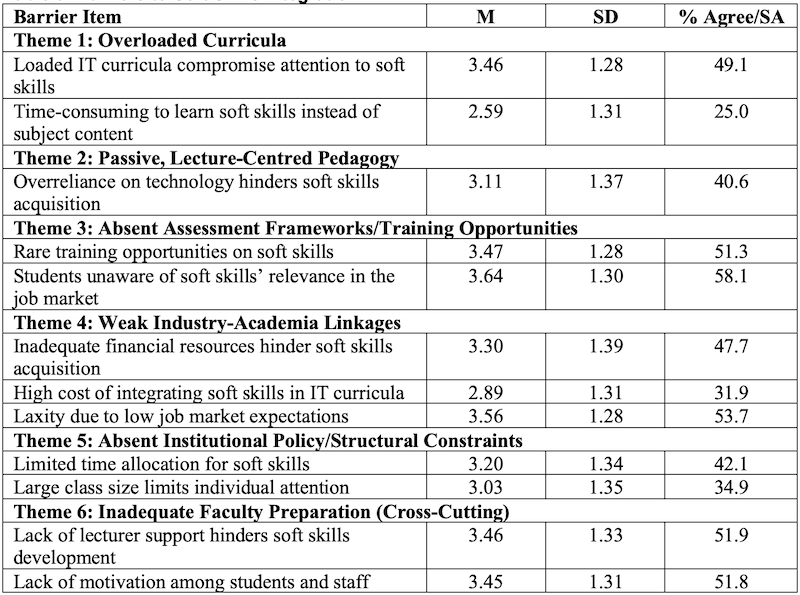
Note: M = mean on 5-point Likert scale; SD = standard deviation; % Agree/SA = combined Agree and Strongly Agree. Theme groupings derived from thematic analysis of interview data (RO2). Items with M below 3.0 indicate overall disagreement with that barrier.
The barrier of inadequate faculty preparation deserves particular emphasis. Only two of 10 lecturers interviewed reported having received any formal professional development in soft skills pedagogy. Lecturer L7 stated: “We were trained as computer scientists, not as communicators or leadership coaches. We do not have the tools to assess these skills fairly” (Interview, Lecturer L7, 13 March 2024). This aligns with Langat et al. (2021), who identified trainer competence as the primary institutional lever in TVET soft skills integration. The implication is that curriculum reform without accompanying faculty development will have limited impact: instruments without skilled users remain inert. Conversely, IT Technician T2 noted the practical leverage available through laboratory settings:
The lab is where students collaborate most naturally. If we designed lab exercises that required written reports and peer presentations, soft skills would develop alongside the technical work without needing extra curriculum time (Interview, Technician T2, 25 February 2024).
This observation, grounded in Kolb’s active experimentation stage, points to a low-cost, infrastructure-compatible integration pathway.
Table 4 summarises student responses on proposed strategies. Mentorship programmes received the strongest endorsement (79.53% agree/strongly agree), followed by curriculum reform (79.35%), policy development (78.48%), work-integrated learning (78.04%), and short courses (75.72%). Lecturers corroborated these priorities in interviews: L9 noted collaboration with Google and Microsoft for student mentoring, while HoD L4 emphasised the need for dedicated curriculum space: “We should incorporate more aspects of soft skills in the curriculum. Technical skills alone are not enough” (Interview, HoD L4, 19 March 2024).
Table 4: Strategies for Improving Soft Skills Development and Acquisition

Note: SD = Strongly Disagree; D = Disagree; UD = Undecided; A = Agree; SA = Strongly Agree.
The ranking of preferred strategies is theoretically coherent. Mentorship and curriculum integration — the two highest-ranked options — both require sustained institutional commitment rather than one-off provision, indicating that students diagnosed the problem as structural rather than incidental. This is a notable finding: students were not seeking cosmetic fixes but systemic redesign. The comparatively lower endorsement of standalone short courses (75.72%), while still substantial in absolute terms, aligns with evidence from Tran (2015) and Finch et al. (2013) that indicated, through decontextualisation, how soft skills modules yielded weaker transfer than discipline-embedded approaches. Lecturers corroborated these priorities qualitatively: HoD L6 described a university-wide mentorship programme involving external speakers from the UN Geneva office as particularly impactful for “igniting a culture of self-directed learning” — a construct directly aligned with Kolb’s abstract conceptualisation stage and with the self-regulated learning literature (Zimmerman, 2002). Taken together, these findings point towards an optimal intervention architecture combining structured mentorship, embedded curriculum design, and a formal institutional policy framework — a tripartite model that neither the CUE accreditation standards nor the KNQA qualification descriptors currently mandate, representing a clear gap for regulatory action.
To address RO4, two inferential tests were conducted. A Pearson Chi-square test compared public and private university students’ agreement levels on soft skills policy integration (χ² = 2.47, df = 4, p = 0.65). The non-significant result indicates that institutional type does not differentiate student perceptions. A one-way ANOVA compared views across four year-of-study cohorts (F(3, 1139) = 1.22, p = 0.30), revealing no statistically significant difference. The results are presented in Tables 5 and 6, respectively. Both null findings carry a clear practical implication: a uniform, sector-wide intervention could reach all IT undergraduates without institution-specific or cohort-targeted adaptations, reducing implementation complexity and cost.
Table 5: Pearson Chi-Square Test — University Type and Soft Skills Policy Perceptions

Note: Significance threshold α = 0.05. The Chi-square test is not statistically significant, indicating no association between institution type and soft skills policy perceptions.
Table 6: One-Way ANOVA — Soft Skills Integration Perceptions by Year of Study

Note: SS = Sum of Squares; MS = Mean Square. F(3, 1139) = 1.22, p = .302. The result is not statistically significant, indicating no difference in soft skills integration perceptions across years of study.
This study’s findings confirm and extend the prior literature in several important respects. First, the recognition-provision paradox — 87.2% valuing soft skills yet only 31.4% receiving formal training — surpasses the severity of such gaps documented by Hart Research Associates (2015) and Succi and Canovi (2020) for Western contexts. Mohammed and Ozdamli’s (2024) systematic literature review of 69 IT education studies confirms that despite high technical competence, IT graduates globally lack communication, teamwork, and problem-solving skills, yet none of the reviewed studies quantified the provision gap at the scale or severity documented here. This study therefore not only corroborates that global pattern but provides the first large-scale empirical measure of its magnitude in Kenyan IT higher education, extending Levin’s (2012) theoretical claim about resource-constrained systems from proposition to documented reality. Its threefold contribution is therefore non-trivial: the sample scale justifies the baseline claim; existing literature presupposes resource-abundant preconditions absent in Kenya, making contextual adaptation — not replication — the scholarly contribution (Alt & Raichel, 2023; Cinque, 2016); and rapidly expanding distance enrolment provides evidence for open-programme redesign both timely and consequential for Vision 2030.
Second, mentorship emerging as the most preferred strategy (79.53%) corroborates Cinque (2016) and Igwe et al. (2022), but this study advances both by revealing that structural provision alone is insufficient. Key informant evidence shows that compulsory mentoring fails to secure broad engagement — consistent with Mutale et al. (2023), who found that mentorship cultures at African universities remain underdeveloped and that building them requires deliberate institutional change management, not merely programme establishment. From a Vygotskian perspective, mentorship is the institutionalised operationalisation of the ZPD; the implication, unaddressed in prior quantitative studies, is that it must be assessed and explicitly linked to employability outcomes to generate the affective buy-in necessary for impact.
Third, the complete absence of standardised soft skills assessment instruments across all sampled institutions is this study’s most policy-urgent finding. A 2024 systematic review of soft skills interventions across educational levels found that while soft skills are increasingly promoted in curricula, rigorous assessment frameworks remain rare and inconsistently applied (Yeung et al., 2024). This study advances that finding by demonstrating that in the Kenyan IT context the problem is not inconsistency but total absence — a qualitatively more severe condition. Alt and Raichel (2023) demonstrated that competency-based learning with formative assessment feedback effectively develops soft skills among undergraduates, yet no such framework has been adopted in any sampled institution.
Fourth, the finding that neither institution type nor year of study predicts student perceptions departs from Pitan (2017), who found private Nigerian universities outperformed public counterparts in employability preparation. Hasan et al. (2024), in a study of Bangladeshi universities, similarly found that private institution status does not automatically confer employability advantage. This study offers a structurally grounded explanation: CUE-mandated frameworks apply uniformly across institution types without differentiating soft skills requirements, producing perceptual convergence at a low baseline. This convergence suggests that regulatory floor effects, rather than institutional culture or resource differences, are the primary determinant of provision — a finding with direct implications for accreditation policy design.
Fifth, the non-significant institutional and year-of-study effects collectively point toward a systemic rather than institutional explanation for the provision gap, consistent with Wachira, Mutai et al. (2024) and with Vygotsky’s (1978) argument that structured scaffolding must be deliberately designed rather than left to emerge organically. Recent UK evidence shows that experiential simulation learning directly enhances graduates’ life skills including resilience and adaptability (Dunbar-Morris & Lowe, 2024), reinforcing that deliberate curricular architecture — not institutional type or student progression — is the decisive variable. Where prior studies recommended institutional interventions, this study argues that sector-wide regulatory reform is the necessary condition, with institutional innovation as a complementary but insufficient lever. Kolb’s (1984) ELT and Vygotsky’s (1978) ZPD together confirm that soft skills are procedural, not propositional — acquired through scaffolded experiential cycles, not lecture transmission. The study’s own data corroborate this: 40.6% identified passive instruction as a barrier; 79.53% preferred mentorship. What was absent was not a module but the entire pedagogical architecture, demanding regulatory redesign (Finch et al., 2013; Tran, 2015).
Four limitations bound the inferences drawn here. Student self-report measures might inflate soft skills awareness and understate training deficits; employer-side data are absent, meaning the competency gap was assessed from a single vantage point; the cross-sectional design precluded causal attribution of competency gains to specific pedagogical practices; and the Nairobi Metropolitan sample limits generalisability to rural, peri-urban, or industrially distinct contexts. Notwithstanding these constraints, this study provides the first large-scale, mixed-methods evidence base for soft skills integration in Kenyan IT higher education, anchored in validated theoretical frameworks and linked to four research objectives. Its findings carry direct implications for the Commission for University Education, the Federation of Kenya Employers, and policymakers at the interface of higher education and the digital economy. Each limitation is addressed in the future research agenda below.
Five interrelated recommendations follow from the findings. First, the Commission for University Education should mandate explicit soft skills learning outcomes within IT programme accreditation, extending beyond declarative inclusion to require structured instructional time, defined assessment weightings, and formal reporting in institutional self-assessments, aligned with the Kenya National Skills Development Policy (2020-2029).
Second, universities should invest in sustained faculty professional development targeting experiential pedagogy, collaborative learning facilitation, and competency-based assessment design. A national CPD programme co-designed between universities, the CUE, and professional bodies — guided by the Policy on ICT in Education and Training (2021) — should link certification to academic promotion criteria to incentivise participation.
Third, a nationally standardised soft skills assessment framework should be developed collaboratively by the CUE, the Federation of Kenya Employers, and the Kenya National Qualifications Authority, drawing on models such as the AACU VALUE rubrics and adapted to the Kenyan IT labour market context.
Fourth, structured industry-academia partnerships — including virtual mentorship, co-developed project briefs, and hybrid internships — should be institutionalised as credit-bearing curricular components, equitably accessible across all delivery modalities.
Fifth, universities should invest in co-curricular activities and implement formal recognition mechanisms — such as transcript supplements — to document competencies acquired outside the classroom, enhancing graduate profile visibility to employers.
Four directions are indicated. First, longitudinal cohort designs tracking IT graduates from enrolment to employment are needed to enable causal inference about which institutional and pedagogical conditions produce measurable competency gains. Second, employer-side surveys should triangulate student self-reports against actual workplace readiness assessments, reducing common-method bias. Third, comparative studies across East African systems — particularly Tanzania, Uganda, and Rwanda — could assess generalisability and inform regional skills framework harmonisation. Fourth, randomised or quasi-experimental intervention studies evaluating the impact of specific curricular innovations — such as embedded project-based learning — on measurable soft skills outcomes could provide the causal evidence base required for policy scaling.
African Technology Policy Studies Network (ATPS). (2024). Unlocking the potential of education and skills for supporting youth employment in Kenya (Techno policy Brief No. 65). ATPS.
Alt, D., & Raichel, N. (2023). Competency-based learning and formative assessment feedback as precursors of college students’ soft skills acquisition. Studies in Higher Education, 48(12), 1901-1917. https://doi.org/10.1080/03075079.2023.2217203
Braun, V., & Clarke, V. (2006). Using thematic analysis in psychology. Qualitative Research in Psychology, 3(2), 77-101. https://doi.org/10.1191/1478088706qp063oa
Busaka, C., Kitta, S.R., & Umugiraneza, O. (2022). The integration of soft skills in secondary school mathematics in Zambia, Rwanda, and Kenya. Paper presented at the 20th Annual Conference of the Southern African Association for Research in Mathematics, Science and Technology Education (SAARMSTE), January 2022.
Cinque, M. (2016). Lost in translation: Soft skills development in European countries. Tuning Journal for Higher Education, 3(2), 389-427. https://doi.org/10.18543/tjhe-3(2)-2016pp389-427
Dunbar-Morris, H., & Lowe, J. (2024). Enhancing graduate employability — Exploring the influence of experiential simulation learning on life skill development. Studies in Higher Education, 49(2), 256-270. https://doi.org/10.1080/03075079.2024.2334837
Federation of Kenya Employers (FKE). (2023). Skills needs survey report 2023. FKE.
Finch, D.J., Hamilton, L.K., Baldwin, R., & Zehner, M. (2013). An exploratory study of factors affecting undergraduate employability. Education + Training, 55(7), 681-704. https://doi.org/10.1108/ET-07-2012-0077
Hart Research Associates. (2015). Falling short? College learning and career success. American Association of Colleges and Universities.
Hasan, K.K., Sharmin, S., Islam, A.T.M.F., Khandakar, H., Siddique, A.H., Shuhan, A.H., & Khandaker, M.A. (2024). Measuring the mediating role of quality education for ensuring employability skills: An analysis of higher education student perception in Bangladesh. PLOS ONE, 19(9), e0311069. https://doi.org/10.1371/journal.pone.0311069
Heckman, J.J., & Kautz, T. (2012). Hard evidence on soft skills. Labour Economics, 19(4), 451-464. https://doi.org/10.1016/j.labeco.2012.05.014
Igwe, P.A., Lock, D., & Rugara, D.G. (2022). What factors determine the development of employability skills in Nigerian higher education? Innovations in Education and Teaching International, 59(3), 337-348. https://doi.org/10.1080/14703297.2021.1873354
Kolb, D.A. (1984). Experiential learning: Experience as the source of learning and development. Prentice-Hall.
Langat, K., Omboto, D.B., Ambuli, A.M., & Ngeno, J.K. (2021). The effect of trainer competencies on training effectiveness: A survey of public TVET institutions in Kenya. The Kenya Journal of Technical and Vocational Education and Training, 4, 2-13.
Levin, H.M. (2012). More than just test scores. Prospects, 42(3), 269-284. https://doi.org/10.1007/s11125-012-9240-z
Manan, S., David, M., & Haidar, S. (2021). Soft skills, policies, practices, and self-assessment: Employability challenges of university graduates in Pakistan. Journal of Educational Sciences & Research, Spring, 8, 117-140.
Mohammed, F.S., & Ozdamli, F. (2024). A systematic literature review of soft skills in information technology education. Behavioral Sciences, 14(10), 894. https://doi.org/10.3390/bs14100894
Mutale, W., Nzala, S.H., Martin, M.H., Rose, E.S., Heimburger, D.C., & Goma, F.M. (2023). Accelerating organizational change to build mentorship culture in Zambian universities. Annals of Global Health, 89(1), 14. https://doi.org/10.5334/aogh.4032
Muyaka, J., & Kitainge, K. (2021). Implementation of whole youth development skills in Kenya’s TVET institutions. TVETA Journal, 4(1), 63-80.
Nunnally, J.C. (1978). Psychometric theory (2nd ed.). McGraw-Hill.
Ondieki, C.M.M., Kahĩhu, N., & Muthoni, S. (2019). Integration of soft skills into the TVET curriculum in Kenya. Journal of Multidisciplinary Engineering Science and Technology, 6(9), 10704-10715.
Osmani, M., Weerakkody, V., Hindi, N., & Eldabi, T. (2019). Graduate employability skills: A systematic literature review. Journal of Education for Business, 94(7), 423-432. https://doi.org/10.1080/08832323.2018.1536988
Pitan, O.S. (2017). Graduate employees’ generic skills and training needs. Higher Education, Skills and Work-Based Learning, 7(3), 290-303. https://doi.org/10.1108/HESWBL-07-2016-0047
Rhodes, T. (Ed.). (2010). Assessing outcomes and improving achievement: Tips and tools for using rubrics. Association of American Colleges and Universities.
Robles, M.M. (2012). Executive perceptions of the top 10 soft skills needed in today’s workplace. Business Communication Quarterly, 75(4), 453-465. https://doi.org/10.1177/1080569912460400
Succi, C., & Canovi, M. (2020). Soft skills to enhance graduate employability: Comparing students and employers’ perceptions. Studies in Higher Education, 45(9), 1834-1847. https://doi.org/10.1080/03075079.2019.1585420
Tran, L.T. (2015). Teaching communication across disciplines in the international higher education context: Lecturers’ perspectives and strategies. British Journal of Educational Studies, 63(3), 347-369. https://doi.org/10.1080/00071005.2015.1056817
Vygotsky, L.S. (1978). Mind in society: The development of higher psychological processes. Harvard University Press.
Wachira, A.N., Koros, P., & Kanga, A. (2024). Stakeholders’ perspectives on the development and acquisition of soft skills among IT undergraduate students in Nairobi. East African Journal of Education and Social Sciences, 5(2). https://doi.org/10.46606/eajess2024v05i02.0348
Wachira, A.N., Mutai, N.C., & Sambiri, B.B. (2024). Paideia patristic education: Analysis into the acquisition of soft skills in universities in Machakos County, Kenya. GILE Journal of Skills Development, 4(2), 92-105. https://doi.org/10.52398/gjsd.2024.v4.i2.pp92-105
Yamane, T. (1967). Statistics: An introductory analysis (2nd ed.). Harper & Row.
Yeung, S., Sherwood, E., & Donnelly, J. (2024). A systematic review of soft skills interventions within curricula from school to university level. Frontiers in Education, 9, 1383297. https://doi.org/10.3389/feduc.2024.1383297
Zimmerman, B.J. (2002). Becoming a self-regulated learner: An overview. Theory into Practice, 41(2), 64-70. https://doi.org/10.1207/s15430421tip4102_2
Author Notes
Anne Njogu Wachira is the Director, Main Campus (Athi River) at Daystar University, Kenya, where she also serves as a Lecturer and Associate Dean-Resident Services. She holds a PhD in Education (Administration and Planning) from Catholic University of Eastern Africa, an MA in English Language Teaching from the University of Reading, an MEd in Management and Leadership from Mount Kenya University, and a Higher Diploma in Counselling Psychology from the Kenya Association of Professional Counsellors. She has more than 40 years of experience in teaching and administration, specialising in curriculum development, student support, and mixed-methods research. Her interests span language-learning motivation, feedback and assessment, reading and writing skills, and the acquisition of soft skills in university and higher-education settings. Email: awachira@daystar.ac.ke; anjowash@gmail.com (https://orcid.org/0009-0001-0671-2872)
Cite as: Wachira, A.N. (2026). Integrating soft skills into IT education for development: A study of universities in Kenya. Journal of Learning for Development, 13(2), 349-360.