
Behnam Behforouz and Ali Al Ghaithi
2026 VOL. 13, No. 4
Abstract: This study investigates the effect of using Speechnotes (text-to-speech) via ChatGPT on higher education students’ speaking skills and willingness to communicate (WTC). The sample comprised 50 Omani English as a foreign language (EFL) students with an intermediate English proficiency level. These learners were divided into a control group (in-class teaching) and an experimental group (in-class teaching and AI-based speaking exposure), each consisting of 25 students. The findings of the speaking tests and WTC questionnaire revealed significantly better performance by the experimental group over the control group. The results of this study.
Keywords: artificial intelligence, language education, speaking skills, willingness to communicate
Speaking challenges result in fewer chances to speak and more rote learning for some students (Al Ghaithi & Behforouz, 2024). Therefore, EFL students need to have enough chances to interact with others and partake in conversational activities to improve their speaking abilities in a genuine context (Behforouz & Al Ghaithi, 2024). These challenges are more pertinent in EFL teaching environments, where the prospects of utilising English outside of structured teaching might be restricted. As a result, students might encounter not only obstacles in developing speaking skills but also difficulties in expressing their WTC in the English language.
Instructors might use instructional technology to help students develop their speaking abilities independently. Thus, computer-assisted language learning (CALL) experts have highlighted many social, pedagogical, and psychological opportunities to improve students’ language competency, particularly in speaking (Dörnyei, 2014; Freiermuth, 2020). Studies have shown that technology-mediated training can improve students’ ability to talk and boost their desire to speak (Chaisiri, 2023). Rahimi and Fathi (2022) found that the skills of speaking and WTC improved with the help of technology-based language learning activities. This suggests that the effectiveness of technology instruction does not solely rely on its accessibility; it also depends on the opportunities it gives students to practise speaking, active involvement, and feedback.
Artificial intelligence (AI) is increasingly used in technology-mediated language learning because it offers opportunities to practise individually and receive feedback (Pokulevska, 2018). One of the objectives of integrating AI into the learning process is to remove the physical and time limitations of learning languages. This may increase the accessibility of instructional resources for students and enhance communication between them and their educators (Ahmad et al., 2021; Gardner et al., 2021). AI apps incorporate the elements of speech processing, speech recognition, and interaction with the user, which may help in speaking proficiency by enabling students to produce language and receive feedback without a teacher present. This ability is essential for students to be more competent in speaking, as they are not always able to meet with native English speakers (Soleimani et al., 2022; Zou et al., 2020). Kang (2022) investigated the interactions between students and AI and reported the advantages of speaking practice with the help of AI. Considering the results of these studies, it can be stated that the use of AI in the classroom provides an alternative source for students to practise and improve speaking skills, but the efficacy of the specific applications and the feedback schemes require a deeper analysis.
Researchers MacIntyre (2017) and Mystkowska-Wiertelak & Pawlak (2016) emphasised that second-language WTC is an important consideration because learners’ WTC is a decisive factor in participation in oral interaction. The present research is rooted in MacIntyre et al.’s (1998) definition of WTC as a student’s willingness to engage in a conversation in a specific context. The framework suggests that participation in AI-assisted speaking tasks might be associated with both linguistic performance and students’ readiness to speak in English. Recently, researchers have also used AI in studying speaking interactions and providing feedback to users. For instance, Fathi et al. (2024) investigated the effectiveness of using AI-mediated speaking activities and found that the AI-supported interaction was more effective in boosting EFL learners’ speaking performance and WTC. Similarly, Zou et al. (2025) examined an AI-driven English-speaking assessment and feedback application and disclosed that learners’ classroom WTC was significantly improved.
However, despite these findings, the evidence does not show that every AI-based method is equally effective. In particular, further context-specific evidence is required for the purpose of finding out if a ChatGPT and a speech-processing technology instructional arrangement would help with both general classroom teaching and students’ speaking performance and WTC of intermediate-level EFL students. Therefore, this research was conducted to address this gap by examining a specific AI-assisted speaking intervention in an Omani higher education setting. The study aimed to take a further step to widen the existing evidence through its evaluation of a specific set of AI tools by Omani EFL learners. Hence, the study provides quantifiable context-related evidence on the impact of such methods as integrating AI-supported speaking practice into EFL instruction in educational settings.
Qiao and Zhao (2023) investigated the efficacy of AI-driven training in enhancing the L2 speaking proficiency of Chinese students. The treatment group received AI-based training through the Duolingo application, and the control group underwent conventional instruction. The results showed that the experimental group had a significant improvement in their L2 speaking skills. Similarly, Zou et al. (2023) investigated the effectiveness of AI speech assessment algorithms with automatic feedback in facilitating EFL learners’ improvement of their speaking skills. Forty Chinese EFL learners used the AI technology of Liulishuo and EAP Talk for speaking practice. The results indicated that the majority of those who participated improved their overall proficiency in speaking, in terms of fluency, pronunciation, and vocabulary.
Makhlouf (2021) examined the impact of using ELSA Speak as an AI tool to improve the fluency and accuracy of communication skills among 20 Saudi students. The primary objectives were to enhance vocabulary, grammar, pronunciation, and fluency. The results of the study revealed that using ELSA Speak significantly increased the fluency, accuracy and general speaking skills of the learners. In another study, Maknun (2020) investigated the role of Orai, which is an AI-driven instrument, to improve the learners’ public speaking abilities. The experimental group received feedback from Orai AI on some speech features such as confidence, conciseness, tempo, words, gestures and pauses. Meanwhile, the control group was exposed to regular conventional classes. The findings of the study revealed that the experimental group showed rapid improvement in speaking abilities.
Fathi et al. (2024) investigated the impact of AI-mediated interactive speaking activities on the WTC and attitude of learners. The experimental group used an AI chatbot to engage in speaking activities, while the control group used peer interaction. The results showed that using AI-mediated speaking activities increased WTC among the participants. Additionally, students stated positive feelings and attitudes toward employing AI tools. Similarly, Zhang et al. (2024) investigated the impact of an AI tool, called Lora, on the WTC of Chinese EFL learners. The experimental group used Lora as a speaking assistant agent, and the findings showed a higher level of WTC in the experimental group. Additionally, Shafiee Rad (2024) examined the impact of an AI tool, Speeko, on the WTC, perceptions, and communication proficiency of language learners. While the control group followed traditional in-class training, the experimental group was exposed to Speeko, and the findings revealed higher WTC abilities in the experimental group, improved speaking skills, and favourable perceptions toward it.
Based on the above explanations, this research aimed to answer the following questions:
RQ1: Does AI-based feedback via ChatGPT improve the speaking abilities of Omani EFL learners?
RQ2: Does AI-based feedback via ChatGPT on speaking increase the willingness of Omani EFL learners to communicate within the educational setting?
The present study was based on a quasi-experimental approach, and the study used a pretest-posttest control group design.
In this study, 50 Omani learners with intermediate English proficiency level from a higher education institute in Oman comprised the target population. Omani Arabic was the primary language, and their ages ranged from 18 to 19 years old. Using a quasi-experimental approach, they were randomly divided into two intact classes — an experimental group and a control group, each consisting of 25 students. The classes were a combination of both males and females.
Speaking Pretest and Posttest
The speaking tests were divided into three parts. The initial part, which consisted of personal background information, was answered by the students. In the second part, students were given cue cards that they had time to prepare before discussing subjects like online shopping, immigration, and tourism. The last part included a conversation between the student and the examiner. Every speaking evaluation took about 10 minutes to finish. The students’ speaking abilities were assessed using four criteria: fluency and coherence, vocabulary, grammar range and accuracy, and pronunciation. Each criterion was rated out of five points, thus providing a possible total of 20. To ensure content validity, two university specialists were first consulted to check the test and ensure it was at the right level for intermediate students. In addition, the students’ speaking performances were rated independently by two examiners using the same scoring guide. The intraclass correlation coefficient (ICC) was calculated to establish the degree of interrater reliability of the examiners who assessed the students’ speaking skills. The statistical findings in Table 1 reveal that there was a strong consensus between the pretest (ICC = .921) and posttest (ICC = .948) results, and, hence, the scoring rubric greatly contributed to the very close rates given by the examiners.
Table 1: Inter-Rater Reliability of the Speaking Pretest and Posttest
Willingness to Communicate Scale
A questionnaire was adapted from Khatib and Nourzadeh (2014) to collect the required data on the students’ WTC and comprised six sections: communicative self-confidence, integrative orientation, situational context of L2 use, topical enticement, learning responsibility, and off-instruction communication, with 27 items. To measure the results, a Likert scale of one to five was implemented, in which one means strongly unwilling, two means unwilling, three means neutral, four means willing, and five means strongly willing. To assess the reliability of this questionnaire, it was piloted with 25 Omani EFL learners with intermediate English proficiency levels. The results from the pilot study showed excellent internal consistency reliability with an overall Cronbach’s alpha coefficient of .842. To establish content validity, an Omani applied linguist was invited to review and modify the statements to monitor the sociocultural factors, the level of the statements, and their suitability for the students’ level. Additionally, an Arabic translation of the statements was provided, with the assistance of a native Arabic speaker, to ensure that the learners could understand the items.
Speechnotes: Speech to Text
The researchers utilised the Speechnotes Speech to Text plugin in Google Chrome to convert the students’ speech into text. Speechnotes allows individuals to convert audio and video recordings swiftly and accurately and to dictate notes rather than typing, thereby saving energy and time. Speechnotes offers services such as automatic capitalisation, spoken instructions for punctuation and formatting, and simple import/export options. The researcher compared the transcriptions made by Speechnotes with those of the students themselves to find and correct any mistakes. The clear need for validation was to reduce the intrinsic mistakes of automatic speech recognition to a minimum, especially when the testing was performed on Omani learners of English as a foreign language.
This study was conducted during the fall semester of 2024-2025. It was announced that the students’ participation was voluntary, with no effect on their continuous assessment scores. The WTC questionnaire and speaking pretests were administered before implementing the treatment. Before the treatment, the researcher conducted a workshop for the experimental group on using the Speechnotes Speech to Text plugin and ChatGPT. Over one month of treatment, the learners worked on four topics. These topics included holidays, dream jobs, plans, and comparing infographics. Each speaking session lasted 90 minutes. Figure 1 shows the class teacher’s steps to complete the tasks.
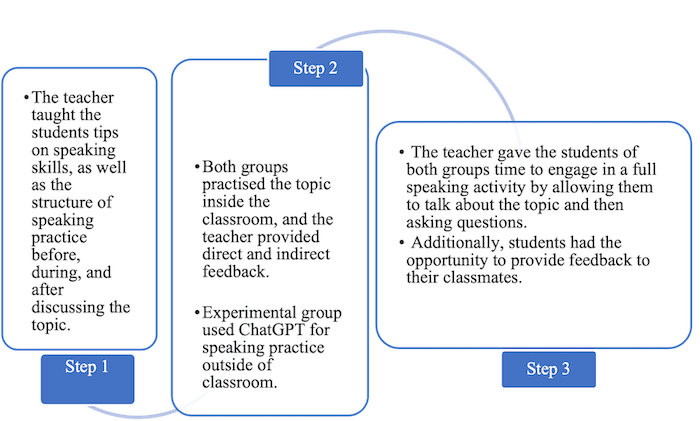
The students were divided into pairs and groups to practise the assigned topics during the in-class training. This could help them feel comfortable communicating and receiving feedback from their peers. Meanwhile, the teacher visited the groups and noted some issues with the students’ speaking. After completing the task, detailed feedback on issues was provided. There was no after-class activity for the control group, but the experimental group continued working with ChatGPT and Speechnotes to practise speaking on topics and receive AI-enhanced feedback. Following the same process for a month, a posttest and the WTC questionnaire were administered to both groups.
The first step in analysing speaking tests was to to run the Shapiro-Wilk test of normality to select an appropriate parametric or nonparametric testing technique (Table 2).
Table 2: Results of Normality of Data Distribution in Pretest and Posttest of both Groups

Table 2 demonstrates that in the pretest, the control and experimental groups noticeably deviated from the normal distribution, p = .015. In the posttest, the control group also did not meet the normality condition, p = .015, while the experimental group was the one that violated normality, p < .001. Therefore, to compare both groups, a Mann-Whitney U test was administered, and the results can be seen in Table 3.
Table 3: Comparison of both Groups in Pretest and Posttest

Table 3 reveals no remarkable difference between the groups in the pretest, p = 1.Table_03, which implies that the two groups had an equal level of speaking performance prior to the intervention. On the other hand, a significant difference was found in the posttest, p < .001. The effect size was extremely large, r = .906, demonstrating immense distinction between the groups following the intervention. The results indicated that the experimental group significantly outperformed the control group on the posttest.
To analyse the performance of the experimental group on each criterion, a Wilcoxon signed-rank test was administered, and the results can be seen in Table 4.
Table 4: The Results of the Wilcoxon Signed-Rank Test

Table 4 indicates statistically significant advances in fluency (Z = −5.000, p = .001), lexical performance (Z = −4.462, p = .001), grammar (Z = −4.838, p = .001), and pronunciation (Z = −4.432, p = .001). These findings suggest that the experimental group made substantial gains in all four speaking components from the pretest to the posttest.
To compare the performance of the learners in the WTC questionnaire, the Wilcoxon signed-rank test was conducted, and Table 5 shows the findings.
Table 5: Results of WTC Analysis in Pretest and Posttest Within each Group

Table 5 demonstrates no statistically significant difference (p = 1.000), in the WTC control group. Whereas, the experimental group demonstrated a statistically significant difference between pretest and posttest (p < .001), showing that the intervention had a higher effect on WTC. Finally, a Mann-Whitney U test was run to compare the results of both groups together, and the results can be seen in Table 6.
Table 6: The Results of the Comparison between Two Groups in the Pretest and Posttest of WTC

Table 6 indicates no statistically significant difference between the groups in the pretest (p = 1.000). This suggests that both groups had comparable levels of desire to communicate before the intervention. On the other hand, the posttest scores showed that the experimental group exhibited a significant improvement compared to the control group (p < .001), indicating that the intervention successfully increased the WTC in the experimental group.
To gain a better understanding of the WTC statements after using AI as the speaking facilitator, the posttest of the experimental group was analysed (Table 7).
Table 7: The Descriptive Analysis of Items in Posttest of the WTC Questionnaire among Experimental Group
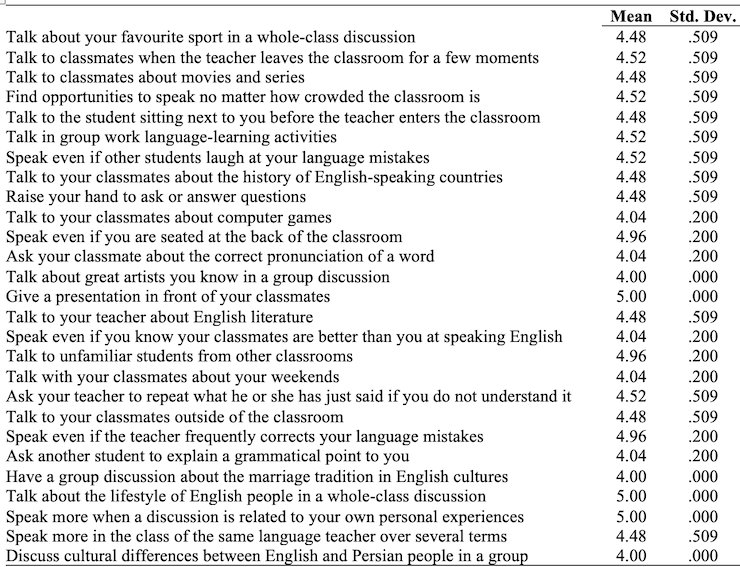
Table 7 indicates that in the posttest, the experimental group demonstrated the highest level of WTC in activities such as “Giving a presentation in front of classmates,” “Discussing the lifestyle of English people in a whole class setting,” and “Speaking more when the discussion relates to personal experiences.” These activities received a perfect mean score of 5.00 and a standard deviation of .000, suggesting unanimous agreement among participants. In contrast, the statements that were used the least frequently were “Engage in a group discussion about well-known artists,” “Participate in a group discussion about marriage customs in English cultures,” and “Explore cultural distinctions between English and Persian individuals in a group.” These statements had an average score of 4.00 and a standard deviation of .000, indicating a slightly lower but still positive inclination to communicate.
The present research analysed the influence of AI tools on speaking skills and WTC of EFL learners. The results showed that the experimental group significantly outperformed the control group at the posttest stage. This indicates that the addition of AI-mediated speaking exercises to regular classrooms may have contributed positively to speaking performance and WTC. However, it should be emphasised that the results should be understood in terms of the study’s quasi-experimental design, since the differences that were noticed might be due to the additional practice of the experimental group.
It is likely that the observed increase in the speaking performance of the experimental group was associated with several instructional features integrated with AI-assisted learning, especially the opportunities for repeated practice, immediate feedback, and personalised learning. Learners could have benefited from ChatGPT’s feedback mechanisms that helped them identify and address potential errors in their language production, which in turn allowed them to revise their responses and practise independently. From the perspective of language acquisition, the potential for learners to identify and correct errors, to change their answers, and to practise their speaking in a variety of contexts might have positively impacted their ability to understand the grammatical forms and to use them afterwards in speaking tasks. Receiving and responding to feedback could have played a main role in helping learners in the gradual process of improvement in speaking performance during the period of intervention. Moreover, AI-assisted learning might have been an opportunity for students to learn according to their own needs and at their own pace, which is not possible on occasion due to limited time in class, for instance. The Speechnotes and ChatGPT combination also served as a tool for students to turn their spoken output into a text form and receive language feedback. This combination might have required the students to compare their transcriptions with their intended statements, and may have increased their awareness of grammatical accuracy and word choice. Regardless, it is not possible to ensure that the output of speech-to-text is accurate in the expression of the original speech of this learner, particularly when issues of pronunciation or mistakes in recognition occur. Since the study did not independently evaluate feedback quality, practice frequency, use of feedback by learners or error correction, these explanations can be understood as plausible pedagogical mechanisms rather than empirically established causes of the observed improvement.
The results of speaking performance align with a study by Fathi et al. (2024) who explored AI-mediated speaking activities and reported substantial improvements in the EFL learners’ speaking skills and WTC. In the same vein, Duong and Suppasetseree (2024) researched the application of an AI voice chatbot and reported enhancements in speaking performance. Qiao and Zhao (2023) also observed that when learners took part in AI-supported instruction, they improved their L2 speaking skills more than learners who had conventional instruction. The studies show that using AI in practice can be an important source for the development of speaking skills, irrespective of variations in the teaching methods. Unlike previous studies, this one applied Speechnotes and ChatGPT, which allowed the students to listen to their own spoken performance in the form of a transcription and then receive feedback. However, it is still uncertain whether the improvements observed were due to AI feedback, more chances to practise, or both factors working together.
The results of WTC in this study also align with Shafiee Rad (2024), who studied the AI-driven Speeko application and documented the enhancement of learners’ speaking outcomes along with WTC. Comparatively, Zhang et al. (2024) investigated AI-speaking assistant technology and noted the increased WTC. Zhi and Wang (2024) further discovered that learners’ perceptions of AI, instructional feedback, and WTC were interrelated. According to the findings, the use of AI in students’ tasks could cultivate their willingness to communicate; however, the exact justification of this may vary in different educational contexts. In the present study, it is possible that the two variables which students practised were speaking and getting feedback on their own, so it possibly improved their WTC. Nonetheless, factors such as confidence and anxiety were not closely evaluated.
The WTC findings can also be understood according to the MacIntyre et al. (1998) conceptual framework, which emphasises the influence of personal and situational variables on willingness to communicate. The employment of AI-driven speaking tasks might have established a low-stress environment that encouraged students to practise and increase their willingness to communicate. This pinpoints the importance of the environmental factors in the WTC; however, the study did not go into detail about the exact psychological processes mentioned in the theoretical model. As a result, the outcomes concur with the theoretical propositions of the model but do not provide any evidence of the reciprocal relations that the model implies.
The current research examined and evaluated the speaking skills and WTC of the students who used Speechnotes and ChatGPT in cooperation with the traditional way of teaching. The experimental group showed a considerable number of skills gained in both areas compared to the control group. The findings indicate that using speech-to-text technology along with AI-generated feedback could be a way to enhance Omani EFL learners’ speaking proficiency and their WTC. However, the quasi-experimental method and the practice that the participants had are the factors that prevented the researchers from drawing a causal conclusion. By exploring the combination of these technologies in an Omani higher education context, the study contributes to the existing body of knowledge and particularly highlights the importance of their careful integration into EFL pedagogy.
The outcomes of the study point to several conclusions regarding EFL instruction in higher education in Oman. EFL teachers should consider integrating structured AI-assisted speaking tasks to offer independent practice. For instance, tools like Speechnotes and ChatGPT can be applied to classroom speaking activities by acoustic language learners to practise, get feedback, and revise their responses. Although these activities can assist in bridging the gap of speaking practice not being conducted in the classroom, the teacher’s supervision is still very necessary, since the AI-generated comments and transcriptions may not always be accurate.
Aside from students’ language proficiency, oral instruction should also consider their WTC. Teachers could design self-directed speaking practice tasks that utilise AI, and then gradually proceed to collaborative activities, group discussions, and real-life communication. The implementation of such an approach would help to bridge the gap between individual practice and the interactive communication that is, in this case, AI being an additional resource for the teacher and not a replacement for the class activities.
This study has some limitations. First, the study sample was composed of 50 intermediate-level learners studying English as a foreign language at a single university in Oman; thus, the implications of the results are not generalisable to other populations. In this regard, future research should be carried out on larger groups with more diversity.
Second, the research was focused on a quantitative methodology that did not investigate the personal experiences of learners or their specific use of the AI-generated feedback. Future research could include qualitative methods such as interviews, observations, and learner self-reflections to gain a more comprehensive understanding of how AI-supported activities impact students’ speaking proficiency and willingness to communicate.
Third, the time allocated for the intervention was confined to one month; therefore, this made it impossible to establish how long the effects of the results gained might last. In addition, future research should target whether these outcomes are maintained by having longer interventions and using delayed posttests.
Finally, the combination of the two tools, Speechnotes and ChatGPT, being used simultaneously made it almost impossible to find the effect of each tool separately. It is also possible to state that only the speaking practice itself was the cause of the results, while the AI technologies were of no extra value. Future studies should examine these technologies separately and in combination, as well as considering the exercise time separately, while at the same time monitoring the accuracy of the transcriptions and the adequacy of the feedback given.
Ahmad, S.F., Rahmat, M.K., Mubarik, M.S., Alam, M.M., & Hyder, S.I. (2021). Artificial intelligence and its role in education. Sustainability, 13(22), 12902. https://doi.org/10.3390/su132212902
Al Ghaithi, A., & Behforouz, B. (2024). The cognitive components of anxiety during speaking tests among Omani learners. Issues in Language Studies, 13(1), 374-390. https://doi.org/10.33736/ils.5854.2024
Behforouz, B., & Al Ghaithi, A. (2024). Unblocking fluency: The power of pair work, group discussion, and presentation in boosting speaking skills. Training, Language and Culture, 8(3), 73-85. https://doi.org/10.22363/2521-442X-2024-8-3-73-85
Chaisiri, P. (2023). Promoting Thai EFL learners’ willingness to communicate in the virtual classroom through technology-mediated oral tasks. LEARN Journal: Language Education and Acquisition Research Network, 16(1), 97–120. https://so04.tci-thaijo.org/index.php/LEARN/article/view/263435
Dörnyei, Z. (2014). The psychology of the language learner: Individual differences in second language acquisition. Routledge.
Duong, T., & Suppasetseree, S. (2024). The effects of an artificial intelligence voice chatbot on improving Vietnamese undergraduate students’ English speaking skills. International Journal of Learning, Teaching and Educational Research, 23(3), 293–321. https://doi.org/10.26803/ijlter.23.3.15
Fathi, J., Rahimi, M., & Derakhshan, A. (2024). Improving EFL learners’ speaking skills and willingness to communicate via artificial intelligence-mediated interactions. System, 121, 103254. https://doi.org/10.1016/j.system.2024.103254
Freiermuth, M.R. (2020). Introduction and overview: The inescapable confluence of technology, psychology and second language learners and users. In M.R. Freiermuth & N. Zarrinabadi (Eds.), Technology and the psychology of second language learners and users (pp. 3–32). Springer International Publishing. https://doi.org/10.1007/978-3-030-34212-8_1
Gardner, J., O’Leary, M., & Yuan, L. (2021). Artificial intelligence in educational assessment: 'Breakthrough? Or buncombe and ballyhoo?' Journal of Computer Assisted Learning, 37(5), 1207–1216. https://doi.org/10.1111/jcal.12577
Kang, H. (2022). Effects of artificial intelligence (AI) and native speaker interlocutors on ESL learners’ speaking ability and affective aspects. Multimedia-Assisted Language Learning, 25(2).
Khatib, M., & Nourzadeh, S. (2014). Development and validation of an instructional willingness to communicate questionnaire. Journal of Multilingual and Multicultural Development, 36(3), 266-283. https://doi.org/10.1080/01434632.2014.914523
MacIntyre, P.D. (2017). An overview of language anxiety research and trends in its development. In C. Gkonou, M. Daubney, & J-M. Dewaele (Eds.), New insights into language anxiety: Theory, research and educational implications (pp. 11-30). Multilingual Matters. https://doi.org/10.21832/9781783097722-003
MacIntyre, P.D., Clément, R., Dörnyei, Z., & Noels, K.A. (1998). Conceptualizing willingness to communicate in a L2: A situational model of L2 confidence and affiliation. The Modern Language Journal, 82(4), 545-562. https://doi.org/10.1111/j.1540-4781.1998.tb05543.x
Makhlouf, M.K.I. (2021). Effect of artificial intelligence-based application on Saudi preparatory-year students’ EFL speaking skills at Albaha university. International Journal of English Language Education, 9(2), 36–57. https://doi.org/10.5296/ijele.v9i2.18782
Maknun, L. (2020). The implementation of Orai as artificial intelligence for digital native students in English speaking learning. iTELL (Indonesia Technology Enhanced Language Learning), 1(1), 131–138.
Mystkowska-Wiertelak, A., & Pawlak, M. (2016). Willingness to communicate in instructed second language acquisition. Multilingual Matters.
Pokulevska, A.I. (2018). Experience of using Skype as a means of foreign languages teaching efficiency improving. Information Technologies and Learning Tools, 68(6), 155–165. https://doi.org/10.33407/itlt.v68i6.2150
Qiao, H., & Zhao, A. (2023). Artificial intelligence-based language learning: Illuminating the impact on speaking skills and self-regulation in Chinese EFL context. Frontiers in Psychology, 14, 1255594. https://doi.org/10.3389/fpsyg.2023.1255594
Rahimi, M., & Fathi, J. (2022). Employing e-tandem language learning method to enhance speaking skills and willingness to communicate: The case of EFL learners. Computer Assisted Language Learning, 37(4), 924–960. https://doi.org/10.1080/09588221.2022.2064512
Shafiee Rad, H. (2024). Revolutionizing L2 speaking proficiency, willingness to communicate, and perceptions through artificial intelligence: A case of Speeko application. Innovation in Language Learning and Teaching, 1–16. https://doi.org/10.1080/17501229.2024.2309539
Soleimani, H., Mohammaddokht, F., & Fathi, J. (2022). Exploring the effect of assisted repeated reading on incidental vocabulary learning and vocabulary learning self-efficacy in an EFL context. Frontiers in Psychology, 13, 851812. https://doi.org/10.3389/fpsyg.2022.851812
Zhang, C., Meng, Y., & Ma, X. (2024). Artificial intelligence in EFL speaking: Impact on enjoyment, anxiety, and willingness to communicate. System, 121, 103259. https://doi.org/10.1016/j.system.2024.103259
Zhi, R., & Wang, Y. (2024). On the relationship between EFL students’ attitudes toward artificial intelligence, teachers’ immediacy and teacher-student rapport, and their willingness to communicate. System, 124, 103341. https://doi.org/10.1016/j.system.2024.103341
Zou, B., Du, Y., Wang, Z., Chen, J., & Zhang, W. (2023). An investigation into artificial intelligence speech evaluation programs with automatic feedback for developing EFL learners’ speaking skills. SAGE Open, 13(3), 1-8. https://doi.org/10.1177/21582440231193818
Zou, B., Liviero, S., Hao, M., & Wei, C. (2020). Artificial intelligence technology for EAP speaking skills: Student perceptions of opportunities and challenges. In M.R. Freiermuth & N. Zarrinabadi (Eds.), Technology and the psychology of second Language learners and users (pp. 433–463). Springer International Publishing. https://doi.org/10.1007/978-3-030-34212-8_17
Zou, B., Xie, S., & Wang, C. (2025). Students’ willingness to communicate (WTC) in using artificial intelligence (AI) technology in English-speaking practice. International Journal of Information and Communication Technology Education, 21(1), 1–18. https://doi.org/10.4018/IJICTE.375387
Author Notes
Dr Behnam Behforouz is an Assistant Professor of English in the Department of Foreign Languages at University of Nizwa, Oman. He graduated from University of Rovira i Virgili in Spain with a PhD in Applied Linguistics in 2022. He has taught English at various Iranian and Omani universities since 2009. His main areas of interest are TESOL, Applied Linguistics, and Educational Technologies. Email: b.behforouz@unizwa.edu.om (https://orcid.org/0000-0002-0078-2757)
Dr Ali Al Ghaithi is an Assistant Professor of English in the Faculty of Language Studies at Sohar University, Oman. Ali earned his PhD in June 2026 from the Universidad Pública de Navarra in Spain, focusing on Applied Linguistics. Ali is interested in research that primarily applies Artificial Intelligence to teaching and learning processes. Email: AGhaithi@su.edu.om (https://orcid.org/0000-0002-9653-508X)
Cite as: Behforouz, B., & Al Ghaithi, A. (2026). Enhancing students’ speaking skills and willingness to communicate with AI technologies. Journal of Learning for Development, 13(4), 663-674.
DOI: https://doi.org/10.56059/fm43ge17