Samsul Alam
2026 VOL. 13, No. 4
Abstract: This study investigates the key determinants influencing student satisfaction and actual usage patterns of information and communication technology for education (ICT4E) among Bangladeshi tertiary students. Analysing 995 valid responses collected through a cross-sectional survey from a public and a private university across ten hypotheses, the findings reveal that network availability, perceived academic performance, learning mode preference and instructional mode were the primary predictors of satisfaction. Likewise, platform preference moderated the impact on satisfaction while institutional gender effects varied. Conversely, interactive tools, socio-economic background and ease of access to resources did not significantly affect student satisfaction, nor did satisfaction drive ICT4E engagement. By highlighting empirical trends in user experience rather than institutional policy evaluation, these insights emphasise contextualising ICT4E infrastructure, digital readiness and user engagement within broader equity frameworks. The study offers actionable recommendations for fostering context-sensitive, learner-centred digital education in developing tertiary education.
Keywords: ICT4E, UTAUT, digital equity, educational technology, tertiary education, student satisfaction, student engagement, Bangladesh
Information and communication technology for education (ICT4E) is pivotal for advancing instructional quality, institutional innovation and educational equity, especially in a developing country context (Assefa et al., 2024; Mielikäinen, 2021). Although post-pandemic remote learning models catalysed digital transition (Pérez Echeverría et al., 2025), students in Global South contexts frequently face persistent usability barriers, unstable network infrastructure and socio-economic inequalities (Adarkwah, 2021; Bakytbekova et al., 2026; Islam & Akhtar, 2026). In Bangladesh, national policy initiatives and institutional frameworks have accelerated ICT4E deployment across higher education institutions (HEIs) (Fearnley & Amora, 2020; Sarker et al., 2019; Shohel et al., 2025).
The Bangladeshi higher education system comprises public universities that often lack sufficient resources, while private universities are generally well-funded and technically sound. Each of these types of universities is at a different level of ICT readiness. Despite the prioritisation of digital transformation globally, challenges still persist in many developing countries, including Bangladesh where the adoption of ICT4E faces significant barriers such as inadequate infrastructure, limited access to technology and lack of proper training for both students and educators (Shohel et al., 2025).
Despite these challenges, the potential for ICT to revolutionise education in Bangladesh remains high, particularly in a rapidly digitalising world (Karim et al., 2025; Shohel et al., 2025). Indeed, the integration of ICT4E has the potential to act as a powerful tool for economic development by preparing the workforce for the digital age (Kirkwood & Price, 2014). Effective ICT4E integration enhances student engagement and academic outcomes (Fayda‐Kinik & Cetin, 2025; Looi, 2025).
However, the extant literature has predominantly evaluated generic e-learning readiness, high-level technology acceptance or general digital literacy, with limited attention to the contextual realities of emerging and developing economies (Al-Fraihat et al., 2020; Fearnley & Amora, 2020). Consequently, a critical empirical gap remains in understanding how technological, pedagogical and socio-demographic factors interact through access- and preference-related mechanisms to shape student satisfaction (SAT) and subsequent behavioural engagement (ENG) within a dual public-private tertiary education system. Addressing this gap, the current study links technical, institutional and socio-demographic factors directly to student-centred outcomes, providing actionable empirical evidence for policy alignment, digital workforce development and equitable technology deployment (Kirkwood & Price, 2014).
To address these empirical and policy imperatives, this study investigates an overarching research question (RQ): How do technical infrastructure, pedagogical modes, socio-demographic characteristics and perceived academic performance structurally shape student satisfaction — via ease of access and ICT4E preference — and drive downstream ICT4E engagement?
To answer this RQ, the study empirically evaluates a structural equation model across public and private universities in Bangladesh by pursuing four specific research objectives (ROs):
RO1: To examine the direct structural relationships between technical, pedagogical and performance antecedents on student satisfaction.
RO2: To evaluate the structural relationships between socio-demographic characteristics (gender and socio-economic background), key mediators (ICT4E preferences and ease of access) and overall satisfaction.
RO3: To analyse the downstream structural relationship between student satisfaction and ICT4E engagement.
RO4: To formulate evidence-based policy frameworks for equitable ICT4E integration across public and private HEIs.
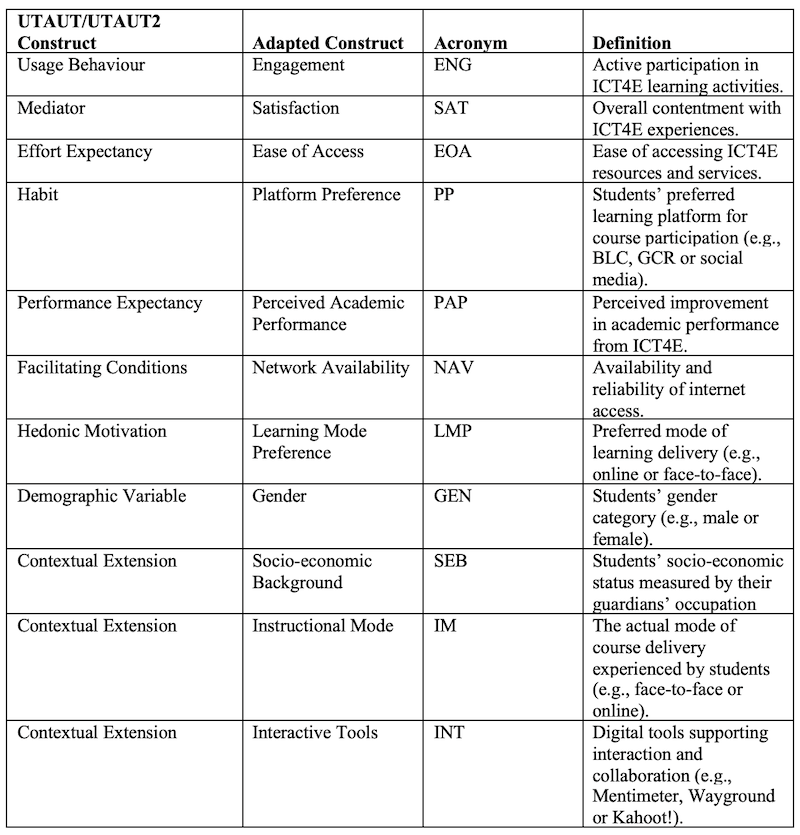
To enhance structural coherence across the RQ and establish conceptual rigour, this study incorporates a unified theory of acceptance and use of technology (UTAUT) and UTAUT2-based conceptual framework (Venkatesh et al., 2003, 2012) in a modified way that connects macro-level implementation barriers to micro-level student adoption and engagement. In line with a modified UTAUT/UTAUT2 model, the study examines how technological infrastructure, pedagogical modes and socio-demographic backgrounds structurally determine student adoption and engagement. Rather than evaluating generic technology acceptance, the framework operationalises core UTAUT/UTAUT2 constructs within a tertiary ICT4E context: (a) Effort Expectancy and Facilitating Conditions are operationalised through technical infrastructure, specifically EOA and NAV; (b) Performance Expectancy is reflected through PAP; (c) Pedagogical Delivery and Hedonic Motivation are captured via IM, INT, LMP and PP; and (d) Socio-Demographic Disparities (GEN and SEB) act as structural antecedents conditioning digital access equity and platform preferences. Table 1 summarises the adaptation of UTAUT/UTAUT2 constructs and their corresponding operationalised constructs used in the proposed ICT4E engagement model.
Table 1: Adaptation of UTAUT/UTAUT2 Constructs for the ICT4E Engagement Model
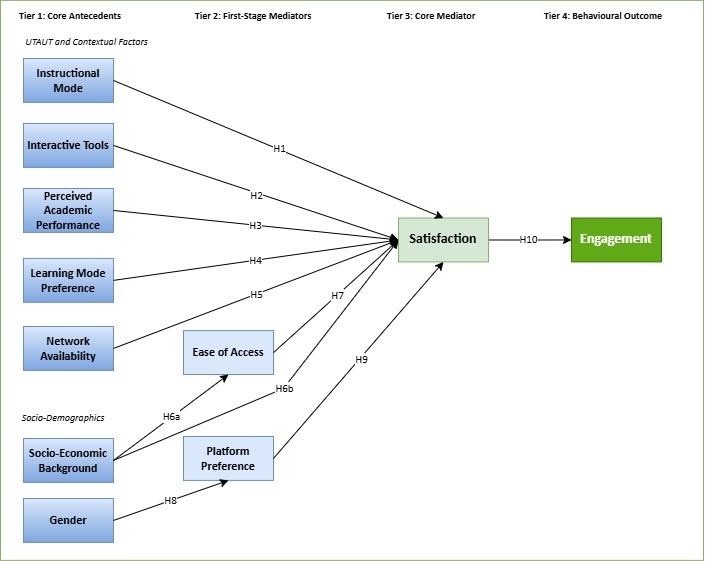
Furthermore, grounded in educational engagement theory (Haugseth, 2025), affective evaluation is operationalised as overall SAT, which serves as the central structural mediator driving downstream behavioural ENG with ICT4E. The proposed framework in Figure 1 was constructed following the UTAUT/UTAUT2 models and engagement theory.
Although ICT4E accelerates higher education innovation with optimal integration depending on facilitating conditions and platform usability (Scherer et al., 2015); nevertheless, technology deployment does not automatically guarantee active usage or satisfaction (Adarkwah, 2021; Pérez Echeverría et al., 2025). The literature highlights distinct contradictory outcomes: while flexible delivery fosters positive perceptions (Fearnley & Amora, 2020), digital fatigue, poor usability and unreliable connectivity simultaneously induce dissatisfaction (Mathrani et al., 2022; Mikhailov et al., 2024). Furthermore, high emergency platform usage often reflected institutional compliance rather than genuine voluntary engagement (Adarkwah, 2021; Haugseth, 2025).
Traditional technology acceptance models frequently overlook structural socio-economic divides (Adarkwah, 2021; Bond et al., 2018; Eze et al., 2018). In Bangladesh, national digital mandates encounter highly heterogeneous adoption patterns driven by a stark institutional divide between resource-constrained public and well-funded private universities (Karim et al., 2025; Lim et al., 2020; Sarker et al., 2019). To address these empirical gaps, this study operationalises satisfaction as the central affective mediator, connecting micro-level barriers to macro-level ICT4E engagement across this dual system (Islam & Akhtar, 2026; Scherer et al., 2015; Venkatesh et al., 2012).
Existing ICT4E literature reveals contradictory outcomes; for instance, while flexible delivery enhances positive perceptions, usability friction, digital fatigue and connectivity barriers frequently drive dissatisfaction, while top-down compliance does not necessarily translate into voluntary engagement. Standard technology acceptance models fail to account for structural public-private institutional disparities in developing contexts. This study addresses these theoretical gaps by developing a four-tier conceptual model across a dual-university sample. Operationalising satisfaction as a core mediator, it explicitly decouples compulsory compliance from active behavioural engagement while evaluating how institutional environments moderate socio-demographic digital divides.
Instructional Modes and Interactive Pedagogies: While digital environments offer spatial flexibility, student satisfaction (SAT) varies significantly based on instructional delivery and tool interactivity (Bond et al., 2018; Pérez Echeverría et al., 2025). The instructional mode (IM) requires distinct self-regulatory effort, compared to traditional face-to-face instruction and directly shapes user evaluations. Furthermore, incorporating a real-time interactive tool (INT) enhances effort expectancy by fostering dynamic participation, though effectiveness depends on instructional alignment (Cheon et al., 2012; Fayda‐Kinik & Cetin, 2025).
H1: IM significantly influences SAT relative to traditional in-person instruction.
H2: INT positively influences overall SAT.
Academic Performance and Learning Preferences: Performance expectancy serves as a core predictor of platform endorsement (Al-Fraihat et al., 2020; Venkatesh et al., 2012). Tools that demonstrably improve perceived academic performance (PAP) also elevate SAT (Bond et al., 2018; Sarker et al., 2019). This is heavily conditioned by students’ baseline learning habits, as pre-existing learning mode preference (LMP) shapes general user expectations and overall course delivery evaluation (Kirkwood & Price, 2014).
H3: PAP positively influences SAT with ICT4E.
H4: LMP significantly conditions overall SAT.
Infrastructure, Socio-Economic Barriers and Accessibility: Reliable infrastructure fundamentally facilitates technology acceptance (Eze et al., 2018; Venkatesh et al., 2003). In developing tertiary contexts, connectivity [e.g., network availability (NAV)] bottlenecks directly diminish SAT (Adarkwah, 2021; Santos et al., 2019). Furthermore, socio-economic background (SEB) dictates digital readiness and physical access equity, creating structural friction that limits both initial ease of access (EOA) and subsequent platform SAT in Bangladeshi HEIs (Bakytbekova et al., 2026; Islam & Akhtar, 2026). Consequently, seamless accessibility to resources acts as a key determinant of positive user SAT.
H5: NAV significantly affects SAT with online learning platforms.
H6: SEB significantly influences EOA (H6a) and overall SAT (H6b) with ICT4E.
H7: EOA to digital learning resources positively influences SAT.
Gender, Digital Orientation and Downstream Engagement: SEB also moderate user preferences and interaction dynamics (Venkatesh et al., 2003, 2012). Gender (GEN) influences digital confidence and collaborative platform selection, shaping an individual’s baseline platform preference (PP) (Scherer et al., 2015). A stronger underlying orientation toward digital tools subsequently increases platform SAT. Ultimately, this affective SAT acts as the primary behavioural driver, propelling downstream engagement (ENG) across ICT4E features (Dziuban et al., 2018; Haugseth, 2025; Looi, 2025).
H8: GEN significantly influences PP.
H9: PP positively influences overall SAT.
H10: SAT with ICT4E positively influences downstream behavioural ENG.
To enhance structural coherence and establish conceptual rigour, this study operationalises tertiary learning environments by positioning student SAT as an affective mediator bridging baseline expectancies and infrastructural conditions to downstream, feature-level ICT4E ENG. Furthermore, socio-demographic factors are integrated as direct structural antecedents driving resource accessibility and platform preferences.
This study employed a quantitative, survey-based, cross-sectional research design, supplemented with contextual qualitative feedback. Rather than in a formal dual-phase, mixed-methods study, primary data were collected through a unified, structured survey instrument containing standardised closed-ended Likert items alongside targeted open-ended questions. The quantitative data facilitate hypotheses testing and path estimation across an institutional framework while students’ qualitative feedback was used solely for narrative triangulation to contextualise observed adoption behaviours and structural barriers.
The target population comprised (an estimated total, N = 21,539) undergraduate students from the two participating universities, including approximately 15,959 from a private institution (Daffodil International University [DIU]) and 5,580 from a public institution (Begum Rokeya University, Rangpur [BRUR]). A purposive sampling technique was utilised to capture a comparative snapshot of Bangladesh’s dual tertiary system. To achieve sufficient statistical power, the survey was distributed and primary data were gathered from a total of 1,018 student respondents across both institutions. The final sample yielded 995 valid responses (97.74%). Table 2 summarises the demographic and academic distribution of the respondents. The sample reflects a male majority (66.23%) and was heavily concentrated in the Business Administration and Management Information Systems disciplines. Semester distributions reflect the specific course assignments of the surveyor during the data collection period, and captured dense clusters in the first and sixth semesters.
Table 2: Demographic Data
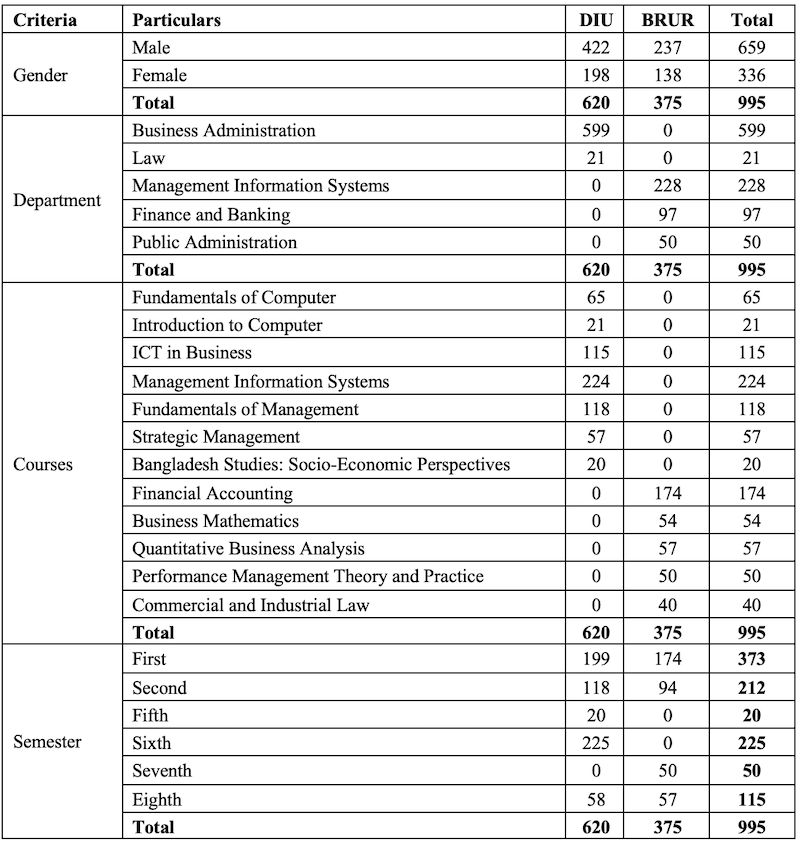
Note. N = 995 (DIU N = 620; BRUR N = 375). A value of 0 indicates that a specific course or department was either not offered within that institution’s academic programme or was outside the target sampling frame for data collection at that university.
Addressing prior methodological vulnerabilities, a structured survey instrument incorporating standardised Likert-scale items and contextual open-ended responses was strictly anchored to the UTAUT/UTAUT2 theoretical framework (Davis, 1989; Venkatesh et al., 2003, 2012). The survey instrument aligned directly with the study’s 4-tier conceptual framework. First, binary (Yes/No) items were used to evaluate student behavioural engagement (ENG) regarding online assignment submissions, blended learning centre (BLC)/Google Classroom (GCR) usage, and active participation in assessments and discussions (Tiers 4; H10). Second, 5-point ordinal scales (1 = Highly Dissatisfied to 5 = Highly Satisfied) measured comparative satisfaction (SAT) across IM, INT, LMP alongside instructor performance evaluations (Tiers 1 and 3; H1, H2, H4). Third, structured items captured core UTAUT antecedent as well as socio-demographic and access constructs, including PAP, NAV, SEB, GEN, EOA and PP (Tiers 1, 2 and 3; H3, H5, H6a, H6b, H7, H8, H9) to evaluate SAT. Finally, open-ended qualitative prompts gathered data on educational goals, career motivators and quality assurance recommendations to contextually triangulate the quantitative structural paths (RO4).
To mitigate common method bias and self-reporting discrepancies, the tool integrated system-generated usage indicators, such as students’ login frequencies and activities in the GCR and BLC as objective behavioural proxies for ICT4E ENG. Data were compiled, coded and analysed using Microsoft Excel under a validated methodological framework. To establish validity and reliability, content and face validity were formally established across two consecutive committee defences through rigorous evaluation and approval by the project supervisor and an appointed subject-matter expert to ensure clarity, construct alignment and contextual appropriateness. Prior to full deployment, pilot testing on a sample group (ç = 30) ensured prompt clarity, eliminated item ambiguity and verified response completeness. For the final analytical dataset (N = 995), quantitative categorical data — comprising binary participation indicators (Yes/No) and ordinal satisfaction ratings — were evaluated using descriptive cross-tabulations, percentage distributions and non-parametric Chi-Square (χ²) of independence to test structural sub-group differences, while qualitative open-ended feedback was systematically evaluated using thematic content analysis.
To evaluate the structural hypotheses, statistical techniques were applied across the four ROs as follows:
RO1 (H1, H2, H3, H4, H5, H7, H9): Descriptive cross-tabulations, percentage distributions, Pearson correlation (r), t-statistics and non-parametric χ² tests of independence were executed to evaluate structural relationships between ICT4E antecedents, access constructs and overall SAT.
RO2 (H6a, H6b, H8): Independent samples t-tests, One-Way ANOVA (F), and χ² tests along with correlation and t-tests evaluated demographic dynamics (gender, socio-economic background) and institutional (DIU vs. BRUR) subgroup variations in EOA, PP and SAT.
RO3 (H10): Independent samples t-tests and r assessed the structural association between overall SAT and downstream behavioural readiness for online ENG.
RO4: Inductive qualitative thematic content analysis of open-ended student responses was integrated with quantitative outputs to formulate evidence-based, equitable ICT4E policy frameworks.
Data collection was administered via Google Forms and distributed both on-campus and remotely through institutional e-learning platforms (GCR and BLC) to ensure broad, equitable access. Following collection, data (N = 995) were systematically cleaned and cross-verified for consistency using Microsoft Excel and statistical software.
Research ethics compliance was maintained in strict alignment with JL4D guidelines and international standards for social inquiry. Voluntary participation and informed consent were secured from all student respondents. To guarantee absolute confidentiality, personal identifiers were excluded and data were securely coded. As a low-risk, non-interventional survey involving consenting adults, the study was exempt from a formal institutional ethics review. Data were utilised exclusively for academic purposes and are reported in aggregate to ensure individual privacy.
Given the sample size (N = 995), non-parametric and parametric tests were executed in Microsoft Excel. To ensure methodological rigour, tests evaluate statistical associations and group differences rather than causal impact.
Independent samples t-tests and r analyses were conducted to evaluate bivariate associations and group mean differences across ICT antecedents, environmental variables and overall student SAT.
Instructional Mode (H1): In-person learners reported significantly higher SAT (M = 4.65) than online learners (M = 3.94), t-test p < .001). These findings support H1, indicating that the IM significantly influences SAT. The observed difference further suggests that face-to-face instruction is associated with higher levels of SAT than online learning mode.
Interactive Pedagogies (H2): Non-users reported higher SAT (M = 4.65) than active users (M = 4.11), showing a negligible negative correlation (r = -0.005, p < .001) between INT and SAT. Although the relationship was statistically significant, the effect size was trivial and contrary to the hypothesised positive direction. Therefore, H2 was not supported. This suggests that tool deployment without technical support creates friction and digital fatigue rather than positive user experience.
Perceived Academic Performance (H3): A significant positive correlation with SAT was found at DIU (r = 0.059, p < .001) and BRUR (r = 0.236, p < .001), supporting H3, particularly within the public university context (BRUR).
Learning Mode Preference (H4): Students preferring in-person learning reported higher SAT (M = 4.65) than those preferring online modes (M = 3.22), p < .001. These findings support H4, indicating that learning mode preference significantly influences student SAT. The observed difference suggests that alignment with LMP is associated with higher levels of SAT.
Network Availability (H5): Moderate-to-strong positive correlation with SAT (r = 0.672, p < .001) was identified between NAV and SAT, strongly supporting H5. This result indicates that connectivity is the primary infrastructure correlate of SAT.
Ease of Access (H7): Weak negative correlation between EOA and SAT (r = -.17, p = .034) was found. Thus, H7 was not supported – EOA alone did not elevate SAT.
Preference for Platform (H9): Weak positive correlation with SAT across platforms, involving BLC (r = 0.132), GCR (r = 0.107), and social media (r = 0.053), all p < .001 was found that supported H9, confirming that a baseline PP modestly improves overall SAT.
Socio-Economic Dynamics (H6): Independent samples t-tests, r, F, and χ² tests evaluated subgroup variations. Correlation showed no significant relationship between SEB and EOA (r = .079, p = .147). No significant SAT difference occurred between urban (M = 4.01) and rural (M = 3.92, p = .263) students or across father/mother’s occupation tiers (F = 0.54, p = .582). SEB does not significantly differentiate EOA or SAT. Thus, H6a and H6b were not supported.
Gender Variations (H8): GEN was significantly associated with PP at BRUR (χ² = 51.37, p < .001), but not at DIU (χ² = 0.75, p > .05). Therefore, H8 was partially supported, indicating that gendered digital divides are institution-specific.
Pearson correlation analysis measured the statistical association between overall SAT and ENG.
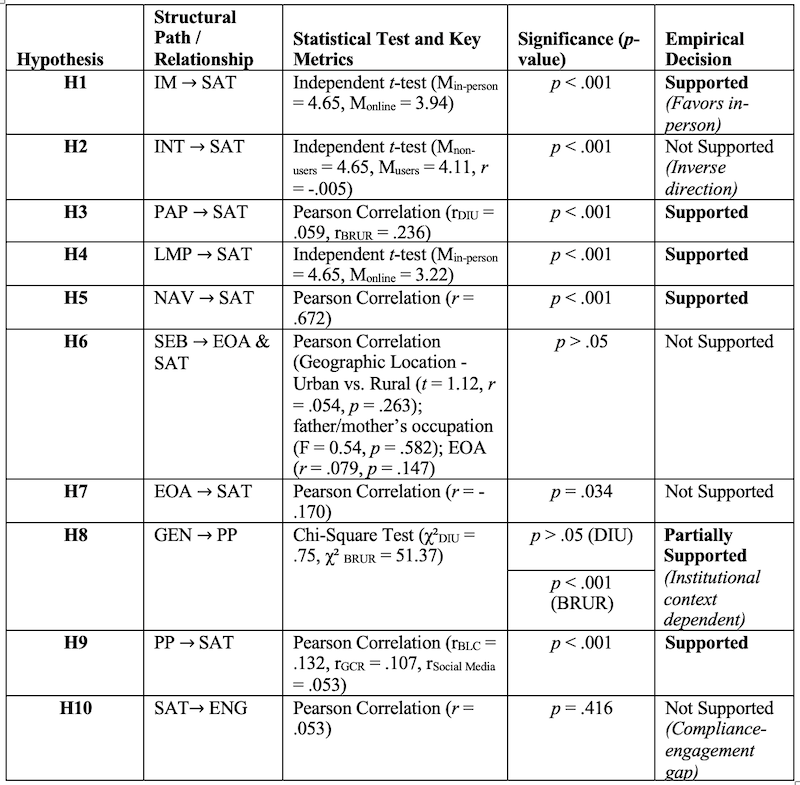
Satisfaction to Engagement Relationship (H10): Testing the path between affective SAT and behavioural ENG yielded a near-zero, non-significant correlation (r = .053, p = .416). Consequently, H10 was not supported, indicating that platform affective SAT does not predict active behavioural ENG. A snapshot of the results is shown in Table 3.
Table 3: Summary of Hypotheses Testing Outcomes
The open-ended responses contextualise the quantitative findings, revealing a highly pragmatic and utilitarian student body. Students at both institutions view ICT4E and business education primarily as vehicles for economic advancement, corporate employability and entrepreneurial capability. While they strongly agree that digital literacy is vital for modern business administration, ENG is heavily shaped by extrinsic career incentives and teacher guidance rather than intrinsic intellectual curiosity or broader philosophical academic goals.
Longitudinal observations of institutional ICT4E deployments (e.g., Moodle-based BLC, GCR, SmartEdu ERP) confirm that these platforms were instrumental in ensuring educational continuity during disruptions like the Covid-19 pandemic. However, the qualitative data clarifies the quantitative disconnect between usage, SAT and ENG: while students recognise the absolute necessity of digital innovation and demand better access to these facilities, their actual user experience remains heavily constrained by uneven academic readiness, connectivity bottlenecks and technical friction.
By synthesising the empirical findings (N = 995) with a conceptual 4-tier ICT4E engagement model, this study addresses key empirical inconsistencies in the literature and contextualises ICT4E adoption across the public-private tertiary divide in Bangladesh. To provide a clear, concise collation for multidisciplinary scholars, the empirical outcomes are organised into five principal takeaways.
Pedagogical Friction and Unhabitual Exposure (H1, H2, H4)
Traditional preferences for face-to-face instruction are progressively evolving. Thus, students exhibited a strong preference for traditional, teacher-centric in-person IM (H1, H4) where both IM and LMP influences SAT (p < .001). Challenging conventional educational technology literature asserts that interactive features are inherently associated with higher student SAT (Cheon et al., 2012; Sung et al., 2016), this study reveals that non-users of INT reported higher SAT than active users (H2, r = -.005, p < .001). Consequently, deploying unhabitual INT without sufficient pedagogical scaffolding is associated with cognitive overload, digital fatigue and pedagogical friction (Adarkwah, 2021; Pérez Echeverría et al., 2025). For unhabituated cohorts, tool complexity correlates with diminished rather than enhanced user experience (Kirkwood & Price, 2014).
Infrastructural Primacy vs. Merit-Based Equalisation (H5, H6)
NAV emerged as the foundational prerequisite for technology acceptance in developing contexts (H5, r = 0.672), superseding higher-order motivational constructs (Al-Fraihat et al., 2020). Conversely, SEB showed no statistically significant relationship with platform SAT (H6, p < .299), challenging classical digital divide frameworks (Assefa et al., 2024). Because university admissions operate on academic merit, standardised institutional delivery, uniform residential accommodations and expanding 4G mobile coverage appear to mitigate home-district infrastructural disparities once students are enrolled (Feng et al., 2025).
Baseline Expectations and the GenAI Horizon (H7)
EOA to resources demonstrated a weak negative relationship with platform SAT (H7, r = -.170). Basic access functions merely as a baseline expectation; effortless retrieval raises students’ performance expectations, resulting in lower SAT when advanced platform functions (e.g., streaming bandwidth) exhibit technical disruptions. Emerging large language model (LLM)-based Generative AI (GenAI) tools offer personalised, conversational scaffolding that bridges basic digital access with active cognitive ENG, accelerating student adaptation to blended learning environments (Bakytbekova et al., 2026; Marshall et al., 2024).
Institutional Moderation of Gender Divides (H6, H8)
Institutional SEB contexts neither correlate with EOA nor SAT, however, it partially moderated gendered patterns in ICT4E adoption (Islam & Akhtar, 2026). At the private university (DIU), more uniform access to high-specification devices and private connectivity, neutralised gender-based preference gaps (H8, p > .05). In contrast, the resource-constrained public university cohort (BRUR) exhibited statistically significant gendered variations in PP (p < .001) (Uleanya & Prinsloo, 2025), reflecting how broader socio-technical inequalities persist in under-resourced institutional settings.
While PAP (H3) and baseline PP (H9) showed modest positive correlations with SAT (e.g., r = .236, .132), overall affective SAT exhibited a near zero, non-significant correlation with downstream behavioural ENG (H10, r = 0.053). This empirically establishes the Compliance-Engagement Gap: in mandatory tertiary education settings, platform usage reflects compulsory institutional compliance rather than voluntary ENG (Fayda‐Kinik & Cetin, 2025; Looi, 2025). Compounded by inadequate digital onboarding and skills gaps, students interact with a learning management system (LMS), primarily out of academic requirement, decoupling affective platform evaluation from active pedagogical participation.
Infrastructural Resilience over Feature Proliferation (H2, H5): Institutional leadership and academic policymakers must prioritise high-speed, stable network access and low-bandwidth LMS optimisation (e.g., offline caching, asynchronous media compression) over data-intensive interactive features. Ensuring baseline connectivity minimises operational friction for unhabituated learners far more effectively than by expanding platform feature density (Mielikäinen, 2021).
Integrating GenAI for Scaffolding (H7): Institutions should formally integrate conversational LLM-based AI assistants into LMS frameworks to provide real-time, adaptive instructional support. This scaffolding can assist students accustomed to traditional classroom formats in transitioning more smoothly toward self-directed e-learning environments (Marshall et al., 2024).
Public Sector Targeted Equity Interventions (H8): To mitigate GEN and SEB disparities in public universities, policymakers should deploy targeted digital equity initiatives — such as subsidised campus devices and universal high-speed Wi-Fi — mirroring the institutional digital standardisation observed in private settings (Shohel et al., 2025), such as DIU’s “One Student One Laptop” programme.
Decoupling Compliance Metrics from Educational Quality (H10): Tertiary education administrators should acknowledge that LMS activity logs (e.g., clicks, logins, page views, downloads) primarily captures compulsory compliance rather than authentic behavioural ENG. Quality assurance frameworks should pivot from simple platform logging toward evaluating critical thinking, collaborative problem solving and tangible learning outcomes (Fernández-Gutiérrez et al., 2020).
To resolve the Compliance-Engagement Gap (H10), and mitigate pedagogical friction (H2), policy interventions should address specific institutional realities rather than issuing generalised mandates.
Resource-Constrained Public HEIs (e.g., BRUR Context)
Infrastructure and Funding Mechanisms: Secure dedicated grants from UGC and external development funding paired with transparent administrative oversight to deploy low-bandwidth, open-source LMS platforms (e.g., Moodle or Canvas) integrated with institutional ERP systems.
Zero-Rated Mobile Data Access: Negotiate national telecommunication partnerships to zero-rate mobile data access for primary LMS domains, directly overcoming student bandwidth constraints (H5).
Targeted Digital Onboarding: Institute first-year digital literacy bootcamps specifically designed to scaffold female and rural cohorts, directly mitigating pre-existing self-efficacy gaps and public-sector gender disparities (H8).
Well-Resourced Private HEIs (e.g., DIU Context)
Rationalised Digital Ecosystems: Eliminate redundant software acquisitions and platform feature bloat, prioritising core platform stability and functional academic utility over feature density (H2, H7).
Pedagogical Faculty Training: Redirect capital toward structured faculty training that emphasises the purposeful integration of interactive tools, minimising student cognitive overload and digital fatigue (H2).
Redesigning LMS Engagement Architecture: Shift LMS design away from passive compliance tracking (click-stream logs) toward active learning frameworks featuring automated formative feedback, gamified modules and structured peer collaboration (H10).
Cross-Institutional and Scalable Policy Actions
Dynamic UX Auditing: Establish quarterly student user-experience (UX) evaluations to continuously adapt platform bandwidth requirements to regional infrastructure constraints.
Scalable Blended Frameworks: Formulate national UGC policy guidelines for blended learning that preserve essential face-to-face instruction while scaling digital support and honouring student baseline preferences for in-person learning (H1, H4).
This study acknowledges four methodological limitations. First, while capturing distinct public and private operational environments, data collection was restricted to two educational institutions (BRUR and DIU) which limited direct cross-national generalisability (Santos et al., 2019). Second, the empirical pipeline relied primarily on self-reported student evaluations rather than direct, automated LMS clickstream telemetry (Kirkwood & Price, 2014). Third, the cross-sectional design evaluated technology acceptance at a single operational window, preventing the measurement of longitudinal adaptation as digital learning ecosystems mature (Almaiah et al., 2020). Finally, while broad socio-economic proxies were evaluated (H6), highly granular economic metrics (e.g., exact household income or personal bandwidth expenditure) were unrecorded, constraining deeper socio-demographic stratification.
To address these boundaries, future research should pursue four empirical trajectories. First, researchers should employ a longitudinal design to model how the rapid adoption of GenAI tools alters students’ habits, reduces technical friction (H2, H7) and reshapes platform SAT over time (Bakytbekova et al., 2026; Marshall et al., 2024). Second, future studies should utilise qualitative observational methods, student interviews and GenAI usage logs to pinpoint exact operational mechanisms causing pedagogical friction during interactive tool deployment (Adarkwah, 2021). Third, investigations into disciplinary variations are needed to determine whether ICT4E effectiveness and engagement dynamics differ across academic fields (e.g., STEM versus the humanities). Finally, expanding research to a comparative, cross-institutional or cross-national scale across South Asian and Sub-Saharan developing contexts would validate whether the Compliance-Engagement Gap (H10) and merit-based socio-economic equalisation (H6) hold universally across differing institutional and regulatory landscapes (Assefa et al., 2024; Uleanya & Prinsloo, 2025).
Acknowledgments: This research was funded by the UGC of Bangladesh and administered by BRUR (Budget #3631108, grant#2014-0862/001-001). The author acknowledges the research support by the City University of Hong Kong (CityUHK) including access to digital resources and software tools. The author further acknowledges the use of GenAI tools: Gemini Pro, Microsoft Copilot and OpenAI’s ChatGPT solely for language refinement, structural formatting and text conciseness during manuscript preparation and revision. All conceptualisation, research design, data collection, statistical analyses, interpretation of findings and conclusions were independently conducted and verified by the author.
The author gratefully acknowledges the supervisory guidance and support of Dr David Jingjun Xu, Professor in the Department of Information Systems, CityUHK and Dr Md Rakibul Hoque, Professor in the Department of Management Information Systems, University of Dhaka. The author also extends sincere thanks to Professor Mohammad Rafiul Azam Khan, Department of Management Studies, BRUR. Their valuable feedback and insights contributed to the further development of this paper. Additionally, the author is grateful to the anonymous reviewers, Professor Dr Santosh Panda (Chief Editor), Dr Tony John Mays (Associate Editor) and Alan Doree (Copyeditor) of JL4D for their constructive comments and editorial support.
Adarkwah, M.A. (2021). “I’m not against online teaching, but what about us?”: ICT in Ghana post Covid-19. Education and Information Technologies, 26, 1665-1685. https://doi.org/10.1007/s10639-020-10331-z
Al-Fraihat, D., Joy, M., Masa’deh, R., & Sinclair, J. (2020). Evaluating e-learning systems success: An empirical study. Computers in Human Behavior, 102, 67-86. https://doi.org/10.1016/j.chb.2019.08.004
Almaiah, M.A., Al-Khasawneh, A., & Althunibat, A. (2020). Exploring the critical challenges and factors influencing the e-learning system usage during COVID-19 pandemic. Education and Information Technologies, 25, 5261-5280. https://doi.org/10.1007/s10639-020-10219-y
Assefa, Y., Gebremeskel, M.M., Moges, B.T., Tilwani, S.A., & Azmera, Y.A. (2024). Rethinking the digital divide and associated educational in(equity) in higher education in the context of developing countries: The social justice perspective. International Journal of Information and Learning Technology, 42(1), 15-32. https://doi.org/10.1108/ijilt-03-2024-0058
Bakytbekova, Z., Rice, M.F., Esgin, E., Kamalova, G., & Shekerbekova, S. (2026). Navigating the digital divide: An in-depth exploration of ICT devices, knowledge, belief, usage, and attitude in educational settings. Contemporary Educational Technology, 18(2), ep654. https://doi.org/10.30935/cedtech/18530
Bond, M., Marín, V.I., Dolch, C., Bedenlier, S., & Zawacki-Richter, O. (2018). Digital transformation in German higher education: Student and teacher perceptions and usage of digital media. International Journal of Educational Technology in Higher Education, 15, 48. https://doi.org/10.1186/s41239-018-0130-1
Cheon, J., Lee, S., Crooks, S.M., & Song, J. (2012). An investigation of mobile learning readiness in higher education based on the theory of planned behavior. Computers & Education, 59(3), 1054-1064. https://doi.org/10.1016/j.compedu.2012.04.015
Davis, F.D. (1989). Perceived usefulness, perceived ease of use, and user acceptance of information technology. MIS Quarterly, 13(3), 319-340. https://doi.org/10.2307/249008
Dziuban, C., Graham, C.R., Moskal, P.D., Norberg, A., & Sicilia, N. (2018). Blended learning: The new normal and emerging technologies. International Journal of Educational Technology in Higher Education, 15, 3. https://doi.org/10.1186/s41239-017-0087-5
Eze, S.C., Chinedu-Eze, V.C., & Bello, A.O. (2018). The utilisation of e-learning facilities in the educational delivery system of Nigeria: A study of M-university. International Journal of Educational Technology in Higher Education, 15, 34. https://doi.org/10.1186/s41239-018-0116-z
Fayda‐Kinik, F.S., & Cetin, M. (2025). ICT and academic achievement in secondary education: A hierarchical linear modelling. Journal of Computer Assisted Learning, 41(1), e13070. https://doi.org/10.1111/jcal.13070
Fearnley, M.R., & Amora, J.T. (2020). Learning management system adoption in higher education using the extended technology acceptance model. IAFOR Journal of Education: Technology in Education, 8(2), 89–106. https://doi.org/10.22492/ije.8.2.05
Feng, J., Yu, B., Tan, W.H., Dai, Z., & Li, Z. (2025). Key factors influencing educational technology adoption in higher education: A systematic review. PLOS Digital Health, 4(4), e0000764. https://doi.org/10.1371/journal.pdig.0000764
Fernández-Gutiérrez, M., Gimenez, G., & Calero, J. (2020). Is the use of ICT in education leading to higher student outcomes? Analysis from the Spanish autonomous communities. Computers & Education, 157, 103969. https://doi.org/10.1016/j.compedu.2020.103969
Haugseth, J.F. (2025). Educational engagement: On the entangled possibilities of investments in education. Educational Theory, 75(3), 531-557. https://doi.org/10.1111/edth.70003
Islam, M.S., & Akhtar, T. (2026). Determinants of social inclusion in South Asia: The role of education, ICT, economic growth, trade, and gender equality. Sustainable Development, 34(6), 8235-8254. https://doi.org/10.1002/sd.70763
Karim, S.M.S., Parvin, S., Ahmed, C.B.U., & Hossain, M.T. (2025). Teachers’ and students’ perceptions of online education in Bangladesh: Challenges and solutions. Discover Education, 4, 234. https://doi.org/10.1007/s44217-025-00653-w
Kirkwood, A., & Price, L. (2014). Technology-enhanced learning and teaching in higher education: What is ‘enhanced’ and how do we know? A critical literature review. Learning, Media and Technology, 39(1), 6–36. https://doi.org/10.1080/17439884.2013.770404
Lim, C.P., Ra, S., Chin, B., & Wang, T. (2020). Leveraging information and communication technologies (ICT) to enhance education equity, quality, and efficiency: Case studies of Bangladesh and Nepal. Educational Media International, 57(2), 87-111. https://doi.org/10.1080/09523987.2020.1786774
Looi, K.H. (2025). Transition from emergency ICT-enabled education to blended education for future emergency preparedness and sustainability: A cross-sectional survey in Malaysia. International Journal of Information and Learning Technology, 42(2), 129-146. https://doi.org/10.1108/ijilt-04-2024-0074
Marshall, S., Blaj-Ward, L., Dreamson, N., Nyanjom, J., & Bertuol, M.T. (2024). The reshaping of higher education: Technological impacts, pedagogical change, and future projections. Higher Education Research & Development, 43(3), 521-541. https://doi.org/10.1080/07294360.2024.2329393
Mathrani, A., Sarvesh, T., & Umer, R. (2022). Digital divide framework: Online learning in developing countries during the COVID-19 lockdown. Globalisation, Societies and Education, 20(5), 625-640. https://doi.org/10.1080/14767724.2021.1981253
Mielikäinen, M. (2021). Towards blended learning: Stakeholders’ perspectives on a project-based integrated curriculum in ICT engineering education. Industry and Higher Education, 36(1), 74-85. https://doi.org/10.1177/0950422221994471
Mikhailov, A., Tikhonov, A., & Fedulov, V. (2024). Digital inequality in education: Features of manifestation and types of discrimination during COVID-19 pandemic. Education and Information Technologies, 29, 20493-20504. https://doi.org/10.1007/s10639-024-12640-z
Pérez Echeverría, M., Cabellos, B., & Pozo, J-I. (2025). The use of ICT in classrooms: The effect of the pandemic. Education and Information Technologies, 30, 14069-14093. https://doi.org/10.1007/s10639-024-13124-w
Santos, H., Batista, J., & Marques, R.P. (2019). Digital transformation in higher education: The use of communication technologies by students. Procedia Computer Science, 164, 123-130. https://doi.org/10.1016/j.procs.2019.12.163
Sarker, M.F.H., Al Mahmud, R., Islam, M.S., & Islam, M.K. (2019). Use of e-learning at higher educational institutions in Bangladesh: Opportunities and challenges. Journal of Applied Research in Higher Education, 11(2), 210-223. https://doi.org/10.1108/JARHE-06-2018-0099
Scherer, R., Siddiq, F., & Teo, T. (2015). Becoming more specific: Measuring and modeling teachers’ perceived usefulness of ICT in the context of teaching and learning. Computers & Education, 88, 202-214. https://doi.org/10.1016/j.compedu.2015.05.005
Shohel, M.M.C., Roy, G., Ashrafuzzaman, M., & Urmee, M.A. (2025). Digitalisation and transformation in higher education in Bangladesh during the COVID-19 pandemic: Implications for policy and leadership. Cogent Education, 12(1), 2514933. https://doi.org/10.1080/2331186x.2025.2514933
Sung, Y-T., Chang, K-E., & Liu, T-C. (2016). The effects of integrating mobile devices with teaching and learning on students’ learning performance: A meta-analysis and research synthesis. Computers & Education, 94, 252-275. https://doi.org/10.1016/j.compedu.2015.11.008
Uleanya, C., & Prinsloo, P. (2025). Mapping the imaginary of information communication technologies (ICTs) in education: The case of Botswana. Learning, Media and Technology, 50(4), 541-559. https://doi.org/10.1080/17439884.2024.2306553
Venkatesh, V., Morris, M.G., Davis, G.B., & Davis, F.D. (2003). User acceptance of information technology: Toward a unified view. MIS Quarterly, 27(3), 425-478. https://doi.org/10.2307/30036540
Venkatesh, V., Thong, J.Y.L., & Xu, X. (2012). Consumer acceptance and use of information technology: Extending the unified theory of acceptance and use of technology. MIS Quarterly, 36(1), 157-178. https://doi.org/10.2307/41410412
Author Notes
Samsul Alam is a PhD Research Fellow in the Department of Information Systems (IS) at City University of Hong Kong and a recipient of the Hong Kong PhD Fellowship Scheme (HKPFS) and Erasmus Scholarships. He is also an Assistant Professor at Begum Rokeya University, Rangpur, Bangladesh where he teaches and conducts research in Management Information Systems (MIS). He earned an MPhil-equivalent MSc degree from the University of Extremadura, Spain through a fully funded scholarship and an MBA in MIS from the University of Dhaka where he graduated with the Dean’s Honor List Award. His research has been published in peer-reviewed, indexed journals, book chapters and conference proceedings. His research interests include artificial intelligence, healthcare systems, digital education, e-commerce, financial technology and the social-ethical-Shariah implications of business and IS. Email: salam5-c@my.cityu.edu.hk (https://orcid.org/0000-0002-1721-1870)
Cite as: Alam, S. (2026). Effectiveness of ICT adoption on student satisfaction and engagement: Empirical evidence from tertiary education in Bangladesh. Journal of Learning for Development, 13(4), 733-748.
DOI: https://doi.org/10.56059/ra6e4n96