Syed Naeem Ahmed and Saeed Saleh Alkahtani
2026 VOL. 13, No. 4
Abstract: Parental engagement is consistently linked to language achievement, yet little is known about how digitally mediated engagement operates in non-Western, multicultural school systems. This study examined the relationship between digital parent-teacher engagement and the English speaking and writing proficiency of high-school students in Saudi international schools, and its regional patterning. A convergent mixed-methods design was applied with 500 students and 250 parents across the central, eastern, western and southern regions, with 16 teacher interviews and 12 parent-student focus groups, over six months. Paired-samples t-tests showed significant gains in speaking, 62.00 to 75.64 (22%; t(499) = 30.50, p < .001, dz = 1.36), and writing, 60.00 to 72.00 (20%; t(499) = 25.55, p < .001, dz = 1.14), averaging 21%. Regional gains ranged descriptively from 24% (central) to 16% (southern) and tracked reported communication frequency. Thematic analysis identified parental digital literacy, access, school training and cultural expectations as explanatory factors.
Keywords: engagement, language acquisition, English language proficiency, educational technology, multicultural context
Saudi Arabia has invested substantially in educational technology under Vision 2030, yet English proficiency remains a national concern. EF Education First (2025) placed Saudi Arabia 115th among 123 countries and regions, with a score of 404, in the “very low proficiency” band; because the index draws on self-selected adult test-takers it is only an indicative national signal, but it is consistent with continuing difficulty in the productive skills. Speaking and writing depend on reinforcement beyond the classroom that schools alone cannot supply (Heidlage et al., 2020), and parental contact with schools is now conducted largely through platforms such as WhatsApp, Classera and Google Classroom. The problem is that this shift presumes a level of parental digital literacy and access that is not equally distributed: Alfalah et al. (2025) highlight continuing geographic and demographic inequalities in Saudi digital inclusion and argue that access alone does not guarantee meaningful participation. Saudi research has also shown that parental participation in technology-supported K–12 education can be affected by technostress and families’ ability to manage digital-learning demands (Al-Abdullatif & Aladsani, 2022).
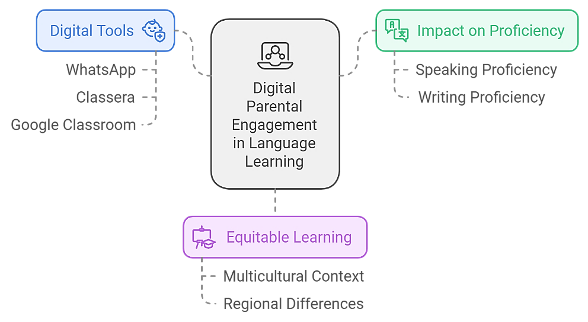
The study treats digital parental engagement, operationalised as the frequency and forms of parents’ use of school-sanctioned digital platforms, as the independent variable, and students’ English speaking and writing proficiency as the dependent variable. Region, parental digital literacy, access to technology and cultural norms regarding parental involvement function as contextual factors that may shape the relationship. The conceptual framework, shown in Figure 1, combines two positions: i) Epstein’s (2018) model of overlapping spheres of influence, in which attainment improves when home and school operate as one partnership rather than as separate domains; and ii) the digital-inclusion perspective (Owens et al., 2023; Qualter, 2024), in which access, skills and confidence, rather than devices alone, determine whether technology narrows or widens participation gaps. The framework therefore proposes that digital tools translate into language gains only where the conditions for meaningful parental participation are present, and reproduce existing inequities where they are absent.
The association between parental involvement and student achievement is well established (Đurišić & Bunijevac, 2017; Grolnick & Pomerantz, 2022; Schmid & Garrels, 2021; Utami, 2022). However, parents’ participation may be constrained by limited time, insufficient understanding of school expectations and weak communication between families and schools (Motshusi et al., 2024). In language learning, parental engagement can extend students’ exposure to English through encouragement, practice and reinforcement outside the classroom (Heidlage et al., 2020; Murshidi et al., 2023; Wahyuni & Bee Tin, 2024). Liang et al.’s (2025) systematic review of 67 empirical studies published between 2000 and 2025 confirms the importance of parental involvement in children’s English learning, but also shows that involvement is shaped by context and takes different forms across studies. These forms include communication with schools (Kausar et al., 2022), homework support (Geduld, 2024; Xu, 2023) and encouragement of English use at home (Apdillah et al., 2022; Fuh Suh, 2022). Evidence from the Gulf is also emerging. For example, Shebani et al. (2025) found that parental involvement supported adolescents’ academic passion in online English learning through student motivation. Nevertheless, much of this literature examines parental involvement generally without distinguishing the communication medium through which parents and schools interact.
Digital tools have expanded the ways in which parents can support and monitor their children’s learning, although different digital-parenting strategies do not necessarily produce the same level of engagement (Banić & Orehovački, 2024). Digital communication therefore does not automatically produce meaningful parental engagement. More broadly, schools’ capacity, organisational support and digital readiness influence whether educational technologies can be used meaningfully (Timotheou et al., 2022). Bordalba and Bochaca (2019) found that digital platforms often reproduced one-way communication in which schools provided information without creating genuine parent-school interaction. Jeynes’s (2025) meta-analysis of 31 studies involving more than 20,000 students found no statistically significant overall association between increased technology-mediated parental communication and achievement beyond the elementary level. Lee et al. (2026) similarly found that parents valued the immediacy and convenience of digital communication but remained concerned about overcommunication, access, cultural barriers and uncertainty about how they were expected to participate. Badiuzzaman et al. (2025) locate these concerns within a multilevel digital divide involving household access, digital capability and schools’ capacity to support families. These barriers may be especially important in multicultural schools, where language, cultural expectations and different understandings of the parental role can further shape participation (Hagage Baikovich & Yemini, 2023).
Three research gaps therefore remain. First, the evidence is concentrated largely in Western and elementary-school contexts, while digital parental engagement in Saudi secondary-level English education remains under-researched. This is important because recent Saudi research continues to identify a need to integrate digital competence more systematically into English as a Foreign Language (EFL) education (Alshehri et al., 2026). Second, previous studies rarely compare engagement and proficiency patterns across regions within the same country. Consequently, the effects of differences in digital access, confidence, school support and cultural expectations remain insufficiently understood. Third, relatively few studies combine measured changes in English proficiency with qualitative evidence explaining why parental engagement varies. The present study addresses these gaps by examining speaking and writing changes among high-school students in four Saudi regions and uses evidence from parents, students and teachers to interpret the regional patterns.
The study pursues three research objectives (ROs), each with a corresponding research question (RQ). Inferential output is available for the change in proficiency between the baseline and post-study assessments, and a hypothesis is therefore stated for RO1; RO2 and RO3 are pursued as descriptive and exploratory objectives:
RO1: To examine changes in students’ English speaking and writing proficiency between the baseline and post-study assessments.
RQ1: How did students’ English speaking and writing proficiency scores change between the baseline and post-study assessments?
H1: Students’ speaking and writing proficiency scores will be significantly higher at the post-study assessment than at the baseline assessment.
RO2: To examine regional variation in digital parental engagement and students’ proficiency-score changes across the central, eastern, western and southern regions of Saudi Arabia.
RQ2: How did patterns of digital parental engagement and proficiency-score changes vary across the four sampled regions?
RO3: To identify the factors that enabled or constrained digital parental engagement in multicultural educational settings.
RQ3: What factors enabled or constrained parents’ digital engagement with their children’s schooling?
This study employed a convergent mixed-methods design. Quantitative and qualitative data were collected within the same six-month study period and integrated during interpretation. The quantitative strand examined changes in speaking and writing scores and described regional engagement patterns, while the qualitative strand explored the conditions that may have shaped those patterns. The design follows from the objectives: RO1 and RO2 require the measurement of change and comparison between groups, whereas RO3 requires an account of the conditions producing that pattern. The quantitative strand therefore addresses RO1 and RO2, the qualitative strand addresses RO3, and the qualitative findings are used to explain the regional differences identified under RO2.
Sampling was purposive and criterion-based and occurred in two stages. First, eight international schools were selected across the central, eastern, western and southern regions of Saudi Arabia. Schools were eligible if they enrolled students in Grades 10 to 12, used WhatsApp, Classera or Google Classroom as an established channel for parent-teacher communication, and agreed to participate throughout the six-month study period. Second, participants were recruited within the selected schools. The student sample comprised 500 students, including 150 from the central region, 125 from the eastern region, 125 from the western region and 100 from the southern region. Parents or guardians were recruited through the participating schools from the households of these students. To participate, parents were required to use at least one of the selected digital platforms and complete the parental-engagement survey at the beginning and end of the study. This produced a sample of 250 parents. Because some parents had more than one participating child, parent and student records were treated as complementary regional groups rather than individually matched records.
For the qualitative strand, the participating schools identified 16 teachers whose responsibilities included English teaching and communication with parents. Twelve parent-student, focus-group sessions were also conducted, with three sessions in each region. Focus-group participants were selected purposively to include families reporting different levels of digital confidence and engagement. The sampling strategy supported comparison within the study context but did not produce a statistically representative sample of all Saudi schools, students or parents.
Four instruments were used and aligned with the research questions:
Formal internal-consistency coefficients for the survey and inter-rater reliability coefficients for the speaking and writing assessments were not calculated during the original study and could not be reconstructed. This limitation is acknowledged when interpreting the findings. The assessments should therefore be described as school-based assessments rather than externally standardised instruments.
Permission to conduct the study was obtained from the administrations of the participating schools. Participants were informed about the purpose of the research, their voluntary participation, confidentiality and right to withdraw. Parents provided consent for their own participation, parental consent and student assent were obtained for students, and teachers consented before the interviews. Participant records were coded, identifying information was removed and electronic files were password protected.
Data collection proceeded in five stages. First, during Week 1, the speaking and writing assessments were administered to the 500 students to establish baseline proficiency scores for RQ1 and RQ2. Second, the parental-engagement survey was administered to the 250 parents to establish baseline patterns of digital engagement for RQ2 and RQ3. Third, from Weeks 2 to 23, the participating schools continued communicating with parents through WhatsApp, Classera and Google Classroom by providing progress updates, assignment feedback and guidance on supporting English learning at home. Fourth, during the closing weeks of the study, 16 teacher interviews and 12 parent-student, focus-group sessions were conducted for RQ3. The sessions were audio-recorded with permission and transcribed. Fifth, during Week 24, the speaking and writing assessments and parental-engagement survey were administered again.
For RQ1, paired-samples t-tests compared baseline and post-study speaking and writing scores. Mean changes, percentage changes, 95% confidence intervals and Cohen’s dz effect sizes were reported.
For RQ2, regional percentage changes and parent-reported communication frequencies were compared descriptively. The study focuses on two principal constructs: digital parental engagement, defined as the frequency and forms of parents’ use of school-sanctioned digital platforms, and students’ English speaking and writing proficiency. Region, parental digital literacy, access to technology, and cultural expectations were treated as contextual factors that could help explain differences in engagement patterns and proficiency-score changes.
For RQ3, interview and focus-group transcripts were analysed using the general thematic-analysis procedures described by Braun and Clarke (2006). The research team read the transcripts, coded relevant passages, grouped related codes, reviewed and named the resulting themes, and compared them across participant groups and regions. Quantitative and qualitative findings were brought together during interpretation, with the qualitative themes used to explain possible reasons for the regional patterns.
RO1 was addressed using the baseline study and post-study speaking and writing scores of all 500 students, analysed by paired-samples t-tests. Percentage change was calculated as: ([post-study mean minus baseline mean] divided by baseline mean) multiplied by 100, and Cohen’s dz was reported as the standardised effect size for paired observations (Table 1).
Speaking scores rose from a baseline mean of 62.00 (SD = 9.00) to a post-study mean of 75.64 (SD = 8.50), an increase of 13.64 points or 22%, which was statistically significant, t(499) = 30.50, p < .001, 95% CI [12.76, 14.52], Cohen’s dz = 1.36. Writing scores rose from 60.00 (SD = 8.50) to 72.00 (SD = 8.20), an increase of 12.00 points or 20%, also statistically significant, t(499) = 25.55, p < .001, 95% CI [11.08, 12.92], dz = 1.14. H1 was therefore supported for both productive skills, with large effect sizes. The average change across the two skills was 21%, the mean of the 22% speaking and 20% writing increases; this combined figure summarises the overall pattern, while the separate results show how each skill changed. Table 1 displays the speaking and writing results separately.
Table 1: Changes in Students’ Speaking and Writing Proficiency

Note. Percentage change was calculated as ([post-study mean minus baseline mean] divided by baseline mean) multiplied by 100. Cohen’s dz is the standardised effect size for paired observations. Both increases were significant at p < .001.
For the general reader, these results indicate that students’ average scores in both productive skills were higher at the end of the six-month period. The mean increase was slightly larger for speaking than for writing. However, because the study did not include a comparison group, the analysis demonstrates change over time but cannot determine how much of that change resulted from digital parental engagement rather than classroom instruction or other influences.
RO2 was addressed by comparing percentage change in proficiency and parent-reported communication frequency across the four regional sub-samples. Improvement was recorded in every region, although its magnitude differed. The central region recorded the largest average increase at 24%, followed by the eastern region at 20%, the western region at 19%, and the southern region at 16%. Parent-reported communication followed the same general order: parents in the central and eastern regions reported approximately five to six digital contacts with the school in a typical week, whereas parents in the western and southern regions reported approximately one to two. Thus, regions reporting more frequent digital parent-school communication also recorded larger average proficiency gains. This comparison is descriptive because no inferential test of the regional differences was available; it should not be interpreted as evidence that communication frequency caused the regional differences.
RO3 was addressed using the 16 teacher interviews and 12 parent-student, focus-group sessions. Thematic analysis identified four recurring themes: parental digital literacy and confidence, access and connectivity, cultural expectations, and school support. The first theme concerned parental digital literacy and confidence. Participants described differences in parents’ ability to use progress-tracking and feedback functions, with some preferring face-to-face contact when they were uncertain about the technology. The second theme concerned access and connectivity, particularly where unreliable internet access interrupted communication. The third concerned cultural expectations about the responsibilities of schools and families and the appropriateness or frequency of parent-teacher contact. The fourth concerned school support, including parent training and regular teacher feedback. Together, these themes suggest that digital engagement depended not only on platform availability but also on whether parents had the confidence, access, guidance and culturally acceptable opportunities needed to participate.
The results address the three research questions. For RQ1, students’ mean speaking and writing scores were higher at the post-study assessment than at the baseline assessment, with speaking increasing by 22% and writing by 20%. These results demonstrate changes over the six-month period but do not independently establish that digital parental engagement caused them.
For RQ2, average proficiency-score changes varied descriptively across the four sampled regions, from 24% in the central region to 16% in the southern region. The regions reporting more frequent parent-school communication also recorded larger average gains. Because no inferential regional analysis was available, this should be interpreted as a regional pattern rather than a statistically established difference or causal effect.
For RQ3, participants identified parental digital literacy, access and connectivity, cultural expectations, school-provided training and regular teacher feedback as factors shaping engagement. Integrating the quantitative and qualitative findings suggests that platform availability alone was insufficient. Parents were more able to participate when they also received guidance, meaningful feedback and communication opportunities suited to their circumstances.
The first research gap concerned the concentration of previous evidence in Western and elementary-school settings. This study extends the discussion to high-school students in Saudi international schools, where parents and students come from different cultural and linguistic backgrounds. The increase observed in speaking and writing scores provides evidence of change during a period in which digital parent-school communication was actively used. However, the findings should not be interpreted as contradicting Jeynes’s (2025) conclusion that increased technology-mediated communication does not necessarily improve achievement beyond the elementary level. The present study suggests a possible explanation for that conclusion: the frequency of contact may be less important than whether the communication is reciprocal, supported and connected to students’ learning. This interpretation remains provisional because the study did not experimentally compare different forms of communication.
The second gap concerned the limited regional disaggregation of digital-engagement outcomes. The four-region comparison revealed an eight-percentage-point difference between the largest and smallest average proficiency gains, with parent-reported communication following the same regional order. Badiuzzaman et al. (2025) describe the digital divide in family-school partnerships as multilevel, involving access, household capability and schools’ ability to support families. The present qualitative findings are consistent with that explanation because participants associated regional variation with several overlapping conditions rather than with technology access alone. Nevertheless, the regional differences were descriptive and should be tested inferentially in future research.
The third gap concerned the limited integration of measured language outcomes with explanations of why engagement varies. The mixed-methods design allowed the study to place changes in proficiency scores alongside accounts from teachers, parents and students. The qualitative themes did not prove the cause of the regional score differences but they helped identify plausible conditions associated with them. This contribution is consistent with Lee et al. (2026), who found that parents value the convenience of digital communication while also experiencing access, cultural and communication barriers. It is also consistent with Liang et al. (2025), whose review indicates that parental involvement in English learning is shaped by the form of involvement and the context in which it occurs.
Figure 1 demonstrates that digital tools influence language learning through parental engagement and that this process is shaped by digital literacy, access, cultural expectations and regional conditions. Two parts of this framework are consistent with the findings. First, access to broadly similar platforms was accompanied by different patterns of engagement across the four regions. This supports the framework’s position that providing technology is not sufficient to ensure meaningful participation. Second, participants repeatedly connected engagement with parent confidence, school guidance and teacher feedback. This is consistent with the framework’s emphasis on the relationship between home and school rather than on technology alone.
Other parts of the framework were not confirmed by the present design. The study could not establish that parental engagement was the mechanism responsible for the observed proficiency changes because there was no comparison group and parent and student records were not individually matched. The study also did not statistically test whether region, digital literacy, access or cultural expectations moderated the relationship between engagement and proficiency. These should therefore be treated as contextual and explanatory factors rather than confirmed moderators.
Future researchers should test the framework using matched parent-student records, platform-use data, validated measures of parental digital literacy and comparison schools. A longitudinal or quasi-experimental design could examine whether structured, response-requiring, parent-school communication produces different outcomes from one-way information sharing. Such research could also test whether the relationships vary significantly across regions, school types and levels of parental digital confidence.
For Saudi schools, adopting a digital platform should be understood as the beginning of an engagement strategy rather than the strategy itself. Schools should explain what parents are expected to do with the information they receive, provide practical training for parents who lack confidence and ensure that teacher feedback is regular, understandable and connected to actions parents can take at home. Alternative channels, including face-to-face communication, should remain available where digital participation is difficult. At the policy level, parental digital literacy should be treated as an educational support need rather than as a capability that schools can assume families already possess. This position is consistent with calls to connect educational technology policies with digital inclusion and meaningful participation rather than technology provision alone (Khalid et al., 2024). Alshehri et al. (2026) similarly argue for a more systematic integration of digital competence in Saudi EFL education. National guidance should therefore encourage parent-directed digital training while allowing schools to adapt communication practices to regional and community needs.
The potentially transferable finding is not the specific regional percentages but the conditional nature of digital engagement. Multicultural and international schools in other countries may also find that the same communication platform produces different levels of participation among families with different linguistic backgrounds, digital confidence and expectations of the parental role. Such schools should therefore evaluate not only whether parents can access a platform but whether they understand the communication, know how to respond and believe that participation is appropriate and useful. These implications require direct examination in other settings and should not be treated as universally established by the present study.
Several limitations qualify the findings. The purposive sample was drawn only from international schools already using digital platforms and therefore may not represent Saudi government schools, other private schools or schools using different systems. Parental engagement was self-reported, and parent and student records were analysed as complementary regional groups rather than matched pairs. The single-group, pre-post design did not include random assignment or a comparison condition, so the observed score changes could not be separated from classroom instruction, teacher quality, student motivation or other influences. Regional differences were descriptive because inferential regional output was unavailable. Formal reliability coefficients were not available for the instruments, the three platforms were examined collectively, and the six-month period did not establish whether the changes were sustained.
Future research should use matched parent-student records, validated instruments, platform analytics and comparison schools. It should include government and private schools, examine speaking and writing separately, extend the analysis to listening and reading, and test regional differences inferentially. Researchers should also compare structured two-way communication with one-way information sharing and investigate whether school-provided parent training improves engagement over time.
Al-Abdullatif, A.M., & Aladsani, H.K. (2022). Parental involvement in distance K-12 learning and the effect of technostress: Sustaining post-pandemic distance education in Saudi Arabia. Sustainability, 14(18), 11305. https://doi.org/10.3390/su141811305
Alfalah, A.A., Abubakar, A.A., Al-Mamary, Y.H., Goaill, M.M., Al-Samhi, N.M., Salisu, I., & Alhaidan, H. (2025). Bridging the digital divide: Empowering Saudi Arabia’s future through psychological resilience and digital literacy. Humanities and Social Sciences Communications, 12, 1627. https://doi.org/10.1057/s41599-025-05914-5
Alshehri, A., Alshammari, K.K., Jamshed, M., & Karim, M.R. (2026). Aligning EFL education with digital skills in Saudi Vision 2030: A systematic review. Theory and Practice in Language Studies, 16S(6), 2101–2109. https://doi.org/10.17507/tpls.1606.29
Apdillah, D., Simanjuntak, C.R.A., Napitupulu, C.N.S.B., Sirait, D.D., & Mangunsong, J. (2022). The role of parents in educating children in the digital age.cRomeo: Review of Multidisciplinary Education, Culture and Pedagogy, 1(3), 1–8. https://doi.org/10.55047/romeo.v1i3.168
Badiuzzaman, M., Lee, J-S., & Cumming, T.M. (2025). A systematic review of the impact of the multilevel digital divide in technology-integrated family-school partnerships. Review of Educational Research. Advance online publication. https://doi.org/10.3102/00346543251400771
Banić, L., & Orehovački, T. (2024). A comparison of parenting strategies in a digital environment: A systematic literature review. Multimodal Technologies and Interaction, 8(4), 32. https://doi.org/10.3390/mti8040032
Bordalba, M.M., & Bochaca, J.G. (2019). Digital media for family-school communication? Parents’ and teachers’ beliefs. Computers & Education, 132, 44–62. https://doi.org/10.1016/j.compedu.2019.01.006
Braun, V., & Clarke, V. (2006). Using thematic analysis in psychology. Qualitative Research in Psychology, 3(2), 77–101. https://doi.org/10.1191/1478088706qp063oa
Đurišić, M., & Bunijevac, M. (2017). Parental involvement as a important factor for successful education. Center for Educational Policy Studies Journal, 7(3), 137–153. https://doi.org/10.26529/cepsj.291
EF Education First. (2025). EF English Proficiency Index: A ranking of 123 countries and regions by English skills. EF Education First. https://www.ef.com/epi/
Epstein, J.L. (2018). School, family, and community partnerships: Preparing educators and improving schools (2nd ed.). Routledge. https://doi.org/10.4324/9780429494673
Fuh Suh, I. (2022). Parental involvement and pupils’ academic performance in English Language. Journal of Language and Linguistics in Society, 2(4), 21–32. https://doi.org/10.55529/jlls.24.21.32
Geduld, B. (2024). Parental involvement in homework to foster self-regulated learning skills: A qualitative study with parents from selected higher quintile schools. Cogent Education, 11(1). https://doi.org/10.1080/2331186x.2024.2343526
Grolnick, W., & Pomerantz, E.M. (2022). Should parents be involved in their children’s schooling? Theory Into Practice, 61(3). https://doi.org/10.1080/00405841.2022.2096382
Hagage Baikovich, H., & Yemini, M. (2023). Parent–teacher relationships in international schools in Cyprus: Challenges and opportunities. Globalisation, Societies and Education, 23(2), 543–559. https://doi.org/10.1080/14767724.2023.2207121
Heidlage, J.K., Cunningham, J.E., Kaiser, A.P., Trivette, C.M., Barton, E.E., Frey, J.R., & Roberts, M.Y. (2020). The effects of parent-implemented language interventions on child linguistic outcomes: A meta-analysis. Early Childhood Research Quarterly, 50, 6–23. https://doi.org/10.1016/j.ecresq.2018.12.006
Jeynes, W.H. (2025). A meta-analysis: The association between increased use of communicative technology and parental involvement and the relationship with academic achievement. Urban Education, 60(6), 1499–1529. https://doi.org/10.1177/00420859241232396
Kausar, F.N., Khan, Q-U-A., & Nasir, I. (2022). Teachers’ opinions regarding how parents-teachers’ meeting affect students’ academic performance: A comparative analysis at elementary level. Pakistan Journal of Social Research, 04(03), 916–923. https://ojs.pjsr.com.pk/index.php/PJSR/article/view/970?utm_source=chatgpt.com
Khalid, U., Kashif, H., Naseer, F., & Qammar, M.Z. (2024). Shaping national education policy through digital learning: The role of technology in policy-making for educational equity. Policy Research Journal, 2(4), Article 1. https://policyresearchjournal.com/index.php/1/article/view/35
Lee, S.M.S., Gao, L., Tan, C.Y., & An, Q. (2026). Parents’ perspectives of technology-mediated parent-school communication: A review. Review of Education, 14(1), e70137. https://doi.org/10.1002/rev3.70137
Liang, C., Yu, S., & Zhou, N. (2025). Parental involvement in children’s English language learning: A systematic review and future agenda. Language Teaching Research. Advance online publication. https://doi.org/10.1177/13621688251395869
Motshusi, M.C., Ngobeni, E.T., & Sepeng, P. (2024). Lack of parental involvement in the education of their children in the foundation phase: Case of selected schools in the Thabazimbi Circuit. Research in Educational Policy and Management, 6(2), 21–41. https://doi.org/10.46303/repam.2024.20
Murshidi, G.A., Daoud, S., Derei, R.A., Alhamidi, H., Jabir, W., & Sayed, N. (2023). Parental involvement in English as foreign language learners’ education: Challenges and solutions in a post-pandemic era. International Journal of Educational Research Open, 5, 100297. https://doi.org/10.1016/j.ijedro.2023.100297
Owens, M., Ravi, V., & Hunter, E. (2023). Digital inclusion as a lens for equitable parent engagement. TechTrends. https://doi.org/10.1007/s11528-023-00859-5
Qualter, D. (2024). From digital exclusion to digital inclusion: Shaping the role of parental involvement in home-based digital learning — A narrative literature review. Computers in the Schools, 41(2), 1–25. https://doi.org/10.1080/07380569.2024.2322167
Schmid, E., & Garrels, V. (2021). Parental involvement and educational success among vulnerable students in vocational education and training. Educational Research, 63(4), 456–473. https://doi.org/10.1080/00131881.2021.1988672
Shebani, Z., Aldhafri, S., & Alsaidi, F. (2025). The effect of parental involvement on academic passion: The mediating role of student motivation in learning English online. International Journal of Adolescence and Youth, 30(1), 2467109. https://doi.org/10.1080/02673843.2025.2467109
Timotheou, S., Miliou, O., Dimitriadis, Y., Sobrino, S. V., Giannoutsou, N., Cachia, R., Monés, A.M., & Ioannou, A. (2022). Impacts of digital technologies on education and factors influencing schools’ digital capacity and transformation: A literature review. Education and Information Technologies, 28. https://doi.org/10.1007/s10639-022-11431-8
Utami, A.Y. (2022). The role of parental involvement in student academic outcomes. Journal of Education Review Provision, 2(1), 17–21. https://doi.org/10.55885/jerp.v2i1.156
Wahyuni, N.T., & Bee Tin, T. (2024). Beyond the classroom walls: Exploring parental involvement on children’s interest development in EFL learning (A case from Indonesia). Education 3-13, 54(3), 1–15. https://doi.org/10.1080/03004279.2024.2340548
Xu, J. (2023). Student-perceived parental help with homework: Identifying student profiles and their relations with homework effort, procrastination, and achievement. Learning and Individual Differences, 104, 102299. https://doi.org/10.1016/j.lindif.2023.102299
Author Notes
Dr Syed Naeem Ahmed is a Professor of Language and Education with more than 25 years of experience in teaching, research, academic quality management, curriculum development, and capacity building. His research interests include teaching and learning, K–16 academic quality, university governance, educational leadership, and EFL education. He has also contributed to USAID’s Teacher Education Project in Pakistan and institutional capacity-building initiatives in research and academic quality. Email: drsyednaeem70@gmail.com (https://orcid.org/0000-0003-1247-8717)
Dr Saeed Saleh Alkahtani is an Assistant Professor of ESL/EFL at Yanbu Industrial College, Saudi Arabia. He holds a BA in Applied Linguistics from King Saud University, an MA in TESOL from Ball State University, and a PhD in ESL/EFL Education from the University of Tennessee, USA. He has more than 26 years of experience teaching English to non-native speakers. His research interests include EFL teaching and learning, learning strategies, assessment, and evaluation. Email: alkahtanis@rcjy.edu.sa (https://orcid.org/0009-0002-6900-0028)
Cite as: Ahmed, S.N., & Alkahtani, S.S. (2026). Digital literacy and parent-teacher engagement in multicultural language learning: Evidence from Saudi Arabian high schools. Journal of Learning for Development, 13(4), 721-732.
DOI: https://doi.org/10.56059/c8kz1d66