Aan Fardani Ubaidillah, Yudin Citriadin, Dewi Ayu Sakdiyyah and Fika Fitriasari
2026 VOL. 13, No. 3
Abstract: This qualitative case study examines how Pentahelix collaboration—structured engagement among government, industry, academicians, community, and local mass media—addresses systemic barriers to AI adoption among 28 secondary school teachers (SETs) from 14 schools in Gresik Regency, Indonesia. Using a holistic single case-study design and guided by four research objectives, the study assessed AI utilisation levels, identified barriers, mapped stakeholder roles, and reconstructed a collaborative model. Findings reveal that most teachers (60%) reached only a moderate level of AI understanding, with persistent misconceptions and structural gaps in infrastructure, resources, and curriculum impeding integration. The Pentahelix model, which emerged inductively from observed collaboration patterns, fostered AI literacy, improved pedagogical integration, and built a sustainable multi-stakeholder support ecosystem. The findings carry critical implications for technology-enabled and blended learning for development, offering a replicable framework for policymakers seeking to scale AI adoption through collaborative governance.
Keywords: Pentahelix model, digital competence, artificial intelligence in education, technology-enabled learning, secondary education, Indonesia
Despite AI’s potential for personalised learning and adaptive pedagogy (Hwang et al., 2020; Zheng et al., 2023), it remains underutilised in secondary education systems in developing countries, where teachers face limited technical knowledge and inadequate institutional support (Kizilcec, 2023; McGrath et al., 2023; Ng et al., 2024). This study examines the Bakti Pendidikan Saka 2023 programme in Gresik Regency, Indonesia, initiated by PT. Saka Indonesia Pangkah Limited (PT SIPL) under Regent Regulation No. 92/2021 (CSER), involving five Pentahelix actors: government, industry (PT SIPL), academicians, SETs—educators at SMA (Senior High School), SMK (Vocational High School), and MA (Islamic Senior High School) levels—and local mass media.
The central variables of this study are digital competence—the ability to effectively deploy digital tools, online platforms, and educational applications in pedagogically meaningful ways—and AI utilisation, i.e., the integration of AI-powered systems into classroom practice. Research establishes that digital competence forms the prerequisite for AI literacy, enabling teachers to critically understand, evaluate, and deploy intelligent systems in their pedagogy (Su et al., 2022; Zawacki-Richter et al., 2019). A comprehensive framework by Chiu et al. (2024) confirms that AI competency encompasses both AI literacy (knowing) and applied competence (confidently using in context). The conceptual framework guiding this study integrates three constructs: the Pentahelix model of multi-stakeholder collaboration, digital competence theory for educators, and AI utilisation in educational contexts.
Four research gaps informed this study: (a) Pentahelix models had not been applied to teacher AI professional development in the Global South (Hoerniasih et al., 2022; Yunas et al., 2023); (b) AI-in-education reviews focused predominantly on higher education in high-income countries (Chiu et al., 2023; Zawacki-Richter et al., 2019); (c) studies on teacher digital competence in Indonesia (Hidayat et al., 2023) had not examined multi-stakeholder collaboration; and (d) CSR-driven educational transformation programmes remained undocumented. This study addressed all four gaps through inductive Pentahelix reconstruction from secondary education field evidence.
The study was guided by four objectives: (1) assess AI utilisation among SETs; (2) identify barriers to AI integration; (3) map Pentahelix actor roles; and (4) reconstruct a Pentahelix model for AI-enabled pedagogy.
The Pentahelix model is a collaborative governance framework involving five actor categories—government, business/industry, academicians, community, and mass media—to achieve inclusive and sustainable development through a shared vision and pooled resources (Yunas et al., 2023). An extension of the Triple Helix (university-industry-government) and Quadruple Helix (adding civil society) Models, the Pentahelix uniquely incorporates mass media as a strategic actor, adding societal legitimation to the collaboration architecture (Hoerniasih et al., 2022). In education, the model has been applied to address institutional challenges and improve innovation diffusion (Sulaeman et al., 2021). Its relevance here lies in its capacity to align resources, expertise, and public advocacy across sectors for systemic teacher competence development. The model’s particular advantage for this study is that it was not applied deductively as a pre-selected framework but emerged inductively from the actual stakeholder structure observed in the field—a methodological choice that strengthens the authenticity of the findings. Prior applications of the Pentahelix in Indonesian education contexts confirmed the model’s suitability for addressing complex, multi-dimensional challenges that exceed the capacity of any single institution (Sulaeman et al., 2021; Yunas et al., 2023), providing theoretical precedent for its application here.
Digital competence encompasses the ability to use digital tools, navigate online platforms, and integrate ICT to facilitate adaptive, meaningful learning experiences (Hidayat et al., 2023; Wang & Zhang, 2023). For educators, digital competence extends beyond hardware and software operation to include: designing learner-centred environments that leverage technology for differentiated instruction; supporting student critical thinking and collaborative skills through technology-mediated tasks; guiding responsible and ethical technology use; and continuously updating one’s own technological knowledge through professional learning networks (Chohan & Hu, 2022; Dai, 2023; Zimmer & Matthews, 2022). Crucially, digital competence serves as the prerequisite for AI literacy—enabling teachers to understand AI system architectures at a functional level, critically evaluate the pedagogical appropriateness of specific AI tools, and effectively deploy AI systems within curriculum-aligned instructional designs (Su et al., 2022; Zawacki-Richter et al., 2019). Without foundational digital competence, teachers cannot meaningfully adopt AI tools for instructional purposes; they lack the conceptual scaffolding to distinguish AI from non-AI digital tools, evaluate algorithmic recommendations critically, or adapt AI outputs for age-appropriate classroom use (Ayanwale et al., 2024; Hava & Babayiğit, 2024; Sperling et al., 2024; Tenberga, & Daniela, 2024). This makes digital competence development the necessary and non-negotiable first stage in any AI integration strategy, preceding tool-specific training. Research on Indonesian teachers specifically documents that digital competence levels remain uneven across school types and regions (Hidayat et al., 2023), with rural and Islamic school teachers consistently showing lower baseline scores—a pattern directly relevant to the Gresik sample studied here, where MA and rural SMK teachers demonstrated the lowest AI understanding levels. The rapid diffusion of generative AI tools such as ChatGPT has intensified this unevenness by creating new demands that precede existing training frameworks (Chiu et al., 2024).
AI in education enables personalised and adaptive learning by tailoring content, pacing, and feedback to individual student needs, thereby improving educational outcomes (Haleem et al., 2022; Hwang et al., 2020). Tools such as ChatGPT, ClassPoint AI, and Assemblr Edu support 21st-century skill development and interactive content creation (Luan et al., 2020; Martín-Sómer et al., 2024). Systematic reviews of AI literacy in secondary schools confirm that such tools are increasingly integrated into K-12 pedagogical practice, though teacher preparedness remains the critical limiting factor (Ng et al., 2024). For SETs to leverage these capabilities, they must develop digital competencies for tool evaluation, curriculum alignment, and AI-assisted formative assessment (Chiu et al., 2023; Khan et al., 2021). The teacher’s role shifts from primary knowledge transmitter to facilitator and AI orchestrator, demanding ongoing professional development supported by multi-stakeholder frameworks.
This study employed a qualitative approach, specifically a holistic single-case study design (Yin, 2017), to examine the Bakti Pendidikan Saka 2023 programme in depth and context. The case study design was appropriate because, despite involving multiple informant categories representing various stakeholder elements, the inquiry was bounded within a single programme context, enabling an in-depth reconstruction of the Pentahelix collaboration model from observed stakeholder dynamics.
Five participant categories were involved using purposive sampling to ensure maximum variation across school types, districts, and stakeholder roles: (1) PT SIPL management (n = 3, including board directors and programme managers responsible for CSR strategy and implementation); (2) Gresik Regency Government representatives from the Education Office and the Ministry of Religion Office, the two agencies with direct oversight of secondary school governance in the district; (3) academic facilitators from the State University of Malang (UM) and the Open University, selected for their expertise in educational technology and professional development design; (4) 28 secondary school teachers from 14 schools spanning SMA, SMK, and MA levels across Manyar and Ujungpangkah districts, with two teachers per school to ensure within-school comparison; and (5) local mass media representatives from print and digital outlets involved in CSR programme coverage. This multi-category sampling strategy ensured that the full Pentahelix collaboration structure was captured empirically, with each actor category represented in the data.
Data were gathered through four instruments: (a) in-depth interviews with teachers and stakeholders to elicit contextual insights; (b) participant observation of teaching practices and AI tool deployment; (c) documentary study of internal programme documents including training manuals, implementation reports, and evaluation materials produced by PT SIPL—authentic records triangulated against other sources to mitigate bias; and (d) Focus Group Discussions (FGDs) with teacher cohorts to surface collective perspectives. Credibility was ensured through data triangulation and member checks; dependability via an audit trail; confirmability through consistent analytical procedures applied across all participant categories; and transferability through thick contextual description of the research site, programme design, and participant demographics. The documentary evidence base relied on internal programme records produced by PT SIPL, a limitation mitigated through triangulation with independent interview and observational data from teachers, government representatives, and media actors not affiliated with the implementing organisation.
Thematic analysis followed a modified inductive model (Bogdan & Biklen, 2007) involving iterative cycles of organising, coding, and interpreting data. The analytical process proceeded in three sequential phases. In the first phase, raw data from interviews, FGDs, and observations were transcribed, organised by participant category, and subjected to open coding to identify recurring concepts and patterns. In the second phase, codes were grouped into thematic categories corresponding to each research objective: AI utilisation profiles (Objective 1), barrier types (Objective 2), actor roles (Objective 3), and model structures (Objective 4). In the third phase, themes were interpreted in relation to the conceptual framework and existing literature. To ensure consistency and reduce subjectivity in coding, all thematic categories were discussed among the research team and cross-checked against documentary evidence from programme records. Competing interpretations were resolved through peer debriefing sessions, which formed part of the dependability audit trail. The data saturation principle guided the decision to conclude data collection: when no new codes or themes emerged from the fifteenth interview onward, the team confirmed that sufficient informational depth had been reached. Member checking was conducted with six teacher participants and two government representatives, who reviewed the initial thematic summaries and confirmed that the interpretations accurately reflected their experiences. This procedure strengthened both the credibility and confirmability of the findings by ensuring that analytical interpretations did not diverge from participants’ lived realities. All data were anonymised at the coding stage, with schools identified by abbreviation codes (e.g., SMA AM, SMK Y) and individual teachers by initials only, consistent with ethical standards for qualitative research involving vulnerable participants. For Objective 1, AI understanding levels were determined using a three-tier rubric (Very Low / Low / Moderate) applied during thematic coding of interview transcripts, validated through triangulation with teacher portfolios (lesson plans, AI-integrated materials, AI tool screenshots). For Objective 2, barrier categories were derived inductively from interview and FGD data. For Objectives 3 and 4, stakeholder roles and the Pentahelix model were reconstructed through cross-stakeholder thematic synthesis and documentary analysis, ensuring the framework reflects observed rather than assumed collaboration patterns.
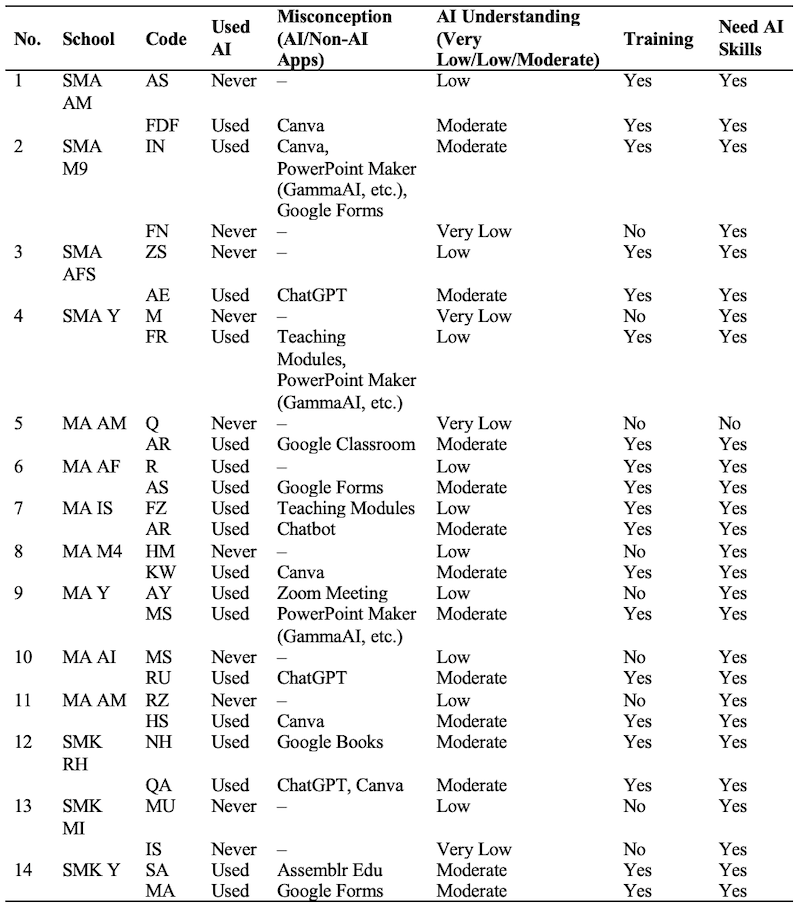
Interviews with 28 teachers across 14 schools showed 17 (60%) had used AI tools in learning contexts, while 11 (40%) had not. Analysis of responses revealed persistent misconceptions: many teachers conflated non-AI digital tools—PowerPoint Maker (GammaAI, etc.), Google Forms, Zoom, Google Books—with genuine AI applications such as ChatGPT and Assemblr Edu. AI understanding levels, determined through rubric-guided thematic coding triangulated with portfolio artefacts, were classified as: Moderate (60%, n = 17), Low (30%, n = 8), and Very Low (10%, n = 3). The rubric assessed clarity of AI concept explanation, accuracy of tool identification, and portfolio evidence of pedagogical application. Full participant-level data are presented in Table 1.
Table 1: Secondary Education Teachers’ AI Utilisation and Understanding Profiles
Note: SMA = Senior High School; MA = Madrasah Aliyah (Islamic Senior High); SMK = Vocational High School. Training = Participation in PT SIPL-organised AI professional development. Very Low/Low/Moderate = levels from rubric-guided thematic coding validated by portfolio artefacts.
Regarding training participation, 70% (n = 20) attended PT SIPL’s AI training programmes covering AI use, interactive e-module development, Quizizz, standalone LMS creation, flipbook development, and Assemblr Edu, while 30% (n = 8) did not, indicating uneven access. Concerning the need for AI skills, 90% (n = 25) reported requiring AI for work efficiency, teaching effectiveness, curriculum demands, and administrative tasks; 10% (n = 3) perceived no need, linked to very low conceptual understanding. Portfolio triangulation confirmed a significant gap between awareness and actual pedagogical application across all understanding levels.
Five interrelated barrier categories were identified inductively from interview and FGD data. Figure 1 presents the gap between current conditions and ideal requirements for each barrier.
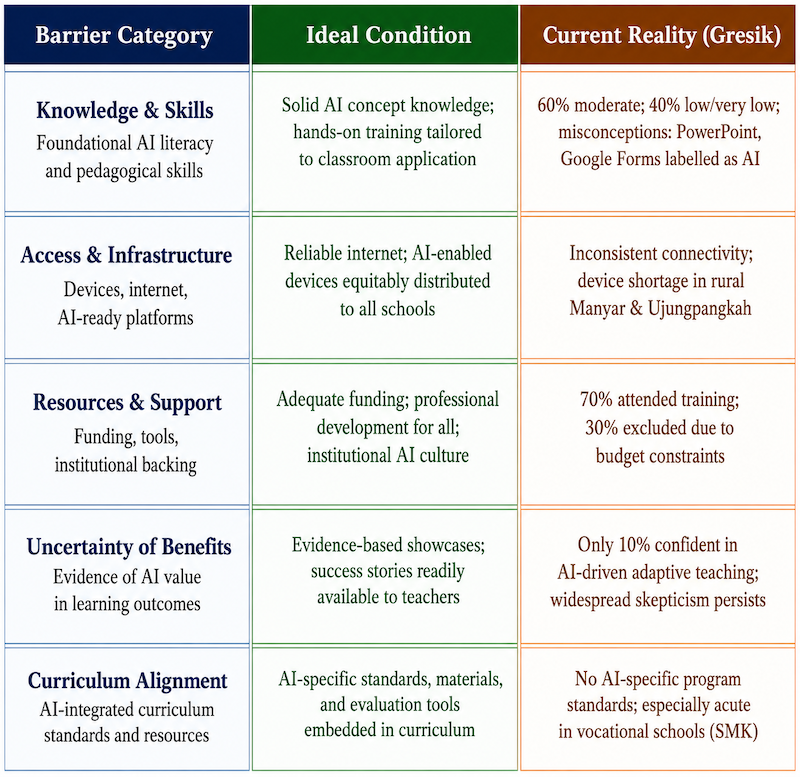
Knowledge and skills limitations were the most pervasive barrier across all school types and districts. Forty percent of SETs could not distinguish AI from conventional digital tools, and even Moderate-classified teachers frequently limited explanations to tool naming rather than pedagogical rationale. For instance, several teachers cited Canva as an AI tool because it features an AI-powered design suggestion function, without recognising that Canva is a general design platform with an AI component. This category confusion indicates exposure to AI through product interfaces without conceptual grounding in how AI functions. Infrastructure challenges were particularly acute in rural Ujungpangkah schools, where inconsistent electricity and limited device availability restricted hands-on training to one or two tools per session, and where unreliable internet connectivity made cloud-based AI platforms such as ChatGPT effectively inaccessible during school hours. SMK vocational school teachers most consistently reported curriculum absence as a barrier: nationally mandated Vocational Competency Standards contained no AI-specific performance indicators, leaving teachers without guidance for tool selection, lesson design, or AI-aligned student assessment. These five barriers are deeply interconnected: infrastructure gaps constrain training access; reduced participation sustains misconceptions; misconceptions fuel benefit uncertainty; and curriculum absence removes the scaffolding needed to convert individual competence gains into sustained classroom practice. Addressing any single barrier in isolation—as prior one-off training interventions have done—produces only marginal, unsustainable improvement, reinforcing the case for a multi-actor, systems-level Pentahelix approach.
Each Pentahelix actor contributed distinct but complementary functions, operating not as parallel independent actors but as a synergistic system in which each actor’s contribution amplified the impact of the others. Figure 2 illustrates the role structure and relationship patterns among the five actors. The model reveals both vertical alignment—government policy enabling industry investment, which in turn enables academic programme design—and horizontal integration, whereby community and media actors simultaneously build the social and public legitimacy required for institutional changes to take root at the classroom level. This dual alignment distinguishes the Pentahelix from simpler partnership models and accounts for its effectiveness in contexts where individual actor interventions have historically struggled to produce lasting outcomes.
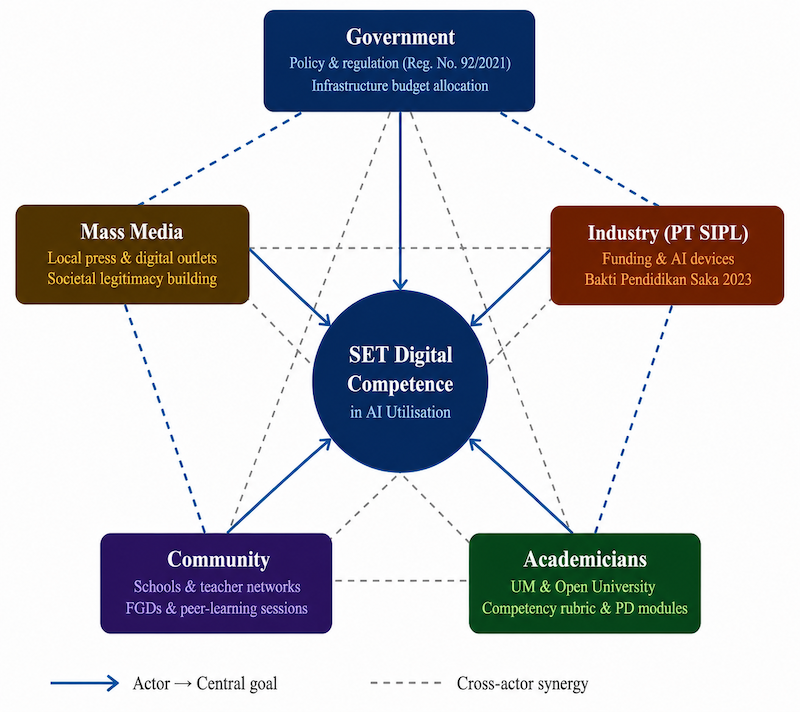
The Government (Gresik Regency) served as regulatory and resource anchor, enacting CSER policy under Regent Regulation No. 92/2021, legitimising PT SIPL’s initiative as policy-aligned rather than purely philanthropic, and consulting with academicians to align training with district educational priorities. Industry (PT SIPL) functioned as the primary operational enabler: procuring AI-enabled devices, funding training infrastructure, and managing the programme through its corporate social responsibility framework. Academicians (UM and Open University) served as knowledge architects and quality assurance agents—designing professional development modules, constructing the three-tier competency rubric, and conducting portfolio-based validation. Community (teacher cohorts and school networks) provided peer-learning infrastructure through FGDs and workshops, building a local community of practice where AI-integrated lesson plans were exchanged and practical classroom strategies co-developed. Mass Media (local press and digital outlets) built societal legitimacy for AI adoption, normalising AI use in schools, reducing parental and community scepticism, and motivating teacher risk-taking through public recognition—a contribution frequently overlooked in AI integration literature (Khan et al., 2021; Ohara, 2023).
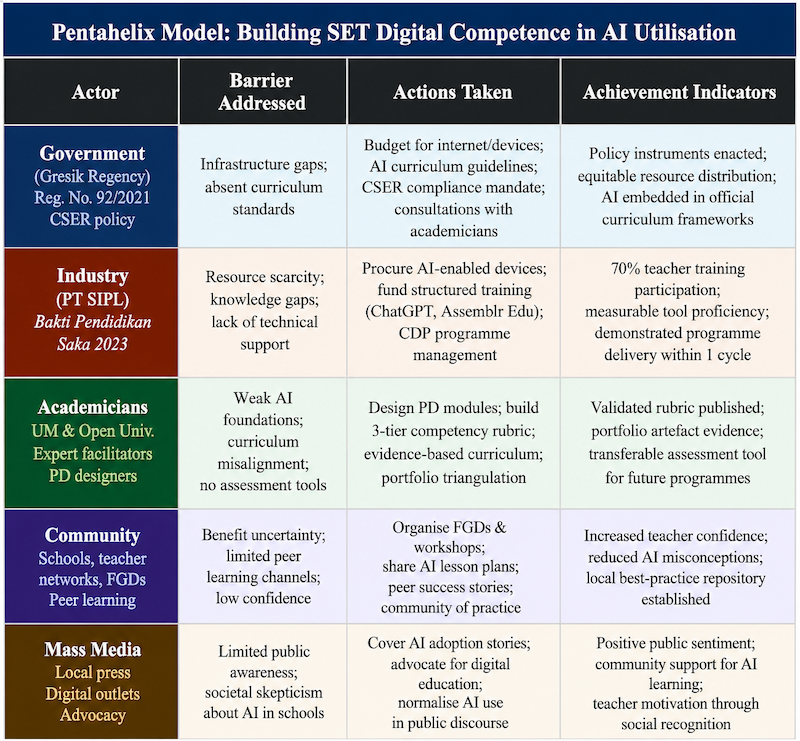
Drawing on findings from Objectives 1 through 3, Figure 3 presents the reconstructed Pentahelix collaboration model for building SET digital competence in AI utilisation, mapping each actor’s barriers addressed, actions taken, and achievement indicators.
The four findings of this study converge on a single overarching interpretation: AI integration in under-resourced secondary education cannot be addressed through any single-actor intervention, however well-resourced. The observation that 60% of teachers reached only a moderate AI understanding—despite varying prior digital training—signals a deeper conceptual gap rather than a skills deficit. This pattern is consistent with Aravantinos et al. (2026), who synthesised 43 empirical studies and concluded that technical training alone is insufficient for AI integration; effective adoption requires combined alignment of pedagogical knowledge, attitudes, organisational support, and continuous professional development. The teacher misconceptions documented in Gresik—conflating PowerPoint Maker (GammaAI, etc.), Google Forms, and Canva with genuine AI applications—are therefore symptomatic of an international pattern. Comparable conceptual confusions have been reported among Indonesian primary teachers (Batubara, 2026), in surveys of Indonesian K-12 teachers across 25 provinces (Harsanti et al., 2025), and in qualitative studies of rural EFL educators (Dinata et al., 2025). What this study contributes is a structural explanation: misconceptions persist because tool-centric training, divorced from conceptual scaffolding and assessment-anchored evidence, leaves teachers unable to distinguish AI from non-AI digital tools. The Gresik programme addressed this gap by combining tool exposure with academician-designed conceptual rubrics—an integration largely absent from CSR training models in the international evidence base.
A second contribution of this study lies in advancing Pentahelix theory beyond its conventional parallel-actor formulation. Prior applications in Indonesian education (Hoerniasih et al., 2022; Yunas et al., 2023) and adjacent governance domains (Sulaeman et al., 2021) describe Pentahelix actors as occupying discrete functional silos—government provides regulation, industry funding, academia knowledge, community participation, media publicity. The Gresik case challenges this additive conception. Industry resourcing without academic scaffolding produced training participation without measurable understanding gains; teachers who attended PT SIPL training but did not engage in portfolio-based application showed competence levels barely distinguishable from untrained peers. Conversely, academic rigour without industry resourcing would have remained confined to scholarly publication, never reaching the 28 teachers across 14 schools at scale. This empirical finding aligns with Lucas et al. (2024), whose European study established that AI-specific knowledge—not generic digital competence—predicts teacher trust and adoption, and with Sanusi et al. (2023), who emphasised that effective AI competency development requires contextually responsive professional learning pathways. The actor-role synergy documented here is therefore structural rather than additive: removing any single actor qualitatively alters programme effectiveness, newly specifying for AI-in-education contexts what earlier theorists proposed only at the level of governance abstraction.
A third contribution—frequently underexplored in the AI-in-education literature—concerns the legitimating function of mass media in collectivist educational contexts. While most reviews of AI integration focus predominantly on classroom and institutional factors (Chiu et al., 2023; Zawacki-Richter et al., 2019), the Gresik findings demonstrate that media advocacy operated as a primary vehicle of social legitimation: positioning participating teachers as innovators, normalising AI-enhanced teaching, and reducing parental scepticism that might otherwise constrain classroom experimentation. This sociocultural mechanism extends the arguments of Khan et al. (2021), Moldalieva et al. (2025), and Zhang et al. (2021) on public engagement in technology integration, and aligns with recent EdTech Hub findings (Jayasinghe et al., 2025) that EdTech sustainability across Southeast Asia depends on aligned public-sector legitimacy and community trust. In collectivist Indonesian contexts, where community perception substantively shapes school-level practices and teacher professional identity, media participation is not auxiliary publicity but a core legitimating mechanism that enables the other four actors to function. This study also extends the empirical base by documenting evidence from secondary education in a middle-income, CSR-driven context, including MA teachers navigating dual Ministry governance—a regulatory complexity not yet theorised in the existing literature.
For ‘Learning for Development’ scholarship and practice, the findings reframe AI integration as a developmental systems challenge rather than a technological one. The persistent infrastructure deficits documented here—inconsistent connectivity in rural areas, device shortages in MA and SMK schools, and absent AI curriculum standards—mirror national-level barriers identified by Herviana (2025) and Haetami (2025), and by Hanifah et al. (2025) across developing-country basic education systems. Addressing these barriers requires the simultaneous activation of policy legitimacy, material resources, human capital, social capital, and public legitimacy—each corresponding to one Pentahelix actor. For technology-enabled and blended learning specifically, the Gresik case demonstrates that AI cannot be effectively blended into instructional practice without first establishing the socio-institutional preconditions for adoption. The UNESCO AI Competency Framework for Teachers (Miao & Cukurova, 2024) similarly positions institutional support, professional development, and ethical governance as preconditions for sustainable integration. The Pentahelix model thus operationalises a blended-learning readiness infrastructure replicable across comparable secondary education contexts in Indonesia and Southeast Asia.
A final contribution concerns the three-tier competency rubric validated through portfolio triangulation. The persistent gap between teacher self-reported competence and demonstrated classroom practice—a recurring methodological problem (Lucas et al., 2024; Sperling et al., 2024)—cannot be closed by self-assessment alone. By anchoring competence judgements in observable artefacts (lesson plans, AI-integrated materials, AI tool screenshots), the Gresik rubric operationalises a more robust and less biased measure that other AI professional development programmes can adapt. For policymakers across Indonesia and Southeast Asia, the policy implication is direct: scaling AI integration in secondary education requires embedding multi-stakeholder collaboration structures within existing CSR governance instruments such as Indonesia’s Regent Regulation No. 92/2021, aligning competency rubrics with national curriculum standards, and investing in community peer-learning networks that sustain competence gains beyond single intervention cycles. Indonesia’s recently launched National AI Roadmap (Komdigi, 2025), which recognises multi-stakeholder coordination as foundational to AI talent development, provides a national policy infrastructure within which district-level Pentahelix programmes can be situated and scaled.
Several limitations frame the interpretation of these findings. The single case-study design restricts generalisation beyond the conditions of Gresik Regency. The documentary evidence relied predominantly on internal PT SIPL records, mitigated through independent triangulation but not externally audited. Competence was assessed at a single point, leaving the sustainability of gains unconfirmed. The three-tier rubric, although validated through portfolio triangulation, requires inter-rater reliability testing before standardised use. Future research should pursue multi-site comparisons to test transferability; longitudinal designs spanning two or more academic years to assess sustainability; and mixed-methods studies incorporating pre-post assessments of teacher competence and student learning outcomes to establish causal links—an evidentiary gap noted in recent reviews (Chiu et al., 2023; Zheng et al., 2023). Examination of gender differentials, school leadership mediation (Harsanti et al., 2025), and comparative studies of national AI policy frameworks in Singapore, Malaysia, and Thailand would advance this inquiry.
This study demonstrates that Pentahelix collaboration—structured engagement among government, industry, academicians, community, and media—constitutes an effective, contextually grounded framework for building secondary school teachers’ AI-enabled digital competence in under-resourced settings. The reconstructed Pentahelix model offers a replicable, policy-aligned blueprint for policymakers, CSR practitioners, academic institutions, and educator communities across Indonesia and the Global South seeking to scale sustainable, equitable AI integration in secondary education.
Aravantinos, S., Lavidas, K., Komis, V., Karalis, T., & Papadakis, S. (2026). Artificial intelligence in K-12 education: A systematic review of teachers’ professional development needs for AI integration. Computers, 15(1), 49. https://doi.org/10.3390/computers15010049
Ayanwale, M., Adelana, O., Molefi, R., Adeeko, O., & Ishola, A. (2024). Examining artificial intelligence literacy among pre-service teachers for future classrooms. Computers and Education Open, 6, 100179. https://doi.org/10.1016/j.caeo.2024.100179
Batubara, M.H. (2026). Balancing efficiency and humanity in the adoption of artificial intelligence among Indonesian primary school teachers. JMIE (Journal of Madrasah Ibtidaiyah Education), 10(1). http://dx.doi.org/10.32934/jmie.v10i1.904
Bogdan, R.C., & Biklen, S.K. (2007). Qualitative research for education: An introduction to theory and methods. Allyn and Bacon.
Chiu, T.K.F., Ahmad, Z., Ismailov, M., & Sanusi, I.T. (2024). What are artificial intelligence literacy and competency? A comprehensive framework to support them. Computers and Education Open, 6, 100171. https://doi.org/10.1016/j.caeo.2024.100171
Chiu, T.K.F., Xia, Q., Zhou, X., Chai, C.S., & Cheng, M. (2023). Systematic literature review on opportunities, challenges, and future research recommendations of artificial intelligence in education. Computers and Education: Artificial Intelligence, 4, 100118. https://doi.org/10.1016/j.caeai.2022.100118
Chohan, S.R., & Hu, G. (2022). Strengthening digital inclusion through e-government: Cohesive ICT training programs to intensify digital competency. Information Technology for Development, 28(1), 16-38. https://doi.org/10.1080/02681102.2020.1841713
Dai, W. (2023). An empirical study on English preservice teachers’ digital competence regarding ICT self-efficacy, collegial collaboration and infrastructural support. Heliyon, 9(9), e19538. https://doi.org/10.1016/j.heliyon.2023.e19538
Dinata, R.P.C., Maulina, M., Astuti, W., & Utama, I.M.P. (2025). Exploring rural EFL lecturers’ perspectives on the integration of artificial intelligence in teaching. LEARN Journal: Language Education and Acquisition Research Network, 18(2), 633-654. https://doi.org/10.70730/OVMA8060
Haetami, H. (2025). AI-driven educational transformation in Indonesia: From learning personalization to institutional management. Al-Ishlah: Jurnal Pendidikan, 17(2), 1819-1832. https://doi.org/10.35445/alishlah.v17i2.7448
Haleem, A., Javaid, M., Qadri, M.A., & Suman, R. (2022). Understanding the role of digital technologies in education: A review. Sustainable Operations and Computers, 3, 275-285. https://doi.org/10.1016/j.susoc.2022.05.004
Hanifah, H., Arnyana, I.B.P., & Margunayasa, I.G. (2025). Systematic literature review: Digital technology-based policy approaches to improve the quality and access of basic education in developing countries. International Journal Education and Computer Studies (IJECS), 5(2), 87-102. https://doi.org/10.35870/ijecs.v5i2.4337
Harsanti, H.R., Sudibjo, N., Riady, S., & Yu, P. (2025). Exploring Indonesian teachers’ intention to use artificial intelligence in schools: The impact of digital leadership, digital readiness, and perceived usefulness. Cogent Social Sciences, 11(1). https://doi.org/10.1080/23311886.2025.2593596
Hava, K., & Babayiğit, Ö. (2024). Exploring the relationship between teachers’ competencies in AI-TPACK and digital proficiency. Education and Information Technologies, 30, 3491-3508. https://doi.org/10.1007/s10639-024-12939-x
Herviana, A. (2025). Artificial intelligence in education: Opportunities and challenges of AI integration in Indonesian classrooms. Journal of Smart Pedagogy and Education, 1(1), 33-45. https://garuda.kemdiktisaintek.go.id/documents/detail/6131739
Hidayat, M.L., Hariyatmi, Astuti, D.S., Sumintono, B., Meccawy, M., & Khanzada, T.J.S. (2023). Digital competency mapping dataset of pre-service teachers in Indonesia. Data in Brief, 49, 109310. https://doi.org/10.1016/j.dib.2023.109310
Hoerniasih, N., Hufad, A., Wahyudin, U., Sudiapermana, E., Yunus, D., & Sukmana, C. (2022). Pentahelix based entrepreneurship management at PKBM Asholahiyah. International Journal of Professional Business Review, 7(3), e0616. https://doi.org/10.26668/businessreview/2022.v7i3.e616
Hwang, G-J., Xie, H., Wah, B.W., & Gašević, D. (2020). Vision, challenges, roles and research issues of artificial intelligence in education. Computers and Education: Artificial Intelligence, 1, 100001. https://doi.org/10.1016/j.caeai.2020.100001
Jayasinghe, N., Chrisani, A., Honda, D., & Gunawan, C.J. (2025). EdTech for marginalised learners in Southeast Asia: Perspectives from funders and providers on priorities, design, investment, and scaling considerations [Landscape Analysis]. EdTech Hub. https://doi.org/10.53832/edtechhub.1117
Khan, I., Ahmad, A.R., Jabeur, N., & Mahdi, M.N. (2021). An artificial intelligence approach to monitor student performance and devise preventive measures. Smart Learning Environments, 8(1), 17. https://doi.org/10.1186/s40561-021-00161-y
Kizilcec, R.F. (2023). To advance AI use in education, focus on understanding educators. International Journal of Artificial Intelligence in Education, 34(1), 12-19. https://doi.org/10.1007/s40593-023-00351-4
Komdigi. (2025). White paper on the National Artificial Intelligence Roadmap. Ministry of Communication and Digital Affairs, Republic of Indonesia. https://oecd.ai/en/dashboards/policy-initiatives/national-artificial-intelligence-roadmap
Luan, H., Geczy, P., Lai, H., Gobert, J., Yang, S.J.H., Ogata, H., Baltes, J., Guerra, R., Li, P., & Tsai, C-C. (2020). Challenges and future directions of big data and artificial intelligence in education. Frontiers in Psychology, 11, 580820. https://doi.org/10.3389/fpsyg.2020.580820
Lucas, M., Zhang, Y., Bem-Haja, P., & Vicente, P.N. (2024). The interplay between teachers’ trust in artificial intelligence and digital competence. Education and Information Technologies, 29(17), 22991-23010. https://doi.org/10.1007/s10639-024-12772-2
Martín-Sómer, M., Casado, C., & Gómez-Pozuelo, G. (2024). Utilising interactive applications as educational tools in higher education: Perspectives from teachers and students, and an analysis of academic outcomes. Education for Chemical Engineers, 46, 1-9. https://doi.org/10.1016/j.ece.2023.10.001
McGrath, C., Cerratto Pargman, T., Juth, N., & Palmgren, P.J. (2023). University teachers’ perceptions of responsibility and artificial intelligence in higher education—An experimental philosophical study. Computers and Education: Artificial Intelligence, 4, 100139. https://doi.org/10.1016/j.caeai.2023.100139
Miao, F., & Cukurova, M. (2024). AI competency framework for teachers. UNESCO. https://doi.org/10.54675/zjte2084
Moldalieva, S., Baruti, S., Baruti-Sylejmani, M., & Koichubaeva, N. (2025). Integrating sociocultural contexts in science education: Comparative analysis and strategic adaptations. Jurnal Ilmiah Ilmu Terapan Universitas Jambi, 9(1), 53-70. https://doi.org/10.22437/jiituj.v9i1.37780
Ng, D.T.K., Su, J., Leung, J.K.L., & Chu, S.K.W. (2024). Artificial intelligence (AI) literacy education in secondary schools: A review. Interactive Learning Environments, 32(10), 6204-6224. https://doi.org/10.1080/10494820.2023.2255228
Ohara, M.R. (2023). The role of social media in educational communication management. Journal of Contemporary Administration and Management (ADMAN), 1(2), 70-76. https://doi.org/10.61100/adman.v1i2.25
Sanusi, I.T., Oyelere, S.S., Vartiainen, H., Suhonen, J., & Tukiainen, M. (2023). A systematic review of teaching and learning machine learning in K-12 education. Education and Information Technologies, 28, 5967-5997. https://doi.org/10.1007/s10639-022-11416-7
Sperling, K., Stenberg, C., McGrath, C., Åkerfeldt, A., Heintz, F., & Stenliden, L. (2024). In search of artificial intelligence (AI) literacy in teacher education: A scoping review. Computers and Education Open, 6, 100169. https://doi.org/10.1016/j.caeo.2024.100169
Su, J., Zhong, Y., & Ng, D.T.K. (2022). A meta-review of literature on educational approaches for teaching AI at the K-12 levels in the Asia-Pacific region. Computers and Education: Artificial Intelligence, 3, 100065. https://doi.org/10.1016/j.caeai.2022.100065
Sulaeman, S., Hakim, A.R., Syahman, M., Makmum, M., Ruspandi, T., & Yoyoh, Y. (2021). Implementasi Komunikasi Model Penta Helix untuk Meningkatkan Pendidikan Agama Islam. COMSERVA (Jurnal Penelitian dan Pengabdian Masyarakat), 1(6), 224-234. https://doi.org/10.59141/comserva.v1i6.32
Tenberga, I., & Daniela, L. (2024). Artificial intelligence literacy competencies for teachers through self-assessment tools. Sustainability, 16(23), 10386. https://doi.org/10.3390/su162310386
Wang, M., & Zhang, L.J. (2023). Understanding teachers’ online professional learning: A “community of inquiry” perspective on the role of Chinese middle school teachers’ sense of self-efficacy, and online learning achievement. Heliyon, 9(6), e16932. https://doi.org/10.1016/j.heliyon.2023.e16932
Yin, R.K. (2017). Case study research and applications: Design and methods. SAGE Publications.
Yunas, N.S., Susanti, A., Izana, N.N., & Widyawati, W. (2023). The pentahelix model in the development of agro-culture-based edutourism in the Taman Nasional Bromo Tengger Semeru buffer village area. Sodality: Jurnal Sosiologi Pedesaan, 11(1), 76-85. https://doi.org/10.22500/11202344218
Zawacki-Richter, O., Marín, V.I., Bond, M., & Gouverneur, F. (2019). Systematic review of research on artificial intelligence applications in higher education—Where are the educators? International Journal of Educational Technology in Higher Education, 16(1), 1-27. https://doi.org/10.1186/s41239-019-0171-0
Zhang, J., Chen, Z., Dai, J., & Liu, Z. (2021). Investigating the influencing factors of teachers’ information and communications technology-integrated teaching behaviors toward “learner-centered” reform using structural equation modeling. Sustainability, 13, 12614. https://doi.org/10.3390/su132212614
Zheng, L., Niu, J., Zhong, L., & Gyasi, J.F. (2023). The effectiveness of artificial intelligence on learning achievement and learning perception: A meta-analysis. Interactive Learning Environments, 31(9), 5650-5664. https://doi.org/10.1080/10494820.2021.2015693
Zimmer, W.K., & Matthews, S.D. (2022). A virtual coaching model of professional development to increase teachers’ digital learning competencies. Teaching and Teacher Education, 109, 103544. https://doi.org/10.1016/j.tate.2021.103544
Author Notes
Aan Fardani Ubaidillah is a lecturer and researcher in the Department of Educational Administration, Faculty of Education, Universitas Negeri Malang, Indonesia. He is a member of the development team for the Distance Education Study Program (Program Studi Pendidikan Jarak Jauh) and the Teacher Professional Education Program (Program Studi Pendidikan Profesi Guru). His research interests include educational leadership and management, educational supervision, and distance and multicultural education. Email: aan.fardani.fip@um.ac.id (https://orcid.org/0000-0002-0938-8676)
Yudin Citriadin is an Associate Professor in the Postgraduate Program (Master of Islamic Education Management) at Universitas Islam Negeri Mataram, Indonesia. His research interests include Islamic education management, educational leadership and supervision, digital integration in education, and qualitative research methodology. He has published extensively in peer-reviewed journals and serves as an editorial board member and reviewer for various educational journals. Email: yudin.citiradin@uinmataram.ac.id (https://orcid.org/0009-0001-0023-1410)
Dewi Ayu Sakdiyyah is a lecturer at Universitas Terbuka, Indonesia, and also serves as a school teacher. Her research interests include distance learning, open education, instructional strategies, and pedagogical practices in elementary and secondary education. She is actively involved in educational development and research aimed at bridging classroom teaching with flexible distance learning models. Email:dewi.sakdiyyah@ecampus.ut.ac.id (https://orcid.org/0000-0001-7331-8843)
Fika Fitriasari is a lecturer and researcher in the Faculty of Economics and Business at Universitas Muhammadiyah Malang (UMM), Indonesia. Her research interests include financial management, Islamic banking, digital financial literacy, entrepreneurship, and innovation management in education and business. She has authored several books and published research articles in national and international peer-reviewed journals. Email: fika@umm.ac.id (https://orcid.org/0000-0002-6647-4319)
Cite as: Ubaidillah, A.F., Citriadin, Y., Sakdiyyah, D.A., & Fitriasari, F. (2026). Pentahelix collaboration for building secondary school Teachers’ AI-enabled digital competence: A case study. Journal of Learning for Development, 13(3), 512-526.
DOI: https://doi.org/10.56059/9wxmjq57