Olena Hlazunova, Volodymyr Kravchenko, Inna Savytska, Valentyna Korolchuk, Tetiana Voloshyna and Taisiia Saiapina
2026 VOL. 13, No. 2
Abstract: This study explored students’ emotional responses to different formats of educational content and the use of cognitive technologies during synchronous online learning. It involved 41 second-year Ukrainian undergraduate students in software engineering and examined their emotional states, attention, and engagement. Three content formats were applied during a live online lecture: (1) presentation, (2) discussion, and (3) demonstration and data were analysed using the MorphCast Emotion AI tool for reading expressions and facial features in real-time. Real-time facial expression and emotion data were collected and analysed using MorphCast Emotion AI. The findings revealed that different content formats elicited distinct emotional responses. Notably, they demonstrated that a practice-oriented task produced the highest average level of positive emotions compared to presentation and discussion, indicating the strong emotional and motivational potential of practice-oriented instructional formats in synchronous online learning.
Keywords: emotional state, attention, involvement, blended learning technology, synchronous interaction
Understanding students' emotional state is a key factor in effective interaction in the learning process and academic success (Cao et al., 2018; Hopwood et al., 2024; Jarodzka et al., 2021). Online students often face heavy cognitive loads that can lead to fatigue and disengagement. To counter this, we should blend digital learning with emotional support through tools like Emotional AI. By addressing both the learner's mind and feelings, these technologies help maintain the focus and motivation essential for academic success (Liu et al., 2024).
Emotions significantly influence learning activity, motivation, and academic performance (Arias et al., 2022; Pekrun & Linnenbrink-Garcia, 2022; Wang et al., 2022). In the context of distance education, this impact is exacerbated because the independent, isolated nature of online classes can lead to negative academic emotions, such as anxiety or boredom, which can inhibit student engagement (Di Leo, 2020; So et al., 2023). At the same time, positive emotions, such as interest in and enjoyment of learning, support self-regulated learning and academic engagement (Carmona-Halty et al., 2021; Lavoué et al., 2020).
The ways educational content is presented also play an important role in shaping students' emotional experiences. The use of various formats (video, audio, images, diagrams, and interactive elements) enhances learning quality, considers students' individual needs, and stimulates their motivation and engagement (Hlazunova et al., 2024; Sahraie et al., 2024; So et al., 2023).
Despite progress in the field, most research still relies on retrospective self-reports rather than real-time emotional analysis. We still know little about how specific content formats shape emotions during live online classes, especially in unstable or crisis-driven environments. This is a vital concern for Ukrainian higher education today. In the face of ongoing military conflict, creating an emotionally safe digital space is no longer just an option; it is a necessity for maintaining both educational quality and students' psychological resilience (Semigina et al., 2020).
Based on these problems and the gaps in the literature, this study aimed to conduct an empirical analysis of students' emotional states in the process of synchronous online learning, and to assess the impact of different forms of presenting educational content on academic emotions using cognitive technologies as a learning analytics tool to improve the quality of the educational process.
To achieve the set goal, the following research questions were formulated:
RQ1: What emotional states do students experience during synchronous interaction, and how do they change depending on forms of content presentation?
RQ2: How can cognitive technologies help analyse students' emotional state during online lectures to improve learning effectiveness?
Emotions play a key role in learning and teaching, shaping interactions between students and teachers and the outcomes of educational activities. The combination of emotional and rational aspects increases the effectiveness of the pedagogical process and contributes to the comprehensive development of participants in the educational environment (Chen & Cheng, 2022). Research demonstrates a two-way relationship between emotions and cognitive processes. Prior emotions or expectations of future achievements direct attention, memory, and judgment towards the completion of learning tasks (Marcos-Merino et al., 2021).
Academic emotions directly affect the wellbeing of students and teachers and shape interpersonal processes in the learning environment (Mendzheritskaya & Hansen, 2019; Meyer & Turner, 2002; Pekrun & Linnenbrink-Garcia, 2014). Understanding students' emotional state in the context of online learning is particularly important for their emotional well-being (Rezapour & Elmshaeuser, 2022).
Pekrun (2019) highlights that academic emotions, ranging from pride and relief to boredom and anxiety, are deeply rooted in how students perceive their control over tasks and the value of what they are learning. Far from being mere side effects, these emotions act as primary engines for engagement and success. Whether a student feels empowered or hopeless directly shapes their productivity and overall achievement in higher education (Shah et al., 2022).
Research on identifying students' emotional states and their impact on the learning process is becoming increasingly important. Academic emotions are related to student motivation, learning strategies, cognitive resources, self-regulation, and academic achievement, as well as personal characteristics and learning environment conditions (Pekrun et al., 2010). Various methods are used to assess emotions: subjective (psychological) self-assessments (Teoh et al., 2023) and technological methods that allow for more accurate and effective identification and analysis of emotions, including facial expression analysis (Nguyen et al., 2022; Sahraie et al., 2024; Zhang et al., 2020). Academic emotions manifest continuously over time in response to a learning situation. For example, Lin et al. (2020) proposed a deep learning-based method for continuous facial emotion recognition to analyse academic emotions during the learning process.
Research by Iqbal et al. (2024) shows that different types of emotions—positive, negative, activating, and deactivating—affect students' academic performance both at the attitudinal level (satisfaction with learning) and at the behavioural level (academic achievement), while their simultaneous influence differs based on the unique effect of each type of emotion. Zheng et al. (2023) found that three key factors, student agency, learning environment, and teaching methods, influence fluctuations in students' academic emotions in different learning modes.
In the learning process, students might experience negative emotions (anxiety, boredom, anger, hopelessness) as well as positive emotions (satisfaction, pride, interest). Especially in distance learning, the lack of direct contact with teachers and classmates intensifies negative emotional challenges, which reduces attention, activity, and learning outcomes (Di Leo, 2020; Li et al., 2007; So et al., 2023). At the same time, positive emotions stimulate self-regulated learning, academic engagement, and the development of students' psychological capital (Carmona-Halty et al., 2021; Lavoué et al., 2020).
The ways educational content is presented also significantly influence students' emotional experiences. Studies by Morrish et al. (2018), Tsai et al. (2021), and Sandanayake et al. (2011) demonstrate that different teaching methods elicit specific emotional responses from students, highlighting the importance of strategically selecting pedagogical approaches. The use of different types of educational content improves learning quality, takes into account students' individual needs, and stimulates their motivation (Sahraie et al., 2024; So et al., 2023).
The study used an intra-subject experimental design to examine the effect of different teaching strategies on students' emotional state and engagement during synchronous online learning. Each participant was exposed to all learning formats, allowing a direct intra-individual comparison of emotional responses across pedagogical conditions while controlling for content-related variability.
The study was conducted at the Faculty of Information Technology of the National University of Life and Environmental Sciences of Ukraine (NULES). The sample consisted of 41 second-year students (aged 18-21, including 29 males and 12 females) enrolled in the bachelor's programme in Software Engineering. Participants were selected using a targeted sample determined by the research design and the specific experimental environment. The selection was based on participants' relevance to the conditions of synchronous online learning with AI analytics integration, which required the relevant digital experience, technical infrastructure, and online interaction skills. All participants voluntarily participated in the study and provided written informed consent for the anonymous collection, processing, and use of data on emotional states for scientific research. The Institutional Ethics Committee of NULES of Ukraine approved the research procedures.
The experiment was implemented within the discipline ‘Modelling and Analysis of the Subject Area’ in the 2023-2024 academic year using a blended learning model (online lectures and offline laboratory work).
During synchronous online lectures, the educational content was presented sequentially in three formats, each lasting 25-30 minutes:
The sequence of formats was the same for all students, which ensured methodological comparability of results.
The MorphCast Emotion AI tool was used to monitor students’ emotional states through real-time facial emotion recognition. Previous studies confirm its effectiveness in assessing student attention and engagement in educational settings, supporting its suitability for experimental research (Glazunova et al., 2025). The system analysed students' video streams in real time. It provided teachers with analytical feedback, allowing them to adapt their teaching strategies by changing the pace of educational content delivery, the level of interactivity, and the forms of student engagement. Thus, AI was integrated into adaptive pedagogical design and educational analytics. All data was stored anonymously in a secure environment and used exclusively for research purposes.
To assess the impact of educational content presentation formats on students' emotional states, the following statistical procedures were used:
Statistical significance was determined at the level of p < 0.05.
RQ1: What emotional states do students experience during synchronous online interaction, and how do they change depending on the forms of content presentation?
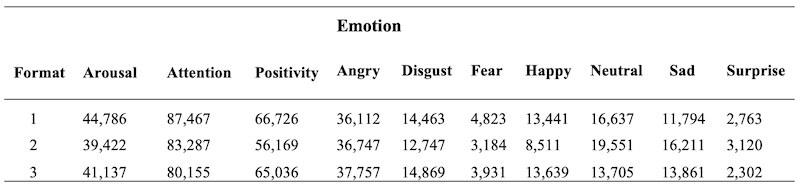
To answer RQ1, a comparative analysis of students' emotional indicators was conducted within three experimental formats. The data showed significant differences in attention, positive emotions, and emotional variability across formats, confirming the differentiated impact of pedagogical strategies on students' emotional states during synchronous online learning. The summarised statistical indicators are presented in Table 1.
Table 1: Average Values of Emotional Indicators Across Instructional Formats
The data presented in Table 1 show apparent differences in students' emotional and cognitive indicators depending on the format of the educational content presentation. The presentation-based format (Format 1) was characterised by the highest average Attention scores (87,467) and the highest Positivity scores (66,726), indicating adequate support for cognitive concentration and learning during the lecture explanation of the material. The discussion-based format (Format 2) showed lower Attention (83,287) and Positivity (56,169) than the other formats. At the same time, Neutral (19,551) and Sad (16,211) increased, indicating greater emotional variability and possible cognitive load during active interaction and discussion. The practice-oriented format (Format 3) combined relatively high Positivity (65,036) and Happy (13,639) scores with a moderate level of Attention (80,155), indicating the formation of a positive emotional background and motivational involvement of students in the process of performing practical tasks.
The combination of these results indicates that different synchronous online learning formats elicited distinct emotional and cognitive profiles in students: the presentation format optimised concentration, while the discussion format stimulated cognitive activity through emotional tension. In contrast, the practice-oriented format promoted positive academic emotions and learning motivation.
Visualisation of the distribution of emotional indicators using violin plots (Figure 1) enabled deeper interpretation of the differences between learning formats. The presentation-based format was characterised by more compact distributions of the Attention and Positivity indicators, suggesting a relatively stable emotional and cognitive state among students during the lecture.




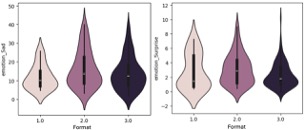
The discussion-based format demonstrated broader, more asymmetrical distributions for most emotional indicators, particularly Happy, Sad, Neutral, and Angry, indicating a high level of emotional variability and heterogeneity in cognitive load during interactive communication. The practice-oriented format was characterised by a shift in distributions towards positive emotional indicators (Happy, Positivity) and a greater concentration of values, which indicated the formation of a positive emotional background and the motivational involvement of students in the process of performing practical tasks. Thus, violin plots not only confirmed statistically significant differences between learning formats but also demonstrated the distinct emotional and cognitive profiles of the students, shaped by the pedagogical strategy for content presentation.
The results of the principal component analysis (PCA) of students' emotions and feelings for different formats of educational content presentation are shown in Figure 2. Each point on the graph corresponds to a separate student observation, and the colours indicate different formats of teacher presentation of educational content during online lectures (Format 1, Format 2, Format 3).
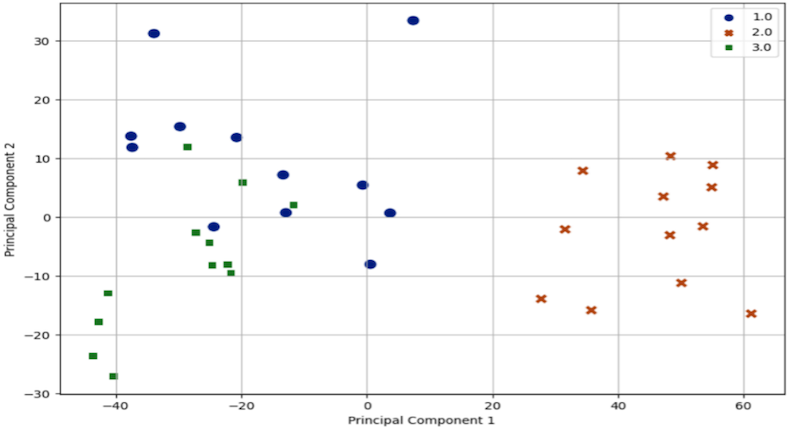
PCA visualisation revealed that different learning formats do not just vary in emotional intensity, they create entirely distinct emotional 'profiles'. Discussions (Format 2) stood out as a clear cluster, reflecting higher emotional variability and unique engagement patterns. In contrast, presentations (Format 1) maintained a more stable and balanced emotional state. Practical tasks (Format 3) occupied their own space, showing a specific emotional structure tied to hands-on activity. Overall, these results demonstrated that pedagogical design does more than trigger emotions; it actively shapes the multidimensional structure of a student's emotional experience.
RQ2: How can cognitive technologies help analyse students' emotions during online lectures to improve learning effectiveness?
To answer RQ2, MorphCast AI was used to collect students' emotional and cognitive indicators in real time during synchronous online lectures. To reduce data multidimensionality, PCA was applied, yielding two dominant components (PC1 and PC2) that explained the main variations in emotional states (Figure 3).
PC1 reflected the overall emotional climate of the lecture: high positivity (Positivity = -0.83), Neutral (0.26), and Sad (0.20) emotions, and moderate negative contributions from Angry (-0.31) and Happy (-0.25). This component allowed us to identify a general decline in engagement or signs of emotional fatigue among students.
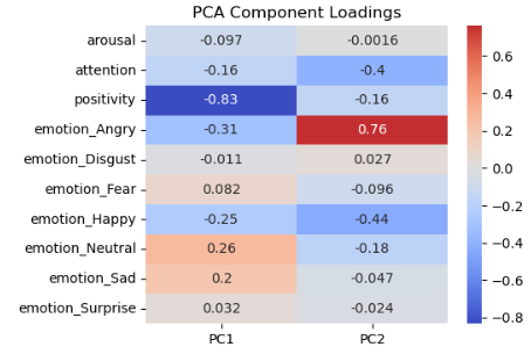
PC2 characterised emotional tension and fluctuations in cognitive load: the positive contribution of Angry (0.76) was accompanied by negative contributions from Attention (-0.40) and Happy (-0.44), suggesting cognitive overload. Interpretation of PC2 allows the teacher to quickly adjust the pace of the lecture or the format of activities to maintain optimal engagement.
By using cognitive tools such as MorphCast AI as supportive resources, educators can sense students’ emotional states in real time and adapt their teaching to reduce fatigue and enhance motivation. Although AI enables this adaptive approach, its effectiveness depends on the human factor. Transparent communication about data privacy and clear awareness of technological limits ensure that these tools strengthen, rather than replace, the teacher-student connection, making online learning more responsive and effective.
Emotions are a fundamental component of the learning process, directly influencing students' cognitive activity, motivation, and academic engagement. The results of this study confirm the provisions of contemporary theories of academic emotions regarding their integration with cognitive processes and learning activities (Chen & Cheng, 2022; Marcos-Merino et al., 2021; Pekrun, 2019). Emotional states are active regulators of attention, self-regulation, and engagement, rather than a passive by-product of learning, and directly affect the effectiveness of the educational process.
Our findings reveal how different teaching formats uniquely shape the student experience. While presentations offer emotional stability and steady focus, discussions spark cognitive energy through active engagement and emotional variability. Practical tasks, however, stand out for building the strongest positive emotions and motivation. This alignment with multidimensional models of engagement confirms that effective online learning must balance cognitive, emotional, and behavioural elements to be truly successful (Lavoué et al., 2020; Pekrun & Linnenbrink-Garcia, 2014). Thus, effective online learning requires didactic diversity and adaptability in the presentation of content.
By using MorphCast AI, we moved from simply describing emotions to understanding their functional role in the classroom. The identification of key components (PC1 and PC2) shows that emotional data can be transformed into actionable insights, allowing teachers to adjust lesson pace, interactivity, and engagement strategies on the fly. In this way, student emotions become a vital tool for managing the learning process, aligning perfectly with the goals of adaptive learning design (Ezquerra et al., 2022; Glazunova et al., 2025).
The results highlighted the potential of using AI for emotion-aware pedagogy, where data on emotional states support psychological well-being, engagement, and learning quality. This is particularly relevant for synchronous online learning, where limited social presence and interaction exacerbate emotional challenges (Di Leo, 2020; So et al., 2023).
The findings of this study have significant implications for ‘Technology-Enabled Learning’ and its role in ‘Learning for Development’. By integrating Emotion AI into synchronous online sessions, educators can move beyond a 'one-size-fits-all' approach to a more responsive, learner-centred environment. In the context of development, especially in regions facing disruptions (like the current situation in Ukraine), such technologies ensure that digital education is not just a substitute for face-to-face interaction but is a transformative tool. Specifically, the ability to identify that practice-oriented demonstrations elicit higher engagement allows for the design of more effective professional training programmes, which are crucial for rapid skill acquisition and economic resilience in developing contexts.
The limitations of the study include technical aspects of emotion recognition (lighting, camera quality, and face position), the contextual specificity of the sample, and the need for further validation of the results across disciplinary and cultural environments. Moving forward, the focus should shift toward creating systems that automatically adapt content based on real-time emotional feedback. Future studies should explore how adjusting task complexity could prevent student burnout and maintain 'flow,' especially during practical demonstrations. Additionally, it is vital to help educators master these AI tools, ensuring that technology strengthens, instead of replaces, the human connection in teaching.
Arias, J., Soto-Carballo, J.G., & Pino-Juste, M.R. (2022). Emotional intelligence and academic motivation in primary school students. Psicologia: Reflexao e Critica, 35(14). https://doi.org/10.1186/s41155-022-00216-0
Cao, L., Xu, J., Yang, X., Li, X., & Liu, B. (2018). Abstract representations of emotions perceived from the face, body, and whole-person expressions in the left postcentral gyrus. Frontiers in Human Neuroscience, 12(419). doi: 10.3389/fnhum.2018.00419
Carmona-Halty, M., Salanova, M., Llorens, S., & Schaufeli, W.B. (2021). Linking positive emotions and academic performance: The mediated role of academic psychological capital and academic engagement. Current Psychology, 40, 2938-2947. https://doi.org/10.1007/s12144-019-00227-8
Chen, J., & Cheng, T. (2022). Review of research on teacher emotion during 1985-2019: A descriptive quantitative analysis of knowledge production trends. European Journal of Psychology of Education, 37(2), 417-438. https://doi.org/10.1007/s10212-021-00537-1
Di Leo, I. (2020). The role and sequencing of academic emotions during mathematics problem solving among elementary students. McGill University.
Ezquerra, A., Agen, F., Rodríguez-Arteche, I., & Ezquerra-Romano, I. (2022). We are integrating artificial intelligence into research on emotions and behaviors in science education. Eurasia Journal of Mathematics, Science and Technology Education, 18(4), em2099. https://doi.org/10.29333/ejmste/11927
Glazunova, O., Savytska, I., Korolchuk, V., Voloshyna, T., & Saiapina, T. (2025). Managing student engagement during the educational process using the MorphCast AI Tool. In V. Ermolayev, I. Potapov, O. Ignatenko, R. Hornung, A. Hlybovets, V. Yakovyna, Y. Prytula, & O. Spivakovsky (Eds.), Information and communication technologies in education, research, and industrial applications. 19th International Conference, ICTERI 2024, Lviv, Ukraine, September 23-27, 2024, Proceedings. Springer. https://doi.org/10.1007/978-3-031-81372-6_10
Hlazunova, O.H., Schlauderer, R., Korolchuk, V.I., Voloshyna, T.V., & Saiapina, T.P. (2024). Microlearning technology based on video content: Advantages, methodology and quality factors. Journal of Physics: Conference Series, 2871(1), 012028). IOP Publishing.
Hopwood, N., Palmer, T.A., Koh, G.A., Lai, M.Y., Dong, Y., Loch, S., & Yu, K. (2024). Understanding student emotions when completing assessment: Technological, teacher and student perspectives. International Journal of Research & Method in Education, 48(2) 1-16. https://doi.org/10.1080/1743727X.2024.2358792
Iqbal, M.Z., Khan, T., & Ikramullah, M. (2024). Toward academic satisfaction and performance: The role of students’ achievement emotions. European Journal of Psychology of Education, 39, 1913-1941. https://doi.org/10.1007/s10212-023-00751-z
Jarodzka, H., Skuballa, I., & Gruber, H. (2021). Eye-tracking in educational practice: Investigating visual perception underlying teaching and learning in the classroom. Educational Psychology Review, 33, 1-10. doi:10.1007/s10648-020-09565-7
Lavoué, E., Kazemitabar, M., Doleck, T., Lajoie, S.P., Carrillo, R., & Molinari, G. (2020). Towards emotion awareness tools to support emotion and appraisal regulation in academic contexts. Educational Technology Research and Development, 68, 269-292. https://doi.org/10.1007/s11423-019-09688-x
Li, W., Zhang, Y., & Fu, Y. (2007). Speech emotion recognition in e-learning system based on affective computing. Third International Conference on Natural Computation (ICNC 2007), 5, 809-813. https://doi.org/10.1109/ICNC.2007.677
Lin, S-Y., Wu, C-M., Chen, S-L., Lin, T-L., & Tseng, Y-W. (2020). Continuous facial emotion recognition method based on deep learning of academic emotions. Sensors and Materials, 32(10), 3243-3259.
Liu, Y., Zhang, H., Jiang, M., Chen, J., & Wang, M. (2024). A systematic review of research on emotional artificial intelligence in English language education. System, 126, 103478. https://doi.org/10.1016/j.system.2024.103478
Marcos-Merino, J.M., Esteban M.R., & Ochoa de Alda, J.A.G. (2021). Prior knowledge, emotions and learning in an experimental science activity. Science Education, 40(1), 107-124. https://doi.org/10.5565/rev/ensciencias.3361
Mendzheritskaya, J., & Hansen, M. (2019). The role of emotions in higher education teaching and learning processes. Studies in Higher Education, 44(10), 1709-1711. https://doi.org/10.1080/03075079.2019.1665306
Meyer, D.K., & Turner, J.C. (2002). Discovering emotion in classroom motivation research. Educational Psychologist, 37(2), 107-114. https://doi.org/10.1207/S15326985EP3702_5
Morrish, L., Rickard, N., Chin, T.C., & Vella-Brodrick, D.A. (2018). Emotion regulation in adolescent well-being and positive education. Journal of Happiness Studies, 19, 1543-1564.
Nguyen, A., Hong, Y., Dang, B., & Nguyen, P.T.B. (2022). Emotional regulation in synchronous online collaborative learning: A facial expression recognition study learning. International Conference on Information Systems (ICIS), Proceedings.
Pekrun, R. (2019). Inquiry on emotions in higher education: Progress and open problems. Studies in Higher Education, 44(10), 1806-1811. https://doi.org/10.1080/03075079.2019.1665335
Pekrun, R., Goetz, T., Titz, W., & Perry, R.P. (2010). Academic emotions in students’ self-regulated learning and achievement: A program of qualitative and quantitative research. Educational Psychologist, 37(2), 91-105.
Pekrun, R., & Linnenbrink-Garcia, L. (2022). Academic emotions and student engagement. In A.L. Reschly, & S.L. Christenson (Eds.), Handbook of research on student engagement. Springer, Cham. https://doi.org/10.1007/978-3-031-07853-8_6
Pekrun, R., & Linnenbrink-Garcia, L. (2014). International handbook of emotion in education. Routledge. doi:10.4324/9780203148211.ch3
Rezapour M., & Elmshaeuser S.K. (2022). Artificial intelligence-based analytics for impacts of COVID-19 and online learning on college students’ mental health. PLoS One, 17(11), e0276767. doi: 10.1371/journal.pone.0276767
Sahraie, F., Rezvanfar, A., Movahed Mohammadi, S.H., Ebner, M., Alambeigi, A., & Farrokhnia, M. (2024). Analysis of learners’ emotions in e-learning environments based on cognitive sciences. International Journal of Interactive Mobile Technologies (iJIM), 18(7), 34-52. https://doi.org/10.3991/ijim.v18i07.48471
Sandanayake, T.C., Madurapperuma, A.P., & Dias, D. (2011). Affective e-learning model for recognising learner emotions. International Journal of Information Education and Technology, 1(4), 315-320.
Semigina, T., Vysotska, Z., Kyianytsia, I., Kotlova, L., Shostak, I., & Kichuk, A. (2020). Psycho-emotional state of students: Research and regulation. Studies of Applied Economics, 38(4). DOI: 10.25115/eea.v38i4.4049
Shah, U.F., Shahzad, G., Nawaz, H., Sardaraz, K., & Ullah, W. (2022). Interplay of students' academic emotions and academic achievement at higher secondary school level. Journal of Positive School Psychology, 6(9), 3271-3288.
So, H.J., Ha, S., & Kim, E. (2023). Complexity of academic emotions in online video-based learning: Implications for Asian learners. In W.O. Lee, P. Brown, A.L. Goodwin, & A. Green (Eds.), International handbook on education development in Asia-Pacific. Springer. https://doi.org/10.1007/978-981-16-2327-1_52-1
Teoh, Y., Cunningham, W., & Hutcherson, C.A. (2023). Framing subjective emotion reports as dynamic affective decisions. Affective Science, 4(3), 522-528. https://doi.org/10.1007/s42761-023-00197-y
Tsai, S-C., Lin, H-C.K. (2021). Effect of adding emotion recognition to film teaching—Impact of emotion feedback on learning through Puzzle Films. Sustainability, 13(19), 11107. https://doi.org/10.3390/su131911107
Wang, Y., Cao, Y., Gong, S., Wang, Z. Na, L., & Ai, L. (2022). Interaction and learning engagement in online learning: The mediating roles of online learning self-efficacy and academic emotions. Learning and Individual Differences, 94, 102128. https://doi.org/10.1016/j.lindif.2022.102128
Zhang, J., Yin, Z., Chen, P., & Nichele, S. (2020). Emotion recognition using multi-modal data and machine learning techniques: A tutorial and review. Information Fusion, 59, 103-126. https://doi.org/10.1016/j.inffus.2020.01.011
Zheng, J., Lajoie, S.P., Li, S., & Wu, H. (2023). Temporal change of emotions: Identifying academic emotion trajectories and profiles in problem-solving. Metacognition and Learning, 18(2), 315-34.
Author Notes
Olena Hlazunova is a Doctor of Pedagogical Sciences, Professor, Vice-Rector for Scientific and Pedagogical Work and Digital Transformation of the National University of Life Resources and Environmental Sciences of Ukraine. Her research activities cover the implementation of digital solutions and Artificial Intelligence technologies, strategic technology management, digital transformation of the university, and change management in a dynamic environment. Email: o-glazunova@nubip.edu.ua (https://orcid.org/0000-0002-0136-4936)
Volodymyr Kravchenko is a Doctor of Economics, Associate Professor, Professor of the Department of Economic Cybernetics of the National University of Life Resources and Environmental Sciences of Ukraine. He is also Deputy Dean for Scientific and Innovative Activities of the Faculty of Information Technologies. His cientific interests are focused on the application of machine learning methods, Artificial Intelligence, and cloud technologies for optimising agribusiness, financial modelling in crisis conditions, and implementing intelligent systems in the educational process. Email: v.kravchenko@nubip.edu.ua (https://orcid.org/0000-0002-8033-3985)
Inna Savytska has a PhD in Philosophy and is an Associate Professor, Dean of the Faculty of Humanities and Education at the National University of Life and Environmental Sciences of Ukraine. Her research interests span the evolution from the philosophical understanding of individual freedom to the formation of the modern educational environment, in which Artificial Intelligence and digital technologies serve as means to develop professional competence and strengthen students' national identity. Email: savitskaya@nubip.edu.ua (https://orcid.org/0000-0002-3795-0427)
Valentyna Korolchuk, PhD, is an Associate Professor in the Department of Information Systems and Technologies at the National University of Life and Environmental Sciences of Ukraine. His research interests include the implementation of Agile methodologies and cloud technologies in education, investigating the impact of Artificial Intelligence on students’ learning experiences, and the digital transformation of educational systems management. Email: korolchuk@nubip.edu.ua (https://orcid.org/0000-0002-3145-8802)
Tetiana Voloshyna has a PhD in Pedagogical Sciences, and is an Associate Professor in the Department of Information Systems and Technologies at the National University of Life and Environmental Sciences of Ukraine. Her research interests encompass transformative learning and the design of innovative educational ecosystems based on cloud technologies, the Agile approach and Artificial Intelligence, aimed at developing students’ digital professional competencies and soft skills in the context of digital transformation. Email: t-voloshina@nubip.edu.ua (https://orcid.org/0000-0002-2931-8018)
Taisiia Saiapina is an Associate Professor in the Department of Information Systems and Technologies at the National University of Life and Environmental Sciences of Ukraine. His research interests include the digitalisation of economic education, the implementation of microlearning, and the integration of Artificial Intelligence into the educational process to enhance learning effectiveness. Email: t_sayapina@nubip.edu.ua (https://orcid.org/0000-0003-1541-1681)
Cite as: Hlazunova, O., Kravchenko, V., Savytska, I., Korolchuk, V., Voloshyna, T., & Saiapina, T. (2026). Analysis of the emotional state of students based on cognitive technologies during an online class. Journal of Learning for Development, 13(2), 374-386.